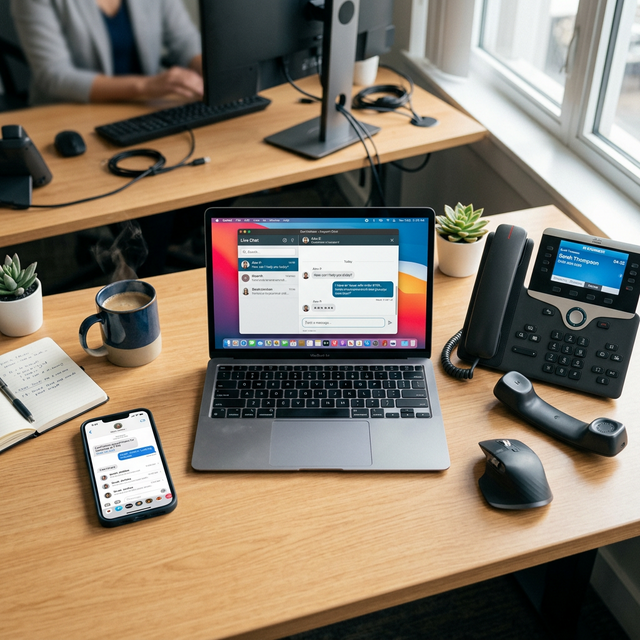
They may do two of those things inside five minutes because they are not sure which path will get answered.
Treat any number without a nearby source or stated method as a planning assumption, then replace it with your own records.
The phone is still the front door for a lot of service businesses.
But it is no longer the only front door.
That is the part owners underestimate.
A buyer may call.
They may text.
They may use the chat widget.
They may message through Google.
They may submit a form.
They may do two of those things inside five minutes because they are not sure which path will get answered.
The business sees channels.
The buyer sees one question:
"Can this company help me?"
If the phone is strong but the form sits until tomorrow, the front door is inconsistent. If chat opens but nobody monitors it, the business has created a fake live channel. If text messages go to one person's phone and calls go to the office, the buyer experience depends on which door they chose.
That is not omnichannel intake.
That is scattered intake.
True omnichannel intake means every serious inquiry, regardless of where it arrives, enters one managed response system.
Why Buyers Choose Different Channels
Channel choice is not random.
It usually tells you something about the buyer.
A phone caller may have urgency. They want a person, a fast answer, or reassurance that someone can help now.
A text sender may want speed without a full conversation. They may be at work, with family, or in a setting where calling feels inconvenient.
A chat user may be comparing options. They may have one question before deciding whether to book.
A form submitter may want a written path, a quote, a consultation, or a way to explain the issue without being put on the spot.
None of these buyers are wrong.
They are simply choosing the door that fits the moment.
The service business that only handles one door well is accidentally choosing which buyers matter.
That choice may not be visible in reporting because the buyers who preferred another channel often disappear before becoming leads.
They do not show up as lost opportunities.
They show up as silence.
Phone Still Matters Most
Omnichannel does not mean the phone becomes less important.
For many service businesses, phone calls are still the highest-intent channel.
Emergency buyers call. Older buyers call. Complex buyers call. People with urgent pain, water, heat, damage, locks, legal anxiety, or scheduling pressure often want the fastest path to a human or human-like response.
So the phone has to work first.
Before adding more channels, the business should know:
- Are calls answered during business hours?
- What happens when the line is busy?
- What happens after hours?
- Do missed calls trigger text-back?
- Can the person or system answering book, route, or triage?
- Are call outcomes tracked?
If the phone is broken, adding chat and text may only create more places for leads to leak.
The phone is the foundation.
Text and chat expand the front door.
They do not excuse a weak phone system.
Text Is the Recovery Channel
Text is powerful because it catches buyers who are still nearby.
A missed call can become a text conversation.
A form submission can receive a text confirmation.
A quote follow-up can continue by text.
An appointment can be confirmed by text.
A dormant customer can be reactivated by text.
For service businesses, text is not only a marketing channel.
It is a recovery channel.
It protects the gap between buyer action and human availability.
The mistake is treating text like a newsletter.
Text should be short, specific, and useful:
"Hi, this is [Business Name]. Sorry we missed your call. Are you looking for help today? You can reply here."
That message does three things.
It confirms the business saw the attempt.
It gives the buyer an easy next step.
It keeps the conversation alive before the buyer fully commits elsewhere.
That is why text belongs in the front-door system.
Chat Is the Research Channel
Chat has a different job.
It often catches people who are not ready to call yet.
They have a question. They want to know if the business serves their area. They want to ask about pricing, availability, insurance, appointment type, timing, or whether their problem is a fit.
If the chat widget says "live chat" and nobody answers, it damages trust.
If the chat asks for too much information too soon, the buyer leaves.
If the chat gives generic answers, it feels like a wall.
Good chat does not need to solve everything.
It needs to do three things:
- Answer the basic question if possible.
- Capture the buyer's contact information.
- Route the conversation into phone, text, or booking when needed.
Think of chat as a bridge, not a separate sales department.
The buyer starts with a question.
The business turns that question into a next step.
The Problem With Separate Inboxes
Most businesses do not fail omnichannel because they lack tools.
They fail because every tool creates its own inbox.
Phone calls are in the phone system.
Texts are on a staff member's phone or SMS platform.
Chats are in the website dashboard.
Forms are in email.
Google messages are somewhere else.
The owner believes the business has five channels.
The team experiences five places to forget.
This is where omnichannel becomes dangerous.
A channel that is not monitored is worse than a channel that does not exist, because it invites buyer action and then ignores it.
The fix is a unified intake queue.
Every channel should land somewhere the team can actually manage:
- One conversation inbox.
- Clear ownership.
- Response-time rules.
- Urgency labels.
- Escalation paths.
- Booking or CRM handoff.
Without that, omnichannel is just more noise.
The Intake Priority Order
Not every channel deserves the same response rule.
The business needs priority logic.
Phone calls usually come first because urgency and abandonment are highest.
Text comes next because buyers expect speed and the conversation is easy to preserve.
Chat comes next because it is often research mode, but still needs a fast first response.
Forms should receive immediate acknowledgment and a routed next step.
Google messages should be treated like local-search leads, not casual DMs.
The point is not to make staff frantic.
The point is to prevent every channel from competing equally for attention.
A good intake system knows what is urgent, what can be queued, and what needs escalation.
That is why the triage layer matters.
A Simple Omnichannel System
For a small service business, the first version can be simple.
You do not need an enterprise stack.
You need a controlled response path.
Start with:
- Phone answer or overflow coverage.
- Missed-call text-back.
- Form auto-response.
- Website chat that captures name, phone, and issue.
- Google messaging routed to the same intake owner.
- One place where every conversation is reviewed.
- Weekly reporting by channel.
That is enough to change the buyer experience.
The buyer no longer has to choose the "right" door.
The business catches the inquiry wherever it arrives.
What the Team Needs
Omnichannel intake is not just software.
It is a workflow.
The team needs rules:
- Who owns new inquiries?
- What counts as urgent?
- Which channel gets answered first?
- When does AI respond?
- When does a human take over?
- How fast should text replies happen?
- What happens after hours?
- Where is the final outcome recorded?
Without rules, the team improvises.
Improvisation works when volume is low.
It breaks when the business gets busy.
That is the moment omnichannel intake is supposed to help, not make worse.
What Good Looks Like
A good omnichannel system feels almost boring from the buyer's side.
If they call, the call gets answered or recovered.
If they text, they get a quick response.
If they chat, the question is handled or routed.
If they submit a form, they get confirmation and a next step.
If they message through Google, someone sees it.
The buyer does not care which tool made that happen.
They care that the business felt reachable.
From the operator's side, good omnichannel intake creates visibility:
- Which channel creates the best leads?
- Which channel is slowest?
- Which inquiries go unanswered?
- Which conversations convert?
- Which channel needs automation?
- Which channel needs human coverage?
That visibility turns "we need more leads" into a more precise question:
"Which doors are already producing intent, and which doors are leaking?"
Three Common Scenarios
Here is what this looks like in the real world.
Scenario 1: The Missed Call That Becomes a Text
A homeowner calls a garage door company at 6:40 PM.
The office is closed.
The old system sends the caller to voicemail. The caller hangs up and calls the next company.
The omnichannel system sends a text within 60 seconds:
"Hi, this is [Company]. Sorry we missed your call. Are you dealing with a garage door issue tonight? You can reply here."
The caller replies, "Spring snapped and the car is stuck inside."
Now the business has the job details, urgency, and phone number. The on-call path can respond. Even if a human calls back five minutes later, the buyer has not been left in silence.
The channel changed, but the buyer did not get lost.
Scenario 2: The Chat That Becomes a Booking
A dental patient visits the website during lunch.
They do not want to call from the office.
They open chat and ask, "Do you take new patients?"
The system answers the basic question, asks whether they prefer morning or afternoon, collects a phone number, and offers a booking link.
The appointment does not happen inside the chat because chat is magical.
It happens because the chat removed enough uncertainty for the buyer to move to the next step.
Scenario 3: The Form That Becomes a Same-Day Conversation
A med spa lead submits a consultation form at 8:20 PM.
The old system sends a generic email and waits until morning.
The better system sends immediate confirmation by text:
"Thanks for reaching out to [Clinic]. We received your consultation request. Is your main interest Botox, skin treatment, laser, or something else?"
The lead replies while motivation is still high.
By morning, the team is not starting from a cold form. They are continuing a conversation.
That is omnichannel intake doing its job.
The 30-Day Implementation Plan
Do not try to build a perfect omnichannel system in a weekend.
Start with the leaks that are easiest to measure.
Week 1: Map the Current Doors
List every way a buyer can currently reach the business:
- Main phone number.
- Google phone button.
- Website form.
- Website chat.
- SMS number.
- Google messages.
- Social DMs if they produce real leads.
Then test each one.
Call, text, chat, submit, and message like a buyer.
Write down what happens.
Week 2: Protect Missed Calls and Forms
Add missed-call text-back.
Add immediate form acknowledgment.
These two changes usually create the fastest improvement because they protect buyers who already tried to act.
Week 3: Unify Ownership
Decide who owns new inquiries.
One person or one team needs to see the queue. If different channels have different owners, define the handoff rules clearly.
The business should never have to ask, "Did anyone see that message?"
Week 4: Add Triage and Reporting
Create simple labels:
- Urgent.
- New booking.
- Estimate request.
- Existing customer.
- Billing or admin.
- Not a fit.
Then review the month.
Which channel produced real revenue?
Which channel was slow?
Which channel created noise?
Which channel needs automation?
That is how omnichannel becomes an operating system instead of a pile of tools.
Where AI Fits
AI is useful when the business has more channels than staff attention.
It can answer first, ask the opening question, collect basic information, detect urgency, and route the conversation.
It should not pretend to be a full human replacement in every situation.
The useful AI layer does this:
- Answers after hours.
- Sends missed-call recovery texts.
- Starts form follow-up.
- Captures chat details.
- Routes urgent issues.
- Creates summaries for staff.
- Escalates when human judgment is needed.
That is the right role.
AI catches the first signal.
Humans handle the moments that require judgment, empathy, negotiation, or exception handling.
When that division is clear, omnichannel intake becomes much easier to manage.
Does every service business need phone, text, and chat?
Not every business needs every channel at full strength. But every business should understand how buyers currently try to reach it. If meaningful inquiries arrive through phone, text, chat, forms, or Google messages, those channels need a managed response path.
Should text replace phone calls?
No. Text should support phone calls. It is especially useful for missed-call recovery, confirmations, follow-up, and buyers who prefer not to call. Urgent and complex situations may still need a phone conversation.
Is website chat worth it for small service businesses?
It can be, if it is monitored or automated responsibly. Chat is useful for research-stage buyers who have one question before they act. A dead chat widget is harmful. A clear chat path that captures the buyer and routes them properly is useful.
What is the biggest mistake with omnichannel intake?
Adding channels without unifying them. Three disconnected inboxes create more failure points. The goal is one intake system that can receive from multiple doors.
What should we implement first?
Start with phone answer rate and missed-call text-back. Then add form auto-response. After that, add or clean up chat and Google messaging. Do not expand channels faster than the team can manage them.
The Bottom Line
Omnichannel intake is not about being everywhere.
It is about being reachable in the ways buyers already try to reach you.
Phone, text, chat, forms, and Google messages are not separate worlds to the buyer.
They are all attempts to get help.
The business that treats them as one managed front door captures more demand with less confusion.
The business that lets each channel become its own forgotten inbox keeps losing buyers who were already interested.
That is the real opportunity.
Not more channels.
One better intake system.
*To see which channels are helping or leaking in your business, run a Revenue Leak Diagnostic across phone, text, chat, forms, and Google messages from the last 30 days.*
Decide what the firm needs to know before the first useful conversation.
A useful intake path protects the buyer's time and the firm's capacity by connecting fit, booking, preparation, reminders, and human handoff.

Vikram Roy is the founder of The Quiet Protocol, a Toronto-based systems firm serving service businesses across the Greater Toronto Area, Canada, and the United States. He works directly with professional firms, home service companies, dental practices, clinics, and local businesses to connect websites, customer intake, booking, reviews, follow-up, and practical AI into a clearer digital front door. All content is written from Toronto, Ontario. See the editorial method →
See how qualification, booking, reminders, documents, and team handoff can become one clearer client journey.
See how the capability in this article fits into a complete customer journey.
Legal, Financial & AdvisorySee the same decision through the language, buyer behavior, and operating reality of this industry.
Client Results & ProofInspect the starting condition, installation, measurement window, and outcome behind real client work.

What Happens When You Call Your Own Business After Hours? The Test 90% Fail
Call your own business after hours and listen like a first-time buyer. This simple test reveals missed calls, weak voicemail, slow response, and revenue leaks.
The 5-Minute Lead Response Rule: Industry Benchmarks Service Businesses Should Know
The five-minute lead response rule matters because buyers keep moving. Here is how service business owners should apply it to calls, forms, chats, and missed leads.
The Revenue Leak Diagnostic: A Free 15-Minute Diagnostic Any Service Business Can Run Today
Run a 15-minute Revenue Leak Diagnostic for your service business. Score after-hours calls, missed-call recovery, form response, reviews, and booking friction.