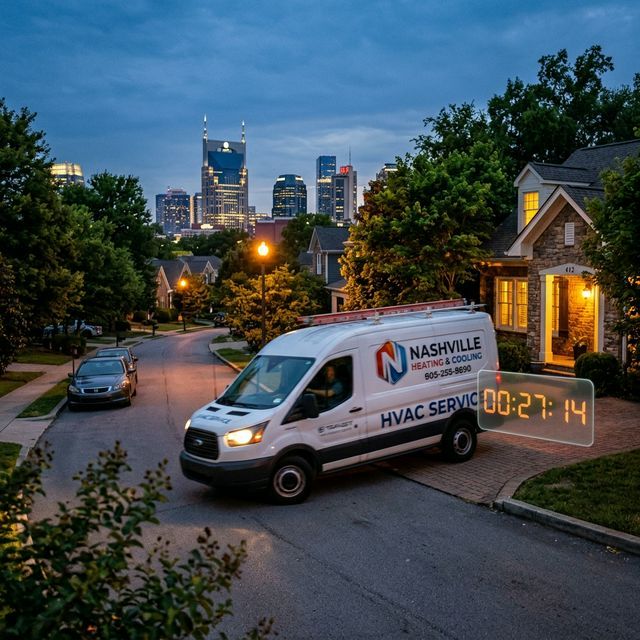

Nashville summers don't ease into the heat. They arrive in May and hold through October, and every HVAC company in Davidson, Williamson, Rutherford, and Wilson counties knows what that means for the phones.
Treat any number without a nearby source or stated method as a planning assumption, then replace it with your own records.
From June through August, the average Nashville HVAC company fields more inbound calls per day than in any other three-month window of the year. And because everyone calls at once - because AC units don't fail on a schedule - the companies with faster intake systems are quietly absorbing market share from those still running on voicemail and callbacks.
Nashville's HVAC Market Is More Competitive Than It Looks
Nashville has been one of the fastest-growing metros in the country for a decade. Population growth from the tech relocation wave, the healthcare industry, and the music business has meant more homes, more commercial buildings, and more HVAC systems that eventually need service.
It's also meant more HVAC companies. Both national brands like ARS and Service Experts operate here aggressively, and there are dozens of independent operators across the Nashville metro. For an established local shop, that means the homeowner who used to default to you out of loyalty is now Googling options and calling two or three before deciding.
The company that responds fastest and most professionally wins the booking. That's not a Nashville-specific insight - but the speed differential matters more here because the summer demand surge is intense and compressed.
The Summer Compression Problem
During a Nashville heat wave - and the metro averages several days above 95°F every summer - HVAC failures are not evenly distributed across the day. They cluster in the late afternoon, when systems have been running at maximum load for hours and temperatures inside start climbing.
A 4 PM system failure on a 97-degree day in Franklin or Brentwood is not a patient homeowner. It's someone with children or elderly parents in the house who needs a technician and will call every company on Google's first page until someone confirms they're coming.
If your dispatcher is already juggling 8 open tickets and the call goes to hold, the homeowner hangs up and calls the next number. This is the Nashville summer drain: not a slow bleed, but a burst pipe during peak demand.
What Nashville Homeowners Do After One Missed Call
Nashville's population skews younger than many Southern metros, with a large share of residents who moved here from larger markets in the last ten years. These are mobile-first consumers who expect fast digital responses and have no historical loyalty to any local HVAC brand.
When they call and get voicemail, the next step is immediate: they Google "HVAC repair Nashville" and start with the next listing. They are not leaving a voicemail and waiting. They have three windows open on their phone and they're calling simultaneously.
The market research on this is consistent: in the trades, 78 percent of homeowners contact more than one company simultaneously, and 65 percent book with the first one who provides a confirmed appointment time.
The After-Hours Summer Rush in Nashville
Nashville residents run their AC units until they fail, often late at night after evening temperatures finally drop. This means after-hours failure calls in Nashville are more common in summer than in most comparable markets because families delay noticing system failures until bedtime.
The gap between when the call comes in (10 PM) and when most Nashville HVAC companies respond (8 AM the next morning) is ten hours. In a Nashville summer, ten hours is a long time to be without air conditioning - especially for households with infants, elderly residents, or medical conditions.
Companies that have after-hours intake systems - even just an AI that acknowledges the inquiry, captures the details, and sends a morning-priority confirmation - convert those calls at dramatically higher rates than companies with static voicemail recordings.
The Math for a Mid-Size Nashville HVAC Operation
A Nashville HVAC company doing $2.4M annually in residential service and installation handles roughly 180 to 220 inbound contacts per month in peak summer months. At a conservative 30 percent after-hours contact rate and a 40 percent leak rate on after-hours contacts (no response before the prospect books elsewhere):
That's 21 to 26 contacts per summer month that reach out after hours and never convert because the system didn't respond. If average ticket value across emergency service and installations is $1,100, that's $23,000 to $28,600 in monthly peak-season revenue evaporating from intake failure alone.
Over three peak summer months: $69,000 to $86,000 in potential revenue that simply wasn't captured.
How Nashville's Fastest-Growing HVAC Companies Are Fixing This
The operators gaining share in the Nashville market share a few common front-door characteristics:
24/7 intake coverage during May through September
The companies growing fastest are not leaving after-hours contacts to voicemail during peak months. They've either extended human dispatcher hours or installed AI intake systems that handle after-hours contacts immediately - capturing job type, urgency, address, and preferred service window before routing appropriately.
Same-night acknowledgment for all cooling failure calls
A homeowner whose AC fails at 11 PM and receives a text saying "We've received your service request, our dispatcher will confirm your morning appointment by 7 AM" stays off the competitor's calendar. That one message, automated, saves the booking.
Priority queue for zone-specific dispatching
Nashville's geography - spread across multiple counties with distinct neighborhoods - means travel time matters. Smart intake systems that capture the service address and automatically assign to the nearest available technician reduce response time and improve customer experience. Williamson County customers who feel like Nashville companies treat them as an afterthought will book with a Franklin-based competitor.
Post-service review requests within 24 hours
Google Business Profile authority in Nashville HVAC is highly competitive. The companies with 200+ reviews averaging 4.8 stars are not necessarily the best operators - they're the ones with automated review request systems. A company doing great work but not capturing reviews is losing organic visibility to operators with more disciplined follow-up.
The Franklin and Brentwood Premium Market
Worth noting specifically: the affluent suburbs of Franklin and Brentwood have a distinct HVAC service dynamic. Homeowners here have newer, more complex systems (dual-zone, smart thermostats, higher-SEER units) and higher tolerance for service costs but lower tolerance for response delays.
A Franklin homeowner with a $450K home and a Trane 18-SEER unit is not calling the cheapest contractor. They're calling the one who sounds most professional and responds fastest. HVAC companies serving this corridor that invest in premium intake processes see significantly higher ticket values because they attract the customers who self-select for professionalism.
What Nashville HVAC Companies Should Audit First
Before adding more marketing spend, any Nashville HVAC operator should run through this checklist:
How many calls went unanswered in the last 30 days, broken out by time of day? What percentage of those unanswered calls booked a service with another company (you can estimate this from your callback conversion rate)? What is your average response time to web form submissions? Do you have an after-hours text response for voicemails?
Most companies who run this audit find that their marketing is generating leads they're failing to capture. More impressions are not the answer if the intake process is the leak.
The Quiet Protocol works with HVAC companies across Nashville and the surrounding counties to install AI intake systems that capture after-hours contacts, triage emergency vs. scheduled work, and automate the follow-up sequences that convert inquiries into confirmed bookings. If your Nashville summer numbers aren't where they should be, the front door is usually where to look first.
What to check before you choose a fix
Before buying another answering service, chatbot, phone tree, or AI receptionist, look at the actual path a no-cooling, no-heat, maintenance, replacement, or emergency caller takes when they reach your business. The first question is not whether the tool sounds impressive. The first question is whether the buyer gets a clear next step while they still care. In HVAC company operations, that usually means a fast answer, a useful question, a booked appointment or estimate path, and a follow-up record that does not rely on memory.
A strong system should make the business feel easier to choose. It should reduce the waiting, repeating, guessing, and manual chasing that make a buyer keep searching. If the current setup answers only during business hours, takes a message without qualifying intent, or leaves the follow-up to whoever remembers first, the problem is not only staffing. It is front-door design.
The Week-One Diagnostic
Run this review over the last seven days before making a decision. Pull the call log, website form submissions, chat history, booking calendar, CRM notes, missed-call list, and Google Business Profile activity. Do not start with opinions. Start with timestamps and outcomes. A small sample is enough to show whether the leak is response speed, qualification, booking friction, review weakness, or follow-up failure.
- Count every missed call and every call that lasted under 20 seconds. Those are often buyers who never became visible in the CRM.
- Count every form or chat that waited more than 10 minutes for a real next step. This is where high-intent demand starts cooling off.
- Mark every inquiry that needed a human callback before booking. That tells you whether the website is explaining the next step clearly enough.
- Review the last five reviews buyers can see publicly. Recency matters because buyers compare proof before they commit.
This is the source method for the article: use your own call log, CRM, booking calendar, form inbox, and Google Business Profile review activity. Public research can explain the pattern, but your own records show where money is escaping in this business.
Where the revenue usually leaks
The leak usually appears in one of four places. First, the buyer calls when the team is busy or closed. Second, the buyer reaches the business but is not qualified clearly enough to book. Third, the buyer receives a polite response but no firm next step. Fourth, the buyer finishes the job or visit but no review, referral, or reactivation path happens after the work is done. Each leak looks small by itself. Together, they decide whether marketing produces booked revenue or only more noise.
For a HVAC company, the most valuable fix is the one that protects dispatch speed, booked calls, estimate quality, and after-hours capture. That is why nashville hvac companies are losing summer calls to faster competitors should be judged by business outcomes, not by novelty. A phone feature that sounds clever but does not improve booked appointments is not enough. A website widget that collects contact details but does not trigger follow-up is not enough. A review tool that asks once and disappears is not enough.
What a stronger system should do
A stronger front door answers quickly, asks the right questions, captures the reason for contact, separates urgent from routine demand, books when rules are clear, sends confirmations, updates the follow-up path, and asks for reviews after the work is done. The system should make the owner less dependent on heroic callbacks and make the buyer feel that the business is organized from the first touch.
The Quiet Protocol treats this as an operating system, not a single widget. Calls, web forms, missed-call text-back, appointment booking, CRM handoff, review requests, and reactivation all need to point in the same direction. When those pieces are connected, a HVAC company can capture more demand without turning the team into a bigger manual call center.
How to judge whether it is working
Do not judge the system by how futuristic it feels on day one. Judge it by what changes in the business. Useful measurements include missed-call recovery rate, average response time, booked appointment rate, no-show recovery, review request volume, review recency, reactivated past-customer conversations, and the number of leads that have a clear next action in the CRM.
The best early sign is calm. Fewer loose callbacks. Fewer mystery leads. Fewer buyers waiting for a reply. More conversations with a clear status. That is what good automation should feel like to the owner and to the customer.
The loss estimate is basic business math, not a magic claim.
Revenue-leak examples on this site are built from visible operating inputs: inquiry volume, missed-call or slow-response rate, booking rate, average job or client value, repeat value, and follow-up recovery. The fastest way to make the number real is to run the diagnostic for your closest business type, then compare it against your own call log, CRM, booking calendar, form timestamps, and review activity.
The practical questions behind this decision.
Is this just a 24/7 answering service?
No. A traditional answering service usually takes a message. A properly designed AI receptionist and front-door system captures intent, qualifies the buyer, routes the request, books when possible, triggers follow-up, and supports reviews after the work is done. Message-taking is coverage. Revenue capture is a fuller operating path.
What should an HVAC company fix first?
Fix the first place buyers disappear. For some businesses that is after-hours calls. For others it is slow website follow-up, weak booking logic, old leads, or stale reviews. The right first move comes from the seven-day diagnostic, not from guessing.
Will AI make the business feel less human?
Bad automation feels colder than a person. Good automation feels like the business is paying attention. It answers quickly, uses plain language, collects the right information, and hands the buyer to a human when judgment or empathy is needed. The goal is not to remove people. The goal is to stop making buyers wait for basic next steps.
How fast should we expect improvement?
The first lift should come from visibility and speed: fewer missed opportunities and cleaner routing. Deeper gains come after the system has enough real conversations to tune scripts, booking rules, follow-up timing, and review requests. Treat the first month as deployment and calibration, not a magic switch.
Review the trust signals visible before someone decides to call.
The useful question is not only the star rating. It is whether recent proof supports the promise the website makes.
Inspect review recency, response habits, and the public trust signals buyers see before they contact the business.
See how the capability in this article fits into a complete customer journey.
HVAC Emergency ServiceSee the same decision through the language, buyer behavior, and operating reality of this industry.
Client Results & ProofInspect the starting condition, installation, measurement window, and outcome behind real client work.

Spring Home Services: Why March, April, and May Decide the Year
Spring home service demand moves fast. Here is why March, April, and May expose intake gaps, missed calls, and follow-up problems before summer even starts.
The After-Hours HVAC Revenue Gap: What Your Voicemail Is Actually Costing You Each Year
HVAC companies lose their highest-value calls after 5 PM. Here is what the annual cost is in precise terms, and what fixed looks like without adding headcount.
AI for HVAC Companies in the United States: The Full Operating System (2026)
HVAC is one of the highest-stakes businesses in America for missed calls and slow follow-up. A residential HVAC company in Texas or Florida can lose $40,000 to $120,000 per year in missed peak-season revenue from calls that went to voicemail. This guide covers exactly how US HVAC companies are using AI operating systems to recover that revenue and what the full stack looks like in practice.