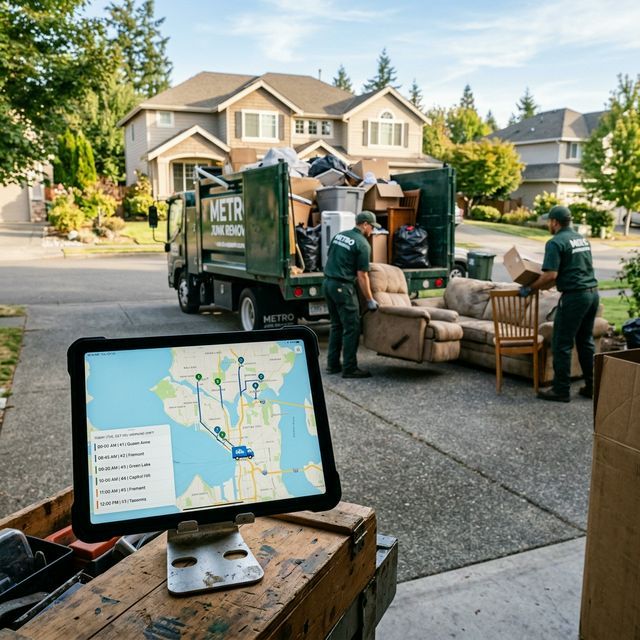

When that truck leaves the yard at 7:30 AM, an invisible meter starts ticking. The only way to beat the meter is to ensure the 15-cubic-yard box on the back of the truck comes back to the transfer station entirely full, ideally twice a day.
Treat any number without a nearby source or stated method as a planning assumption, then replace it with your own records.
A junk removal truck costs $80,000. The two guys sitting in the cab cost you $50 an hour combined. The diesel fuel costs $4.50 a gallon.
When that truck leaves the yard at 7:30 AM, an invisible meter starts ticking. The only way to beat the meter is to ensure the 15-cubic-yard box on the back of the truck comes back to the transfer station entirely full, ideally twice a day.
Every cubic yard of empty space inside that box at the end of the day is revenue that simply evaporated. In the industry, we call this the Empty Truck Problem.
The Empty Truck Problem is not a marketing failure.Most junk removal companies get plenty of leads. It is a dispatch and intake failure. The business failed to capture, price, and route the customer while the customer was holding the phone.
Junk removal is an impulse industry. Customers do not spend three weeks getting quotes to remove a 1990s sectional sofa. They wake up on a Saturday morning, drink a cup of coffee, look at the sofa, get angry at it, and type "junk pickup near me" into Google.
They want it gone today. If they have to leave a voicemail, they won't. They will just call the 1-800-GOT-JUNK franchise down the street because the massive national call center picks up on the first ring.
The Dispatcher Bottleneck
In a traditional independent junk removal business, the owner or a front-desk dispatcher relies on a chaotic blend of cell phones, whiteboards, and routing software (like Workiz or Housecall Pro) to manage the trucks.
When a call comes in, the human dispatcher has to calculate three extremely complex variables in their head in less than ten seconds:
First, geography: "Does Truck 2 have a job near this caller's zip code today?"
Second, volume: "The caller says it's a couch, a mattress, and some boxes. Does Truck 2 have enough physical space left in the box to fit that after their morning cleanout job?"
Third, price transparency: "How do I quote this without seeing it so the customer doesn't yell at my crew for bait-and-switch pricing?"
It is too much mental math for a human to do reliably while the phone is ringing off the hook on a busy Saturday. As a result, human dispatchers play it safe. They leave gaps in the schedule. They tell callers, "We'll have to send someone out tomorrow to give you an estimate."
"Tomorrow" is the word that kills the deal. The customer hangs up and calls the guy who can come today.
The AI Route Coordinator
This is why modern junk removal operators are completely removing the human from the top of the funnel and installing a Voice AI Intake Coordinator.
The AI solves the human math problem instantly. It integrates directly with the live routing API of the CRM. It knows exactly where the trucks are, how much space is theoretically left in them, and what the pricing matrix looks like.
Here is what a highly optimized AI intake call sounds like in the junk removal business:
**AI Intake:** "Thanks for calling Apex Hauling. This is Alex. Are you looking for a dumpster rental, or did you need our crew to come load and remove some items for you?"
**Caller:** "I need you guys to come get some stuff. Mostly a heavy sleeper sofa and a pile of broken drywall from a bathroom remodel."
**AI Intake:** "Got it. We can handle both the furniture and the construction debris. Just to give us an idea for the truck, would you say that pile takes up about a quarter of a standard pickup truck bed, half a bed, or a full bed?"
**Caller:** "Probably a full pickup truck bed."
**AI Intake:** "Perfect. That is roughly an eighth of our box truck. Based on that volume, the removal usually runs right around $275, which includes all the labor, hauling, and dump fees. If that works for you, I have a truck in your zip code that can swing by between 1:00 PM and 3:00 PM today. Should I grab that slot for you?"
The call took sixty seconds. The AI translated consumer language ("a full pickup truck bed") into operational volume ("an eighth of our box truck"), provided a transparent, un-ambiguous price anchor, and locked in the geographical routing match. The Empty Truck Problem was just solved for $275.
The Asynchronous Photo-Quote System
The number one dispute in junk hauling happens on the driveway. A customer calls and says they have "just a little pile of yard waste." The dispatcher quotes $150.
The crew arrives, and the "little pile" is a mountain of sodden oak branches mixed with concrete blocks that will take three hours to load and max out the suspension of the Isuzu NPR. The crew chief tells the homeowner it will be $600. The homeowner explodes in rage.
AI Intake prevents this completely by moving the business to an asynchronous Photo-Quote protocol.
When a customer is unsure about volume, the AI does not guess. It pivots to visual data collection without losing the momentum of the sale.
**AI Intake:** "Since it's a mix of yard waste and heavy materials, the best way to get you an exact, down-to-the-penny price is to have our crew chief look at a picture. I am texting you a secure link right now from this number. If you can just snap a quick photo of the pile with your phone, our system will analyze it and text you back the exact flat-rate price in about two minutes. Is it okay if I send that text right now?"
The customer receives an automated SMS. They reply with a photo. The image populates on the dispatcher's dashboard at the office. The experienced human dispatcher looks at the oak branches and concrete, clicks the "$600" quote button on the screen, and the CRM instantly texts the customer: "Thanks for the photo! A load of that size and weight is a flat rate of $600. Reply YES to dispatch a truck today before 4 PM."
The conflict is entirely removed from the driveway. The transaction is clinical, transparent, and frictionless. The crew arrives knowing exactly what they are lifting, and the homeowner has already agreed to the price in writing.
The Proactive Realtor and Property Manager Pipeline
While B2C homeowner cleanouts are the bread and butter of junk removal, the real wealth in the industry is built on B2B relationships.
Real estate agents dealing with hoarder houses, property managers turning over abandoned apartments, and contractors gutting kitchens generate massive, high-margin, full-truck loads.
These B2B clients do not have time for pleasantries. When a property manager discovers a tenant left behind three rooms of garbage, they need it gone by tomorrow so the painters can come in.
Voice AI can be trained to recognize the phone numbers of your VIP commercial clients and completely bypass the standard intake sequence.
**AI Intake:** "Hi David! Thanks for calling from RPM Property Management. Because you are on our VIP list, I am bypassing the queue. Do you have an eviction cleanout you need us to route today?"
**Property Manager:** "Yeah, the unit at 402 Elm Street. It's a disaster. Two bedrooms full of trash. We need a full truck."
**AI Intake:** "Done. I have routed a dedicated truck to 402 Elm Street for 8:00 AM tomorrow. We will invoice the corporate office as usual. I'm texting you the confirmation right now. Thanks, David."
By treating commercial clients with ruthless efficiency, the local junk hauler secures loyalty that cannot be broken by a competitor's discount flyer. Time is the only currency property managers care about, and the Voice AI just bought them thirty minutes of their day back.
The Dumpster Rental Upsell
Many scaled junk hauling businesses also operate a dumpster rental (roll-off) division. This creates intake friction because calling customers do not always know which service they actually want.
"Do I hire two guys to load this for $600, or do I rent a dumpster for $400 and spend my entire weekend loading it myself?"
When a human dispatcher is busy, they usually just sell whatever the customer asks for. An AI Intake Coordinator acts as an analytical salesperson, calculating the highest-margin outcome based on the customer's constraints.
If a customer calls asking to rent a 15-yard dumpster for a bathroom remodel, the AI handles the dumpster logistics but smoothly presents the alternative:
**AI Intake:** "I can absolutely have a 15-yard dumpster dropped in your driveway tomorrow morning for $425. You'll have it for a week. However, if you already have the bathroom debris piled up in the garage, our crew can just arrive with a truck tomorrow, load it all for you in thirty minutes, and sweep the floor clean for $495. Some of our clients prefer that so they don't have to lift the heavy tile themselves. Would you prefer the dumpster drop-off, or the full-service removal?"
A massive percentage of homeowners, when confronted with the reality of lifting heavy tile into a steel tub in the hot sun, will instantly pay the $70 premium for the full-service crew. The AI effortlessly upsells the labor service, deploying the truck more profitably and capturing higher top-line revenue.
Nightcap Routing: Filling Tomorrow After Hours
The most magical aspect of deploying AI in a junk removal business happens between the hours of 7:00 PM and midnight.
This is when homeowners finish dinner, walk out to the garage, trip over a rusty bicycle, and finally hit their breaking point. "That is it. I am getting this junk out of here tomorrow."
Because independent junk companies close their offices at 5:00 PM, these late-night impulse buyers traditionally end up booking with the national franchises online.
With an AI Intake Coordinator, your local business intercepts that nightcap traffic. The AI answers the phone at 9:30 PM, quotes the quarter-truck load, and books the 10:00 AM slot for the following morning.
When the business owner recover the office at 7:00 AM the next day, they don't have an empty routing board staring back at them. They look at the dashboard and see $1,200 in revenue already neatly scheduled, geographically clustered, and confirmed via SMS.
The Franchise Expansion Advantage
The end goal for many successful independent junk removal operators is scale. They want to move from owning one location with three trucks to operating a regional footprint with fifteen trucks across three distinct metropolitan zones. The traditional barrier to this expansion is not capital for trucks; it is the sheer administrative nightmare of dispatching.
When a business relies entirely on a "hero" human dispatcher-someone who has the entire city map memorized and knows the exact volume capacity of every crew-that business cannot scale beyond that one person's mental bandwidth. If you open a second territory fifty miles away, the hero dispatcher suddenly has to manage zip codes they don't know and drivers they can't physically see in the yard. As a result, route efficiency totally collapses.
Voice AI completely destroys this barrier to entry. Because the AI routes mathematically based on live API connections to your scheduling software rather than geographic intuition, it scales infinitely. An AI Intake Coordinator does not care if the caller is in your primary zip code or in a brand-new expansion territory three hours away. It looks at the grid, identifies the closest active truck in that specific zone, and books the slot.
Furthermore, for multi-location operators, the AI provides centralized, cost-free intake. Massive national franchises like College Hunks Hauling Junk or Junk King require their franchisees to pay into a centralized, human-staffed corporate call center. This national call center takes a massive percentage of top-line revenue just to answer the phone and book the jobs.
By deploying an enterprise-grade AI intake system, an independent operator who is expanding into multiple locations essentially builds their own private, frictionless "national call center" for pennies on the dollar. The AI handles the volume of three different cities simultaneously without ever putting a customer on hold. When the independent operator acquires their fourth, fifth, and sixth truck, they simply plug those assets into the CRM. The AI recognizes the new capacity instantly and begins filling the new routes with exactly the same perfect logic it used for truck number one.
This turns what used to be a human-intensive, heavily stressed administrative scaling problem into a pure mathematical advantage. You focus on hiring the guys to drive the trucks; the AI makes sure the trucks are always full.
The trucks leave the yard full. The invisible meter of diesel fuel and hourly payroll is instantly offset by secured revenue.
The junk removal business is ultimately a logistics puzzle written in real-time.Trying to solve it with a whiteboard and an answering machine is guaranteeing empty space in the truck. Solving it with AI guarantees that every inch of the box translates into cash.
The Operating Standard
When we evaluate the ROI of an intake system like the one described for The Empty Truck Problem: How Junk Removal Uses AI to Fill Tomorrow's Route Tonight, we look beyond the immediate convenience of automation. We look at the 'Revenue Leak' that occurs in the silence between a prospect reaching out and a business responding. In this vertical, that silence is the biggest competitor you have.
Data Anchor: The average LTV of a client in this space is significantly higher than the cost of a missed intake opportunity. By resolving for 'concurrency': the ability to handle infinite leads simultaneously-The Quiet Protocol transforms a passive operation into an aggressive revenue engine.
The loss estimate is basic business math, not a magic claim.
Revenue-leak examples on this site are built from visible operating inputs: inquiry volume, missed-call or slow-response rate, booking rate, average job or client value, repeat value, and follow-up recovery. The fastest way to make the number real is to run the diagnostic for your closest business type, then compare it against your own call log, CRM, booking calendar, form timestamps, and review activity.
The practical questions behind this decision.
What proof should I look for in my own business?
Look for proof in the places where demand either moved forward or stalled: missed calls, short calls, unbooked forms, slow callbacks, no-show recovery, old leads, and reviews that were never requested. If the business cannot see those moments clearly, the first improvement is better tracking and routing.
How do I know whether this is a marketing problem or an operations problem?
If people are already calling, filling forms, asking for prices, requesting appointments, or comparing reviews, the problem is usually operations. More marketing will not fix a front door that lets warm demand wait. The better move is to capture and route the demand already arriving.
What should happen after the first response?
The first response should create a next step: booked appointment, estimate path, intake handoff, callback window, review request, or reactivation sequence. A response that only says someone will get back to you is not enough when the buyer is comparing several providers at once.
Where does The Quiet Protocol fit?
The Quiet Protocol fits when the business already has demand but too much of it depends on manual attention. We connect AI receptionist coverage, web intake, missed-call recovery, booking logic, follow-up, review requests, and reactivation into one managed front-door system.
Decide what the AI must handle before you choose the software.
A useful intake system begins with the caller journey, the rules, and the human handoff, not a long feature list.
Give the receptionist a realistic scenario and hear how it answers, gathers context, and moves the caller toward a useful next step.
See how the capability in this article fits into a complete customer journey.
Junk Removal & DumpstersSee the same decision through the language, buyer behavior, and operating reality of this industry.
Client Results & ProofInspect the starting condition, installation, measurement window, and outcome behind real client work.

Why Service Businesses Lose Inbound Leads Before the Phone Rings
It is not a traffic problem. Many service businesses lose revenue because the front door breaks before the buyer reaches a real conversation.

How 3-Person Service Businesses Handle 20-Person Call Volumes with AI
Small service teams lose revenue when call volume spikes beyond human capacity. Learn how voice AI helps answer, triage, book, and route calls without hiring a full front desk.

The After-Hours Revenue Leak: How Service Businesses Lose Their Best Jobs After 5 PM
After-hours callers are often the highest-intent buyers in a service business. Learn how to calculate the leak, triage calls, and protect revenue without burning out staff.
Calculate the revenue leak.
Stop guessing. See how much demand your business may be losing through missed calls, slow replies, weak booking, review gaps, and follow-up drag, then decide whether Voice AI is the right system path.
Run the calculationPrefer to hear it first?
Call the live AI receptionist and test the conversation.
Call the live AI receptionist anytime. Tell it about junk removal & dumpsters, then hear a short live roleplay based on the calls your front desk actually gets.