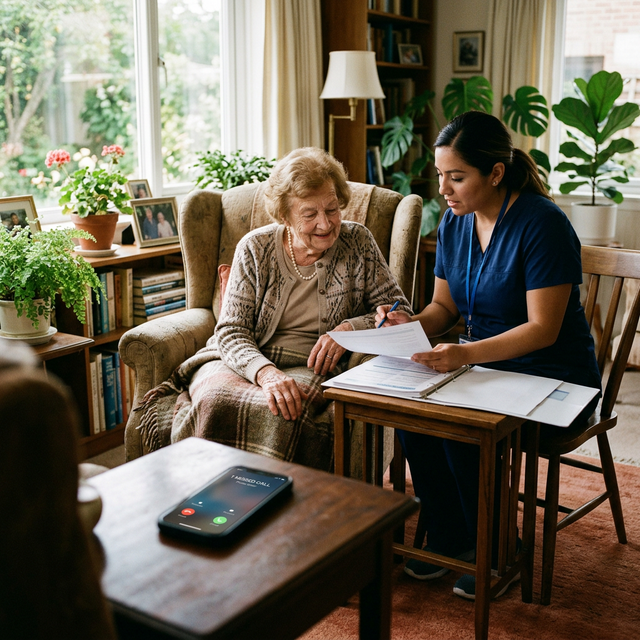

A home health care agency can lose a high-value family inquiry before the first callback happens. The adult child is worried, the discharge timeline is moving, and the agency that answers with warmth and a clear care path has a real advantage.
Treat any number without a nearby source or stated method as a planning assumption, then replace it with your own records.
The intake failure rate for home health agencies, regardless of how well the business owner runs the clinical side, averages 28 to 33 percent of new inquiry calls,per Activated Insights (formerly Home Care Pulse) benchmarking data from 2024. That means roughly 1 in 3 prospective families who contact a home health care agency for the first time do not convert to a care agreement. A fraction of those losses are attributable to price, service area limitations, or care type mismatch. The majority are attributable to intake failure: the call was not answered, the callback was not timely, or the first interaction failed to project the competence and warmth that the caregiver family member needs to feel before handing their parent's safety to a stranger.
The home health care service business, and its business owner, operates in a fundamentally different buyer psychology than most other service categories.The buyer is not the end user. The adult child calling about their parent is making a decision under duress, often under time pressure from a hospital discharge timeline, and is simultaneously processing grief, guilt, and logistics. They need two things from the intake interaction in this order: first, to feel heard and understood; and second, to be given a clear, competent path to getting care started. An agency that delivers neither converts the inquiry at below 20 percent. An agency whose business owner has built an intake process that delivers both converts at 75 to 85 percent.
The Four Triggering Events That Drive Home Health Care Inquiries
Understanding what caused the call is the most important intake data point a home health agency can collect. The four primary triggering events each carry distinct time constraints, emotional states, and agency selection criteria that should shape how the intake call is handled.
Trigger 1: Hospital discharge.The family member calls because the hospital has given a discharge date, typically 1 to 4 days away. The urgency is extreme and non-negotiable. The family is not looking for the best agency. They are looking for a capable agency that can start care by the discharge date. NAHC 2024 policy data found that 41 percent of all new home health agency inquiries nationally are discharge-driven. For these callers, intake speed is the primary differentiator. An agency that answers, confirms service area and care type availability, and schedules a care assessment for the same day or next day captures this inquiry. An agency that cannot answer or cannot confirm service availability in the first call loses to the next agency on the list.
Trigger 2: A fall or acute health event.The parent fell. There may or may not have been a hospital visit. The family has realized that the current living situation is no longer safe and that something has to change, urgently. Unlike the discharge trigger, this caller typically has a window of several days to a week, but the emotional state is acute. They are frightened, often guilty for not having made this decision earlier, and looking for an agency that will make them feel that their parent will be genuinely cared for. Warmth and competence in the intake call carry more weight with this caller type than with the discharge-driven caller.
Trigger 3: Gradual decline recognition.The family has noticed over months that the parent's situation is changing. Meals not prepared. Bills unpaid. The house getting harder to manage. This call is less urgent but equally important to capture because this client, once enrolled, typically continues with an agency for 18 to 36 months, the longest average tenure in the home health client lifecycle. Activated Insights found that gradual-decline clients have a 23 percent higher 24-month retention rate than discharge-driven clients, making them the highest lifetime value segment in the intake funnel. These callers are often more receptive to a scheduled intake call (versus the same-day urgency of discharge callers) and more responsive to educational content about care levels and transition pathways.
Trigger 4: Caregiver burnout.A family member has been providing informal care and has reached their limit. The parent may have dementia, mobility limitations, or both. The calling family member is exhausted, often emotionally raw, and may feel guilt about seeking professional help. Intake for this caller type requires the most explicit empathetic acknowledgment before moving to logistics. An intake interaction that moves immediately to availability and pricing with a caller in caregiver burnout fails routinely, even when the agency has the right services and pricing. The first 45 seconds of this call are about acknowledgment. The remaining time is about solution.
The Intake Call Architecture That Converts in Home Health Care
The answer speed standard is non-negotiable.Discharge-driven callers, who represent 41 percent of inquiries, are typically calling multiple agencies simultaneously. BrightLocal home care consumer behavior data found that families contacting agencies about a discharge situation call an average of 3.2 agencies before deciding. The first agency to answer and confirm availability is selected in 72 percent of cases. Being second or third agency to return a call, even by 20 minutes, loses the inquiry in nearly 3 out of 4 discharge situations. For the home health care service business, answer speed is not a customer service metric. It is the primary competitive differentiator in the largest single segment of the intake funnel.
The first sentence must name what the caller is experiencing, not what the agency does.The intake interaction that begins with "Thank you for calling [Agency], how can we help you?" is technically correct and functionally inadequate. The intake interaction that begins with "Thank you for calling, it sounds like you're going through a lot right now, tell me what's happening with your family member" changes the entire dynamic of the call. The caller is invited to share their situation before being asked to navigate service categories or insurance questions. This sequencing, named before qualifying, is the single intake change that most consistently improves conversion rates in home health care, per CareAcademy intake training research.
Qualification must feel like care coordination, not interrogation.The practical intake information a home health agency needs to qualify a new inquiry: care recipient name and age, current location (home, hospital, rehab facility), primary care needs (personal care, companion care, dementia/memory care, post-surgical), geographic area, funding source (private pay, long-term care insurance, Medicaid waiver), and urgency timeline. This information, collected through a well-structured conversational intake flow, takes 4 to 6 minutes and gives the agency everything needed to confirm service fit and schedule the care assessment. The same information collected through a form or a checklist approach takes the same time but feels transactional and converts at a 25 to 35 percent lower rate.
Close with a clear and immediate next step.The intake call in home health care should always end with a confirmed next action: a care assessment scheduled, a follow-up call time confirmed, or a specific intake packet sent with a response deadline. Calls that end with "we'll have someone call you back soon" have a follow-through rate of 31 percent, per Activated Insights. Calls that end with "I have you scheduled for a care assessment with our care coordinator at [specific time]" have a follow-through rate of 78 percent. The difference is psychological commitment. The specific appointment creates an obligation for both parties. The vague callback creates an obligation for neither.
The Revenue Calculation: What Each Converted Inquiry Is Actually Worth
Average monthly revenue per home health client:Home Care Association of America 2024 data puts the average weekly home care hours for a private-pay residential client at 28 to 36 hours per week. At an average private-pay rate of $28 to $35 per hour in mid-market US regions, that is $3,136 to $5,040 per month per client. Using $3,800 as a conservative mid-market average.
Average client tenure for converted inquiry:14 to 22 months, per HCAOA retention data across agency size categories. At 18 months average and $3,800 per month, the lifetime revenue of a single converted inquiry is $68,400.
A home health care service business that converts 70 percent of its inquiries instead of the industry average of 65 percentrecovers one additional full-term client from every 20 inquiries.At a $68,400 lifetime value, that incremental conversion represents $68,400 in lifetime revenue from 20 inquiries. The business that answers its phone and runs a structured intake conversation achieves this. The one that sends inquiries to voicemail does not.
Technology Options for Home Health Care Intake Coverage
After-hours and overflow coverage.Home health inquiry calls do not follow business hours. Hospital discharges happen on evenings and weekends. Health events occur at any time. A home health care agency whose business owner allows the intake line to go to voicemail after 5 PM is unavailable to the family member calling from the emergency room at 7 PM on a Friday about a Saturday discharge. An AI intake system configured for home health care can answer these calls at any hour, collect the triggering event and urgency level, confirm service area, and schedule a care coordinator callback for the next morning with immediate confirmation to the caller. This eliminates after-hours inquiry loss while maintaining human involvement in the highest-stakes parts of the intake interaction.
CRM and scheduling integration.Home health agencies using platforms such as Alayacare, ClearCare (now WellSky), HHAeXchange, or HomeTrak can configure direct intake integrations that move a new inquiry from the AI intake call into the scheduling system without manual data transfer. The business owner or care coordinator who arrives Monday morning sees a structured intake summary for the weekend inquiries, with urgency flags, care types requested, and assessment appointments already scheduled for qualified leads.
The human-AI boundary in home health.Given the emotional weight of the first call in home health intake, the AI intake system for this category must be configured with explicit escalation paths: callers expressing grief or extreme distress routed to an on-call human immediately, callers describing safety emergencies (parent currently in distress, safety situation unfolding) offered a direct number for the agency's care coordinator, and discharge situations with same-day timelines flagged for priority callback within 60 minutes. The AI handles the initial information collection and urgency classification. The human handles the relationship-critical escalation. This division, correctly configured, outperforms either approach alone.
The Operating Standard for Home Health Intake
When we evaluate the ROI of an intake system like the one described for Home Health Care Agencies: The Intake Gap That Costs You 30% of New Client Inquiries, we look beyond the immediate convenience of automation. We look at the 'Revenue Leak' that occurs in the silence between a prospect reaching out and a business responding. In this vertical, that silence is the biggest competitor you have.
Data Anchor: The average LTV of a client in this space is significantly higher than the cost of a missed intake opportunity. By resolving for 'concurrency': the ability to handle infinite leads simultaneously-The Quiet Protocol transforms a passive operation into an aggressive revenue engine.
The loss estimate is basic business math, not a magic claim.
Revenue-leak examples on this site are built from visible operating inputs: inquiry volume, missed-call or slow-response rate, booking rate, average job or client value, repeat value, and follow-up recovery. The fastest way to make the number real is to run the diagnostic for your closest business type, then compare it against your own call log, CRM, booking calendar, form timestamps, and review activity.
The practical questions behind this decision.
How is home health care intake different from intake at other healthcare-adjacent service businesses?
The primary structural difference is the buyer identity gap. In dental, veterinary, and most medical service businesses, the person calling is either the patient or the pet owner, and the decision to engage is relatively direct. In home health care, the person calling is almost always a family member or caregiver, not the care recipient. This creates a dual emotional dimension: the caller is managing their own distress while also advocating for someone else's needs. Intake systems that treat this caller as a standard service inquiry caller miss the foundational psychology of the interaction. Intake systems that acknowledge the caregiver's experience explicitly, and then align the agency's capabilities with the care recipient's specific situation, operate in a different conversion category.
What is the most common mistake home health agencies make in their intake process?
The most consistent mistake, documented across Activated Insights care agency surveys from 2022 to 2024, is routing intake calls to a general voicemail during peak inquiry windows (6 to 9 PM weekdays and all weekend). The second most common mistake is opening the intake interaction with insurance and funding questions before establishing any relational connection with the caller. Families calling about care do not feel comfortable committing personal and financial information to an agency they have not yet decided to trust. The agency that inverts this sequence, leading with acknowledgment and care coordination before moving to qualification and funding, consistently outperforms those that lead with administrative questions.
How quickly should a home health care agency respond to an inquiry that goes to voicemail?
For discharge-triggered inquiries, the answer is immediate, meaning within 30 minutes during business hours. This is not a customer service target. It is a competitive necessity. As noted above, discharge-driven families call multiple agencies simultaneously and select the first one that confirms availability. A callback after 2 or 3 hours is typically too late. The family has already signed an agreement with a competitor. For non-urgent inquiries such as gradual decline situations, a same-day callback within 4 hours is sufficient and will convert at high rates if the callback interaction is conducted well. An AI intake system that answers immediately, confirms urgency, and sets a precise callback time with the caller protects the inquiry during the response gap regardless of trigger type.
Decide what the firm needs to know before the first useful conversation.
A useful intake path protects the buyer's time and the firm's capacity by connecting fit, booking, preparation, reminders, and human handoff.
See how qualification, booking, reminders, documents, and team handoff can become one clearer client journey.
See how the capability in this article fits into a complete customer journey.
Home Health AgenciesSee the same decision through the language, buyer behavior, and operating reality of this industry.
Client Results & ProofInspect the starting condition, installation, measurement window, and outcome behind real client work.

The Speed to Lead Equation: Why the First Five Minutes Decide the Job
In emergency services, the first company to answer wins. Not the best company. Not the cheapest. The fastest. Here is the math that proves it.

The Real Cost of Missing Calls: Why Service Businesses Are Going AI-First in 2026
Missed calls do not show up on the P&L, but they can quietly cost service businesses six figures. Learn how to calculate the leak and decide if AI-first intake makes sense.

Funeral Home After-Hours Calls: How Missed Calls Fail Families
In compassionate care, the first call determines the relationship. Providers losing 12% of first-call inquiries to voicemail gaps are leaving $238,000 in annual arrangement value on the table.