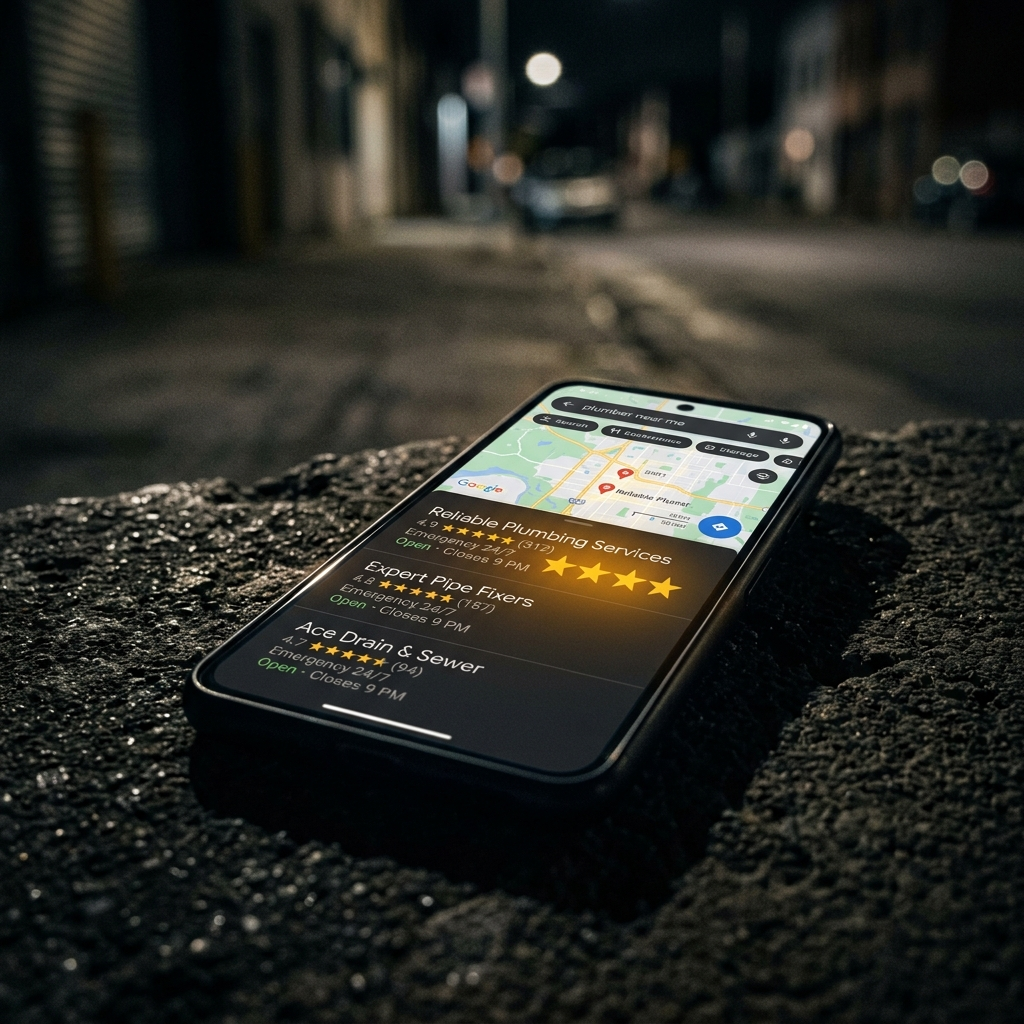
Walk into any service business handling more than 30 inbound inquiries per week and you will find the same invisible problem. Not every call gets the same treatment it deserves.
Treat any number without a nearby source or stated method as a planning assumption, then replace it with your own records.
Quick Answer:An AI triage and routing engine is Layer 2 of an AI-Powered Business Operating System. It reads every incoming inquiry - across voice, SMS, web, and chat - classifies it by urgency and intent within seconds, and routes it to the correct destination: a human dispatcher for emergencies, a booking sequence for scheduling requests, or a nurture sequence for general inquiries. It ensures that no emergency waits in a queue and no low-urgency inquiry consumes expensive human time.
The Routing Problem Every Service Business Has and Nobody Talks About
Walk into any service business handling more than 30 inbound inquiries per week and you will find the same invisible problem. Not every call gets the same treatment it deserves.
An emergency call comes in at 11 AM on a Tuesday when the office is busy. The person answering the phone is already on another call. The emergency goes to voicemail. Meanwhile, a general quote request for a job three weeks out reaches the owner's cell phone directly because he happened to be near it. The emergency caller calls a competitor and books with them. The quote request gets a callback within 20 minutes.
The wrong lead got the right response. The right lead got the wrong one. This is not a staffing problem or a training problem. It is a routing problem - and it happens hundreds of times per year in most service businesses without anyone noticing, because the lost emergency bookings simply never appear in the revenue data. They are invisible.
AI triage and routing is Layer 2 of the AI-Powered Business Operating System because it sits immediately downstream of intake. Layer 1 captures every inquiry across all channels. Layer 2 reads those inquiries the moment they arrive and sends each one to its correct destination - immediately, consistently, and without human judgment required.
What Triage Actually Reads: The Signals That Determine Routing
The word "triage" comes from emergency medicine, where it describes the process of sorting patients by severity to allocate care resources appropriately. The parallel to service business operations is precise: not every inquiry has equal urgency, and treating them as if they do wastes the most expensive resource in any service business - a skilled human's time and attention.
AI triage reads three categories of signals in every incoming inquiry.
Urgency signals.These are keywords and phrases that indicate time-sensitive situations: no heat, no hot water, flooding, burst pipe, locked out, no power, gas smell, sewage backup. In voice inquiries, triage also reads tone indicators - elevated pitch, rapid speech, multiple requests restated in quick succession - that signal distress even when the vocabulary is neutral. An inquiry containing any urgency signal bypasses all automated sequences and generates an immediate alert to the designated human responder, typically a dispatcher or owner, via phone call or SMS.
Intent signals.These identify what the prospect wants to do: schedule, appointment, quote, estimate, price, how much, can you come. Intent signals route the inquiry into the booking sequence - an automated flow that presents available times, collects the job details, and confirms the appointment without any human involvement. For a business running 15 to 40 bookings per week, intent routing alone can handle 60 to 70 percent of all incoming inquiries autonomously.
Information signals.Everything that does not contain an urgency or intent signal is categorized as an information request: hours of operation, service area, licensing questions, general how-does-this-work queries. These route into an FAQ response delivered immediately by SMS or chat, followed by a nurture sequence that moves the prospect toward a booking over the following days. No human time is required until the prospect signals intent.
The routing decision happens in under three seconds from inquiry receipt. For a business receiving 40 inquiries per week, that is 40 routing decisions per week made with perfect consistency, zero interruption to the team, and zero misclassification of urgencies.
The Response Time Revenue Equation
Before explaining the full routing mechanism, the economic case for Layer 2 speed requires a direct statement.
Studies across the service industry consistently show that a prospect who receives a response within five minutes of submitting an inquiry converts at 35 percent. The same prospect, reached at 30 minutes, converts at 22 percent. At two hours, the conversion rate falls to 11 percent. At 24 hours or more - where most small service businesses without AI triage operate - conversion falls to 3 percent.
The math is stark. A business receiving 20 booking inquiries per week and responding at an average of 2 hours is converting at roughly 11 percent - about 2.2 bookings per week from those 20 leads. The same 20 leads, responded to within 5 minutes by an AI routing system, convert at 35 percent - 7 bookings per week from the same inbound volume. At an average ticket of $400, the difference is $8,320 per month in additional revenue from leads the business already has, from advertising it has already paid for.
The most expensive marketing decision a service business makes is spending money to acquire leads and then letting those leads wait. Layer 2 is the mechanism that eliminates the wait.
Emergency Routing and the Escalation Standard
The emergency routing path within Layer 2 operates to a different standard than the rest of the system. For standard booking inquiries, a 3-minute response time is excellent. For emergencies, the acceptable threshold is 90 seconds - and the routing must be fault-tolerant enough to guarantee delivery even when the primary contact is unavailable.
The emergency escalation sequence operates in layers. When an urgency signal is detected, the system sends an immediate alert to the primary dispatcher via SMS and automated phone call simultaneously. If no acknowledgment is received within 60 seconds, the alert escalates to the secondary contact - typically the owner, a lead technician, or an on-call manager. If no acknowledgment is received within a further 90 seconds, a third escalation fires.
Simultaneously, the prospect receives an automated response acknowledging the urgency and setting an explicit timeline: "We received your urgent request and our team is being alerted now - you will receive a call within 5 minutes." This message serves two purposes: it prevents the prospect from calling a competitor during the acknowledgment window, and it sets a concrete expectation that the business is now accountable to meet.
The 90-second response window for emergency confirmation is not arbitrary. Research on consumer behavior in high-urgency service situations consistently shows that a prospect who has not received human contact within 3 minutes of an emergency submission will begin calling competitors. The AI routing system's function in that window is to hold the prospect's attention long enough for the human call to arrive.
Intent Routing and Rules-Based Booking
For the majority of incoming inquiries - those containing intent signals for scheduling or quoting - Layer 2 routing operates fully autonomously. No human is required for the booking to complete.
The rules-based booking flow operates as follows. When an intent signal is detected, the system sends an immediate response via the same channel the prospect used (SMS if they texted, email if they emailed, chat reply if they used the website chat). The response contains a direct booking link - a real-time calendar that shows the business's actual available windows and allows the prospect to select a time, provide the job address, describe the service needed, and confirm the appointment in a single session.
The booking confirmation is automatic: the prospect receives a confirmation message with the appointment details, the business's contact information, and any preparation instructions. The CRM record is created automatically with all captured details. The owner or dispatcher receives a notification that a new booking has been confirmed - requiring zero action, just awareness.
For a home services business handling 25 to 40 bookings per week, this autonomous flow typically handles 15 to 25 of those bookings with zero human involvement - freeing the office team to focus on the jobs that actually require judgment: complex estimates, emergency dispatching, and customer retention situations.
The Overflow Protocol: When Volume Exceeds Human Capacity
One routing scenario that Layer 2 must handle that most businesses never plan for: the overflow surge.
A seasonal demand spike - a cold snap that drives 40 HVAC calls in a single afternoon, a storm that generates 30 roofing inquiries in 48 hours - creates a situation where the intent routing system may be filling the calendar faster than the business can actually service the appointments. Without overflow logic, the booking sequence will overschedule, creating appointment conflicts and service failures that damage the reputation the business has spent years building.
A properly configured Layer 2 includes calendar capacity logic: the booking flow monitors appointment density in real time and automatically adjusts available windows as the calendar fills. When appointment density reaches a configured threshold - say, 85 percent of daily capacity - the system shifts from offering same-week windows to offering the earliest available next-week window and frames the wait as a sign of quality: "Our team is fully booked through Friday - our next available window is Monday at 10 AM."
This framing matters. A business that says "we are booked out" is signaling demand - and demand signals quality to prospects in a way that an empty calendar never can. Layer 2 enforces the capacity ceiling automatically, preventing the service delivery failures that destroy reputation faster than any negative review.
What Layer 2 Triage Costs Versus What It Returns
The investment in AI triage and routing is typically embedded within the broader AI Business Operating System rather than sold as a standalone component. For a service business implementing the full five-layer OS, the triage and routing layer accounts for a relatively small portion of the total system configuration - but its revenue impact is disproportionately large because it operates at the top of the funnel where lead loss is highest.
A service business converting 20 percent more of its incoming inquiries through better response time and routing logic generates a revenue multiple of 4x to 7x the cost of the triage system in the first year. For a business with an average ticket of $500 and 25 weekly inquiries, a 15 percentage point improvement in conversion rate - from 11 percent at 2-hour average response to 26 percent at sub-5-minute AI response - generates approximately $9,750 per month in additional revenue from leads already being generated.
The triage and routing layer does not generate new leads. It converts the leads that are already arriving at a materially higher rate by eliminating the response delay that kills conversion and by ensuring that every emergency is handled at the urgency level it deserves.
The Front Door Diagnostic: Your Triage Score
The Front Door Diagnostic that The Quiet Protocol uses to evaluate service business operations includes a triage and routing assessment. It examines five dimensions: average response time to incoming inquiries, differentiation between emergency and non-emergency routing, rules-based booking percentage, calendar capacity protection logic, and escalation protocol for non-acknowledged urgencies.
Most service businesses score below 20 percent on the triage assessment - not because they are poorly run, but because the concept of systematic lead routing is relatively new to the category. The businesses that have implemented Layer 2 consistently score the highest revenue per lead of any cohort in our diagnostic data.
If your business is generating more than 20 inquiries per week, the triage and routing layer is the single highest-ROI implementation in the five-layer stack. It works on the leads you already have. It costs less than one lost emergency booking per month to operate. And it eliminates the most common, most invisible, and most expensive failure mode in service business revenue operations.
Before You Choose a System
Use this section as a quick buyer check. A service business owner does not need another vague automation pitch. They need to know which part of the front door is leaking, what the system will change, and how they will measure whether the fix is working.
Source method: compare the article against your own call log, CRM notes, booking calendar, missed-call records, web form timestamps, and Google Business Profile review recency. Those records are more useful than a generic benchmark because they show what buyers actually experienced in your business.
What proof should I look for in my own business?
Look for proof in the places where demand either moved forward or stalled: missed calls, short calls, unbooked forms, slow callbacks, no-show recovery, old leads, and reviews that were never requested. If the business cannot see those moments clearly, the first improvement is better tracking and routing.
How do I know whether this is a marketing problem or an operations problem?
If people are already calling, filling forms, asking for prices, requesting appointments, or comparing reviews, the problem is usually operations. More marketing will not fix a front door that lets warm demand wait. The better move is to capture and route the demand already arriving.
What should happen after the first response?
The first response should create a next step: booked appointment, estimate path, intake handoff, callback window, review request, or reactivation sequence. A response that only says someone will get back to you is not enough when the buyer is comparing several providers at once.
Where does The Quiet Protocol fit?
The Quiet Protocol fits when the business already has demand but too much of it depends on manual attention. We connect AI receptionist coverage, web intake, missed-call recovery, booking logic, follow-up, review requests, and reactivation into one managed front-door system.
The loss estimate is basic business math, not a magic claim.
Revenue-leak examples on this site are built from visible operating inputs: inquiry volume, missed-call or slow-response rate, booking rate, average job or client value, repeat value, and follow-up recovery. The fastest way to make the number real is to run the diagnostic for your closest business type, then compare it against your own call log, CRM, booking calendar, form timestamps, and review activity.
The practical questions behind this decision.
What proof should I look for in my own business?
Look for proof in the places where demand either moved forward or stalled: missed calls, short calls, unbooked forms, slow callbacks, no-show recovery, old leads, and reviews that were never requested. If the business cannot see those moments clearly, the first improvement is better tracking and routing.
How do I know whether this is a marketing problem or an operations problem?
If people are already calling, filling forms, asking for prices, requesting appointments, or comparing reviews, the problem is usually operations. More marketing will not fix a front door that lets warm demand wait. The better move is to capture and route the demand already arriving.
What should happen after the first response?
The first response should create a next step: booked appointment, estimate path, intake handoff, callback window, review request, or reactivation sequence. A response that only says someone will get back to you is not enough when the buyer is comparing several providers at once.
Where does The Quiet Protocol fit?
The Quiet Protocol fits when the business already has demand but too much of it depends on manual attention. We connect AI receptionist coverage, web intake, missed-call recovery, booking logic, follow-up, review requests, and reactivation into one managed front-door system.
Decide what the firm needs to know before the first useful conversation.
A useful intake path protects the buyer's time and the firm's capacity by connecting fit, booking, preparation, reminders, and human handoff.

Vikram Roy is the founder of The Quiet Protocol, a Toronto-based systems firm serving service businesses across the Greater Toronto Area, Canada, and the United States. He works directly with professional firms, home service companies, dental practices, clinics, and local businesses to connect websites, customer intake, booking, reviews, follow-up, and practical AI into a clearer digital front door. All content is written from Toronto, Ontario. See the editorial method →
See how qualification, booking, reminders, documents, and team handoff can become one clearer client journey.
See how the capability in this article fits into a complete customer journey.
Service BusinessesSee the same decision through the language, buyer behavior, and operating reality of this industry.
Client Results & ProofInspect the starting condition, installation, measurement window, and outcome behind real client work.

AI Business Operating System: What the Label Should Mean Before You Buy
A plain-language buyer guide to the category label, the operating path underneath it, and the questions that separate useful systems from inflated software claims.

Five Breakpoints in a Customer System, and What to Fix First
A practical operating guide to finding where a customer journey is losing time, trust, or momentum before the business buys more software or automates the wrong step.
Review Request Automation Without Review Gating: A Practical System
How eligible service businesses can request genuine reviews consistently, respond professionally, route service issues, and keep the workflow within clear policy and human-approval boundaries.