
An AI business operating system for a dental practice is not an autonomous office or a single piece of software. It is a connected operating layer that helps the practice present accurate public information, receive inquiries, book and confirm appointments, follow up with eligible patients, request and respond to reviews, maintain an accountable record, and hand clinical or sensitive decisions to the right person.
This article links to 7 external sources beside the claims they support.
The phrase is useful only when it describes how the patient-facing work actually moves. A dental practice does not need another impressive label for disconnected tools. It needs public information that matches the services offered, an inquiry path that preserves context, appointment rules the team can honor, follow-up that respects patient preferences, and a record that shows what happened next.
The operating system is therefore a category description, not a separate Quiet Protocol product. Depending on the practice's current gap, the connected path may begin with a dental practice website and intake system, the Quiet Platform, or a Custom Conversion System. The correct starting point depends on the patient journey that is failing, the work that must be configured, and the boundary the practice is prepared to govern.
Begin with the patient journey, not the feature list
A feature comparison can make every platform look complete. The more useful question is whether one patient can move from first impression to the correct team response without losing context, receiving the wrong promise, or becoming another unowned task.
- Evaluate: the patient or family member checks the website, services, location, team, reviews, and practical answers.
- Contact: the person calls, submits a form, opens chat, or requests an appointment.
- Understand: the practice gathers the minimum approved information needed to choose a useful next step.
- Book: the correct appointment, location, provider, and timing rule are applied.
- Prepare: confirmations, forms, instructions, and internal context reach the right people.
- Continue: recall, reviews, rescheduling, and appropriate follow-up preserve the relationship after the visit.
A connected system should make these transitions visible. It should not erase the professional, privacy, scheduling, or relationship decisions that belong to the practice.
Layer one: public trust and the website
The website is the public front of the operating system. It should help a prospective patient understand what the practice does, who it serves, where it operates, what makes an appointment appropriate, and what will happen after an inquiry. A polished visual design matters, but visual quality without decision clarity remains a brochure.
Organize services around patient questions
A general dentistry practice, implant center, pediatric office, or multispecialty group should not force every visitor through the same generic contact page. Each important service path should explain the situation it addresses, the questions a patient is likely to ask, the proof available, and the next step the practice is prepared to offer.
Keep public facts consistent
The website, Google Business Profile, appointment links, phone routing, directory listings, and patient messages should agree about the practice name, locations, hours, services, clinicians, and contact paths. That consistency helps people evaluate the practice and makes the public business easier for search and AI systems to interpret. It does not establish a ranking, citation, or recommendation.
Treat accessibility and mobile use as operating requirements
A patient may be searching from a phone, under stress, or with limited time. Clear type, sufficient contrast, useful headings, descriptive controls, visible phone and booking paths, and a stable mobile layout are not decorative refinements. They determine whether the public system can be used.
Layer two: inquiry and first response
Calls, forms, chat, and referral messages are different doors into the same practice. A connected intake layer should acknowledge the person, collect only the approved facts needed for the next administrative decision, and create an accountable handoff.
Separate new patients, existing patients, and non-patient requests
A new-patient question should not enter the same path as an existing patient's clinical concern, a records request, a vendor message, or a referring provider's communication. The first useful routing decision is often the person's relationship to the practice and reason for contact.
Use AI inside a defined conversational boundary
An AI receptionist can answer approved nonclinical questions, collect administrative context, offer valid appointment options, and route the record. It should not diagnose, interpret symptoms, promise treatment, disclose protected information, improvise financial terms, or decide whether a clinical situation is urgent.
Make the human fallback part of the product
The system should identify the situations that require a person, name the team role that receives them, state the response expectation the practice can honor, and preserve the information already collected. A handoff is not successful because an alert was created. It is successful when the correct person accepts responsibility.
Layer three: booking, confirmation, and rescheduling
A booking calendar is useful only when it reflects real capacity and practice rules. Appointment type, duration, provider, location, new-patient status, preparation requirements, insurance or payment questions, and clinical review boundaries may change the correct route.
Publish only appointment options the practice can honor
Do not expose a universal calendar merely because the software allows it. Define which appointments can be self-scheduled, which require team review, and which should begin with a conversation. The confirmation should tell the patient what was booked and what remains subject to review.
Record the patient's preferred contact method
The ADA's appointment-confirmation guidance advises practices to ask patients to consent to their preferred reminder method and record that choice. The operating system should use the practice's approved preference and stop rules rather than assuming every available channel is appropriate.
Use a consistent cancellation and rescheduling path
The ADA guidance on minimizing canceled appointments emphasizes consistent confirmation and rescheduling procedures. A connected path can make the policy easier to follow, record the response, offer the approved alternative, and route exceptions to the team. It should not invent a penalty, clinical warning, or availability promise.
Layer four: recall and patient reactivation
Recall begins with the clinical interval and patient status established by the practice. Reactivation addresses eligible patients who are already overdue or inactive under the practice's documented process. A responsible system uses those records. It does not create a universal lapse percentage or assume every patient should receive the same campaign.
Use the practice record as the source of truth
The ADA's recare guidance recommends a system for tracking patients who have not scheduled, including overdue-patient reporting and designated team ownership. The patient status, recare date, existing appointment, contact preference, and outcome should remain tied to the practice's approved source record.
Define the eligible segment and exclusions
- Exclude patients who opted out of the proposed channel.
- Exclude records with disputed, invalid, shared, or unverified contact details.
- Exclude patients who are already scheduled or already in an active team conversation.
- Route clinical, billing, privacy, relationship, and record exceptions to the practice before contact.
The complete recall and reactivation workflow is covered in the dental patient reactivation and recall guide. The important systems principle is that eligibility, message approval, reply handling, booking, and team ownership form one path.
Layer five: reviews and public reputation
Reviews are not merely a score. They are public accounts of patient experience, and the practice's responses become part of the same public record. A connected review process should request feedback at an appropriate point, respect platform rules, route concerns, and help the practice respond without exposing private information.
Ask through an approved patient path
The practice should decide who is eligible for a review request, when the request is appropriate, which channel may be used, and when the sequence stops. Do not condition the request on an expected rating, suppress unhappy patients, or treat incentives as a shortcut to credibility.
Use AI as a drafting aid, not a public autopilot
AI can help prepare a concise response draft, classify a review for human attention, or suggest a neutral acknowledgement. The practice should review the public reply, remove private or clinical details, and decide whether the concern belongs in a private service-recovery conversation.
Make responses useful and human
Google's guidance for managing customer reviews advises verified businesses to keep replies helpful, relevant, professional, and protective of private information. A short, specific response that reflects the practice's voice is more credible than a repetitive automated paragraph.
Layer six: one accountable operating record
The connected system needs a record the team can understand. That record does not replace the practice-management system or clinical record. It organizes the patient-facing journey: inquiry source, approved contact details, administrative context, appointment request, conversation status, owner, follow-up task, and final disposition.
Choose the source of truth for each fact
- The practice-management or clinical system controls patient and appointment facts designated by the practice.
- The public website and profile control approved public descriptions and contact paths.
- The patient-journey record controls inquiry, response, routing, and follow-up status.
- The team resolves conflicts between systems before a workflow relies on the data.
Make ownership visible
Every open item should have a status, a next action, and a responsible person or queue. The practice should be able to see which inquiries await review, which appointments need confirmation, which patient replies need a person, and which records have reached a final disposition.
Do not call a notification a handoff
An email, text alert, or task is evidence that the system attempted a handoff. It is not evidence that the team accepted it. Define acknowledgement, reassignment, fallback, and escalation so work does not disappear behind a green delivery status.
Privacy and vendor controls belong in the architecture
A dental operating system may touch patient communications, appointment details, recordings, transcripts, summaries, and contact records. The practice should decide what each component may access, where information is stored, how long it is retained, who can see it, and how a patient preference or correction propagates.
Limit disclosure in messages
HHS guidance on patient reminder messages permits treatment-related communications while emphasizing reasonable safeguards, limited disclosure, and reasonable accommodation of confidential communication requests. Text previews, voicemail, shared phones, and shared inboxes can expose more than the sender intended.
Review business-associate relationships
If a vendor creates, receives, maintains, or transmits protected health information on behalf of the practice, the practice should evaluate the relationship and applicable obligations. The ADA's business-associate guidance is a useful starting point for classification, agreements, and due diligence. The practice remains responsible for approving the data boundary.
Govern the AI components after launch
A successful demonstration does not establish that the live system is safe or useful. Services change, staff responsibilities change, new questions appear, and unusual conversations expose gaps. The operating system needs a continuing review process.
Govern the permitted role
Document what the AI may answer, what information it may collect, which actions it may take, and which situations require a person. Keep the boundary visible to the staff responsible for the system.
Map the real operating context
Test the system against actual practice services, locations, hours, provider rules, appointment types, patient states, contact preferences, languages, and escalation roles. A generic script is not an operating model.
Measure behavior and exceptions
Review correct routes, incomplete records, unsupported questions, incorrect assumptions, failed integrations, privacy concerns, patient complaints, opt-outs, and human escalations. Accuracy is not one number when the system performs several different tasks.
Manage change and failure
The NIST AI Risk Management Framework Core describes govern, map, measure, and manage as continuing risk-management functions. A dental practice can use that structure as an operating lens while relying on its own legal, privacy, clinical, security, and professional advisers for the final controls.
Measure the patient journey in stages
Do not collapse the system into one revenue number. Use the practice's own records to establish the current state, define the denominator for each stage, and compare the same measures after a controlled change.
Public trust measures
- Visits to important service and location pages.
- Movement from those pages into a phone, form, booking, or other useful next step.
- Questions patients still need a person to answer before acting.
Inquiry and response measures
- New inquiries received by channel and time window.
- Acknowledgements delivered and useful human responses completed.
- Records with enough approved context for the next decision.
- Incorrect routes, abandoned paths, opt-outs, and escalations.
Appointment measures
- Appointments requested, reviewed, booked, confirmed, rescheduled, canceled, and completed.
- Time from inquiry to the first useful next step.
- Booking exceptions that required team intervention.
Recall and reputation measures
- Eligible recall records contacted, delivered, replied, booked, and completed.
- Review requests delivered, reviews received, concerns routed, and public replies reviewed.
- Records excluded because of preference, quality, status, or privacy rules.
The operating system earns trust when the practice can explain what happened, who owned the next step, and which record supports the result.
Choose the smallest complete starting path
A dental practice does not need to replace every public and operational system at once. It needs one complete patient journey that can be launched, tested, measured, and governed without hiding the work required.
Website Foundation from $2,395
This path fits a focused practice that needs a credible public front door, clear service information, and a useful inquiry or booking path. It connects to Quiet Platform Foundation at $197 per month for hosting, care, booking calendars, a unified inbox, review requests, review-response assistance, and the agreed standard capabilities.
Core Protocol at $497 per month
Core Protocol provides the broader Quiet Platform and an agreed standard launch. Standalone setup and guided launch begin at $1,495. The scope defines which standard pipeline, forms, calendars, reminders, review tools, and starter AI capability are configured. Platform access does not mean every possible workflow is designed and operated for the practice.
Custom Conversion Systems from $1,495 per month
A practice that needs business-specific AI intake, routing, recall, review, exception, integration, or multi-location logic requires a custom operating scope. Implementation begins at $5,000, Core Protocol is included, and continuing work is defined in the agreement. Phone, messaging, carrier registration, and applicable AI usage are separate. The current investment guide explains the public starting paths and scope boundaries.
The label should follow the installed path
A website alone is not a dental operating system. Platform access alone is not a configured patient journey. An AI receptionist alone is not a complete front door. Use the category label only when the public experience, administrative workflow, record, ownership, and human boundary actually connect.
Audit the current practice before choosing the system
- Review a representative sample of calls, forms, appointment requests, recall records, review requests, and unresolved follow-ups using the practice's approved privacy procedures.
- Record the patient's reason for contact, the first response, the information collected, and the next step offered.
- Identify where context was repeated, lost, collected too early, or routed to the wrong person.
- Name the source record, team owner, acceptance step, fallback, and final disposition for each path.
- Choose one journey whose improvement is valuable and whose boundary the practice can govern.
- Establish the current denominator and measurement method before configuration begins.
A practice can book a Systems Review to map that first complete path. The purpose is to decide what should change before deciding which software capability should be activated.
The loss estimate is basic business math, not a magic claim.
Revenue-leak examples on this site are built from visible operating inputs: inquiry volume, missed-call or slow-response rate, booking rate, average job or client value, repeat value, and follow-up recovery. The fastest way to make the number real is to run the diagnostic for your closest business type, then compare it against your own call log, CRM, booking calendar, form timestamps, and review activity.
The practical questions behind this decision.
Is an AI business operating system a separate Quiet Protocol product?
No. It is explanatory category language for a connected operating layer. Quiet Protocol's actual starting paths remain websites, the Quiet Platform through Core Protocol, and Custom Conversion Systems. The scope determines how many patient-facing paths are connected and operated.
Does the system replace dental practice-management or clinical software?
Not by default. The practice-management or clinical system remains the approved source for the facts assigned to it. The connected layer organizes public information, inquiries, administrative conversations, routing, appointments, follow-up, and ownership around those records.
Can an AI receptionist answer clinical questions?
It should remain inside the practice's approved administrative boundary. It can answer approved public questions and collect limited context. Diagnosis, symptom interpretation, urgency decisions, treatment promises, and other clinical judgments require an appropriate person and practice process.
Does a connected system eliminate staff work?
No. It can reduce repeated administrative steps, make ownership visible, and prepare better context. The practice still owns patient relationships, exceptions, clinical and privacy decisions, schedule rules, public responses, and continuing system review.
Will the operating system reduce no-shows or recover a fixed amount of production?
No fixed result should be assumed. Establish the practice's current appointment, recall, response, and completion measures, launch a controlled path, and compare the same denominators. Patient behavior, practice capacity, list quality, message approval, and team follow-through all affect the result.
What should the practice test before launch?
Test real services, appointment types, new and existing patients, incomplete answers, shared contact details, opt-outs, privacy-sensitive questions, clinical language, unavailable staff, failed integrations, incorrect routes, review concerns, and the exact fallback a patient receives.
Review the trust signals visible before someone decides to call.
The useful question is not only the star rating. It is whether recent proof supports the promise the website makes.

Vikram Roy is the founder of The Quiet Protocol, a Toronto-based systems firm serving service businesses across the Greater Toronto Area, Canada, and the United States. He works directly with professional firms, home service companies, dental practices, clinics, and local businesses to connect websites, customer intake, booking, reviews, follow-up, and practical AI into a clearer digital front door. All content is written from Toronto, Ontario. See the editorial method →
Inspect review recency, response habits, and the public trust signals buyers see before they contact the business.
See how the capability in this article fits into a complete customer journey.
Dental PracticesSee the same decision through the language, buyer behavior, and operating reality of this industry.
Client Results & ProofInspect the starting condition, installation, measurement window, and outcome behind real client work.

AI Business Operating System: What the Label Should Mean Before You Buy
A plain-language buyer guide to the category label, the operating path underneath it, and the questions that separate useful systems from inflated software claims.
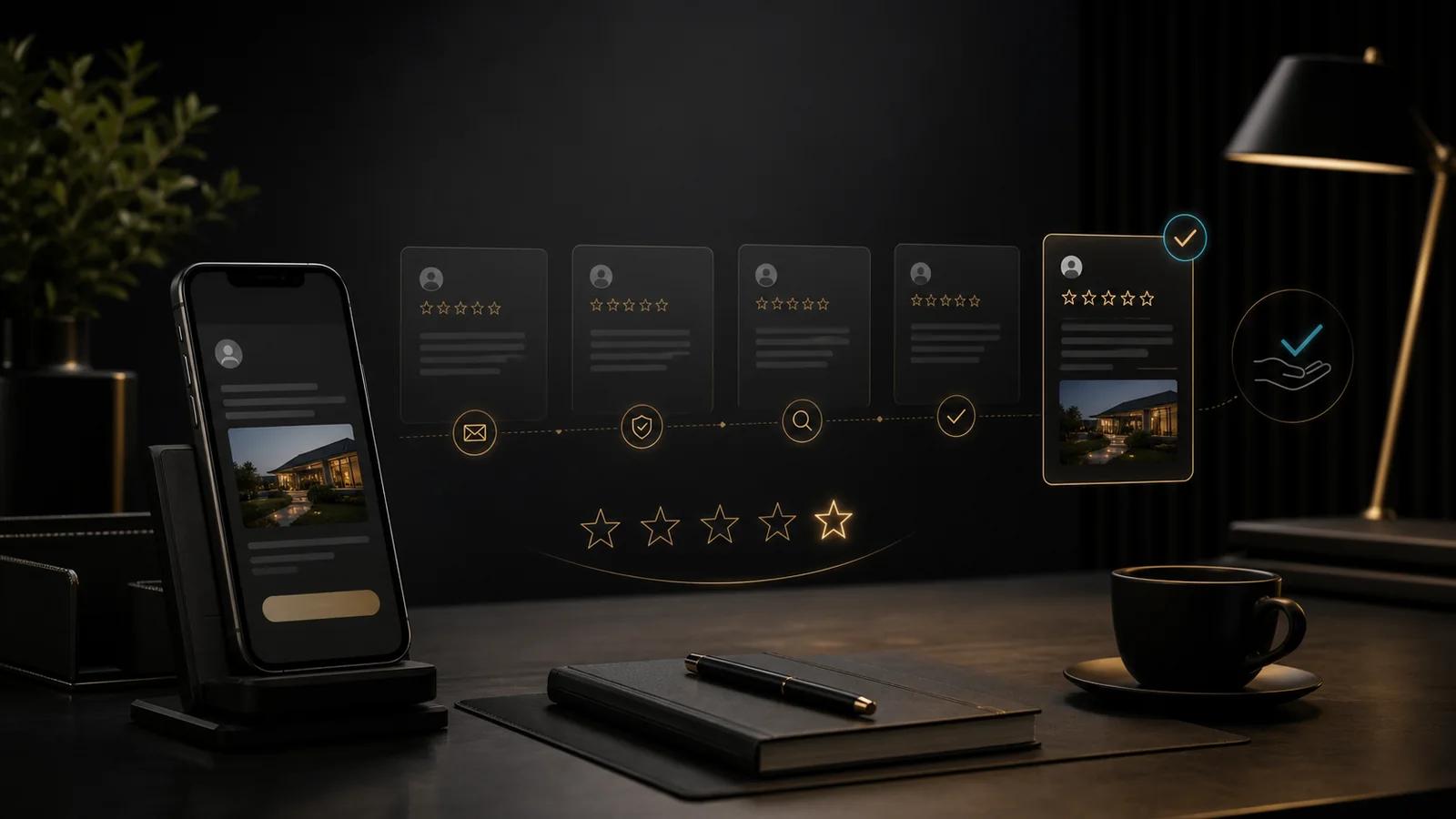
Review Request Automation Without Review Gating: A Practical System
How eligible service businesses can request genuine reviews consistently, respond professionally, route service issues, and keep the workflow within clear policy and human-approval boundaries.