
A sales funnel audit for your service business should follow one inquiry from the customer's attempt to reach you through receipt, response, a next step, a decision and completed work. Find the first point where the record and the action stop agreeing. TQP's Revenue Leak Diagnostic gives you a way to start that investigation and identify the system your business needs.
“We need more leads” can be true. It can also be the explanation everyone repeats because it is easier than finding the estimate in your inbox.
I would trace the inquiries you already have before deciding what to buy. The useful result is a sentence you can act on: “The form reaches the inbox, but nobody owns the callback when the receptionist is away.” That is a repair. “Our funnel is underperforming” is an invitation to another meeting.
At The Quiet Protocol, we build and run the agreed receiving, booking and follow-up systems that these investigations point to. Our Signature Systems start at US$5,000 setup plus US$995 per month, with a six-month initial commitment, AI included in the defined scope and usage billed separately. We design, test, operate and maintain the named process. A smaller gap may call for one focused service; the evidence below helps choose it.
Choose a group you can follow to the end
Start with one service and one received period, such as new bookkeeping inquiries in a completed month. Take every inquiry in that group, or a declared consecutive sample you can review. Do not choose only the disappointing ones and use them to describe the whole business.
Give each distinct request an ID. Link repeat calls, forms and messages about the same request. Keep an existing client's service question separate from a new-business opportunity. Record unsuitable or out-of-area requests so they can explain a fit problem, but do not assume they were jobs the business could have won.
Use a review date that gives that type of request enough time to reach the next decision. An estimate sent yesterday is allowed to be open. A future booked job is allowed not to be completed yet. Record pending work and its due date rather than calling every unfinished row a leak.
Have the person who receives inquiries help with the trace. They may know that the job was entered under a different name, that a caller came through a personal referral, or that a contact record belongs to an existing client. The data should explain their work, not accuse them because two tools failed to match.
Look for the evidence at each step
Your business may not use every stage below. A defined introductory call can lead directly to an engagement proposal; an urgent field request may require a different approved dispatch route. Write your actual route before looking for omissions.
The inquiry trace
| Stage | Find this evidence | What deserves investigation |
|---|---|---|
| Attempt | Call attempt, form submission or message, with time and service path | A broken action, failed submission or a customer route that reaches nobody |
| Received | The identifiable inquiry in the intended receiving record | Customer sees success but the record is missing, incomplete or in the wrong place |
| Owned and answered | Responsible colleague, useful response and actual timing | No owner, no absence cover, or an acknowledgement standing in for a real answer |
| Next step | Agreed appointment, estimate visit or review task, with a truthful confirmation | Customer believes a step is arranged while the team has only a preference or message |
| Decision | Sent estimate or proposal and accepted, declined or open outcome | Reply never reaches a person, open work has no next action, or a guessed reason closes the record |
| Delivered | Completed work or engagement milestone, plus cancellation or delay when relevant | Accepted work cannot be scheduled or the promised handoff never happens |
Put times beside the events where timing matters. Measure an inquiry's arrival to a useful response, not just an automated receipt. Then measure that response to its agreed next step. The team needs to know which wait you are describing.
Compare elapsed time with what your business actually promised and the caller's situation. You do not need a borrowed five-minute rule to see that a callback promised that afternoon was left until the following week. Urgent and ordinary inquiries need their own approved paths and realistic coverage.
A confirmation needs something behind it
Try a labelled fictional inquiry with the staff aware of the test. Use a real customer path and ordinary service request, without confidential customer information. Check the receiving record and have the intended colleague show where they would continue it.
A successful form message should match successful receipt. W3C calls for clear success and error feedback after submission. Our further recommendation is to verify the business record behind that feedback. The customer should not receive “we have your request” while the team has nothing to work from. W3C: form notifications
For a calendar path, check which appointment exists, with whom, and what the customer was told. An introductory call, an estimate request and a booked service visit make different promises. Contact form versus online booking helps choose that promise.
For a call path, check that the receiving note supports the next action. A friendly answer followed by a missing callback number is still an unfinished handoff. Use the AI receptionist field dictionary to choose and confirm the details.
These checks locate configured behaviour. They do not prove a conversion rate or show how every customer experiences the business. Combine the test with the real inquiry records before deciding how widespread the problem is.
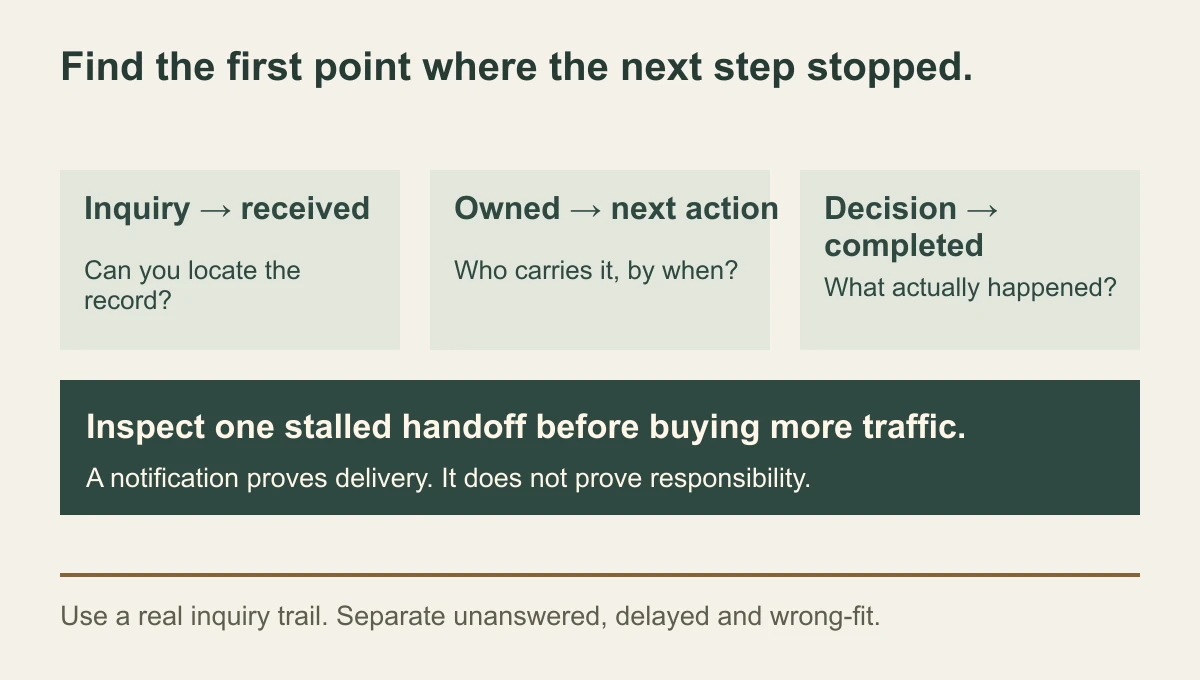
Not every unfinished inquiry is a preventable loss
Give each reviewed row a factual outcome. Suitable work that nobody handled is different from a customer who postponed the project. A service the firm does not offer is different from a request it could not route. An accepted job scheduled for next month is different from an accepted job the team forgot.
Use these categories to make the distinction visible:
- Confirmed process failure: a defined receiving or follow-up action did not happen, with evidence of the missed step.
- Customer decision: the customer accepted, declined or postponed, with the decision recorded.
- Business constraint: service fit, professional review or available capacity prevented progression.
- Pending within the agreed window: the next event is due later and has an owner.
- Unknown: the available records cannot establish what happened.
A confirmed failure is a reason to repair a process. It does not prove the customer would have bought if the step had worked. Unknown is a reason to improve traceability. Do not quietly count either as a lost invoice.
For estimates, start with whatever status evidence your current tool provides. Intuit documents estimate status updates and reports, including invoice conversion. Review that evidence against your own acceptance rule and the customer's actual decision. Intuit estimate guidance
Use the quote acceptance register for cohort measurement. It keeps the open estimates in view instead of letting the diagnostic treat silence as a decision.
One request can reveal the first repair
Imagine a fictional accounting prospect submitting a bookkeeping-cleanup inquiry on Monday. The form records the request and sends a receipt. The record has a general inbox as its destination, but no assigned colleague. On Friday, the office finds it while searching for another message.
The first failure is ownership after receipt. A better website headline will not assign that callback. An AI voice will not repair a form route that remains unowned. The repair is to create the receiving task, assign it to the right person, define absence cover and make overdue work visible.
Now imagine a fictional plumbing request. The phone record contains a confirmed address and the dispatcher offers a visit. The customer believes the visit is booked, but the calendar contains only an unassigned note. The first repair is the booking and confirmation handoff. Counting the call as answered would hide it.
In a law firm, an inquiry can legitimately stop for a human fit or conflict review. The diagnostic should check whether that review reached the authorised person and whether the caller received an accurate explanation. It should not mark professional judgment as inefficiency to automate away.
These examples are illustrations. Your records may point somewhere else. That is why we recommend tracing the actual receiving path before choosing a system.
Write a repair someone can deliver
- Observed gap
- Name the exact stage and the evidence. For example: suitable form requests have a receiving record but no assigned callback task.
- Required behaviour
- Describe what should happen, to whom and by when. Include the genuine customer confirmation.
- Exception
- Define what happens when the assigned person is away, the details are unclear or the customer requests a human.
- Acceptance check
- Send a labelled fictional request, locate the task and ask the receiving colleague to continue it. Test the agreed exception too.
- Review evidence
- Follow a comparable group after the change. Keep unresolved records, customer decisions and capacity constraints visible.
Choose the TQP service that fixes that step
If suitable visitors cannot understand or submit the right request, choose a Smart Website with the inquiry path and receiving connection implemented. If callers need useful coverage, captured details and a human route, choose a configured AI Receptionist.
If the gap is open estimates and unowned replies, choose our Estimate Follow-Up System. If the customer journey needs several connected steps and continuing responsibility, ask us to scope a Signature System. We build and maintain the components named in that scope, including the agreed exceptions and handoffs.
That responsibility is the commercial difference I would pay attention to. Someone has to define the route, connect it, test what happens when it fails, and keep the purchased process working. Giving the office another subscription without giving that work an owner can preserve the same problem in a more expensive form.
For a dollar scenario, use the unconverted-lead contribution worksheet or the revenue calculator, with their assumptions visible. This article's job is to locate the failed step. The AI readiness assessment helps take that finding into a conversation about the right system; it does not replace the inquiry trace.
Start the assessment with one concrete gap. Tell us what reached the business, where it stopped and what the team needs to happen next. We can turn that into an implementation your staff can use, and a process you can inspect without keeping the whole receiving queue in your head.
Frequently asked questions
How do I find where my service business loses inquiries?
Follow a representative request from the first contact through receipt, review, response and the next action. Mark where the promise and actual record separate, then check whether that gap also appears in ordinary work.
Should every unanswered inquiry be counted as lost revenue?
No. First establish the request, service fit, response and outcome. Keep unknown intent and missing evidence visible rather than assigning every record an imagined sale.
What happens after a TQP lead-leak diagnostic?
Use the identified gap to choose a defined repair: the website path, intake, AI answering, booking or follow-up. TQP designs and connects the relevant system so the company can carry the next inquiry with clearer responsibility.
Start the assessment with the stage your inquiry trace exposed. TQP can implement the receiving, booking or follow-up route that fits, with records, named handoffs and continuing responsibility for the written scope.
Find the first system your business needs