
Liability: Missing a safety check on a Category 3 water damage loss and getting sued for mold remediation failures later. If the moisture is not pulled correctly, the mold and structural rot become a multi-million dollar liability that could have been avoided with a 24/7 intake and follow-up protocol.
Treat any number without a nearby source or stated method as a planning assumption, then replace it with your own records.
The after-job hangover. It is 3 AM in a damp basement in the middle of a record-breaking freeze. A restoration owner is dragging an LGR dehumidifier down a flight of stairs, sweating through their IICRC-certified gear while the homeowner, Mrs. Johnson, watches with a mix of terror and relief. The owner is doing the "heroic" work of saving a family home from mold and structural rot. The drying plan is solid. The moisture maps are meticulous. The equipment is humming. This is the part of the job that feels meaningful.
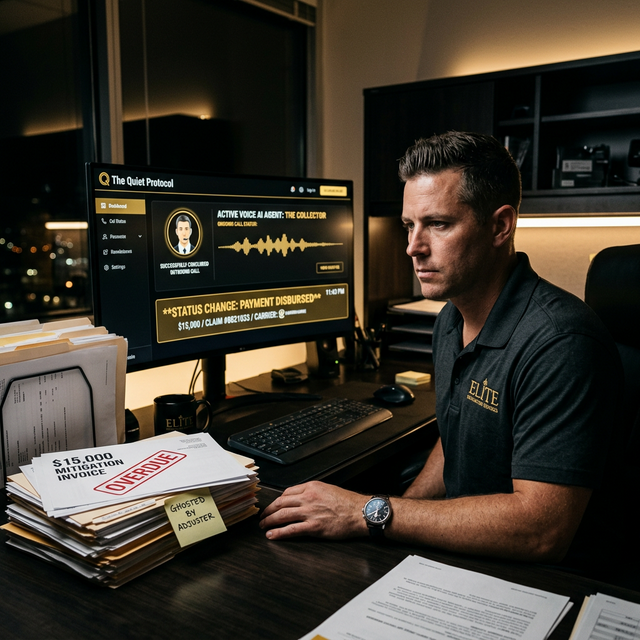
Fast forward ninety-five days. That same owner is sitting in a sterile office, staring at a stack of unpaid invoices. The "hero" feeling has vanished, replaced by the grating reality of accounts receivable. Mrs. Johnson has stopped answering her phone because she "already gave the check to the carrier." The insurance adjuster has not returned an email in six weeks. The TPA is demanding more photos of the basement floor before they will release the final three thousand dollars of the mitigation bill.
In the property restoration industry, cash flow is the only metric that matters during a CAT event. You can be the best technical drying specialist in the country, but if your DSO (Days Sales Outstanding) stretches past the 120-day mark, you are effectively a non-profit company carrying expensive equipment and payroll risk. The gap between doing the work and getting paid for the work is where restoration businesses go to die.
Liability: Missing a safety check on a Category 3 water damage loss and getting sued for mold remediation failures later. If the moisture is not pulled correctly, the mold and structural rot become a multi-million dollar liability that could have been avoided with a 24/7 intake and follow-up protocol.
This is the "Collections Crisis," and in 2026, it is no longer a problem that can be solved with manual office management. The volume of outbound persistence required to actually "shake the tree" at an insurance carrier exceeds the capacity of a human office team. To fix the cash flow gap, restoration owners must stop relying on hope and start deploying automated outbound infrastructure to exploit what we call the "Lien Letter Loophole."
The Carrier Ghosting Problem: Why Adjusters Win the Silence Game
Insurance carriers are multi-billion-dollar institutions built on the preservation of capital. One of their most effective, if unstated, strategies for preserving that capital is simple inertia. If an adjuster can delay the payment of a $15,000 mitigation invoice by sixty days across a thousand claims, the interest earnings alone are staggering. For the adjuster, silence is a professional tool. For the restoration contractor, silence is a payroll problem.
The "Ghosting" mechanics. Most restoration company office managers follow a predictable and ineffective follow-up cadence. They call the adjuster on Tuesday for a water damage claim. They get a voicemail. They leave a message. They wait a week. They call again. They get a different adjuster. They start the process over. This manual approach is precisely what the carrier wants. It allows the claim to sit in a state of perpetual "review" while the restoration company carries the cost of the labor, the equipment depreciation, and the materials associated with the water damage project.
The reason adjusters ghost contractors is that they are overwhelmed and under-incentivized to close small files. A "small file" to a carrier is a $12,000 water damage mitigation claim. To a local restoration company owner, that $12,000 is the difference between making a truck payment or missing it. When the contractor is the only one feeling the heat, the contractor loses.
The only way to win the silence game is to make your follow-up more consistent than their delay. This does not mean being aggressive or rude. It means being relentlessly persistent. It means calling the adjuster three times a day, every day, until the file is moved to "Disbursement" status. If a human tried to do this, they would quit within a week. If a Voice AI does it, it is simply code executing a perfectly polite, consistent follow-up protocol.
The Lien Letter Loophole: Legal Leverage for Property Restoration
Every state provides restoration contractors with a powerful legal tool: the Mechanic's Lien. However, most restoration owners view the lien as a "nuclear option" - something to be used only when a job has gone completely sideways. They fear that mentioning a lien will damage their reputation with the homeowner or the local agent.
This is a tactical misunderstanding of the notice of intent to lien. The actual lien is a legal document filed with the county. The Notice of Intent to Lien (NOI) is a communication tool. When a restoration company sends an automated NOI, it creates a "loophole" in the carrier's delay strategy. The carrier is legally obligated to protect the homeowner's title. Once an NOI is on the record, the carrier can no longer ignore the file without exposing themselves to significant liability.
The "loophole" is that the mere mention of a pending lien, handled with professional poise, forces the carrier to prioritize the payment to "clear the threat" to the property title. The problem is the friction. Sending an NOI requires legal templates, certified mail, and a precise timeline. If you wait until a job is 120 days overdue, the lien rights may have already expired. If you send it too early, you look desperate.
Automation solves the timing problem. By integrating your job management software (like Encircle or Dash) with an outbound Voice AI agent, you can trigger a "Soft Collection" protocol at day 45. The AI calls the homeowner and the adjuster with a pre-formatted, empathetic script that mentions the upcoming legal deadline for filing a lien. It is not a threat; it is an "update on project compliance." This subtle shift in framing forces the cash to move without the owner ever having to pick up the phone.
The Automated Follow-Up Layer
Restoration is a business of "Wait and Rush." You wait for the rain, then you rush to the job. The same happens in the office. You wait for the check, then you rush to pay the bills. The "follow-up layer" is the role required to bridge this gap. It is the person who calls the adjuster to verify receipt of the Xactimate file, then calls back to verify the photo documentation, then calls back to verify the W-9 is on file.
Why automation fits the task. Unlike a human employee, a Voice AI agent does not feel "bad" about calling the same adjuster three times in one afternoon. It does not get discouraged by being put on hold for twenty minutes. It doesn't get frustrated when the adjuster is "away from their desk" for the fourth consecutive day. The AI simply executes the "Infinite Burst" capacity of cloud-based telephony.
Consider the standard "Collections Path" for a Voice AI agent integrated into a restoration company:
Day 15 (Soft Check): the AI calls the homeowner to ensure the carrier has sent the initial "actual cash value" (ACV) check. If not, it offers to call the adjuster on their behalf.
Day 30 (Operational Verification): the AI calls the adjuster to confirm all "required documents" (the digital moisture logs and infrared photos) have been reviewed. If there is a "file deficiency," the AI immediately flags the project manager in the office.
Day 45 (The Leverage Shift): the AI calls the adjuster with the NOI protocol. It notes that "legal compliance requires a notice to be sent at day 60" and asks for a confirmed disbursement date to avoid the administrative filing. This is where 80% of stalled payments suddenly "clear" the system.
The result is a compression of the payment cycle.When adjusters know that your company is the one that calls every day at 10 AM like clockwork, they learn to pay your invoices first just to stop the phone from ringing. You have effectively out-organized the carrier's delay department.
Operating Example: Recovering a Stalled Claim
A mid-sized restoration company in Florida was struggling with a "Category 3" sewage loss job that had been ghosted by the carrier for over four months. The owner had $15,342 sitting on the books, all of it in labor and equipment costs that had already been paid for. Every two weeks, the office manager would call, get transferred to a "general claims queue," and wait on hold until they had to hang up to handle a new FNOL (First Notice of Loss).
The operating pattern: the owner installed an automated outbound agent - an outbound follow-up agent - and mapped it to his Xactimate status dashboard. The AI was given the file number, the adjuster's direct line, and the homeowner's contact info. Its instructions were simple: Secure a payment date for the water damage work or a mold remediation file deficiency list. The goal was simple: keep following up until the file produced either a payment date or a documented deficiency list.
The AI called every morning at 9:05 AM. On day three, it actually reached the adjuster. The adjuster claimed they were "missing the 3rd-day moisture readings" for the water damage mitigation. The AI immediately sent an SMS to the office manager with the specific request. The office manager uploaded the data. The next morning, the AI called back to "confirm receipt of the 3rd-day readings." On day five, the adjuster, clearly recognizing the systematic nature of the follow-up, approved the full water damage claim and the associate mold remediation labor for "full reimbursement."
Total owner intervention: near zero. The check arrived via direct deposit nine days later. The "loophole" was not a legal trick; it was the total elimination of the "Adjuster Ghosting" strategy through sheer, automated persistence.
Auditing Your A/R: The Math of Ghosting
If you want to know if your restoration company is being ghosted by carriers, you need to look past your "Total A/R" and look at your "Over-90" bucket. In a healthy restoration business, the Over-90 bucket should be less than 5% of your total outstanding invoices. If yours is 20% or higher, you are paying a "Ghosting Tax" to the insurance companies.
The Ghosting Tax calculation. If you have $500,000 in A/R and $100,000 of it is over 90 days old, you are not just "waiting on money." You are losing money. At a 10% cost of capital (the interest you pay on your line of credit to keep the lights on while waiting for the carrier), that $100,000 in ghosted invoices is costing you $833 every single month in pure interest. Over a year, that is $10,000 of profit evaporated into thin air.
But the real cost is the "Opportunity Gap." When your cash is tied up in a carrier's back-office review, you cannot hire the next crew. You cannot buy the next truck. You cannot stock the warehouse for the next storm. The "Ghosting Tax" is not just a line item on your P&L; it is a ceiling on your growth.
By automating the collection follow-up, you are not just "getting paid." You are de-risking your entire business model. You are moving from a state where your growth rests in the hands of a disinterested adjuster to a state where your growth is fueled by a predictable, high-velocity cash conversion cycle.
DIY vs. Professional Implementation: Fixing the Water Damage Collection Gap
Every restoration company owner faces a choice: Do you continue to hire more office staff to "nag" adjusters about water damage status, or do you install a machine to do it?
The DIY Approach.You can instruct your office manager to dedicate two hours every Tuesday and Thursday to "collections calls" for outstanding water damage and mold remediation invoices. You can buy a spreadsheet template to track the lien deadlines. You can manually send out "Notice of Intent" letters via certified mail. This is better than doing nothing, but it is rarely consistent. The moment a new "Water Mitigation" emergency comes in, the collections work gets pushed to next week. The carrier wins.
The Professional Approach.This involves deploying a dedicated outbound Voice AI agent that handles the entire A/R lifecycle for water damage and mold remediation cases. It requires zero manual prompting. It hooks into your CRM, watches for "Invoiced" status, and initiates the follow-up cadence automatically. It handles the mundane "status updates" that humans hate and ensures that no file ever hits the 60-day mark without a "Notice of Intent" protocol being engaged.
The ROI of professional implementation is almost immediate. Recovering just one $15,000 mitigation job that would have otherwise gone to litigation or been written off pays for the entire system for a year. But more importantly, it recovers the owner's time. Instead of arguing with adjusters on the phone, the owner can be out in the field - doing the work they were born to do.
Stop letting carriersfund their balance sheets with your capital.The work is hard enough without having to beg for the money you have already earned. Automate your collections, close the lien letter loophole, and make your restoration company run quietly.
Use your own records before you decide
Source: start with your call log, CRM notes, booking calendar, missed-call records, web form timestamps, and Google Business Profile. Those records show whether buyers reached you, how fast they heard back, what they asked for, and where the next step broke down.
For seven days, mark each missed call, late reply, unbooked form, stale estimate, and review request that never went out. That small sample gives an owner a practical picture of the front-door gap before they spend more on ads, software, or staff.
The loss estimate is basic business math, not a magic claim.
Revenue-leak examples on this site are built from visible operating inputs: inquiry volume, missed-call or slow-response rate, booking rate, average job or client value, repeat value, and follow-up recovery. The fastest way to make the number real is to run the diagnostic for your closest business type, then compare it against your own call log, CRM, booking calendar, form timestamps, and review activity.
The practical questions behind this decision.
Is it legal to use Voice AI to mention a lien letter?
Yes, provided you are stating the legal reality of your state's lien statutes. A "Notice of Intent to Lien" is a required step in most states before a lien can actually be filed. Mentioning this upcoming deadline to an adjuster or homeowner is not "harassment," it is "proactive project communication." The AI is programmed to be empathetic and professional, focusing on compliance rather than aggression.
Will this damage my relationship with the insurance adjusters who send me work?
The opposite is actually true. Professional, systematic follow-up earns respect from experienced adjusters. They are overwhelmed with hundreds of files. When they see a contractor who is "buttoned up" and has a system that tracks every document receipt and disbursement date, they treat that contractor as a priority. They stop ghosting you because they know you aren't as easy to ignore as the "disorganized guy in the truck" who only calls once a month.
How does the AI know when a check has actually been received?
The AI is one part of the Quiet Protocol ecosystem. It connects to your CRM and accounting software. When you mark a "Payment Received" in your system, the AI immediately stops all follow-up protocols. Many owners also set up a proactive call where the AI calls the homeowner 48 hours after the adjuster claims the check was "mailed" to verify its arrival. This ensures the carrier isn't lying about the "check is in the mail" story - another common ghosting tactic.
Can I customize the frequency of the follow-up calls for mold remediation vs water damage?
Yes. Every restoration company has a different "tolerance" for persistence. Some prefer a soft touch every 14 days for a standard water damage job. Others, especially in Tier-1 storm markets where mold remediation is a critical high-margin component, prefer a "Hyper-Persistence" mode where the AI calls every 24 hours until a payment date is secured. The Quiet Protocol allows you to dial the intensity up or down based on your local market dynamics and current cash flow needs.
Locate the point where interested buyers stop hearing from the business.
Review one customer journey from first inquiry through booking, estimate, reminder, and recovery.
Use the diagnostic to locate the handoff where good inquiries, estimates, appointments, or past customers stop moving.
See how the capability in this article fits into a complete customer journey.
Restoration & RemediationSee the same decision through the language, buyer behavior, and operating reality of this industry.
Client Results & ProofInspect the starting condition, installation, measurement window, and outcome behind real client work.

Restoration Emergency Call Intake: A Dispatch Handoff Guide
A practical guide for restoration companies that need to turn an urgent water-loss call into a clear, time-stamped incident brief without letting automation make safety or dispatch decisions.

Storm Season and the Restoration Company: How to Handle the Call Surge When It Matters Most
A single severe weather event can send a restoration company's call volume up 4 to 8 times overnight. Most of those calls go to voicemail. Here is how the companies capturing storm revenue are built differently.
The Real Cost of a Missed Call for a Service Business: The Math Nobody Runs
A missed call costs more than the immediate job. Here is the full three-layer calculation, immediate value, lifetime client value, and referral chain, and the annual total most owners never see.