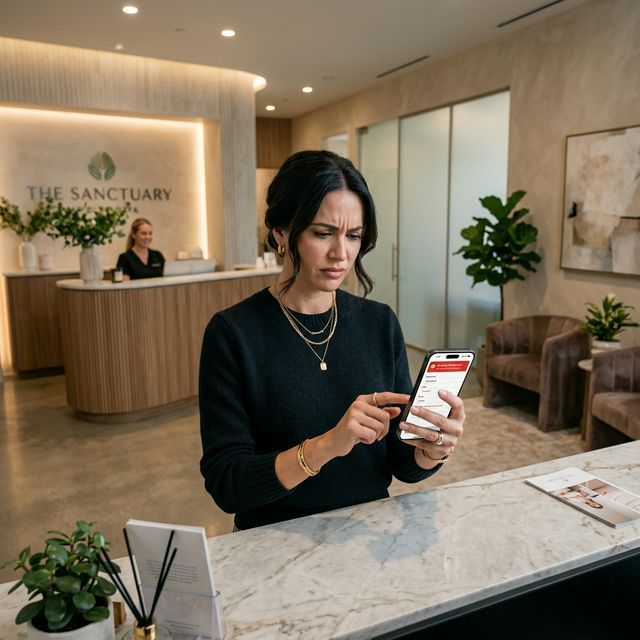
The intuition most med spa owners operate with is that serious buyers call during business hours. This intuition is wrong, and it is costing money in direct proportion to how confidently it is held.
Treat any number without a nearby source or stated method as a planning assumption, then replace it with your own records.
The aesthetics industry has a front-door problem that most med spa owners understand intuitively but have never actually measured. Your marketing budget drives calls, web inquiries, and DMs at all hours. Your front desk covers 9 to 5. The gap between those two facts is where a significant portion of your annual revenue goes - not to competitors who out-market you, but to competitors who simply answered the phone when you did not.
The average med spa receives between 30 and 60 inbound inquiries per week across calls, web forms, and social DMs. Somewhere between 35 and 45 percent of those arrive outside of business hours, based on data across aesthetics practices we have worked with. For a practice doing $1.2 million in annual revenue, that means 12 to 27 unanswered inquiries per week. At a $400 average Botox consultation value and a 55 percent conversion rate from consultation to service, each week of unaddressed after-hours inquiry volume represents roughly $2,600 to $5,900 in potential revenue that simply never entered the system.
Over a year, the math becomes difficult to ignore.
The After-Hours Window Is Not a Gap: It Is Peak Demand
The intuition most med spa owners operate with is that serious buyers call during business hours. This intuition is wrong, and it is costing money in direct proportion to how confidently it is held.
The data on when aesthetics inquiries actually arrive tells a different story. The largest single spike in med spa inquiry volume occurs between 7 PM and 10 PM on weekday evenings - specifically Tuesday through Thursday. This is when your client base, which skews toward working professionals and high-income households, has finished their workday, fed their families, sat down on the couch, opened Instagram, seen a before-and-after, and decided to finally do something about it. The decision-to-inquiry window in aesthetics is short. The prospect is in the moment. They pick up the phone or hit your contact page. If nothing happens, the moment passes.
This is not a problem you can solve with better voicemail.Research on consumer behavior in the services sector is consistent: over 80 percent of people who reach voicemail when making an inquiry about an elective service do not leave a message and do not call back the next day. The window is the window. Once it closes, it closes.
What Happens to the Lead After Nobody Answers
The assumption built into most practice management is that a prospect who calls after hours will try again in the morning. The reality is that most will not, and understanding why matters for building the right response.
The aesthetics prospect pool is not making emergency decisions. They are making discretionary spending decisions, which means they are simultaneously evaluating options and managing a low-level anxiety about whether they are making the right choice. When they call your practice and reach voicemail, the moment of commitment deflates. They did not get validation. They did not get a warm, professional response that made them feel like they were in good hands. They got a recording.
The next step for most of them is not to wait for a callback. It is to open Google and call the next result. In most mid-to-large markets, there are three to six competing med spas within 15 minutes. At least one of them has an answering service, a text-back system, or an AI receptionist that picks up immediately. That practice gets the consultation. You get a voicemail inbox with nothing in it.
The competitive dynamic in aesthetics has shifted.Five years ago, being the best med spa in your market was enough to win on reputation alone. Today, the practices that are growing fastest are combining clinical excellence with operational infrastructure that captures demand at every hour it arrives. The clinical quality is table stakes. The infrastructure is the differentiator.
The Summer Demand Spike: Your Most Expensive Coverage Gap
The period from May through August is historically the highest-demand window for med spa services in North America. Patients are planning for summer events, vacations, and social occasions. Botox, filler, laser treatments, and body contouring all see peak inquiry volumes in this window. For practices in warmer climates or resort-adjacent markets, the spike can be even more pronounced.
This is also the period when after-hours coverage failures are most expensive. Summer social calendars mean prospects are often planning and booking in the evenings and on weekends, outside normal operating hours. A practice that does not have any coverage infrastructure during this window is losing its most valuable revenue period to practices that do.
If you are heading into May without an after-hours capture system in place, you are about to spend four months paying for marketing that drives demand you cannot fully catch. The Google Ads budget runs. The Instagram content goes out. The calls arrive. And a meaningful fraction of them hit voicemail and walk.
The Botox Consultation Funnel Is Not Forgiving
The specific economics of Botox and filler services make the after-hours coverage gap especially damaging compared to other service categories.
First, the consultation commitment is low - a prospective patient calling about Botox has a much lower barrier to switching providers than a patient who has already started a multi-session laser series with you. They have no relationship with your practice yet. The switching cost is zero. The only reason to choose you over a competitor is the quality of the initial interaction.
Second, first-service clients have significantly higher lifetime value than the initial transaction suggests. A patient who comes in for her first Botox appointment at 33 and has a good experience becomes a quarterly client for years, adds filler, refers her friends, and eventually asks about laser resurfacing. The industry average lifetime value of an aesthetics patient who completes their first service is between $3,500 and $8,000 over five years, depending on market and service mix. Losing her at the point of initial inquiry - because nobody picked up at 7 PM - is not a $400 loss. It is a $4,000 to $8,000 loss.
This is the number that changes how med spa owners think about the after-hours coverage problem.It is not a convenience issue. It is a revenue infrastructure issue.
What an AI Intake Layer Actually Does on a Med Spa After-Hours Call
The alternative to missed calls is not hiring a receptionist to work evenings and weekends. The economics do not work, the staffing is difficult, and the consistency is unreliable. The operational solution is a Voice AI system configured specifically for aesthetics practices.
When a prospect calls your med spa at 6:43 PM and the Voice AI answers, the experience is not a recording and it is not a phone tree. The AI introduces itself as the practice assistant, acknowledges the time, and moves directly into the conversation. It asks what brought the caller in - whether they are interested in a specific service, whether they have been to the practice before, and whether they would like to schedule a consultation. If they say yes, it pulls from your actual booking calendar and schedules the appointment in real time. If they are not ready to book, it captures their name and contact information and notifies the front desk to follow up the next morning.
The caller experiences a professional, warm, responsive interaction with your practice. The prospect does not know whether they spoke with a human or an AI. What they know is that someone answered, they were treated professionally, and they now have a confirmed consultation on the calendar. That is the experience that converts.
For practices that implement this system, the after-hours capture rate typically moves from near zero to 65 to 80 percent of after-hours inquiry volume. The calls that arrive outside of business hours begin contributing to booked consultations at rates comparable to calls that arrive when the front desk is staffed. The coverage gap closes.
What to check before you choose a fix
Before buying another answering service, chatbot, phone tree, or AI receptionist, look at the actual path a Botox, filler, laser, consultation, pricing, or treatment-package lead takes when they reach your business. The first question is not whether the tool sounds impressive. The first question is whether the buyer gets a clear next step while they still care. In med spa operations, that usually means a fast answer, a useful question, a booked appointment or estimate path, and a follow-up record that does not rely on memory.
A strong system should make the business feel easier to choose. It should reduce the waiting, repeating, guessing, and manual chasing that make a buyer keep searching. If the current setup answers only during business hours, takes a message without qualifying intent, or leaves the follow-up to whoever remembers first, the problem is not only staffing. It is front-door design.
The Week-One Diagnostic
Run this review over the last seven days before making a decision. Pull the call log, website form submissions, chat history, booking calendar, CRM notes, missed-call list, and Google Business Profile activity. Do not start with opinions. Start with timestamps and outcomes. A small sample is enough to show whether the leak is response speed, qualification, booking friction, review weakness, or follow-up failure.
- Count every missed call and every call that lasted under 20 seconds. Those are often buyers who never became visible in the CRM.
- Count every form or chat that waited more than 10 minutes for a real next step. This is where high-intent demand starts cooling off.
- Mark every inquiry that needed a human callback before booking. That tells you whether the website is explaining the next step clearly enough.
- Review the last five reviews buyers can see publicly. Recency matters because buyers compare proof before they commit.
This is the source method for the article: use your own call log, CRM, booking calendar, form inbox, and Google Business Profile review activity. Public research can explain the pattern, but your own records show where money is escaping in this business.
Where the revenue usually leaks
The leak usually appears in one of four places. First, the buyer calls when the team is busy or closed. Second, the buyer reaches the business but is not qualified clearly enough to book. Third, the buyer receives a polite response but no firm next step. Fourth, the buyer finishes the job or visit but no review, referral, or reactivation path happens after the work is done. Each leak looks small by itself. Together, they decide whether marketing produces booked revenue or only more noise.
For a med spa, the most valuable fix is the one that protects consult booking, follow-up, no-show recovery, and review proof. That is why why med spas lose 40 percent of inquiries after 5 pm should be judged by business outcomes, not by novelty. A phone feature that sounds clever but does not improve booked appointments is not enough. A website widget that collects contact details but does not trigger follow-up is not enough. A review tool that asks once and disappears is not enough.
What a stronger system should do
A stronger front door answers quickly, asks the right questions, captures the reason for contact, separates urgent from routine demand, books when rules are clear, sends confirmations, updates the follow-up path, and asks for reviews after the work is done. The system should make the owner less dependent on heroic callbacks and make the buyer feel that the business is organized from the first touch.
The Quiet Protocol treats this as an operating system, not a single widget. Calls, web forms, missed-call text-back, appointment booking, CRM handoff, review requests, and reactivation all need to point in the same direction. When those pieces are connected, a med spa can capture more demand without turning the team into a bigger manual call center.
How to judge whether it is working
Do not judge the system by how futuristic it feels on day one. Judge it by what changes in the business. Useful measurements include missed-call recovery rate, average response time, booked appointment rate, no-show recovery, review request volume, review recency, reactivated past-customer conversations, and the number of leads that have a clear next action in the CRM.
The best early sign is calm. Fewer loose callbacks. Fewer mystery leads. Fewer buyers waiting for a reply. More conversations with a clear status. That is what good automation should feel like to the owner and to the customer.
Before You Choose a Fix
Is this just a 24/7 answering service?
No. A traditional answering service usually takes a message. A properly designed AI receptionist and front-door system captures intent, qualifies the buyer, routes the request, books when possible, triggers follow-up, and supports reviews after the work is done. Message-taking is coverage. Revenue capture is a fuller operating path.
What should a med spa fix first?
Fix the first place buyers disappear. For some businesses that is after-hours calls. For others it is slow website follow-up, weak booking logic, old leads, or stale reviews. The right first move comes from the seven-day diagnostic, not from guessing.
Will AI make the business feel less human?
Bad automation feels colder than a person. Good automation feels like the business is paying attention. It answers quickly, uses plain language, collects the right information, and hands the buyer to a human when judgment or empathy is needed. The goal is not to remove people. The goal is to stop making buyers wait for basic next steps.
How fast should we expect improvement?
The first lift should come from visibility and speed: fewer missed opportunities and cleaner routing. Deeper gains come after the system has enough real conversations to tune scripts, booking rules, follow-up timing, and review requests. Treat the first month as deployment and calibration, not a magic switch.
The loss estimate is basic business math, not a magic claim.
Revenue-leak examples on this site are built from visible operating inputs: inquiry volume, missed-call or slow-response rate, booking rate, average job or client value, repeat value, and follow-up recovery. The fastest way to make the number real is to run the diagnostic for your closest business type, then compare it against your own call log, CRM, booking calendar, form timestamps, and review activity.
The practical questions behind this decision.
Will patients mind that they spoke with an AI instead of a real person?
In practice, this concern is far less significant than most practice owners expect. The prospects who call after hours are not expecting to speak with a senior aesthetician or the practice owner. They are expecting someone professional to answer, take their information, and help them schedule. An AI that does this well - that sounds natural, responds to what the caller actually says, and confirms the appointment clearly - delivers exactly that expectation. Post-interaction surveys across aesthetics practices using Voice AI consistently show high satisfaction with the intake experience regardless of whether the caller initially knew they were speaking with an AI.
What happens when a caller has a clinical question the intake layer cannot answer?
The AI is not designed to answer clinical questions, and it is specifically trained not to attempt to do so. When a caller asks whether Botox is right for their specific concern, or asks about contraindications, or wants to know which filler the injector recommends for their case, the AI acknowledges the question, explains that clinical questions are best addressed by the provider directly, and offers to schedule a consultation where the caller can discuss their specific situation. The clinical conversation stays with the clinician. The logistics and scheduling stay with the AI.
How does AI-supported intake handle a call from someone who is nervous or uncertain?
Nervousness and uncertainty are common in first-time aesthetics inquiries, and a well-configured AI handles them with appropriate pacing and language. It does not rush the caller or push toward a booking if the caller is clearly in an exploratory mode. It answers general questions about what the process looks like, normalizes the consultation step as a no-pressure conversation, and captures contact information so the practice can follow up. The goal of the AI is not to close every call - it is to keep every lead inside your system rather than letting them disappear into a competitor's calendar.
What does this system cost compared to what it recovers?
The economics of a Voice AI system for a med spa are straightforward once you run the after-hours inquiry volume against your per-consultation value. A practice receiving 15 after-hours calls per week, converting 70 percent through the AI, and closing 50 percent of those consultations into services at a $400 average transaction value is recovering approximately $2,100 per week in revenue that was previously lost. Over a year, that is over $100,000 in captured revenue against a monthly system cost that is a small fraction of that figure. The Rage Number calculation - which you can run in about 90 seconds on our site - walks through this math for your specific practice.
Is this just a 24/7 answering service?
No. A traditional answering service usually takes a message. A properly designed AI receptionist and front-door system captures intent, qualifies the buyer, routes the request, books when possible, triggers follow-up, and supports reviews after the work is done. Message-taking is coverage. Revenue capture is a fuller operating path.
What should a med spa fix first?
Fix the first place buyers disappear. For some businesses that is after-hours calls. For others it is slow website follow-up, weak booking logic, old leads, or stale reviews. The right first move comes from the seven-day diagnostic, not from guessing.
Will AI make the business feel less human?
Bad automation feels colder than a person. Good automation feels like the business is paying attention. It answers quickly, uses plain language, collects the right information, and hands the buyer to a human when judgment or empathy is needed. The goal is not to remove people. The goal is to stop making buyers wait for basic next steps.
How fast should we expect improvement?
The first lift should come from visibility and speed: fewer missed opportunities and cleaner routing. Deeper gains come after the system has enough real conversations to tune scripts, booking rules, follow-up timing, and review requests. Treat the first month as deployment and calibration, not a magic switch.
Map how a serious buyer decides in this kind of business.
Use the operating reality of the industry instead of copying a generic lead-generation playbook.

Vikram Roy is the founder of The Quiet Protocol, a Toronto-based systems firm serving service businesses across the Greater Toronto Area, Canada, and the United States. He works directly with professional firms, home service companies, dental practices, clinics, and local businesses to connect websites, customer intake, booking, reviews, follow-up, and practical AI into a clearer digital front door. All content is written from Toronto, Ontario. See the editorial method →
Replace broad industry assumptions with the business's actual inquiry volume, customer value, response time, and booking data.
See how the capability in this article fits into a complete customer journey.
Aesthetics & Med SpaSee the same decision through the language, buyer behavior, and operating reality of this industry.
Client Results & ProofInspect the starting condition, installation, measurement window, and outcome behind real client work.

Why Service Businesses Lose Inbound Leads Before the Phone Rings
It is not a traffic problem. Many service businesses lose revenue because the front door breaks before the buyer reaches a real conversation.
The Med Spa Summer Reactivation Playbook: How to Fill Your Schedule From Clients Who Already Trust You
A med spa guide to filling summer schedules with dormant clients, treatment timing, SMS follow-up, reviews, and booking automation.
Why Med Spas Lose 40% of Their Bookings Before the Phone Even Rings
Most med spa revenue leaks before intake, not in the treatment room. Here is exactly where it goes, how much it costs annually, and what the fix looks like without adding staff.