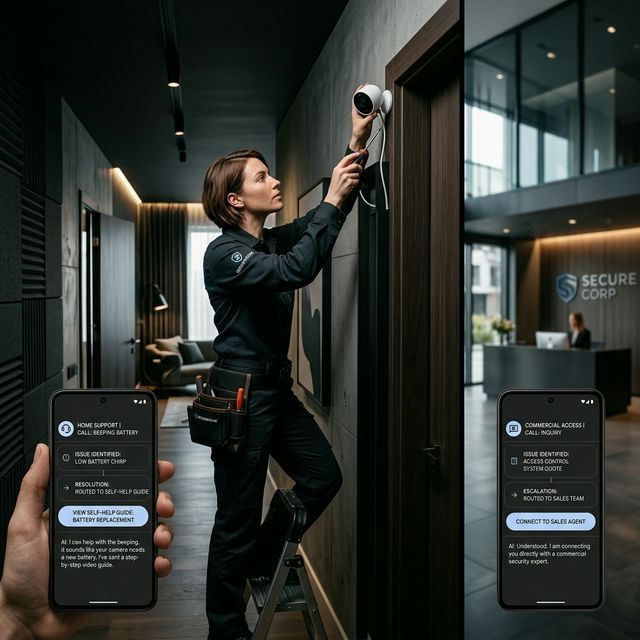

The physical security industry relies on two entirely different, deeply opposed revenue streams running through the exact same central nervous system.
Treat any number without a nearby source or stated method as a planning assumption, then replace it with your own records.
The first stream is residential monitoring. This is a high-volume, low-margin, high-attrition business built entirely on recurring monthly revenue (RMR). You install a panel, three door contacts, and a motion sensor for a nominal upfront fee, and you collect $39 a month for the next five years. To make the math work, you need thousands of accounts.
The second stream is commercial integration. This is a low-volume, massive-margin business built on complex hardware deployments. A school district needs 45 cameras, card-access readers on 18 exterior doors, and a unified cloud dashboard. That is a $250,000 contract with a 40% margin, plus service agreements.
The operational disaster occurs when the thousands of residential accounts need customer service, but the commercial prospects need consultation. If you do not have a robust routing infrastructure, the two streams collide in your front office.
Your highest-paid commercial sales engineer, whose job is to fly out to construction sites and read blueprints with architects, ends up answering the phone on a Tuesday afternoon. The caller is an octogenarian in a subdivision whose keypad is emitting a faint chirp every sixty seconds because the backup battery has died. The engineer spends fifteen minutes explaining how to open the panel with a Phillips-head screwdriver.
While that engineer is playing tech support,a property manager for a newly constructed data center calls the main line, gets placed on hold, gets frustrated, and calls the massive national integrator down the street instead.
The Support Surge: Why the Beeping Panel Matters
In a residential alarm business, the most common inbound call is never an actual burglary. It is a technical annoyance. Panel batteries die. Window contact batteries die. Wi-Fi networks change passwords, disconnecting the cameras. Power surges trip fuses.
These support calls, while completely mundane, carry a massive risk of churn if they are not handled well. If a customer's alarm panel wakes them up with a low-battery chirp at 3:00 AM, and they can't get someone on the phone to tell them how to silence it, they will rip the panel off the wall and cancel their service the next morning.
Therefore, the business must answer the phone. But answering these calls with human agents is brutally expensive. A dedicated call center agent costs the business approximately $20 to $25 per hour fully loaded. If an agent spends an eight-hour shift walking people through battery replacements, the cost of servicing those residential accounts begins to eat into the RMR profit margin.
This is why the largest security companies in the world lean so heavily into Interactive Voice Response (IVR) phone trees. They try to deflect the customer. "For billing, press 1. For technical support, press 2." They force the customer into an app or onto a website FAQ page. The customer hates it.
The Tier 1 Support Layer
Voice AI completely resolves the tension between support costs and customer experience in the security industry.
Instead of a hostile phone menu, the customer is greeted by an empathetic, highly intelligent digital agent capable of diagnosing technical issues in real-time.
The AI is integrated directly with the security company's monitoring software platform (like Alarm.com or SecureNet). It can pull the live diagnostic telemetry of the caller's system before the caller even explains the problem.
Here is what an AI-powered Tier 1 resolution sounds like:
**AI Intake:** "Thank you for calling SecureHome. This is Sarah. I see you are calling from the number associated with the Smith residence on Oak Lane. Are you calling regarding a technical issue with your system today?"
**Caller:** "Yes! The keypad in the hallway has been beeping for two hours and it says 'Trouble' on the screen. How do I make it stop?"
**AI Intake:** "I am so sorry, I know how annoying that beeping can be. Let me pull up your system diagnostics right now... Okay, I see the issue. Our system shows the battery in the 'Back Door' sensor has run completely out. It takes a standard CR2032 watch battery. I can silence the keypad beeping from my end right now for the next 24 hours so you can go to the store and get a battery. Would you like me to silence it now?"
**Caller:** "Oh my god, yes, please silence it."
**AI Intake:** "Done. You won't hear a sound. I am also going to text you a quick 60-second video showing exactly how to pop the cover off that back door sensor and slide the new battery in. Do you need help with anything else?"
In under ninety seconds, the AI diagnosed the issue, executed a remote command to silence the panel, deployed a visual self-help asset via SMS, and preserved the customer relationship. The cost of that interaction to the business was pennies. Zero human payroll was utilized. The customer was thrilled completely.
The Commercial Transfer Protocol
By entirely absorbing the massive volume of low-tier residential support tickets, the AI frees up the communication channels for the high-margin signal: commercial inquiries.
When a commercial lead lands on the phone, the AI's objective fundamentally shifts from "resolution and deflection" to "qualification and hot-transfer." The AI is trained to recognize corporate language, facility terminology, and the scale of the request.
The commercial track demands immediate white-glove service:
**AI Intake:** "Thank you for calling SecureHome. This is Sarah. Are you an existing customer calling for support, or are you looking for information about a new system?"
**Caller:** "I need a new system. We're opening a new corporate office downtown next month."
**AI Intake:** "Congratulations on the new location! Because we have dedicated divisions for residential and commercial systems, I just want to route you to the right expert. For this new office, are you primarily looking for burglar alarms, camera surveillance, or card-swipe access control for the doors?"
**Caller:** "We need all of it. We have about forty employees and there is a server room that needs restricted badge access. Plus exterior cameras."
**AI Intake:** "Excellent. That is a robust project, and exactly the kind of integration our Enterprise team specializes in. I am going to hot-transfer you to David, our Director of Commercial Operations, so you can discuss the blueprints and site requirements with him directly. Can you hold for just thirty seconds while I connect him?"
While the caller holds, the AI fires a notification to David's screen: "INBOUND LEAD: Commercial Office. Scoping Alarms, CCTV, and Access Control. Approx 40 Employees. High intent."
David picks up the phone. He does not ask, "How can I help you?" He says, "Hi there, Sarah just passed your file over to me. I understand you're setting up a new campus downtown and need a unified camera and access control setup. What timeline are we looking at for occupancy?"
The psychological positioning is devastatingly effective.The commercial prospect feels like they just entered the executive suite of a highly competent engineering firm. They did not have to repeat themselves. They were not treated like a homeowner buying a ring doorbell. They were elevated.
Handling the Mid-Market Business Caller
The hardest tier of security sales to manage is the mid-market or "Main Street" business. A retail bakery owner looking for three cameras and a basic burglar alarm is an excellent, profitable customer. But they do not require an onsite blueprint consultation from the Director of Commercial Operations.
If you treat the bakery owner like a massive enterprise client, you waste expensive sales engineering time. If you treat them like a residential homeowner, you insult them.
The AI Intake Coordinator handles this middle ground by asking the golden sizing question:
**AI Intake:** "Roughly how many square feet is the facility, and is it a single location or multiple buildings?"
If the caller says, "It's just a 1,200 square foot retail space in a strip mall," the AI routes them to the Inside Sales team, which is trained in rapid, phone-based quoting and standard package deployments. The Inside Sales agent can look at the layout on Google Earth, quote a standard alarm and four-camera package over the phone, and secure a $2,500 contract in ten minutes.
By filtering the leads by floorplan size and complexity, the AI ensures that your most expensive human talent is only ever looking at the most complex, highest-margin blueprints.
Active Alarms and Panic Hand-offs
In the security industry, the stakes can become a matter of life and death in a fraction of a second. If a customer hits their panic fob because someone is breaking through their back door, and they call the security company in a panic, an AI attempting to run a qualification script is unacceptable. It is dangerous.
The programming logic of a security-focused AI must contain hyper-aggressive escalation triggers. It listens constantly for distress keywords: "break-in," "burglar," "police," "robbed," "fire," or even intense vocal modulation indicating panic.
If the AI detects distress in the opening sentence, it fundamentally aborts its primary logic tree.
"I am connecting you to our central monitoring station emergency dispatch right now. Please stay on the line."
The call is instantly bridged to the UL-Listed central station operators who have direct lines to the local PSAP (Public Safety Answering Point), bypassing the standard office phone network entirely. The AI removes itself from the equation instantly when a human life or active crime is in progress.
The Financial Yield of Signal Isolation
For the owner of a security integration firm, the financial impact of deploying an AI Intake Coordinator is profound, but it is not found in the marketing budget. It is found in the payroll margins and the close rate of the commercial division.
When you remove the burden of Tier 1 technical support from your company's physical office, you no longer need to staff a floor of $22-per-hour customer service representatives. You can allow your support margin to scale infinitely with zero added headcount.
The Weekend Move-In: Capturing New RMR After Hours
There is a massive, highly competitive acquisition window in the residential security market: the weekend move-in. When a new family buys a house that is already pre-wired with a security panel from a local installation company, they usually discover the panel on a Saturday afternoon while unpacking boxes.
They look at the keypad, see your company's logo stamped on the plastic, and dial the 1-800 number. They want the system activated immediately because they are sleeping in a new, unfamiliar house tonight. If your office is closed on the weekend and that call goes to a voicemail machine, that new homeowner will pull out their iPhone, download the SimpliSafe or Ring app, and order a DIY system on Amazon Prime. You just lost a five-year monitoring contract that cost you absolutely nothing to acquire because the hardware was already on the wall.
An AI Intake Coordinator prevents this completely by remaining functionally open 24/7. When the new homeowner calls on a Saturday at 4:00 PM, the AI picks up immediately.
**AI Intake:** "Thank you for calling SecureHome. Are you calling from a property that already has one of our systems installed, or are you looking for a brand new installation?"
**Caller:** "We just moved into a house today that has your panel on the wall near the garage. We want to get it turned on."
**AI Intake:** "Welcome to your new home! I can help you get that activated right now. I just texted a secure activation link to this phone number. You can pick your monitoring tier-we have packages starting at $39 a month-and activate the panel immediately from your phone without needing a technician to come out. Did you receive that text?"
By completely automating the recurring monthly revenue (RMR) capture process for pre-existing hardware, the AI turns weekend dead-air into pure profit. The customer feels a deep sense of relief because their house is secure on their first night, and the security company owner logs in on Monday morning to see three new monitoring contracts activated automatically while they were at their kid's soccer game. This is the definition of operational leverage.
When your commercial prospects no longer have to wait in the same phone queue as angry homeowners holding dead batteries, your commercial close rate climbs. Your enterprise team spends their entire day designing systems and closing $50,000 to $500,000 contracts, rather than routing phone calls and acting as a glorified switchboard.
The security business is chaotic because humans behave chaotically.The AI brings a ruthless, clinical order to the chaos at the absolute edge of the network-the moment the phone rings. It filters the noise. It answers the questions. It silences the beeping. And it escorts the real money straight to the closing table.
The Operating Standard
In the context of Home Security Intake: How Security Companies Use AI to Route Commercial Contracts Around Residential Noise, we must address the fundamental friction that exists in manual intake. Every 'missed call' is a missed revenue opportunity, but more importantly, it's a signal of operational weakness that high-value prospects detect instantly. By bridging this gap with AI-driven intake, you're not just 'automating.' You're humanizing the interaction by ensuring that your clients get the attention they deserve, instantly. This is the math of responsiveness that wins markets.
Strategic ROI: When we apply the Quiet Protocol math to Home Security Intake: How Security Companies Use AI to Route Commercial Contracts Around Residential Noise, the result is always the same: a dramatic reduction in cost-per-acquisition (CAC) and a significant increase in client lifetime value (LTV) through immediate resolution.
The loss estimate is basic business math, not a magic claim.
Revenue-leak examples on this site are built from visible operating inputs: inquiry volume, missed-call or slow-response rate, booking rate, average job or client value, repeat value, and follow-up recovery. The fastest way to make the number real is to run the diagnostic for your closest business type, then compare it against your own call log, CRM, booking calendar, form timestamps, and review activity.
The practical questions behind this decision.
What proof should I look for in my own business?
Look for proof in the places where demand either moved forward or stalled: missed calls, short calls, unbooked forms, slow callbacks, no-show recovery, old leads, and reviews that were never requested. If the business cannot see those moments clearly, the first improvement is better tracking and routing.
How do I know whether this is a marketing problem or an operations problem?
If people are already calling, filling forms, asking for prices, requesting appointments, or comparing reviews, the problem is usually operations. More marketing will not fix a front door that lets warm demand wait. The better move is to capture and route the demand already arriving.
What should happen after the first response?
The first response should create a next step: booked appointment, estimate path, intake handoff, callback window, review request, or reactivation sequence. A response that only says someone will get back to you is not enough when the buyer is comparing several providers at once.
Where does The Quiet Protocol fit?
The Quiet Protocol fits when the business already has demand but too much of it depends on manual attention. We connect AI receptionist coverage, web intake, missed-call recovery, booking logic, follow-up, review requests, and reactivation into one managed front-door system.
Decide what the AI must handle before you choose the software.
A useful intake system begins with the caller journey, the rules, and the human handoff, not a long feature list.
Give the receptionist a realistic scenario and hear how it answers, gathers context, and moves the caller toward a useful next step.
See how the capability in this article fits into a complete customer journey.
Fire Protection & Life SafetySee the same decision through the language, buyer behavior, and operating reality of this industry.
Client Results & ProofInspect the starting condition, installation, measurement window, and outcome behind real client work.

Why Prospects Hang Up on Robotic AI: Programming Brand Empathy into Your Voice System
Prospects hang up on robotic AI when it interrupts, over-talks, or fails to route sensitive calls. Learn how service businesses can program brand empathy into voice AI.

Why Service Businesses Lose Inbound Leads Before the Phone Rings
It is not a traffic problem. Many service businesses lose revenue because the front door breaks before the buyer reaches a real conversation.
Commercial Cleaning Intake: Qualify Contract Opportunities Without Guesswork
A practical framework for commercial cleaning companies that need to separate service fit, prepare walkthroughs, route urgent requests, and hand qualified contract opportunities to an accountable salesperson.
Calculate the revenue leak.
Stop guessing. See how much demand your business may be losing through missed calls, slow replies, weak booking, review gaps, and follow-up drag, then decide whether Voice AI is the right system path.
Run the calculationPrefer to hear it first?
Call the live AI receptionist and test the conversation.
Call the live AI receptionist anytime. Tell it about fire protection & life safety, then hear a short live roleplay based on the calls your front desk actually gets.