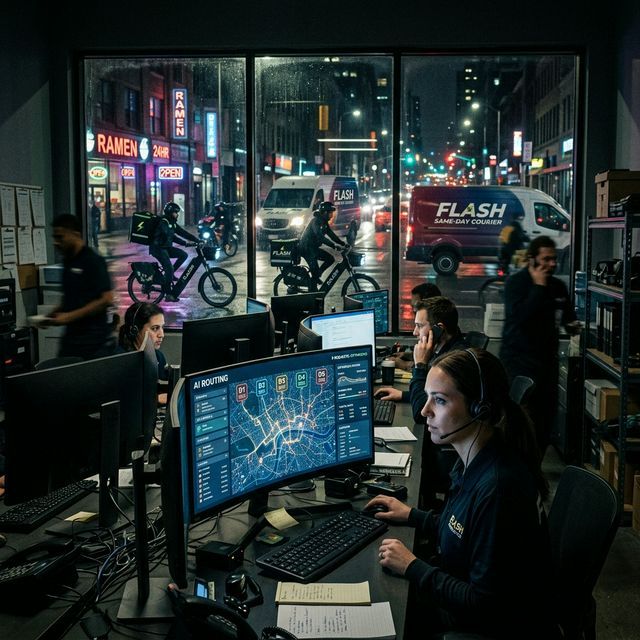

A same-day courier loses revenue when a delivery buyer needs an answer now and dispatch is stuck in phone tag. The fastest useful response often wins the delivery before price is even discussed.
Treat any number without a nearby source or stated method as a planning assumption, then replace it with your own records.
The independent, local same-day courier operates in the microscopic, chaotic grid measured in minutes. They exist entirely to catch the things the massive carriers drop, or the emergencies that materialize too late for the afternoon sorting hub.
A B2B same-day caller is never calling to ask if you can deliver something next Tuesday. They are calling because an operational failure, a sudden court deadline, or a medical crisis has created an immediate geographical problem that must be solved right now.
The entire business model hinges on Speed-to-Quote.When a paralegal or a hospital lab manager dials a courier, they have their company credit card sitting on the desk. They want to give someone that card. The first company to pick up the phone, calculate the mileage, quote the rush fee, and guarantee the delivery window gets the money.
If the call goes to voicemail, the deal is dead. If the dispatcher says, "Let me check with a driver and call you back in five minutes," the deal is dead. Five minutes is an eternity to someone staring at a 4:00 PM court filing deadline.
The Overloaded Dispatcher Paradox
The irony of a successful local courier business is that success actively destroys the intake process.
When a courier only has three drivers on the road, the dispatcher can easily answer the phone, quote a run, and text a driver.
But when a courier scales to fifteen drivers-moving medical specimens, legal documents, machine parts, and architectural blueprints simultaneously across a sprawling metropolitan grid-the dispatcher's brain becomes overwhelmed. The phone rings, but the dispatcher is busy on the other line trying to verbally guide Driver 4 into a confusing loading dock. The new caller gets placed on hold. The new caller hangs up. The revenue vanishes.
To scale beyond the dispatcher bottleneck, courier businesses historically had to hire multiple dispatchers. But dispatchers are expensive, and courier margins are notoriously tight. Paying three people $25 an hour just to sit in a room and stare at map software creates a massive fixed overhead that bleeds the company dry during slow routing periods.
The AI Routing Protocol
Voice AI destroys the dispatcher bottleneck by mathematically decoupling the "intake" phase from the "routing" phase.
When a panicked lab tech or paralegal calls a modernized courier firm, they are instantly greeted by an AI Intake Coordinator that already knows the exact GPS coordinates of every active driver in the fleet via API integration with the routing software (like Onfleet or OptimoRoute).
Here is what an AI-handled STAT medical run looks like:
**AI Intake:** "Thank you for calling Metro Fast Logistics. This is Alex. Do you need to track an existing delivery, or are you looking to book a new same-day run?"
**Caller:** "I need a new run. It's an emergency. I need to get a biopsy box from Northwestern Memorial to the North Shore lab in Skokie."
**AI Intake:** "I can absolutely handle that STAT medical run. Because it's medical, I want to confirm: is this a standard ambient temperature box, or does it require a refrigerated or dry-ice transport?"
**Caller:** "It's standard ambient, just a sealed biohazard bag in a locking box."
**AI Intake:** "Perfect. The distance from the downtown campus to the Skokie lab is 14 miles. With our current traffic routing, I can have a dedicated medical driver at the downtown loading dock within 20 minutes, and delivered to Skokie by 1:15 PM. The total for this STAT tier run is $145. Do you want me to lock in this driver right now?"
**Caller:** "Yes, absolutely, do it."
In sixty seconds, the AI captured the origin, destination, and specialized handling requirements. It calculated the mileage, checked standard traffic density, applied the STAT surcharge modifier to the base rate, and provided a binding timeline.
When the caller said "Yes," the AI pushed the GPS coordinates directly to the closest medical-certified driver's mobile device. The human dispatcher at the corporate office merely watched the icon on the map turn from "Available" to "In Transit." Zero human administrative friction.
The Weight and Dimensions Qualification System
The second biggest failure point in local logistics is the vehicle-capacity mismatch.
A customer calls and says they need "a box" delivered to a construction site. The human dispatcher books it and sends a driver in a Toyota Prius. The driver arrives and discovers the "box" is a 400-pound custom electrical transformer that requires a lift-gate box truck and a pallet jack. The driver wastes an hour driving to the pickup, only to cancel the run. The dispatcher then has to scramble to find a box truck, and the customer is furious about the delay.
Voice AI prevents this by aggressively anchoring the dimensional parameters during the very first phase of the conversation.
**AI Intake:** "To make sure I dispatch the correct vehicle, what are the rough dimensions and weight of the load? Is this something that can fit in the front seat of a sedan, or will we need a cargo van or box truck?"
**Caller:** "Oh, it's definitely a cargo van job. It's three pallets of printed marketing collateral. About 600 pounds total."
**AI Intake:** "Understood. Three pallets at 600 pounds. I am filtering our fleet for an available cargo van with a pallet jack right now."
By standardizing the data collection process, the AI prevents the single most costly error in the courier business: the dead-head routing of the wrong vehicle class to a pickup site. The profitability of a route is entirely dependent on vehicle utilization, and the AI ensures 100% accuracy before the tires ever move.
VIP Routing for Recurring B2B Accounts
The bedrock of a successful local courier is the recurring B2B account. The local print shop that sends out twenty boxes of flyers every Wednesday. The architecture firm that sends massive blueprint tubes to the permit office every morning.
These clients do not want to be treated like strangers. They do not want to spell out their corporate address every single time they call.
Voice AI systems use Caller ID database cross-referencing to instantly pull the account profile of VIP B2B clients before the AI even speaks its first word.
**AI Intake:** "Hi Sarah from Apex Architecture! Because you are calling from your corporate number, I have your downtown office set as the pickup location. Do you have a permit run for City Hall today, or a different destination?"
**Caller:** "Just the usual City Hall permit run today. Two tubes."
**AI Intake:** "Done. I have routed a driver to your 4th-floor reception desk. They will be there by 10 AM. We will bill the run to the corporate account on file. Have a great day, Sarah."
This interaction takes twenty seconds. It eliminates the billing friction. It reinforces the relationship. When the competitor's sales rep calls Sarah next week offering a 5% discount, she will reject them instantly, because the competitor's dispatch process is an unknown hassle, and she already has an AI assistant that handles her runs flawlessly in under thirty seconds.
The Chain of Custody Protocol
For high-liability courier work-specifically legal filings and medical specimens-the chain of custody is more important than the delivery itself. If a courier loses a $50 pair of shoes, the company buys new shoes. If a courier misplaces a biopsy sample or a wet-ink real estate closing document, the liability is catastrophic.
Customers shipping high-liability items are often highly anxious. They call the dispatch office not just to book, but to seek emotional reassurance that the company knows exactly what they are doing.
Voice AI is programmed to deploy specific reassurance language tracks when it detects keywords like "medical," "specimen," "court filing," or "legal document."
**AI Intake:** "Because this is a legal document, I want to assure you that this run is being assigned exclusively to one of our bonded, HIPAA-certified drivers. The document will not be handed off or transferred. You will receive a direct SMS tracking link the moment the driver takes possession, and a final SMS alert with the signature of the recipient the exact second it is delivered to the clerk. Your chain of custody will be completely documented."
This rigid, highly professional script eliminates customer panic. It establishes the courier firm not just as a "guy in a car," but as a highly sophisticated logistics operation. The customer happily pays the $150 rush fee because they are buying peace of mind, not just transportation.
Reclaiming the Night: The After-Hours Manufacturing Crisis
If you want to understand where courier companies charge the highest premiums, look at the manufacturing sector at 2:00 AM.
If a massive automotive parts factory has a CNC machine go down in the middle of the third shift, the entire assembly line halts. The factory is losing $10,000 an hour. They locate a replacement servo motor at a parts supplier two hours away. They need an emergency "hot shot" driver to run it immediately.
The problem? It's 2:00 AM on a Wednesday. The independent courier office closed at 6:00 PM.
With an AI Intake Coordinator, the local courier firm remains permanently open. The AI answers the desperate factory manager's 2:00 AM call, calculates the out-of-hours premium rate, and blasts an emergency push-notification to the courier's "on-call" driver pool.
The Weekend Crisis: Capturing High-Margin Runs
The most lucrative deliveries in the local logistics sector happen between 5:00 PM on Friday and 8:00 AM on Monday. During the standard business week, competition is fierce, and pricing is somewhat standardized. A cross-town envelope delivery on a Tuesday morning might carry a $35 base rate.
On a Sunday morning, the rules entirely change. There is virtually no competition because 90 percent of local courier offices lock their doors on Friday afternoon. Therefore, the pricing elasticity for a weekend delivery is massive. If a laboratory needs blood samples moved to a diagnostic center on a Sunday, they are not price shopping. They are simply trying to find a human being with a car who will answer the phone. That cross-town envelope run shifts from a $35 baseline to a $150 weekend hot-shot tariff.
The problem is capturing that demand without destroying the operational lifestyle of the business owner. A courier dispatcher cannot be expected to sit by the phone 24 hours a day, seven days a week, waiting for a Sunday morning 911 call from a hospital.
An AI Intake Coordinator solves the weekend crisis by maintaining the intake perimeter indefinitely. The AI is functionally immortal and never goes off the clock.
**AI Intake:** "Thank you for calling Metro Fast Logistics. Our standard office is closed for the weekend, but our on-call emergency drivers are active. Do you have a STAT or emergency delivery that needs routing immediately?"
**Caller:** "Yes, I have an oncology biopsy that has to be moved from the outpatient clinic to the main hospital lab right now."
**AI Intake:** "I am routing this as a weekend emergency medical hot-shot. The base rate for this off-hours run is $175. I am sending a priority push-notification to our three on-call medical drivers right now. As soon as a driver accepts the run, I will text you their ETA and live tracking link. Does that work for you?"
Because the AI is integrated directly with the driver mobile app ecosystem (like Onfleet or OptimoRoute), it acts as an automated triage sergeant. The business owner, who is at home having breakfast on a Sunday, doesn't even know the call occurred until they receive a notification an hour later that a $175 run was completed and the invoice was generated.
This capability fundamentally transforms the financial profile of an independent delivery company. By simply intercepting and routing the high-margin, high-urgency runs that every other courier drops to voicemail, the business generates a completely new layer of weekend revenue without turning the lights on at the main office.
The driver wakes up, accepts the $350 hot-shot run, and hits the road. The factory gets their part by 5:00 AM. The courier firm captures massive after-hours revenue with zero administrative overhead.
The local logistics game is won by the operator who removes all friction.When you force a frantic paralegal or an angry factory manager to navigate a phone tree or leave a voicemail, you are pushing money directly into the pockets of your competitors. When you deploy an AI Intake Coordinator, you build a frictionless, 24/7 capture net that guarantees every urgent need in your city is solved through your fleet.
The Operating Standard: ROI and Routing Confidence
When we evaluate the ROI of an intake system like the one described for Same-Day Couriers: How AI Dispatch Wins the Delivery Race While Competitors Play Phone Tag, we look beyond the immediate convenience of automation. We look at the 'Revenue Leak' that occurs in the silence between a prospect reaching out and a business responding. In this vertical, that silence is the biggest competitor you have.
Data Anchor: The average LTV of a client in this space is significantly higher than the cost of a missed intake opportunity. By resolving for 'concurrency': the ability to handle infinite leads simultaneously-The Quiet Protocol transforms a passive operation into an aggressive revenue engine.
The loss estimate is basic business math, not a magic claim.
Revenue-leak examples on this site are built from visible operating inputs: inquiry volume, missed-call or slow-response rate, booking rate, average job or client value, repeat value, and follow-up recovery. The fastest way to make the number real is to run the diagnostic for your closest business type, then compare it against your own call log, CRM, booking calendar, form timestamps, and review activity.
The practical questions behind this decision.
What proof should I look for in my own business?
Look for proof in the places where demand either moved forward or stalled: missed calls, short calls, unbooked forms, slow callbacks, no-show recovery, old leads, and reviews that were never requested. If the business cannot see those moments clearly, the first improvement is better tracking and routing.
How do I know whether this is a marketing problem or an operations problem?
If people are already calling, filling forms, asking for prices, requesting appointments, or comparing reviews, the problem is usually operations. More marketing will not fix a front door that lets warm demand wait. The better move is to capture and route the demand already arriving.
What should happen after the first response?
The first response should create a next step: booked appointment, estimate path, intake handoff, callback window, review request, or reactivation sequence. A response that only says someone will get back to you is not enough when the buyer is comparing several providers at once.
Where does The Quiet Protocol fit?
The Quiet Protocol fits when the business already has demand but too much of it depends on manual attention. We connect AI receptionist coverage, web intake, missed-call recovery, booking logic, follow-up, review requests, and reactivation into one managed front-door system.
Decide what the AI must handle before you choose the software.
A useful intake system begins with the caller journey, the rules, and the human handoff, not a long feature list.
Give the receptionist a realistic scenario and hear how it answers, gathers context, and moves the caller toward a useful next step.
See how the capability in this article fits into a complete customer journey.
Auto & Mobility ServicesSee the same decision through the language, buyer behavior, and operating reality of this industry.
Client Results & ProofInspect the starting condition, installation, measurement window, and outcome behind real client work.

Why Service Businesses Lose Inbound Leads Before the Phone Rings
It is not a traffic problem. Many service businesses lose revenue because the front door breaks before the buyer reaches a real conversation.
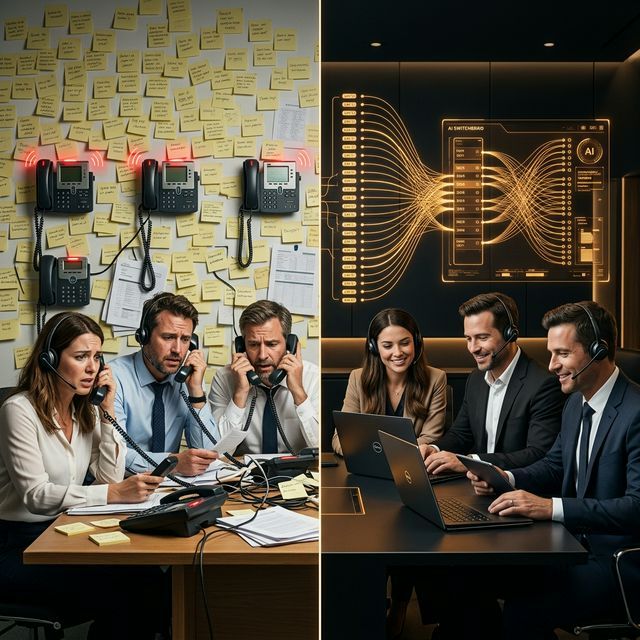
How 3-Person Service Businesses Handle 20-Person Call Volumes with AI
Small service teams lose revenue when call volume spikes beyond human capacity. Learn how voice AI helps answer, triage, book, and route calls without hiring a full front desk.
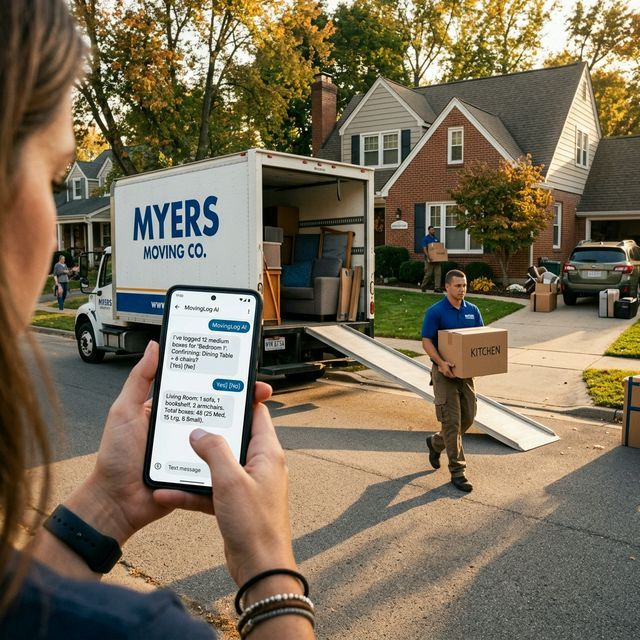
The Logistics of Leaving: How Moving Companies Are Using AI Intake to Secure High-Value Jobs
Moving day is universally ranked as one of the most stressful experiences in modern life. When a homeowner calls a moving company for an estimate, they are not just looking for a truck; they are looking for reassurance. But while customers demand empathy, moving company dispatchers are drowning in logistics, frantic truck schedules, and chaotic day-of-move changes. Here is how modern moving operators are using Voice AI to master intake, capture high-value leads instantly, and let their human teams focus on flawless execution.
Calculate the revenue leak.
Stop guessing. See how much demand your business may be losing through missed calls, slow replies, weak booking, review gaps, and follow-up drag, then decide whether Voice AI is the right system path.
Run the calculationPrefer to hear it first?
Call the live AI receptionist and test the conversation.
Call the live AI receptionist anytime. Tell it about auto & mobility services, then hear a short live roleplay based on the calls your front desk actually gets.