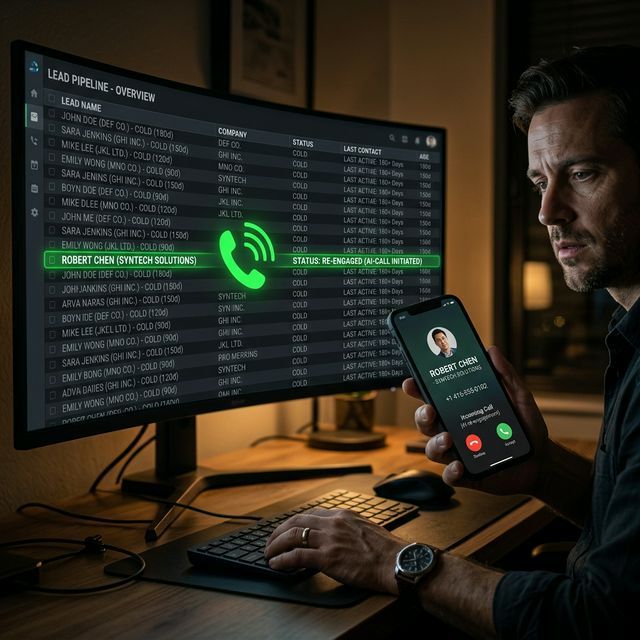

It is a practical way to sort old leads, contact them with context, and move the right ones back into a human sales or booking path.
Treat any number without a nearby source or stated method as a planning assumption, then replace it with your own records.
Most service businesses have money sitting quietly inside the CRM.
Not obvious money.
Not booked jobs.
Not active pipeline.
Almost-revenue.
The person who asked for a quote and never replied.
The past customer who meant to book again.
The homeowner who said, "Call me next month."
The clinic lead who wanted an appointment but did not pick a time.
The prospect who went cold after one missed callback.
The business usually calls these leads dead.
I do not like that word.
Many of them are not dead.
They are snoozed.
Nobody built a serious system to wake them up.
That is the Anti-Snooze Protocol.
It is not a blast.
It is not a desperate discount campaign.
It is a practical way to sort old leads, contact them with context, and move the right ones back into a human sales or booking path.
The CRM Is Usually Not The Problem
Owners often blame the CRM.
"Nobody uses it."
"The data is messy."
"The team forgets to follow up."
"Leads disappear in there."
Sometimes the CRM really is poorly configured.
But very often, the CRM is doing what it was asked to do.
It stores records.
It holds notes.
It keeps names, numbers, dates, and statuses.
The missing layer is action.
A database is not a profit engine by itself.
It only becomes useful when the business has a rhythm for deciding who should be contacted, when, why, and by whom.
Without that rhythm, the CRM becomes a museum of missed timing.
The owner can see the leads.
The team can see the leads.
Nobody has the time or confidence to revive them properly.
Why Manual Reactivation Fails
Manual reactivation sounds simple until someone has to do it.
Pull old leads.
Call them.
Send texts.
Update the CRM.
Book the ones who are interested.
That looks clean on a whiteboard.
Inside a real service business, it breaks quickly.
The best people are already busy with current customers.
The front desk is already answering new calls.
The owner is already overloaded.
Nobody wants to spend three hours calling people who may not remember the company.
Follow-up starts strong for one day, then stops.
The campaign becomes another unfinished project.
That is not because the team is lazy.
It is because stale-lead revival is repetitive, emotionally awkward, and operationally easy to postpone.
The work matters.
It just needs a better system.
Start With Segments, Not Scripts
The first mistake is treating every old lead the same.
A six-week-old estimate is different from a three-year-old contact.
A past customer is different from a never-booked prospect.
An emergency plumbing caller is different from a kitchen remodel inquiry.
A med spa lead who asked about Botox is different from someone who asked about a surgical consult.
The Anti-Snooze Protocol starts by segmenting the database.
Useful groups include:
- Unclosed estimates.
- Missed-call leads.
- No-show consultations.
- Past customers due for repeat service.
- Seasonal service reminders.
- Abandoned forms.
- Dormant high-value prospects.
- Old quote requests with no decision recorded.
- Leads marked "call later."
Each segment needs a different reason for contact.
The reason matters because it keeps the message from feeling random.
The best reactivation does not sound like:
"Just checking in."
It sounds like:
"You asked us about this specific thing, and there may still be a useful next step."
The Four Lead Buckets
Most databases become easier to work once the owner stops looking at one giant list.
There are usually four practical buckets.
The first bucket is still-warm leads.
These people contacted the business recently, maybe in the last 30 to 90 days, but never booked. They may have been missed, delayed, quoted, or left uncertain. This group deserves the fastest follow-up because the original problem may still exist.
The second bucket is seasonal leads.
These are past customers or prospects tied to a timing window. HVAC tune-ups, pest control, landscaping, tax prep, dental recall, med spa treatments, pool opening, roof inspections, and holiday cleaning all fit here. The follow-up reason is natural because the season gives the business a legitimate reason to call.
The third bucket is high-ticket unresolved leads.
These are estimates, consultations, and project inquiries that did not close. Some were lost. Some were postponed. Some were never properly followed up. This bucket should be handled carefully because a single revived project can justify the whole campaign.
The fourth bucket is database cleanup.
Wrong numbers, old records, duplicate contacts, people who moved, and people who are clearly not interested. This bucket is still useful because cleanup improves the CRM. A smaller accurate database is better than a larger one nobody trusts.
These buckets keep the Anti-Snooze Protocol sane.
They also help the team understand why each person is being contacted.
The reason for contact is what separates a respectful reactivation from a noisy campaign.
The Permission and Fit Check
Reactivation should be respectful.
Some leads should not be contacted.
Bad-fit inquiries.
Do-not-contact records.
People who opted out.
Sensitive situations where the timing would feel intrusive.
Records with unclear consent.
Duplicate or low-quality entries.
The protocol needs a cleaning step before any voice AI campaign starts.
Remove contacts that should not be touched.
Confirm the business has a reasonable basis to follow up.
Separate sensitive categories.
Decide which segments require human review first.
This is not bureaucracy.
It is what keeps automation from damaging trust.
The goal is not to call everyone.
The goal is to contact the right people with the right context.
What Voice AI Should Say
Voice AI should not sound like a robocall.
It should not pretend to be a human salesperson.
It should not pressure people.
It should make a simple, context-aware contact.
For example:
"Hi, this is calling on behalf of the team at [business]. You had asked about [service] a little while ago. I am checking whether this is still something you want help with, or whether we should close it out."
That question is powerful because it gives the buyer permission to answer honestly.
Still interested.
Not now.
Already hired someone.
Wrong timing.
Need a quote.
Want a callback.
Do not contact again.
Every answer is useful.
The business either reopens an opportunity or cleans the database.
Both outcomes are better than silent uncertainty.
A Simple Reactivation Sequence
The first version does not need to be complicated.
Step one: export or segment the target list.
Step two: remove bad-fit and no-contact records.
Step three: write the reason for contact by segment.
Step four: let voice AI make the first pass.
Step five: tag outcomes.
Step six: route interested contacts to a human or booking path.
Step seven: send a short confirmation text.
Step eight: update the CRM automatically.
The important part is outcome capture.
Every contacted lead should land in a clear state:
Interested now.
Interested later.
Not interested.
Already solved.
Wrong number.
Do not contact.
Needs human callback.
Booked.
That creates a clean database and a cleaner sales day.
The Revenue Math
Take a service business with 1,200 old leads in the CRM.
After cleaning, 700 are appropriate for a reactivation pass.
Voice AI reaches 300.
Sixty show some level of renewed interest.
Twenty book a consultation, estimate, or appointment.
If 10 become jobs worth $900 each, the campaign creates $9,000 from records the business had already paid to acquire.
That is conservative for many categories.
For remodeling, legal, cosmetic, dental, specialty clinic, or high-ticket home service leads, one revived opportunity can be worth far more.
The point is not that every database hides a fortune.
The point is that old leads have already cost the business money.
Ads paid for them.
SEO earned them.
Referrals created them.
Staff answered them.
The only question is whether the business has a serious second attempt.
Why Email Alone Is Usually Too Weak
Email can help.
Text can help.
But many stale leads need more than another message sitting unread.
Voice creates a different kind of signal.
It lets the buyer respond in plain language.
It can clarify intent.
It can capture objections.
It can identify wrong numbers.
It can route urgency.
It can book while the person is engaged.
That does not mean voice should be the only channel.
The best sequence often uses voice, text, and email together.
Voice asks the question.
Text confirms the next step.
Email provides details when useful.
CRM records the outcome.
That is a system.
A one-time email blast is not.
The Human Handoff
The handoff is where many reactivation campaigns fail.
The AI finds an interested lead.
The summary goes somewhere vague.
Nobody calls back quickly.
The revived opportunity goes cold again.
That is worse than doing nothing because it teaches the buyer that the business still cannot follow through.
Before launching the campaign, decide:
Who receives hot leads?
How fast should they call?
Which appointment types can be booked directly?
Which leads need senior review?
What should happen if the human misses the callback?
How many follow-up attempts are acceptable?
What notes must land in the CRM?
Reactivation only works if the business is ready for the leads it wakes up.
Otherwise, the Anti-Snooze Protocol becomes a re-snooze protocol.
What Not To Automate
Do not automate sensitive reactivation without review.
Do not call people who opted out.
Do not pressure past leads with fake urgency.
Do not pretend the business remembers details it does not have.
Do not invent discounts.
Do not over-contact people who clearly say no.
Do not let AI handle conversations that require licensed advice, clinical judgment, legal judgment, or complex pricing.
Good reactivation is controlled.
It respects the buyer.
It respects the database.
It respects the human team.
The goal is to surface intent, not force a sale.
A 30-Day Anti-Snooze Plan
Week one: audit the CRM.
Find the stale lead categories.
Remove bad records.
Choose one segment with clear commercial value.
Week two: write the contact reason, outcome tags, and handoff rules.
Do not start with the whole database.
Start with one clean segment.
Week three: run a controlled voice AI reactivation pass.
Limit the volume so the team can handle interested replies.
Week four: measure reach rate, interest rate, booked appointments, sales, opt-outs, wrong numbers, and staff workload.
Then decide whether to expand.
This keeps the project practical.
The owner gets evidence before scaling.
The team does not get buried.
The CRM becomes more useful whether or not every lead revives.
How The Team Should Use The Results
The campaign should not end with a spreadsheet.
It should change the next week of work.
Interested-now leads should appear in the team workflow with a clear owner.
Interested-later leads should receive a future reminder.
Already-solved leads should be closed with the competitor or outcome noted when known.
Wrong numbers should be cleaned.
Do-not-contact requests should be respected immediately.
Common objections should be reviewed.
If many old estimates say the price was too high, the business should review its estimate follow-up and value explanation.
If many leads say nobody called back, the business should review its first-response process.
If many people still want help, the business has proof that the database was underworked.
This is why reactivation is more than a short-term revenue play.
It shows the owner where the original intake system failed.
The stale CRM lead is often the symptom.
The cause is usually missed follow-up, unclear next steps, weak ownership, or a front door that depended too much on memory.
What A Good Summary Should Include
The AI call summary should be short enough to use and detailed enough to act on.
At minimum, it should include:
- Contact name.
- Original service or inquiry.
- Current interest level.
- Requested next step.
- Urgency.
- Any objection or hesitation.
- Best callback time.
- Whether a human follow-up is required.
- CRM status update.
The summary should not force the team to listen to every recording before acting.
That defeats the purpose.
A good summary lets a human open the record and understand the next move in under 30 seconds.
That is how old leads become workable again.
Bottom Line
Old CRM leads are not automatically dead.
Many are simply unworked, mistimed, or forgotten.
The business already paid to create those opportunities.
Letting them sit untouched is a quiet revenue leak.
The Anti-Snooze Protocol gives the database a second chance without asking the team to manually grind through hundreds of awkward calls.
Segment the records.
Clean the list.
Contact with context.
Capture the outcome.
Route the interested people fast.
Then let the CRM become a working revenue system instead of a storage cabinet for almost-revenue.
*If your CRM has old leads nobody wants to touch, start with a Revenue Leak Diagnostic of stale records. The next revenue win may already be in the database.*
Use your own records before you decide
Source: start with your call log, CRM notes, booking calendar, missed-call records, web form timestamps, and Google Business Profile. Those records show whether buyers reached you, how fast they heard back, what they asked for, and where the next step broke down.
For seven days, mark each missed call, late reply, unbooked form, stale estimate, and review request that never went out. That small sample gives an owner a practical picture of the front-door gap before they spend more on ads, software, or staff.
The loss estimate is basic business math, not a magic claim.
Revenue-leak examples on this site are built from visible operating inputs: inquiry volume, missed-call or slow-response rate, booking rate, average job or client value, repeat value, and follow-up recovery. The fastest way to make the number real is to run the diagnostic for your closest business type, then compare it against your own call log, CRM, booking calendar, form timestamps, and review activity.
The practical questions behind this decision.
Are old CRM leads worth calling?
Some are. The mistake is treating all old leads as equal. Segment the database first. Past customers, unclosed estimates, missed-call leads, and seasonal service reminders often deserve a structured follow-up attempt.
Is voice AI safe for lead reactivation?
It can be when the campaign is permission-aware, properly segmented, and connected to a clear human handoff. It should not contact opt-outs or sensitive records without review.
Why not just send an email campaign?
Email is useful, but it often produces weak feedback. Voice can capture intent, objections, wrong numbers, urgency, and appointment interest in a way a passive email cannot.
What should happen when someone is interested?
They should be routed immediately to the right next step: booking, human callback, estimate review, or consultation. The CRM should be updated with the outcome so the lead does not get lost again.
How many leads should we reactivate at once?
Start smaller than you think. A controlled segment is better than waking up hundreds of leads and then failing to respond. Match campaign volume to your team's ability to handle interested replies.
Decide what the AI must handle before you choose the software.
A useful intake system begins with the caller journey, the rules, and the human handoff, not a long feature list.
Give the receptionist a realistic scenario and hear how it answers, gathers context, and moves the caller toward a useful next step.
See how the capability in this article fits into a complete customer journey.
Legal, Financial & AdvisorySee the same decision through the language, buyer behavior, and operating reality of this industry.
Client Results & ProofInspect the starting condition, installation, measurement window, and outcome behind real client work.

Why Service Businesses Lose Inbound Leads Before the Phone Rings
It is not a traffic problem. Many service businesses lose revenue because the front door breaks before the buyer reaches a real conversation.

Founder Burnout: Automating Intake Before Your Operations Break
Founder burnout often starts when every new lead, callback, booking, and follow-up depends on the owner. Learn how intake automation protects revenue before operations break.

Stop Buying Local Service Leads: Fix Your Intake Infrastructure Before You Buy Another Ad
Bad lead quality is not always the problem. Many service businesses lose paid leads because callbacks are slow, after-hours intake is weak, and follow-up is inconsistent.
Calculate the revenue leak.
Stop guessing. See how much demand your business may be losing through missed calls, slow replies, weak booking, review gaps, and follow-up drag, then decide whether Voice AI is the right system path.
Run the calculationPrefer to hear it first?
Call the live AI receptionist and test the conversation.
Call the live AI receptionist anytime. Tell it about legal, financial & advisory, then hear a short live roleplay based on the calls your front desk actually gets.