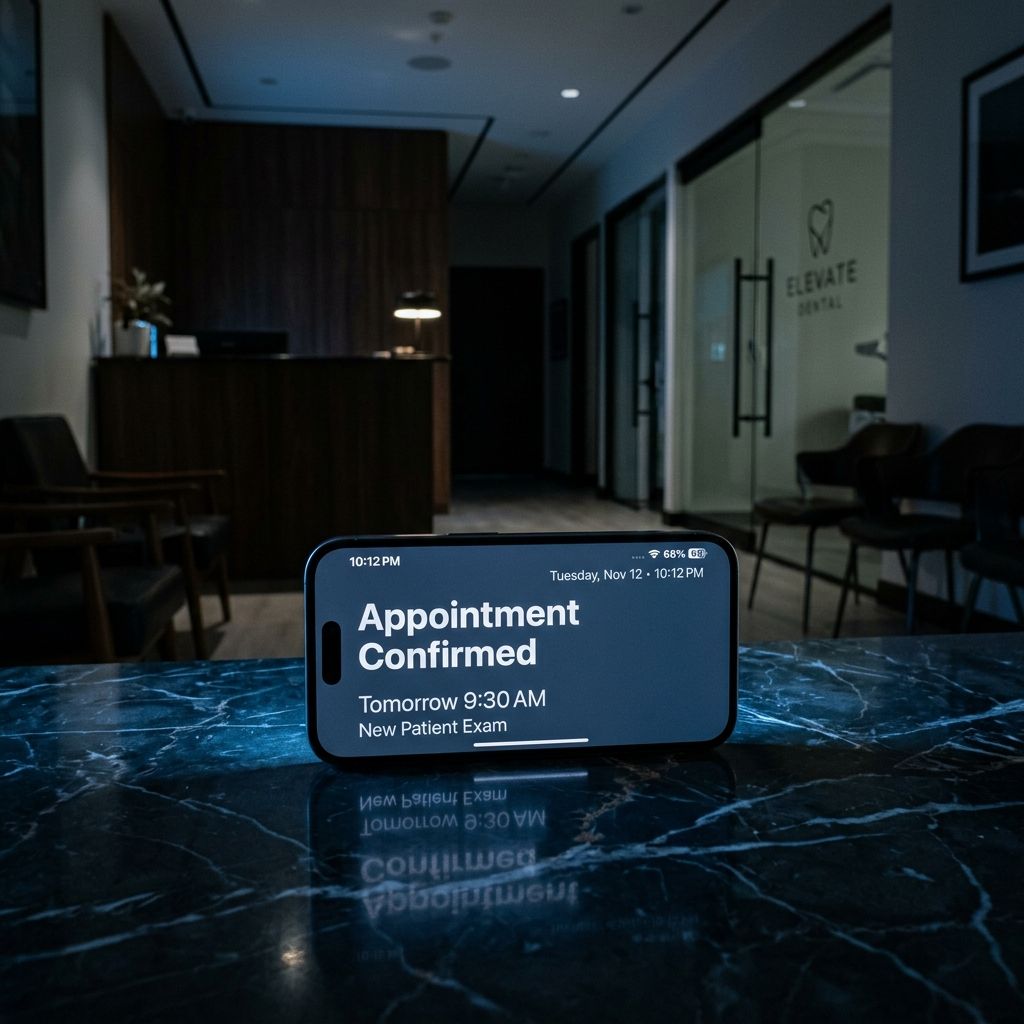
A person calling at night may want a routine new-patient exam, help with an existing appointment, guidance about a concern, or access to the practice's emergency process. Those situations may arrive through the same phone number, but they do not carry the same decision risk.
This article links to 4 external sources beside the claims they support.
A dental after-hours intake system should answer promptly, identify whether the caller is a new or existing patient, record the concern in the caller's own words, and assign a clear next step. Routine appointments may be booked under approved rules. Urgent, uncertain, or care-related decisions should move to a licensed dentist or the practice's documented emergency path.
After-hours dental intake is not one conversation
A person calling at night may want a routine new-patient exam, help with an existing appointment, guidance about a concern, or access to the practice's emergency process. Those situations may arrive through the same phone number, but they do not carry the same decision risk.
The goal is not to make every call sound automated. The goal is to help the caller reach an accurate next step without asking a receptionist, answering service, or AI system to make a care decision outside its authority.
A safe after-hours path separates administrative intake from professional judgment before the first script is written.
Define the practice's after-hours promise first
The practice should decide what it genuinely offers when the office is closed. A system cannot communicate a reliable promise until the dentists and operations team have defined one.
Questions the practice must answer
- Does the practice accept new-patient requests after hours?
- Which routine appointment types can be offered without staff review?
- What happens when an existing patient reports an urgent concern?
- Who owns the on-call or next-business-day review queue?
- What information can be collected through each supported channel?
- What should the caller hear if the system is uncertain or unavailable?
The American Dental Association's emergency-treatment guidance recommends a defined contingency plan, clear instructions for life-threatening emergencies, access information for patients of record, referral information for other callers, and staff training. Those operating decisions belong to the practice.
Separate four common inquiry paths
A useful system begins with a small number of understandable paths. It should not force the caller through a long questionnaire before revealing what the practice can do.
Routine new-patient request
Collect contact details, the caller's stated reason for reaching out, preferred timing, and only the administrative facts needed to offer an approved appointment. Confirm what was booked and what the patient should expect next.
Existing-patient administrative request
Identify the patient using the practice's approved process, record the request, and route it to the correct queue. Rescheduling, billing questions, record requests, and care concerns should not be treated as one interchangeable category.
Urgent or uncertain concern
Do not infer severity from a few phrases. Follow the practice's written emergency instructions, preserve the caller's own words, and send the request to the accountable clinical path. If the system cannot apply a permitted rule with confidence, it should stop and escalate.
Request outside the practice's service
Explain the boundary plainly. Use only referral or emergency information the practice has approved. Never invent availability, treatment capability, or a care recommendation to keep the conversation moving.
What an automated receptionist may do
A bounded receptionist can be valuable when the practice controls the information, booking rules, and exception paths. The work should remain administrative and observable.
- Answer with the practice's approved identity and disclosure.
- Distinguish a new patient, existing patient, and other caller.
- Collect contact information and the concern in the caller's own words.
- Explain published hours, locations, services, and routine process information.
- Offer an approved calendar when every eligibility rule is satisfied.
- Create a record, send a confirmation, and notify the accountable queue.
- Escalate uncertainty, urgency, sensitive questions, and system failure.
What should remain under professional control
The system should not make a diagnosis, recommend treatment, interpret symptoms, promise that a condition can wait, or decide that an urgent concern is routine. It should not present a booked slot as proof that the practice has accepted a patient for a particular treatment.
If the practice provides remote evaluation or care, that becomes more than administrative intake. The ADA Policy on Teledentistry places responsibility for information sufficiency, documentation, follow-up, patient rights, privacy, licensure, and quality with the dentist. Technology does not expand the permitted scope of practice.
Booking needs rules, not optimism
A calendar connection is useful only when the practice has decided which appointments may be booked, how much time they require, which provider or location can accept them, and what happens when information is incomplete.
A routine booking rule should specify
- The appointment type and duration.
- New-patient or existing-patient eligibility.
- Location, provider, age, service, and payer constraints where applicable.
- Whether the slot is confirmed, requested, or held for human review.
- The forms, instructions, and reminders that follow.
- The fallback when the calendar or messaging path fails.
A caller should never be left believing that an appointment is confirmed when the practice only received a request. The words used in the conversation and confirmation should match the actual calendar state.
Collect only what the next step requires
After-hours systems often collect too much because every possible field is available. That creates longer conversations, more abandonment, and more sensitive information to protect.
HHS guidance on the minimum necessary standard and role-based access explains that covered entities should make reasonable, purpose-specific decisions about the information and access needed for recurring activities. A dental practice should apply its own privacy, security, consent, retention, vendor, and access policies to the after-hours path.
A practical data question
For every field, ask: does this information change the permitted next step tonight, or can the trained team collect it later? The answer will differ between routine scheduling, an existing-patient concern, and remote care.
The record must be useful the next morning
A pleasant call that creates a vague message is still a failed handoff. The next person should see who contacted the practice, when they contacted it, whether they are new or existing, what they said, what the system did, what was promised, and who owns the next action.
Minimum handoff fields
- Caller identity and verified contact method.
- New-patient, existing-patient, or other status.
- Caller-stated reason for reaching out.
- Appointment offered, requested, or confirmed.
- Instructions or disclosures that were provided.
- Urgency or uncertainty flag without an automated clinical conclusion.
- Assigned queue, owner, timestamp, and fallback status.
The AI intake system buyer guide explains why the record, routing, ownership, and exception path matter as much as the conversation.
Human review needs a real operating queue
Saying that a person can take over is not an operating model. The practice needs a named role, a visible queue, an expected review window, a backup owner, and a way to record the final disposition.
NIST's AI Risk Management Framework Core emphasizes defined human and AI roles, documented scope, testing, evaluation, monitoring, and continuing management. For a dental practice, that means human review is part of the system design, not a disclaimer added after launch.
Test the awkward calls before the easy ones
A polished demo usually shows a cooperative caller asking a familiar question. Acceptance testing should focus on the situations that can create confusion or risk.
A dental after-hours test set
- Routine booking. A new patient requests an approved exam and accepts an available time.
- Incomplete information. The caller cannot answer a required administrative question or changes the request midway through the call.
- Urgent language. The caller describes a concern that must follow the practice's emergency instructions and human review path.
- Existing patient. The request concerns recent treatment, a prescription, billing, records, or an appointment change.
- Unavailable calendar. The booking destination fails or no approved slot exists.
- Privacy boundary. A family member requests information or attempts to act for a patient.
- Unclear caller. Background noise, an accent, an interruption, or contradictory answers reduce confidence.
- Unsupported request. The caller asks for a treatment, location, outcome promise, or recommendation the practice has not authorized.
Inspect the conversation, the patient-facing confirmation, the created record, the queue assignment, and the final human action. A call is not successful merely because it ended politely.
Measure the path with the practice's own records
There is no responsible universal percentage for how many dental inquiries arrive after hours or how many patients a system will recover. Practice size, location, services, payer mix, seasonality, call routing, current reputation, and scheduling capacity all change the result.
Start with operating measures
- After-hours inquiries by channel and caller type.
- Complete, incomplete, and abandoned intake.
- Appointments offered, requested, confirmed, changed, and attended.
- Urgent and uncertain requests reaching the accountable human path.
- Time from inquiry to human ownership where review is required.
- Failed confirmations, routing failures, corrections, and complaints.
- Information fields collected but not used in the next decision.
Financial analysis should come later by connecting accepted patients and completed treatment to collected revenue in the practice's own records. Do not convert every inquiry into hypothetical lifetime value.
Choose the smallest system that can represent the practice safely
Voicemail may be enough when
After-hours volume is low, the message clearly communicates the practice's emergency path, and the team reliably reviews and resolves every message. The practice should verify this with call logs and outcomes rather than assumption.
A basic AI receptionist may be enough when
The practice has one stable routine booking path, limited approved information, simple routing, low exception complexity, and a trained team that owns every care-related decision.
A custom intake agent may be needed when
The practice has several locations, providers, appointment types, services, payer rules, languages, existing-patient paths, urgent exceptions, or system integrations that change the next step.
A broader conversion system may be needed when
The leak continues after the first conversation through incomplete forms, no-shows, treatment-plan follow-up, recall, reviews, or an unclear website. The dental practice system overview shows how the website, intake, booking, reminders, reviews, and follow-up can work as one customer path.
What to ask a provider before launch
- Which conversations and decisions are explicitly in scope?
- Which situations always move to a licensed dentist or trained staff member?
- How are routine booking rules approved and changed?
- What patient information is collected, stored, transmitted, and accessed?
- What does the caller hear when the system is uncertain or unavailable?
- How are failures, corrections, complaints, and overrides reviewed?
- Who accepts the system after realistic testing?
- Which software, implementation, usage, and ongoing support costs are separate?
The AI receptionist scope comparison distinguishes a bounded starter path from a custom intake agent. The right choice depends on the decisions and handoffs the practice must represent, not the novelty of the voice.
Review the current investment guide to separate platform access, implementation, recurring system scope, and usage before comparing proposals.
A practical first step for a dental practice
Review two weeks of calls, forms, booking requests, after-hours messages, confirmations, and staff follow-up. Mark each inquiry by caller type, stated need, next step, owner, and final disposition. Pay special attention to messages that were vague, requests that needed several callbacks, and appointments the practice thought were confirmed but were not.
Then write the after-hours promise, routine booking rules, emergency language, data fields, human review path, and failure fallback. If the practice needs help turning that operating model into a configured system, book a Systems Review after the internal decisions are visible.
The practical questions behind this decision.
Can an AI receptionist book dental appointments after hours?
Yes, when the practice has approved the appointment type, eligibility rules, calendar, confirmation language, and fallback. The system should distinguish a confirmed appointment from a request and move exceptions to human review.
Should an AI system decide whether a dental concern is an emergency?
No. The practice should provide approved emergency instructions and a professional escalation path. The system may preserve the caller's words and apply permitted administrative rules, but care decisions should remain with a licensed dentist or the practice's documented emergency process.
What information should the system collect?
Collect the information needed for the permitted next step. Routine scheduling may need identity, contact details, caller status, stated reason, and appointment preferences. The practice should apply its own privacy, consent, security, retention, and role-based access policies.
Is after-hours intake the same as teledentistry?
Not necessarily. Administrative intake can collect information and arrange a next step. When a dentist evaluates the patient's condition or provides remote care, the practice enters a different professional and regulatory context with dentist responsibility, documentation, privacy, licensure, and follow-up obligations.
How should a practice judge whether the system is working?
Use the practice's records. Track inquiry disposition, completed intake, booking state, human ownership, urgent-path handoffs, failed routing, corrections, attendance, and patient complaints. Do not rely on a universal recovery rate or hypothetical patient lifetime value.
Decide what the AI must handle before you choose the software.
A useful intake system begins with the caller journey, the rules, and the human handoff, not a long feature list.

Vikram Roy is the founder of The Quiet Protocol, a Toronto-based systems firm serving service businesses across the Greater Toronto Area, Canada, and the United States. He works directly with professional firms, home service companies, dental practices, clinics, and local businesses to connect websites, customer intake, booking, reviews, follow-up, and practical AI into a clearer digital front door. All content is written from Toronto, Ontario. See the editorial method →
Give the receptionist a realistic scenario and hear how it answers, gathers context, and moves the caller toward a useful next step.
See how the capability in this article fits into a complete customer journey.
Dental PracticesSee the same decision through the language, buyer behavior, and operating reality of this industry.
Client Results & ProofInspect the starting condition, installation, measurement window, and outcome behind real client work.

AI Business Operating System: What the Label Should Mean Before You Buy
A plain-language buyer guide to the category label, the operating path underneath it, and the questions that separate useful systems from inflated software claims.

What a $497/Month Business Platform Includes, and What It Does Not
A practical buyer guide to platform access, launch configuration, usage charges, team-owned software, and the point where a custom system becomes a separate engagement.
Review Request Automation Without Review Gating: A Practical System
How eligible service businesses can request genuine reviews consistently, respond professionally, route service issues, and keep the workflow within clear policy and human-approval boundaries.
Calculate the revenue leak.
Stop guessing. See how much demand your business may be losing through missed calls, slow replies, weak booking, review gaps, and follow-up drag, then decide whether AI Receptionists & Intake Agents is the right system path.
Run the calculationPrefer to hear it first?
Call the live AI receptionist and test the conversation.
Call the live AI receptionist anytime. Tell it about dental practices, then hear a short live roleplay based on the calls your front desk actually gets.