Why Storm Season Is Won or Lost in the First 24 Hours
When a hailstorm moves through a suburban area of Dallas or a hurricane makes landfall in central Florida, every homeowner with roof damage makes three decisions within 48 hours. They call their insurance company. They look up roofing contractors on Google. And they call the ones that show up first.
The roofing company that answers those calls, qualifies the damage type, and schedules an inspection within hours of the storm event wins the jobs. The roofing company whose voicemail fills up by 9 AM and whose crew is too busy to call back loses them.
For most US roofing companies, storm season is both the highest-revenue period of the year and the period with the highest rate of missed revenue. The demand surge exceeds the team's capacity to respond. Every unanswered call during a peak 72-hour window is a potential $9,000 to $18,000 job that went to a competitor.
An AI operating system does not get overwhelmed by a storm event. It answers every call simultaneously, qualifies every inquiry, and schedules every inspection, regardless of whether 20 or 200 calls come in within the same hour.
The Roofing Lead Problem Is Different From Other Trades
Roofing has a specific lead dynamic that makes AI follow-up systems particularly valuable.
In most trades, a customer with a broken HVAC unit or a leaking pipe needs help now and will not wait days to hear back. Urgency drives conversion speed. In roofing, especially insurance-related work, the timeline is longer. A homeowner with hail damage files an insurance claim. They wait for an adjuster. They compare multiple estimates. They talk to neighbours. The sales cycle can run three to six weeks from first contact to signed contract.
This means the roofing lead does not die after 48 hours the way an HVAC lead does. But it does require consistent, intelligent follow-up over an extended period to stay competitive.
A homeowner who got estimates from three roofing companies in the first week after a storm will, by week three, have forgotten which company said what. The one that has been in contact every few days, providing relevant information about the insurance process and their specific proposal, is the one that stays top of mind when the adjuster approves the claim.
Without an automated follow-up system, most roofing company sales teams follow up once or twice and then let the lead go cold. An AI follow-up engine runs the sequence through day 45 without anyone having to manage it manually.
Layer 1: Storm Season Call Intake
The intake layer handles every inbound call during storm season and throughout the year, without volume limits.
When a homeowner calls to report storm damage, the AI answers within two seconds and qualifies the inquiry with five specific questions:
What type of damage is visible? Missing shingles, visible hail impacts, interior leaks, or other?
What is the address?
Is the homeowner filing an insurance claim or looking for a cash estimate?
How urgently does the damage need attention? Is there active leaking into the home?
When is the homeowner available for an inspection?
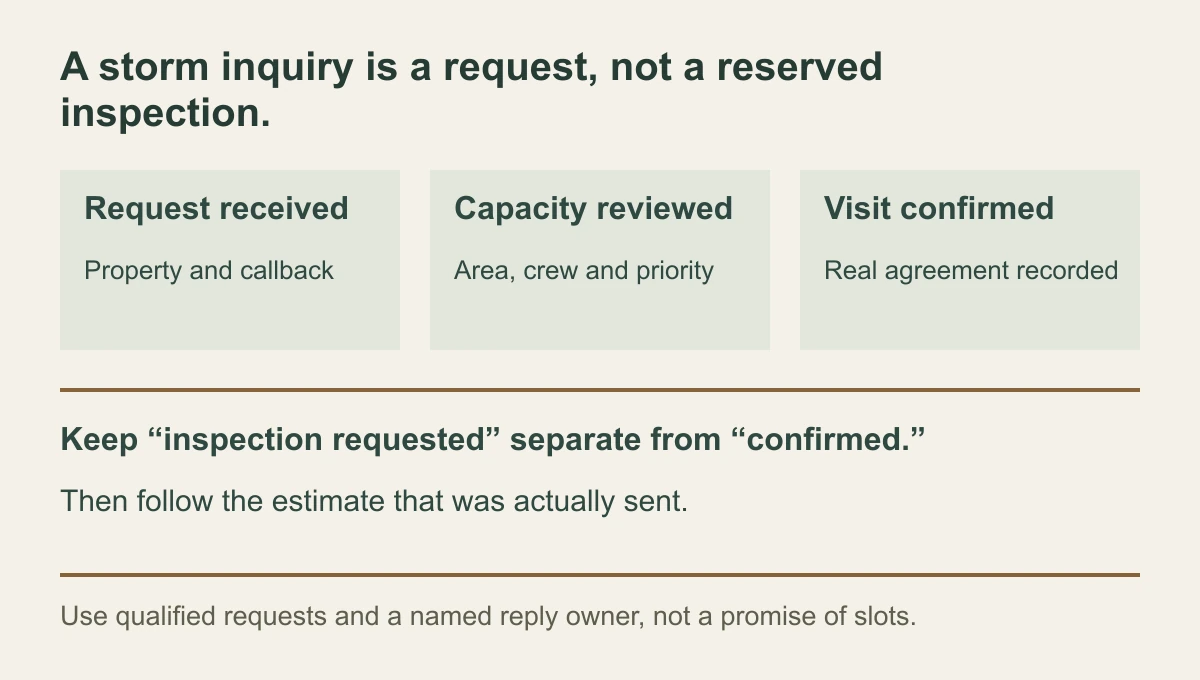
Based on the answers, the AI books the inspection into the field schedule, confirms the appointment with a text message, and flags emergency situations for immediate human escalation if interior water intrusion is present.
During a storm event when 40 to 80 calls might come in over 24 hours, this system ensures every call is answered and every inspection is scheduled. The roofing team arrives to work each day with a full inspection schedule that was built overnight by the system while they slept.
For non-storm inquiries, the same intake process qualifies re-roofs, commercial jobs, gutter repairs, and skylight work, routing each to the appropriate team member or scheduling queue.
Layer 2: The Extended Follow-Up Sequence
The roofing follow-up sequence is longer and differently paced than other trades because the insurance claims process creates a natural extended timeline.
Touch 1 at 15 minutes: Sent immediately after the estimate is delivered. A message confirming the estimate details and providing the next steps for the insurance claim process.
Touch 2 at day 2: A check-in asking whether the homeowner has heard from their adjuster and offering to answer any questions about the claim or the estimate.
Touch 3 at day 5: A value-add message about the claims process specifically. For markets with high hail frequency like Texas and Colorado, this might reference the typical adjuster timeline in the region. It positions the roofing company as a knowledgeable resource, not just a vendor.
Touch 4 at day 10: A direct inquiry about the claim status and an offer to join the adjuster meeting if the homeowner would like a professional present.
Touch 5 at day 21: A follow-up in case the claim has been approved and the homeowner is ready to schedule.
Touch 6 at day 45: A final check-in that acknowledges the process takes time and keeps the company present for when the homeowner is ready to move forward.
This six-touch sequence, run automatically, converts 22 to 28 percent of estimates that had otherwise gone cold into signed contracts. For a roofing company sending 30 estimates per month during storm season, that is six to eight additional jobs per month from leads that the sales team had stopped working.
Layer 3: Insurance Claim Support Automation
Roofing jobs involving insurance claims have a specific communication need that most roofing companies handle poorly: keeping the homeowner informed and engaged during the weeks between the estimate and the adjuster approval.
When a homeowner does not hear from the roofing company for three weeks after the estimate is submitted, they start looking at competitors again. They are not avoiding the original company. They have simply moved on in their attention while waiting for the process to resolve.
The insurance claim support sequence sends periodic updates to homeowners with open claims. Week one: a message confirming the claim has been submitted and providing the expected timeline. Week two: a check-in asking about adjuster contact and offering assistance. Week three: an update message with relevant information about the claims process in their state.
These messages are not sales messages. They are service messages. They keep the roofing company present in the homeowner's experience throughout the claims process. When the adjuster approves the claim and the homeowner is ready to sign, the company that was in contact throughout the process wins the job.
TCPA Compliance for Roofing Lead Follow-Up
Roofing companies using automated text sequences for follow-up and storm-season lead management need to handle TCPA compliance correctly.
The key requirement is consent. For homeowners who called the roofing company or submitted a web form, implied consent for follow-up messages typically applies. For outbound reactivation campaigns to past clients or neighbourhood prospecting lists, express written consent must be documented.
Colorado, Texas, Florida, and Georgia, the four highest-storm-frequency markets for US roofing, all have active TCPA enforcement environments. A roofing company sending automated texts to homeowners in these states without documented consent is creating real legal exposure.
The consent architecture for a roofing company should capture consent at three points: the initial inquiry or estimate request, the signed estimate document, and any outbound campaign list. Each consent record should include the date, the mechanism, and the specific type of communication consented to.
Any AI vendor serving US roofing companies should be able to explain this architecture clearly and demonstrate how consent records are stored.
Roofing-Specific Review Strategy
Google reviews are the primary decision factor for homeowners comparing roofing companies on Google Maps. In most US markets, the top-three roofing companies in the local map pack have review counts in the 80 to 200 range. A company with 28 reviews is invisible in most storm-season search scenarios.
The challenge for roofing companies is timing. A homeowner whose roof is being replaced is in a project mindset during the job and not thinking about reviews. The right moment to ask for a review is within 24 to 48 hours of final inspection, when the project is complete, the homeowner can see the finished work, and the relief of having the problem resolved is fresh.
The reputation layer sends a review request at this exact moment. A short text with the homeowner's name, a reference to the project completion, and a single tap to the Google review form. A second message 48 hours later for non-respondents.
Roofing companies completing 20 to 40 jobs per month, at a 7 to 12 percent review conversion rate, accumulate two to five new reviews per month. Over 12 months, a company at 30 reviews reaches 54 to 90 reviews, moving from map pack invisibility to map pack contention in most US markets.
The Insurance Adjuster Meeting Strategy
One feature of the AI operating system that is specific to insurance roofing work is the adjuster meeting offer.
Homeowners with storm damage often do not know that they can request that a roofing professional attend the adjuster meeting on their behalf. When a roofing company offers this through the follow-up sequence and the homeowner accepts, the company representative can point out damage that adjusters miss, advocate for full replacement versus repair in appropriate cases, and build a relationship with the homeowner during the most high-stakes moment of the decision process.
The AI follow-up sequence includes a message at day 10 specifically offering this service. The conversion rate on this message, when the homeowner is still in the middle of the claims process, is consistently higher than any other touchpoint in the sequence. And the close rate from an adjuster meeting where the roofing company is present is significantly higher than from a cold follow-up call.
The Revenue Math for US Roofing Markets
The storm season revenue recovery numbers for roofing are among the largest of any service business vertical because both the job values and the missed call volumes are high.
For a Texas hail market roofing company missing 22 calls during a major storm week, at a 40 percent booking rate and $12,500 average job value, the recovery from three major storm events per year is approximately $330,000 annually.
For a Florida hurricane-market roofing company missing 16 calls per peak week across eight peak weeks per year, at a 38 percent booking rate and $10,500 average job, the annual recovery is approximately $508,800.
For a Georgia storm-market roofing company missing 14 calls per storm event across four events per year, at a 35 percent booking rate and $11,200 average job, the annual recovery is approximately $219,520.
These figures represent only the intake recovery layer. The follow-up sequence adds 20 to 35 percent on top as dead estimates are recovered through systematic six-touch outreach.
At an AI operating system cost of $2,000 to $3,500 per month, a single recovered storm-season job typically covers the cost for an entire month. Every additional recovery is pure margin.
What to Look for in an AI Vendor for Roofing
Not every AI vendor understands the roofing business well enough to configure a system that works for it. Before engaging any vendor, a US roofing company should ask:
One: How does the system handle simultaneous call volume during a storm event? What is the call capacity ceiling?
Two: Does the follow-up sequence understand the insurance claims timeline? Show me the sequence specifically.
Three: How is TCPA consent captured at first contact and at estimate signing?
Four: How does the system handle adjuster meetings and insurance supplemental claims in the follow-up flow?
Five: Show me a live example from a current roofing client in a comparable storm market.
Any vendor that cannot answer five for five is not ready to serve a storm-season roofing business.
The Quiet Protocol
What You Actually Get When You Work With The Quiet Protocol
When a business partners with The Quiet Protocol, we install a connected AI operating system across five layers of their operation. Here is what that looks like in plain terms.
Every call gets answered. An AI voice receptionist picks up every phone call within two seconds, 24 hours a day, seven days a week. It greets the caller as your business, asks the right qualifying questions, and either books the appointment directly into your calendar or routes urgencies to the right person. No more voicemail. No more lost leads after hours.
Every inquiry gets followed up. Whether someone calls, submits a web form, sends an Instagram DM, or emails your general address, the system responds within 60 seconds and starts a structured follow-up sequence if they do not convert immediately. The sequence runs automatically for days or weeks without anyone on your team having to remember to send a message.
Dormant contacts come back. Every business has a database of past clients, lapsed patients, or cold leads that cost money to generate and then went quiet. The system runs re-engagement campaigns to these contacts on a schedule you approve, bringing back people who already trust you without any new ad spend.
Your Google review count climbs every month. The system sends a review request to every client at the right moment after they interact with your business. Not a mass blast. A personal, timed message that earns two to five times more reviews per month than manual requests do. More reviews mean a higher Google Maps position, which means more organic new business.
You see everything in one dashboard. Every call answered, every follow-up sent, every booking made, every review collected. The intelligence layer shows you what is working and where the system is recovering revenue you would otherwise have missed.
The businesses that install this system typically see a measurable improvement in new client capture within the first 30 days and a meaningful increase in organic Google traffic within 90 days as their review profile builds.
There are no long-term lock-in contracts. The system is configured for your specific business, your specific market, and your specific compliance environment. And every implementation starts with a Front Door Audit, a 30-minute diagnostic that quantifies exactly how much revenue your current setup is leaving behind.
The Quiet Protocol is a Toronto-based AI automation agency serving your roofing company and other service businesses across the Greater Toronto Area, Ontario, Canada, and the United States. Every engagement starts with a [Front Door Audit](/book/audit) that identifies exactly how much revenue your current intake and follow-up setup is leaving behind. The audit is free. The math is specific to your business.
[Book your Front Door Audit](/book/audit) | [See how it works](/services) | [Read client results](/results)
Related reading: [AI for HVAC Companies in the United States](/blog/ai-for-hvac-companies-united-states-full-operating-system-2026) | [AI Follow-Up System for US Service Businesses](/blog/ai-follow-up-system-us-service-businesses-stop-losing-leads) | [Results](/results)
Vikram Roy is the Founder of The Quiet Protocol, a Toronto-based AI systems firm serving service businesses across the Greater Toronto Area, Canada, and the United States. He works directly with home service companies, dental practices, clinics, and local businesses to install AI operating systems that capture more leads, reduce no-shows, and grow revenue. All content is written from Toronto, Ontario. Connect on LinkedIn →
See the system page tied most closely to the problem this article is diagnosing.
IndustriesOpen the industry path where this revenue leak is framed in operational terms.
Run the Rage CalculatorQuantify the leak before you decide what type of system needs to be installed.
Call the AI Receptionist DemoHear the receptionist live, give it your business context, and test a short caller roleplay before you book.
Results & ProofReview what the system changes once the front door is rebuilt around response and continuity.
Calculate Your Revenue Leak.
Stop guessing. See the revenue your firm is bleeding through its front door and where the operational drag is coming from, then decide whether Voice AI is the right system path.
Run the CalculationPrefer to hear it first?
Call the AI receptionist demo and test the conversation live.
Call the AI receptionist demo anytime. Tell it about industries, then hear a short live roleplay based on the calls your front desk actually gets.