
Do I need a website for my business if I already have a Google Business Profile? Yes. The profile gets you found; a website on your own domain gets you chosen. It has room to explain the service, establish trust and connect the inquiry or booking to the way your team works.
The Quiet Protocol’s Essential Website is a clear starting point: $99/month, free setup for up to ten professionally designed essential pages, with your supplied information shaped into copy, suitable images, a contact form, hosting and SSL. You do not need to commission a huge site to give the customer a better explanation.
For the local information that introduces the business, I recommend annual Get Found: US$990 prepaid for twelve months for one location, including one-time Google Business Profile optimization. The profile and supported listings help customers find the right business; the website helps them decide what to ask it for.
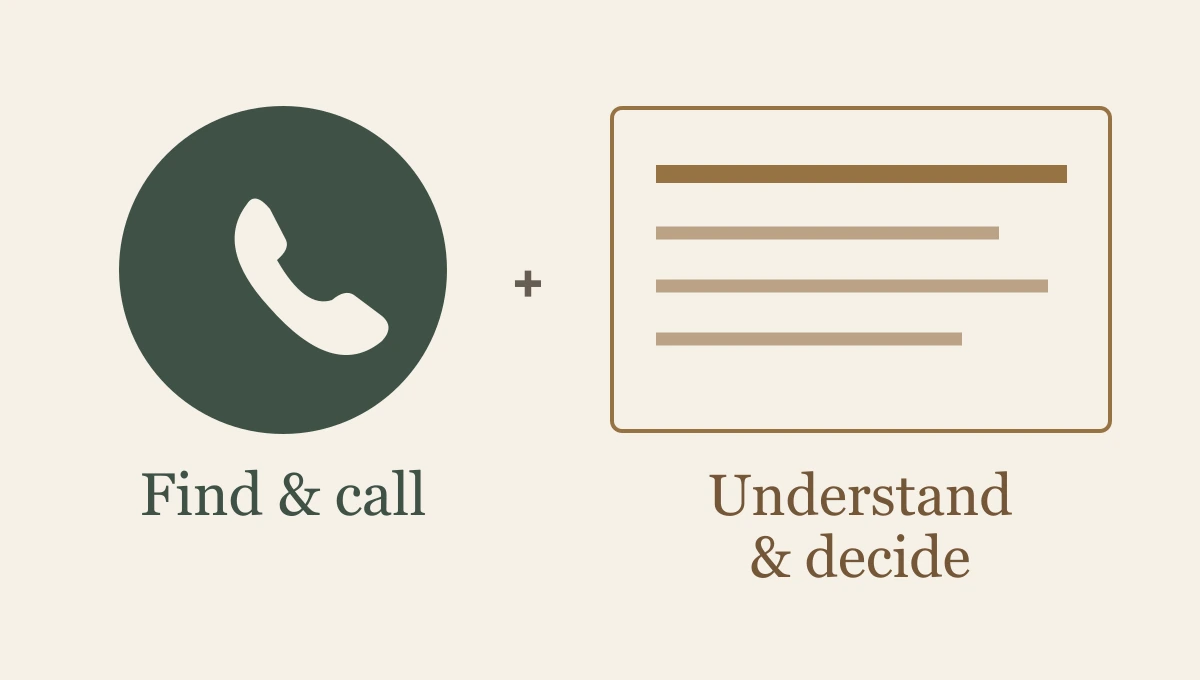
A profile can get someone to the door
For an eligible business, Google Business Profile is a no-cost way to manage how it appears on Google Search and Maps. It can show important business details and help customers contact you. Google also allows a website link; some categories and regions can have additional appointment or ordering links. Google Business Profile introduction, profile editing guidance
A person looking for a nearby, open business may get enough information there to call. You do not need to force that person through another page just because you have paid for one.
Keep the easy route easy. Check your actual details, hours, contact number and applicable service area. The phone still needs a person or a defined handling path at the other end.
Now consider a fictional homeowner comparing two firms for a substantial renovation. Their questions may go further: what projects does each firm take, how does an estimate work, what evidence can they see, and what happens before anyone commits to the work? A short profile description is not always the best place to explain that decision.
Where does the customer get the answer?
A planning aid. Check the capabilities actually available for your category and region.
- “Are you nearby and how do I call?”
- Accurate profile details may answer the immediate question. The website can repeat essential contact information consistently.
- “Do you handle a job like mine?”
- A specific service page can explain fit, exclusions and the relevant service area in more depth.
- “Why should I trust you with it?”
- Publish genuine, permitted evidence and explain the working process beside the claim. A large site is not proof.
- “What happens if I contact you?”
- Explain the estimate, inquiry or booking path. Make the promise match what the office can do.
- “Where do I send someone this explanation?”
- A useful page on your own business domain gives staff and customers a stable place to share the answer.
| Google Business Profile | Your website | |
|---|---|---|
| Main job | Help nearby people find and contact you | Explain the work, build trust and take the inquiry |
| You control | Hours, photos, services, posts, replies | Everything: words, pages, forms, booking, pricing context |
| Limits | Short descriptions, Google decides layout and eligibility | Only what you build and look after |
| If it disappears | Customers can lose their easiest route to you | You still own the address and the content |
| Best use | The first impression and the tap-to-call | The decision, and the follow-up |
A website gives you room to explain the work
The site can hold a proper service explanation, original photographs you can publish, relevant qualifications, practical boundaries and a contact path suited to the inquiry. You choose the pages and their arrangement. That is a worthwhile job even when the visitor first found you through a profile.
Write the page the phone conversation keeps needing. If staff repeatedly explain that you repair one type of equipment but do not service another, make that distinction clear. If callers assume an estimate is already a confirmed job, explain the stages. You will still get questions. The site should give useful answers, rather than merely create another surface to maintain.
Google's SEO Starter Guide recommends content and organisation that people can understand. A website can also provide pages for search engines to discover; the search engines decide placement. Google SEO Starter Guide
When the service decision needs more than a clear brochure, choose our Smart Website packages. Priced from $2,395 setup + $197/month, we work on the positioning and conversion copy, create the custom design and connect the agreed inquiry or booking path. The customer can move from understanding the service to taking a useful next step, with a record the team can continue.
You may need fewer pages than an agency suggests
For a simple owner-operated service, a clear home page, enough service detail to establish fit, genuine evidence and a working contact route may be sufficient. Some of that can live together. There is no mandatory page count.
Do more when the questions actually differ: several services, substantial decisions, different inquiry routes or important information that needs its own page. Add pages for different decisions, not every possible keyword spelling.
If the site only repeats the profile's name, hours and phone number, it may still serve as a useful basic business presence. Be honest about the scope and budget. Do not promise an authority site while delivering a second business card.
A profile is not available to every business
Google's eligibility rules generally require in-person contact with customers during stated hours, with specified exceptions. Online-only businesses are among the ineligible examples. A website does not make an otherwise ineligible business qualify. Service-area and storefront businesses also have representation rules to follow. Google eligibility guidelines, business representation guidelines
Likewise, a business website is not a universal requirement for every eligible profile. Google's representation rules allow a location phone number or a website representing the location. The case for a site should come from the customer and the business, not an invented platform requirement. Google's website and phone guidance
Keep both assets under accountable business control. Know which business account manages the profile and which account controls the domain, hosting and site. Keep details consistent and give each asset a maintainable job.
Give the profile somewhere worthwhile to point. Bring us the questions callers keep asking, the evidence you can publish and the next step you want the customer to take.
I recommend Essential for a clear professional presence, and a Smart Website when you need the deeper explanation and connected customer path. Let us make the business easier to understand and choose, while Get Found keeps its local details current.
Frequently asked questions
Does a business need a website if it has a Google Business Profile?
A profile helps with discovery and basic information. A website gives the business room to explain services, people and the next decision, using an address and content it controls. Many firms need both parts to make the inquiry useful.
Does a small business need a large website?
No. It needs enough useful pages to explain the work and help the right visitor act. A smaller, clear site with a dependable contact route is a sounder foundation than a large collection of repetitive pages.
What is the practical TQP starting point?
The Essential Website provides a done-for-you website foundation; Get Found maintains the supported local identity. Add a connected Smart Website or intake system when the next customer step requires booking, qualification or follow-up.
Start with an Essential Website for the service answers and proof your profile cannot explain in depth. Choose Smart when those answers need to lead into a connected inquiry or booking.
Give customers the website your profile points toward