
Your contact form conversion rate says how many visits became a submitted inquiry. It says nothing about whether anyone gave that customer a useful reply. A successful form can still leave your next customer waiting, so review submission and follow-up together.
The form works. The notification arrives. The website records a conversion. Meanwhile, the person who asked for help has received “Thanks, we'll be in touch.” Nobody can quite say who “we” is today.
That is an unfinished reply, even if every technical test is green.
At The Quiet Protocol, we build Smart Websites around finishing that handoff. Priced from $2,395 setup + $197/month, the work combines custom design and conversion copy with a defined inquiry or booking path. Your visitor's request has a destination, its context stays useful and the team knows what happens next.
I would trace one inquiry before commissioning another landing page. Then give us the missing connection to configure and test. The question is simple: did the business continue the conversation the website started?
Receipt is useful. It is only the first part
A receipt tells someone their message arrived. A useful reply tells them what happens next, based on what they asked.
Consider a fictional bookkeeping firm. A visitor says their records are behind and asks whether the firm can help before a deadline. A receipt can confirm that the request reached the office. A useful reply might explain that the catch-up team must review the dates and volume, ask for one missing detail and offer an appropriate consultation. It should not promise that the work will be completed before anyone has reviewed it.
Confirm what actually happened. W3C recommends clear success and error notifications. “Submitted successfully” is feedback about the form. It does not mean the firm accepted the engagement, a technician is dispatched or an appointment is confirmed. W3C form notifications
Two messages with different jobs
Illustrative copy for a fictional office. Use a review window only if your team can keep it.
- Receipt after submission
- “Your catch-up bookkeeping request reached our office. It has not yet been reviewed. Our team reviews these requests during business hours. If you need immediate help, use the contact route listed below.”
- Useful reply after review
- “You mentioned a deadline and several months of records. Before we suggest a next step, which months need catching up? Reply with that detail and our catch-up coordinator will review the request.”
- Staff record
- Request, deadline stated by the visitor, assigned coordinator, last reply and remaining question stay together. The receipt does not close the inquiry.
The exact messages depend on the service. An estimate request, an existing customer's question and a professional-review inquiry should not all receive the same promise.
Our implementation makes those differences practical. We define the approved questions, confirmation, receiving record and appropriate inquiry or booking route. The supplied platform connects customer records, inbox and standard calendar/reminder paths. The business gets a coherent beginning to the conversation, rather than several unrelated notifications.
Follow the message with the person who normally handles it
Submit an unmistakably labelled test inquiry using information the team has agreed to use. Do it from a phone. Include an ordinary service request and a detail the recipient will need later. Avoid real sensitive information.
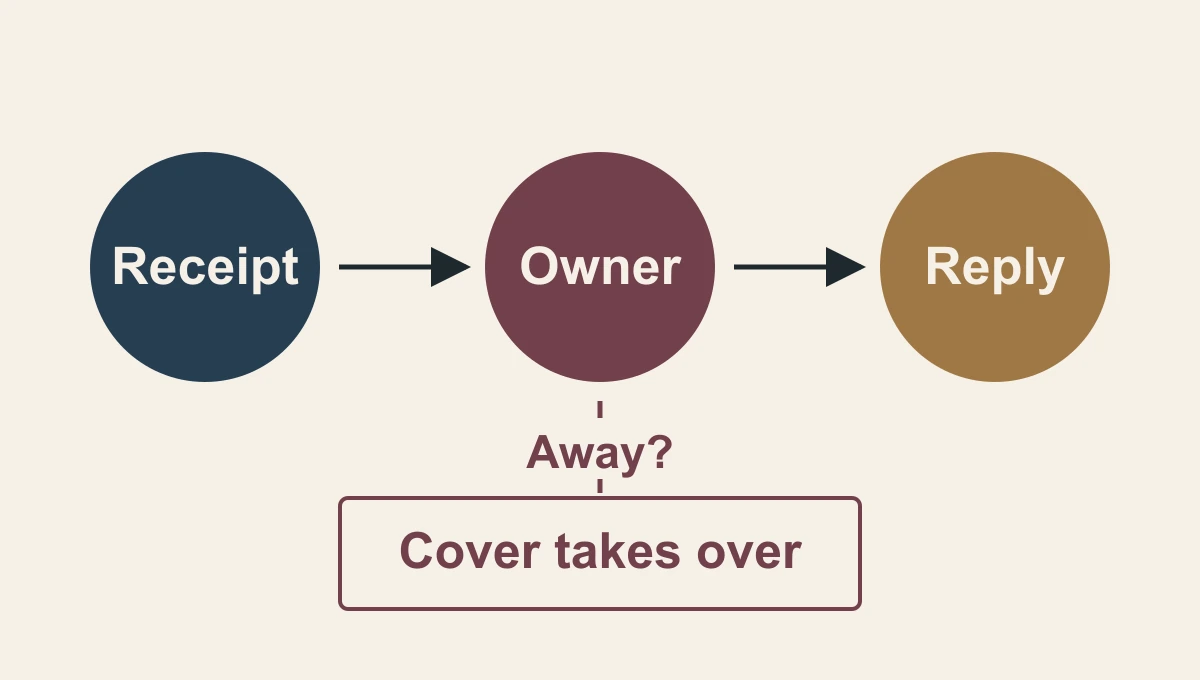
Then ask the responsible person to show you where it arrived. Can they see the service, the visitor's contact preference and the original detail? Can they reply without copying it into another place? If they are absent, who sees the waiting request?
Assign the reply, not just the notification. Software can tell several people that a form arrived. It cannot make them agree who is doing the work unless the setup and team routine establish that responsibility. Wix's own documentation separates notification recipients, inbox permissions and reply-to configuration. Even an included feature needs those choices made. Wix form notifications
Look at a week of inquiries as well as the tidy test
A demonstration usually follows the happy path. Ordinary messages are more interesting.
Take a representative week of valid inquiries, or a longer period if you receive few. This is a suggested review window, not an industry benchmark. Record arrival time, request type, first useful reply, responsible person and what happened next. Separate spam using a stated rule, so legitimate requests do not disappear because they were awkward.
Look for after-hours messages, duplicates, wrong-service requests and replies that ask the visitor to repeat what they already submitted. Count movement toward the next step, as well as notifications. A faster receipt is an improvement in acknowledgment; it is not evidence that more people received help.
Use those records to choose an honest response promise by inquiry type. Urgent work needs a route that can actually provide urgent help. A routine consultation can have a different review window.
When several teams, exceptions and follow-up stages need continuing attention, I recommend our Signature Systems. Priced from $995/month, setup from $5,000, with AI included and usage billed separately, we build, operate, monitor, repair and improve the named customer journey. The written scope gives each handoff continuing responsibility. That is a different purchase from standard website and platform care, and a worthwhile one when you are still carrying the whole process personally.
Keep the first form proportionate
Ask what the next decision requires. A service choice, location, preferred contact method and short description may be enough. A detailed application or estimate can reasonably need more. Explain the fields, show correctable errors and confirm the real next step. W3C advises asking only for information required by the process. W3C forms tutorial
After hours, a receipt may explain when requests are reviewed and offer a genuine future booking route. Do not imply the office is available when it is not. If an automated assistant gathers context, give it approved questions, defined escalation and a human owner for exceptions. It should not improvise advice, acceptance or availability.
Bring us the inquiry that disappeared into the gap: what the customer asked, what the receipt said and where the team lost the next step. We can turn that into a defined implementation.
Choose a Smart Website to connect the service explanation with the right inquiry or booking route. Choose a managed Signature System when the wider response journey needs us to keep it running. Buy a path your team can continue, so you can stop being the person who remembers every unanswered message.
Frequently asked questions
What should happen after a website contact form is submitted?
The customer should receive a truthful acknowledgment, and a named person should get a usable record with the next action. Receipt of a message is different from review, response or a confirmed appointment.
How can I test form follow-up?
Submit an approved test request from outside the team, then inspect the receiving record and the response. Check a representative period of real inquiries too; one successful test does not establish routine performance.
Why use TQP for the form and receiving system together?
We connect what the page promises to the questions, record, staff responsibility and follow-up. The visitor does not have to guess what happened, and you do not have to chase a submission through several inboxes.
A Smart Website joins the service page, inquiry record and defined next step. For a larger journey needing continuing operation, ask us about a managed Signature System.
Connect the form to a reply your team can carry