
Local citations get sold as a ranking trick. For a service business they are plainer than that: places where a customer can find your name, number and hours. They are worth paying for when they are accurate and useful, and not as a bulk order of sites nobody visits.
If you want that work handled, I recommend our Get Found annual plan. We establish the business identity, distribute and synchronize it across supported listings, review information and duplicates, and keep the agreed details maintained. US$990 prepaid covers twelve months for one location, with no setup fee and one-time Google Business Profile optimization included. Pay for being accurately represented where customers look.
A local citation is an online mention or listing of the business and its identifying information, commonly its name, address and phone number. Some listings also offer a website, hours, services, reviews or a direct contact route.
Those public references connect the business to places customers already use. Where a publisher displays your website link, the directory also provides a backlink and another route to your official site. Publishers control whether the link appears and how it is marked. The value is a clearer business identity and a usable customer route, rather than a promised number of links.
Listings are part of being findable. A customer may begin in a map app, a professional directory, a review platform or a community resource. Your own website cannot correct a wrong phone number they see elsewhere before they ever reach it.
Start with the places a customer could reasonably use
For a service business in the US or Canada, I would review its main map and search profiles, then relevant professional and local discovery sources. Think of familiar places such as Google, Apple Maps, Bing, Yelp and Facebook. Our Get Found network explains the breadth; the connected destinations for your business are confirmed before activation based on country, category, access and eligibility.
A flooring installer and an accounting practice do not need an identical directory shopping list. They do both need accurate business details in the places their customers use.
A professional membership directory may help a customer confirm who belongs to an organisation. A local chamber directory may put the business in a useful community context. A service-specific directory may let people compare providers. Check actual eligibility, current listing options and the route a customer can take; a familiar name alone is not proof that its paid tier is valuable to you.
Google Business Profile itself is available at no charge for eligible businesses. A provider may charge for setup, corrections or ongoing management, but it should describe that work rather than imply it is selling Google's basic listing. Google's Business Profile introduction
Accurate identity is useful before any ranking argument
Imagine a hypothetical accounting practice that moved offices. Its website is correct, but a map result still shows the old address and a professional directory lists a former partner's phone. Updating those records is useful whether or not the owner can isolate a change in rankings afterwards. It helps someone looking for the practice arrive or call correctly.
Compare the business name, actual location or service arrangement, phone, website, hours and the specific work shown. Look for records representing the same business under old details, not just small formatting differences. Prioritise errors that could misdirect a customer. An obsolete phone number deserves a clearer urgency than the difference between “Street” and “St.”
Google says its business information comes from several sources, including websites, licensed third-party data and user contributions. That makes accurate information beyond your own site relevant to a sensible maintenance plan. It does not establish that every directory submission causes a ranking improvement. How Google sources business information
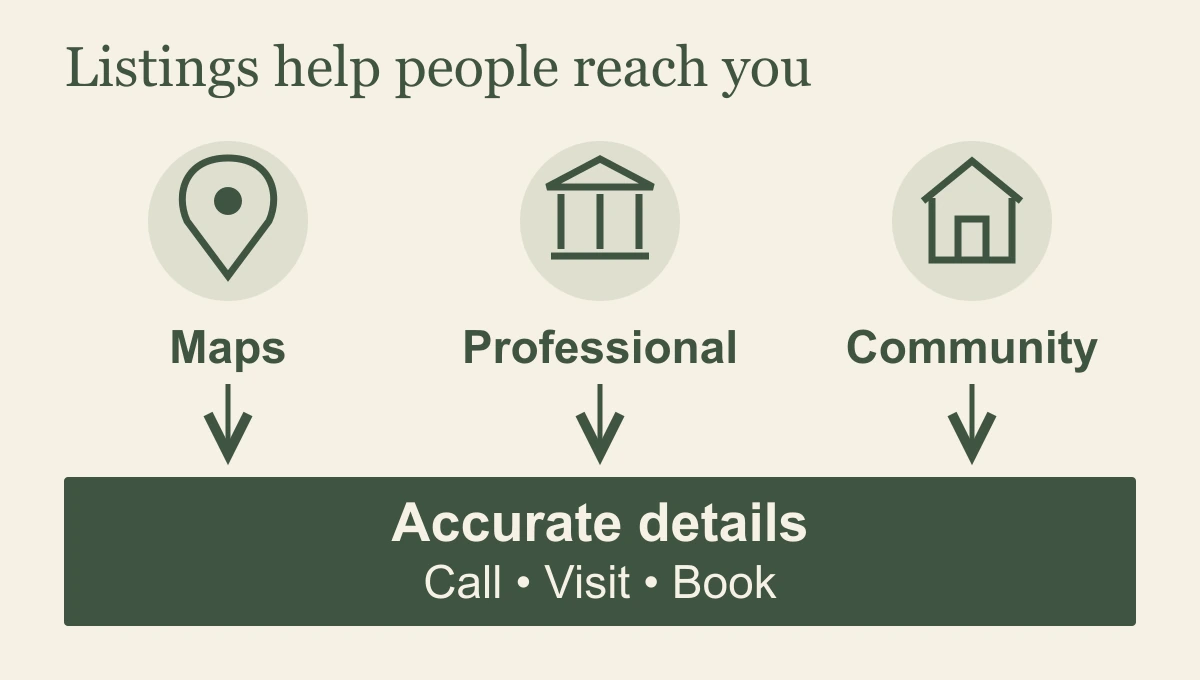
A useful directory can also be a real referral source
Open the actual listing as a customer. Can someone understand what you do, confirm the service area and reach the business? Is the page useful in its own right, or merely an unfinished record created to count another submission?
Ask new inquiries where they found you, when that question fits the conversation. Check available referral traffic and use a tagged website link where appropriate and supported. Keep the limits visible: a customer may see the business in several places before calling, and a directory's click count is not a count of booked jobs.
For a paid professional or community listing, ask what the fee buys beyond the basic entry. It might include enhanced information, a particular placement or participation in a genuine organisation. Evaluate the customer route and membership value together. Do not pretend every benefit must be reduced to a neatly attributed lead; do require a reason the business wants to be there.
Who will carry the listing work?
| Buying option | What you buy | Who carries it afterwards? |
|---|---|---|
| One-off freelancer or Fiverr listing gig | A defined submission or correction project. Confirm the sites, live work record and account access. | You arrange later changes and checks unless continuing care is part of that proposal. |
| Self-service listings software | The tools and publisher connections in the subscription. | Your team approves facts, watches listing health and follows exceptions. |
| TQP Get Found | Done-for-you business identity, supported distribution, continuing sync, duplicate review, monitoring, corrections and reporting. | Our team carries the management work while you confirm business changes and required verification. |
| Professional and community directories | Relevant membership or listing value for the actual business. | Keep these in the plan; membership and destinations outside the connected service may need separate work. |
Pay for a defined job
A one-off freelance submission can be a useful purchase for a defined correction job. A marketplace gig, including one on Fiverr, should still say which sites will be handled and give you a record of the work. That purchase ends where its proposal says it ends.
Self-service software keeps connections and tools available, but someone on your team must still approve the information, inspect problems and act on exceptions. BrightLocal's documentation illustrates the distinction between pay-as-you-go Citation Builder work and Active Sync's continuing updates. Two different listing services
Get Found is the done-for-you choice I recommend when you want that management taken off your desk. Continuing sync and monitoring are the purchase. We watch listing health, work through corrections and keep the connected identity managed as business facts or publisher records change. You are buying care for the presence, rather than another submission of the same details.
Tell us about a new phone number or holiday schedule once. We carry the approved change through the connected listings, monitor their health and work through corrections. Publisher edits and new conflicts are part of why the care continues after the first setup.
A submission is not the same as a corrected live listing. Publishers make their own publication decisions. We keep that distinction clear in the work record and identify anything that still needs attention.
The BrightLocal vs Yext guide compares those buying arrangements more closely, including subscriptions and exit terms.
Give accurate listings someone to look after them
Google says complete, accurate business information helps local search, alongside relevance, distance and prominence. Rankings remain Google's decision. Google's local ranking guidance
The value of Get Found is practical: a customer looking for your business should encounter the right name, number, hours, location and route to contact you. A move should not leave them navigating to the old office. A phone change should not leave yesterday's number scattered across useful listings.
That is why I recommend the annual plan. US$990 prepaid is equivalent to US$82.50 per month. It saves US$198 compared with twelve US$99 monthly payments and includes the one-time profile optimization. The business gets twelve months of agreed maintenance and reporting, and you get a team responsible for the supported listing work.
Accurate records in useful places, kept current by us. Bring your business details and the places customers already find you. We will put the right information to work and help keep it that way.
Frequently asked questions
Are local citations worth paying for?
They are worth buying when the purchase maintains accurate information in places customers can use. Useful directories can also provide a public reference or a website link where displayed. Paying for a large list without ongoing responsibility is a weaker decision.
Why choose Get Found over a one-off directory gig?
Get Found combines supported distribution with continuing synchronization, listing-health review, corrections and agreed maintenance. TQP carries the work after the first submission, so a changed phone number or service does not leave the business with an old batch of listings.
Why does TQP recommend the annual Get Found plan?
It gives the listing foundation a full year of responsibility and includes one-time Google Business Profile optimization. Pair that maintained identity with a clear website and receiving path so a prospect who finds the business can take the next step.
Give customers clear business details, useful directory references and a route to your website. Annual Get Found keeps the connected information current for you and includes one-time Google Business Profile optimization.
Put your business where customers look