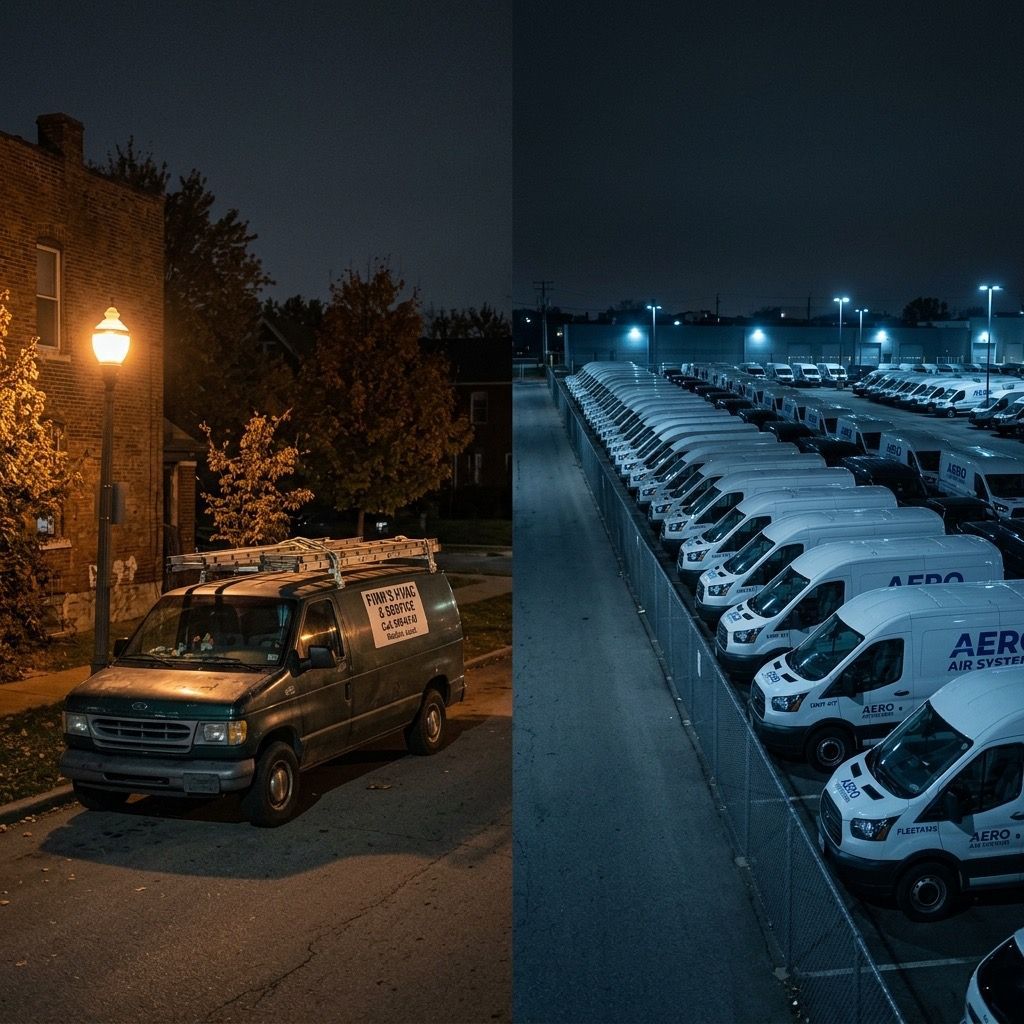

Small service businesses do not lose to larger operators because the larger company is always better.
Treat any number without a nearby source or stated method as a planning assumption, then replace it with your own records.
They lose because the larger company is often easier to reach.
That sounds too simple, but it shows up constantly.
The franchise answers faster. The regional operator has a call center. The bigger company has dispatch coverage, reminders, review requests, estimate follow-up, and enough staff that one busy afternoon does not break the front door.
The local owner may do better work.
The buyer may prefer a smaller company.
But if the smaller business misses the call, responds tomorrow, forgets the follow-up, or makes the buyer chase them, the advantage disappears.
This is where AI can help small service businesses compete.
Not because AI is magic.
Because AI can give a small team the operating consistency of a bigger team without forcing the owner to build a call center.
The Real Advantage Larger Operators Have
Large operators usually have more capacity around the edges of the business.
They may have:
- A staffed phone line.
- After-hours coverage.
- A dispatcher.
- A CRM administrator.
- Automated reminders.
- Review request systems.
- Dedicated sales follow-up.
- A marketing team watching lead sources.
That does not guarantee better service.
It does mean fewer opportunities vanish because nobody had time to answer, log, route, or follow up.
Small businesses often operate differently. The same person may answer the phone, schedule jobs, invoice customers, help technicians, calm down unhappy clients, update the owner, and remember which estimate needs a second touch.
That person may be excellent.
They are still human.
When call volume spikes, the system bends.
The Small Business Advantage Is Still Real
The point is not that bigger operators are better.
Many are not.
Small businesses often have the deeper trust advantage. The owner cares. The technician may know the customer. The company can make exceptions. The service can feel personal. The promise is not being filtered through five departments.
That matters.
But the trust advantage only helps if the buyer reaches the business.
This is where the competitive picture gets frustrating. A local company can have stronger workmanship, better ethics, and a more loyal customer base, but still lose a first-time buyer because the bigger company has a stronger intake machine.
The buyer does not know your quality yet.
They know whether you answered.
They know whether you sounded organized.
They know whether the next step was clear.
AI is useful when it lets the small business keep its human advantage while fixing the operational disadvantage.
The Wrong Way To Think About AI
The wrong question is, "Can AI replace my people?"
That is usually the least useful version of the conversation.
The better question is, "Where does our small team lose consistency because we do not have enough coverage, memory, or follow-up capacity?"
AI is useful when it handles repeatable front-door work:
- Answering overflow calls.
- Capturing caller details.
- Qualifying basic intent.
- Routing emergencies.
- Creating clean summaries.
- Sending confirmations.
- Triggering follow-up.
- Reactivating old customers.
- Requesting reviews after completed work.
That is not replacing the craft, judgment, or trust of the business.
It is protecting the opportunities that already reached the business.
Competing On Speed
Large companies often win by being first to the conversation.
Small companies can fight back by making speed systematic.
If a buyer calls from Google Maps and reaches voicemail, speed is already lost. If a form waits until tomorrow, speed is lost. If an estimate gets one follow-up a week later, speed is lost.
AI helps when it removes the delay between intent and next step.
For example:
- A call comes in while the owner is on a job.
- The AI receptionist answers.
- It asks what the caller needs.
- It captures location, urgency, and contact details.
- It sends the team a summary.
- It texts the caller confirmation.
- It escalates if the call is urgent.
That small sequence changes the buyer's experience.
Instead of "I could not reach them," the buyer feels received.
Speed is not only about minutes. It is about whether the buyer feels the business has control.
Competing On Memory
Bigger operators usually have better memory because they are forced to build it.
They cannot run everything from the owner's head.
Small businesses often try to do exactly that for too long.
The owner remembers which customer is important. The office manager remembers which estimate sounded promising. A technician remembers who asked for a maintenance plan. Someone remembers to follow up if the week is not too chaotic.
That works until volume grows.
Then memory becomes a leak.
AI can help by turning moments into records:
- A call summary enters the CRM.
- A missed call creates a recovery task.
- A quote request gets tagged by service type.
- A completed job triggers a review request.
- A stale estimate reappears before it dies.
- A dormant customer gets a useful check-in.
This is not glamorous, which is why it matters.
Most revenue leaks are not glamorous either.
Competing On Coverage
Coverage is where small teams are usually weakest.
They may be good during office hours when the right person is sitting at the desk. But the market does not only call when the team is perfectly available.
Calls arrive:
- During lunch.
- After 5 p.m.
- On weekends.
- During busy season.
- While staff are already on the phone.
- When the owner is driving.
- When the office manager is out.
Large operators solve this with more people.
Small businesses can solve part of it with an AI front-door layer.
The goal is not to answer every call with a script forever. The goal is to make sure the business does not go dark just because the team is busy.
That is a real competitive advantage.
Competing On Follow-Up
Many small businesses are good at the first conversation and weak at the second, third, and fourth touch.
That is understandable. Follow-up is easy to drop when new work is arriving, technicians need support, and the owner is solving today's problems.
But larger operators often win because follow-up is built into the machine.
The buyer gets a reminder. The estimate gets a check-in. The consultation request gets a text. The review request goes out automatically. The dormant customer gets contacted before the season starts.
Small businesses can copy this part without copying the corporate feel.
The sequence can still sound human. The timing can still respect the buyer. The owner can still step in on high-value opportunities.
The important thing is that follow-up does not depend on someone remembering at the end of a long day.
Competing On Consistency
Small businesses often depend on heroic effort.
The owner remembers who needs follow-up. The office manager remembers which customer was upset. The technician remembers to ask for the review. Someone remembers to call the estimate from last week.
Heroic effort is admirable.
It is also fragile.
AI can help turn recurring tasks into operating rhythm:
- Every missed call gets a recovery text.
- Every new lead gets a clean record.
- Every estimate gets a follow-up sequence.
- Every completed job gets a review request.
- Every dormant customer gets a reactivation campaign.
- Every urgent inquiry gets routed differently.
This is how a small company starts to feel bigger to the buyer.
Not corporate. Not robotic. Just responsive, organized, and easy to work with.
Competing Without Becoming Corporate
There is a risk here.
Some small businesses hear "systems" and worry they will lose the human feel that makes them good.
That is a valid concern.
The point is not to copy the worst parts of large operators: phone trees, generic scripts, long holds, cold handoffs, and nobody owning the outcome.
The point is to use systems to protect the best parts of the small business:
- Faster human follow-up.
- Cleaner context for the team.
- Less chaos for the owner.
- Better memory.
- More reliable service.
- Fewer buyers slipping away.
A good AI system should make the business feel more attentive, not less human.
If automation makes good customers feel processed, it is being used badly.
A Practical Small-Team Stack
A small service business does not need a massive technology stack.
It needs a few connected layers that do their jobs reliably.
Start with the front door:
- AI receptionist or overflow answering.
- Missed-call text recovery.
- Web form response automation.
- Basic lead qualification.
Then add the workflow:
- CRM record creation.
- Appointment or callback routing.
- Estimate follow-up reminders.
- Team notifications.
Then add the revenue recovery:
- Dormant customer campaigns.
- Review requests.
- Maintenance reminders.
- No-response estimate follow-up.
This is what I mean by an AI-powered operating system. It is not one flashy tool. It is a set of small systems that reduce leakage.
A Few Places AI Is Not The Answer
AI will not fix unclear positioning.
It will not make bad service good.
It will not replace licensed judgment.
It will not create trust if the business breaks promises after booking.
It will not magically solve pricing, capacity, hiring, quality control, or poor leadership.
That is why I do not like selling AI as a blanket cure.
For small service businesses, AI is best used as leverage around specific repeatable bottlenecks. It should make the business more reachable, more organized, and more consistent.
If the underlying offer is weak, AI only helps the business disappoint people faster.
If the underlying service is strong, AI helps more buyers experience that strength.
Where Small Businesses Can Beat Bigger Ones
Small companies still have advantages.
They can make decisions faster. They can sound more personal. They can change scripts without a committee. They can know their local market. They can route unusual calls to the owner quickly. They can build trust in ways a call center cannot.
AI should amplify those advantages.
For example, a local HVAC company can use AI to answer and qualify calls after hours, but still route high-value replacements to the owner quickly.
A dental practice can use AI to capture missed calls and appointment requests, but still have the front desk handle sensitive patient conversations.
A contractor can use AI to sort serious projects from bad-fit inquiries, but still have the owner personally follow up on the best opportunities.
That combination is powerful.
Big-company consistency. Small-company judgment.
The Mistake To Avoid
Do not buy AI because you are afraid of falling behind.
Buy or build it because you have identified a specific leak.
Ask:
- Are we missing calls?
- Are we slow to respond?
- Are estimates going stale?
- Are after-hours leads disappearing?
- Are reviews inconsistent?
- Are past customers being ignored?
- Are staff wasting time on bad-fit inquiries?
If you cannot name the leak, you will probably buy the wrong tool.
If you can name the leak, AI becomes easier to judge.
Does it reduce the leak?
Does it make the team faster?
Does it create cleaner handoff?
Does it protect the buyer experience?
That is the practical buying standard.
What This Looks Like In A Normal Week
Picture a small plumbing company with one owner, two trucks, and one office coordinator.
Before the system, the coordinator answers what she can. The owner gets calls in the field. After-hours calls go to voicemail. Estimates are followed up when someone remembers.
After the system, overflow calls are answered, after-hours callers are qualified, urgent requests are escalated, routine calls are summarized for morning, and estimates receive scheduled follow-up.
The company did not become a franchise.
It became harder to miss.
That is the point.
The First 30 Days Should Be Boring
The first 30 days of a good AI rollout should not feel like science fiction.
It should feel like fewer dropped balls.
Calls get answered. Summaries appear. The team sees which leads are urgent. Follow-ups go out. The owner gets fewer random interruptions and more useful alerts. Buyers receive confirmation instead of silence.
That is boring in the best way.
After that, the business can add more:
- Review generation.
- Dormant customer reactivation.
- Estimate nurture.
- Seasonal campaigns.
- Reporting dashboards.
- Call quality review.
But the first job is simple.
Stop letting demand leak because the team is small.
Bottom Line
Small service businesses do not need to become large operators.
They need to stop losing to large operators on the basics.
Answer faster. Capture cleaner. Follow up better. Route urgent work. Remember past customers. Ask for reviews. Protect the front door.
AI helps when it gives a small team the consistency it could not otherwise afford.
That is the useful promise.
Not hype. Not replacement. Not a magic button.
A practical operating layer that makes a good small business easier to choose.
If you want to know where AI would actually help your service business, start with a Revenue Leak Diagnostic. Find the leak first. Then build the system around it.
Use your own records before you decide
Source: start with your call log, CRM notes, booking calendar, missed-call records, web form timestamps, and Google Business Profile. Those records show whether buyers reached you, how fast they heard back, what they asked for, and where the next step broke down.
For seven days, mark each missed call, late reply, unbooked form, stale estimate, and review request that never went out. That small sample gives an owner a practical picture of the front-door gap before they spend more on ads, software, or staff.
The practical questions behind this decision.
Can AI really help a small service business compete with larger companies?
Yes, when it improves speed, coverage, consistency, and follow-up. AI will not make a bad service business good, but it can help a good small business stop losing opportunities because the team is stretched thin.
What should a small business automate first?
Start with the biggest revenue leak. For most service businesses, that is missed calls, after-hours intake, slow form response, estimate follow-up, or review requests.
Will AI make the business feel less personal?
It can if implemented badly. The better approach is to use AI for first-layer intake, reminders, summaries, and routing so humans have better context and can respond faster.
Is an AI receptionist enough by itself?
Usually no. An AI receptionist is useful, but the real value comes when intake connects to follow-up, CRM records, scheduling, review requests, and human escalation.
Should small businesses wait until they are bigger to install systems?
No. The point of systems is to help the business grow without depending on the owner to personally remember everything. Waiting too long usually means the leak gets normalized.
Decide what the AI must handle before you choose the software.
A useful intake system begins with the caller journey, the rules, and the human handoff, not a long feature list.
Give the receptionist a realistic scenario and hear how it answers, gathers context, and moves the caller toward a useful next step.
See how the capability in this article fits into a complete customer journey.
Service BusinessesSee the same decision through the language, buyer behavior, and operating reality of this industry.
Client Results & ProofInspect the starting condition, installation, measurement window, and outcome behind real client work.

AI Receptionist Rollout Guide for Service Businesses
A practical operating guide to choosing the first call path, preparing staff, testing real handoffs, and deciding whether an AI receptionist is ready to handle more customer conversations.
Voice AI vs. Hiring a Part-Time Receptionist: The Real Math for Service Businesses
Compare voice AI and a part-time receptionist for service businesses: coverage, cost, consistency, booking, after-hours calls, and the real front-door math.

The Missed Call Problem: How Service Businesses Lose $180,000 Per Year From the Front Door
Missed calls are not harmless. Learn how service businesses calculate the annual revenue leak from unanswered calls, delayed callbacks, and lost buyer intent.
Calculate the revenue leak.
Stop guessing. See how much demand your business may be losing through missed calls, slow replies, weak booking, review gaps, and follow-up drag, then decide whether Voice AI is the right system path.
Run the calculationPrefer to hear it first?
Call the live AI receptionist and test the conversation.
Call the live AI receptionist anytime. Tell it about service businesses, then hear a short live roleplay based on the calls your front desk actually gets.