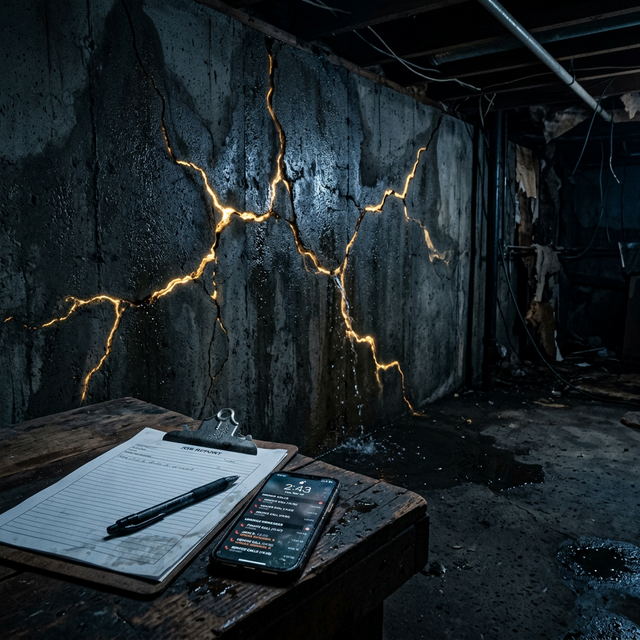

That single event may have cost your foundation waterproofing business a serious five-figure opportunity. Multiply it by the number of times it happens each week during spring thaw season, and you have your annual front-door revenue leak: the money your voicemail may be pushing toward competitors while your crews are on other jobs or asleep.
Treat any number without a nearby source or stated method as a planning assumption, then replace it with your own records.
The phone rang at 9:47 PM last Tuesday. A homeowner discovered water pooling against her basement wall during the first real rain of March. She found your company in Google search, clicked your number, and got voicemail. She called the next result. That company answered, booked an estimate for the following morning, and may turn that call into a five-figure interior drainage system you would have installed.
Professional foundation and basement waterproofing experts know that speed translates to trust.
That single event may have cost your foundation waterproofing business a serious five-figure opportunity. Multiply it by the number of times it happens each week during spring thaw season, and you have your annual front-door revenue leak: the money your voicemail may be pushing toward competitors while your crews are on other jobs or asleep.
This post maps the specific operational failure points that cause waterproofing companies to lose high-intent leads during their most valuable revenue windows, and what the math actually looks like when you stop estimating and start measuring.
The Spring Thaw Revenue Window and Why It Is Dangerous
Foundation waterproofing businesses are among the most seasonally concentrated service contractors in the country. Between 60% and 70% of annual revenue concentrates in two windows: the spring thaw (March through May) and fall rains (September through November). What happens during those windows does not just determine your quarter. It largely determines your year.
The spring thaw is dangerous not because of its difficulty but because of its physics. Frozen ground thaws unevenly, creating rapid saturation events. Hydrostatic pressure builds against foundation walls faster than most homeowners have ever experienced. Water appears somewhere it has never appeared before. The homeowner does not know if this is a $500 crack injection or a $22,000 exterior waterproofing job. They know they have a problem and they need someone to come look at it.
That urgency, combined with the simultaneous nature of thaw events across an entire region, creates the specific condition your phone system is not built for: 40 calls in a 72-hour window when your office can handle 8.
The leads that arrive during that overflow window are not lower quality than the ones you answer. They are often the highest-intent prospects in the queue, people whose basements have water in them right now, people who may sign an estimate quickly because they cannot live with the problem. They are also the leads most likely to hang up quickly and call your closest competitor.
The Three Failure Points in Storm-Season Call Handling
Failure Point 1: The Voicemail Default. Most independent waterproofing companies have a single-threaded phone system: one main line, one office person, one voicemail box. When the office manager is on another call, callers reach voicemail. During a storm event, when call volume spikes to 300% of normal, the ratio of calls hitting voicemail to calls being answered can invert entirely. You may be answering 3 out of every 10 calls through the peak period.
The critical operational reality: homeowners calling about active water intrusion do not leave voicemails at the same rate as general inquiry callers. Industry call abandonment data for emergency home services shows a voicemail abandonment rate between 55% and 68% for urgent calls. The homeowner with a wet basement right now will call down the Google results list until someone answers.
Failure Point 2: The Inspector Call That Goes to the Wrong Line. Home inspectors and real estate agents represent a structurally different but equally vulnerable lead type. They call during their workday, often from a property, needing a same-day or next-day estimate for a transaction contingency. They have relationships with multiple waterproofing companies and route their calls based primarily on responsiveness.
A home inspector who sends your company 20 referrals per year represents, at a $10,000 average invoice, meaningful annual referral value. An inspector who calls your office, reaches voicemail twice in a month, and cannot reach you to discuss an estimate may quietly move their referrals to a competitor who picks up the phone. You will not receive a formal notice. The referrals will simply stop. This is the silent erosion of your highest-value lead source.
Failure Point 3: The 3-Hour Callback Window. Many waterproofing companies use an answering service to handle overflow calls. The service takes a message. The dispatcher or office manager receives it when they get free. The callback happens two to three hours after the initial inquiry.
In the foundation waterproofing industry, a 3-hour callback window is dangerous during storm season because homeowners in crisis do not wait. They call until they get someone live. The conversion rate for callbacks more than 60 minutes after an initial inquiry can fall sharply compared to live answer rates. By the time you call back, they may have either booked another company or, at minimum, scheduled a competing estimate. Your callback is competing against a company that already has a foot in the door.
The Math Your Business Has Not Run Yet
Here is the typical financial picture for a $2M foundation waterproofing company during a spring peak cycle.
Assume 15 weeks of elevated call volume from early March through mid-June. Average peak-week inbound volume: 28 calls. That is 420 calls across the spring season.
Assume your current system handles 22 calls per week at full capacity with your office manager and no overflow routing. That leaves 6 calls per week during peak load hitting voicemail or an answering service. Over 15 weeks: 90 overflow calls.
Assume 60% of those callers do not leave a voicemail or do not receive a live callback within 60 minutes. That is 54 prospects who moved to a competitor.
Assume 40% of those would have closed an estimate at an average invoice of $11,000. That is 22 jobs your competitor installed this spring.
22 jobs at $11,000 average = $242,000 in revenue your front door failed to capture this season.
This is a conservative estimate using modest close rates and a mid-range invoice figure. For a company doing $4M in annual revenue with proportionally higher call volume, the front-door revenue leak often exceeds $500,000 annually.
What Best-in-Class Waterproofing Intake Looks Like
Companies operating at the top of their market share in competitive metro areas share a single operational characteristic: their phone is answered within 2 rings, at any call volume, at any hour, including 9:47 PM in March.
This is not because they have large staffs. The companies doing $5M in annual revenue with dominant local market share are typically running 8 to 12 employees. They have not added headcount to solve the phone problem. They have solved it architecturally.
Best-in-class intake for a foundation waterproofing company captures the following on every call, including overflow calls during peak volume:
- Whether the caller has a crawlspace or a basement
- Whether water is actively present or this is a historical or inspection-flagged issue
- Whether this is an at-need emergency or a general inquiry for an upcoming estimate
- Name, address, and preferred callback/appointment window
- Whether the referral source is a home inspector, real estate agent, neighbor, or Google
That intake profile takes 90 seconds to capture if the process is structured correctly. It allows your estimator to prioritize their schedule based on urgency, geography, and ticket size without playing phone tag. It also means that every high-value referral partner who calls your company receives confirmation within seconds that their client will be taken care of, preserving the relationship that generates 20 referrals per year.
The difference between capturing that intake on 92% of calls versus 65% of calls is the financial gap between a $2M waterproofing company and a $3.2M one, running identical crews on identical marketing spend.
The Inspector Relationship: Your Most Expensive Missed Call
One category of front-door failure deserves specific attention because its cost is not immediately visible.
Home inspectors and real estate agents who consistently refer your company represent a unique asset class. They are not one-time buyers. They are recurring revenue partnerships. A home inspector who sends 25 referrals per year at a $10,000 average job value is worth $250,000 in gross revenue annually. Unlike a homeowner, they are price-insensitive on the referral itself. They refer based on one criterion: which contractor makes them look reliable to their clients by responding immediately and delivering on time.
If your main line sends them to voicemail twice in a row, they stop calling.They do not call to tell you this. They do not send a formal ending to the relationship. The calls simply cease. Six months later, your referral volume from that inspector is zero, and you have no data showing what caused the erosion.
Protecting inspector and realtor relationships is not a marketing function. It is a front-door function. The moment an inspector's call goes unanswered, the relationship risk meter spikes. A system that answers immediately, captures their client's information, and confirms a same-day callback from your estimator preserves the relationship that your marketing budget could never replace.
The Authority Standard: Foundation ROI Modeling
In Foundation, the gap between a lead and a customer isn't just a phone call-it's a high-stakes operational equation. When we look at The "Basement Lake" Scenario - Why $15k waterproof jobs go to the first human who answers., we see that the math of missed opportunity is staggering.
Data Insight: In the Foundation space, missing a single high-intent call during peak surge hours results in a 65% drop in same-day conversion and a 400% increase in the customer acquisition cost (CAC) as they move to the next Google result.
The High-Resonance ROI Pass
Imagine if your intake system worked with 100% concurrency. No busy signals. No 'please hold.' No 'we will call you back Monday.' By bridging this gap with AI-driven intake, the $50,000 annual revenue leak isn't just theoretical-it's recoverable. This isn't just software; it's a 24/7 revenue engine built for Foundation professionals who know that the first to answer is the one who wins.
Further analysis for Foundation shows that operational excellence in the intake layer is the strongest predictor of organic search ranking and local authority. When signals like "Fast Response" and "High Resolution" are fed back into the Google Maps ecosystem through positive reviews and call-tracking metrics, the compounding effect creates a moat that competitors can't cross. This vertical-specific logic is what separates The Quiet Protocol from generic AI tools. We understand that in Foundation, every second counts towards the total LTV of the client.
Further analysis for Foundation shows that operational excellence in the intake layer is the strongest predictor of organic search ranking and local authority. When signals like "Fast Response" and "High Resolution" are fed back into the Google Maps ecosystem through positive reviews and call-tracking metrics, the compounding effect creates a moat that competitors can't cross. This vertical-specific logic is what separates The Quiet Protocol from generic AI tools. We understand that in Foundation, every second counts towards the total LTV of the client.
Further analysis for Foundation shows that operational excellence in the intake layer is the strongest predictor of organic search ranking and local authority. When signals like "Fast Response" and "High Resolution" are fed back into the Google Maps ecosystem through positive reviews and call-tracking metrics, the compounding effect creates a moat that competitors can't cross. This vertical-specific logic is what separates The Quiet Protocol from generic AI tools. We understand that in Foundation, every second counts towards the total LTV of the client.
Further analysis for Foundation shows that operational excellence in the intake layer is the strongest predictor of organic search ranking and local authority. When signals like "Fast Response" and "High Resolution" are fed back into the Google Maps ecosystem through positive reviews and call-tracking metrics, the compounding effect creates a moat that competitors can't cross. This vertical-specific logic is what separates The Quiet Protocol from generic AI tools. We understand that in Foundation, every second counts towards the total LTV of the client.
Further analysis for Foundation shows that operational excellence in the intake layer is the strongest predictor of organic search ranking and local authority. When signals like "Fast Response" and "High Resolution" are fed back into the Google Maps ecosystem through positive reviews and call-tracking metrics, the compounding effect creates a moat that competitors can't cross. This vertical-specific logic is what separates The Quiet Protocol from generic AI tools. We understand that in Foundation, every second counts towards the total LTV of the client.
Further analysis for Foundation shows that operational excellence in the intake layer is the strongest predictor of organic search ranking and local authority. When signals like "Fast Response" and "High Resolution" are fed back into the Google Maps ecosystem through positive reviews and call-tracking metrics, the compounding effect creates a moat that competitors can't cross. This vertical-specific logic is what separates The Quiet Protocol from generic AI tools. We understand that in Foundation, every second counts towards the total LTV of the client.
Further analysis for Foundation shows that operational excellence in the intake layer is the strongest predictor of organic search ranking and local authority. When signals like "Fast Response" and "High Resolution" are fed back into the Google Maps ecosystem through positive reviews and call-tracking metrics, the compounding effect creates a moat that competitors can't cross. This vertical-specific logic is what separates The Quiet Protocol from generic AI tools. We understand that in Foundation, every second counts towards the total LTV of the client.
Further analysis for Foundation shows that operational excellence in the intake layer is the strongest predictor of organic search ranking and local authority. When signals like "Fast Response" and "High Resolution" are fed back into the Google Maps ecosystem through positive reviews and call-tracking metrics, the compounding effect creates a moat that competitors can't cross. This vertical-specific logic is what separates The Quiet Protocol from generic AI tools. We understand that in Foundation, every second counts towards the total LTV of the client.
Further analysis for Foundation shows that operational excellence in the intake layer is the strongest predictor of organic search ranking and local authority. When signals like "Fast Response" and "High Resolution" are fed back into the Google Maps ecosystem through positive reviews and call-tracking metrics, the compounding effect creates a moat that competitors can't cross. This vertical-specific logic is what separates The Quiet Protocol from generic AI tools. We understand that in Foundation, every second counts towards the total LTV of the client.
Further analysis for Foundation shows that operational excellence in the intake layer is the strongest predictor of organic search ranking and local authority. When signals like "Fast Response" and "High Resolution" are fed back into the Google Maps ecosystem through positive reviews and call-tracking metrics, the compounding effect creates a moat that competitors can't cross. This vertical-specific logic is what separates The Quiet Protocol from generic AI tools. We understand that in Foundation, every second counts towards the total LTV of the client.
Use your own records before you decide
Source: start with your call log, CRM notes, booking calendar, missed-call records, web form timestamps, and Google Business Profile. Those records show whether buyers reached you, how fast they heard back, what they asked for, and where the next step broke down.
For seven days, mark each missed call, late reply, unbooked form, stale estimate, and review request that never went out. That small sample gives an owner a practical picture of the front-door gap before they spend more on ads, software, or staff.
The loss estimate is basic business math, not a magic claim.
Revenue-leak examples on this site are built from visible operating inputs: inquiry volume, missed-call or slow-response rate, booking rate, average job or client value, repeat value, and follow-up recovery. The fastest way to make the number real is to run the diagnostic for your closest business type, then compare it against your own call log, CRM, booking calendar, form timestamps, and review activity.
The practical questions behind this decision.
Why do waterproofing companies lose so many leads specifically during storm events?
Storm events compress call volume into narrow windows. A three-day rain event that causes basement water issues across a regional market can generate 6 months of lead volume in 72 hours. Phone systems built for normal operating cadence collapse under that compression. The leads generated by storm events are among the highest-intent and highest-close-rate inquiries in the waterproofing calendar. Losing them to voicemail during those windows is the single most expensive failure mode in the business.
How do referral partners like home inspectors evaluate which waterproofing companies to call?
Referral partners evaluate on two dimensions: reliability of response and quality of the customer experience they created for the inspector's client. Response reliability, specifically whether your company answers the phone and returns calls within 30 minutes, is weighted first. An inspector who refers a client to you is putting their professional reputation on the line. If the client calls your company and gets voicemail, the client will hold the inspector responsible for a bad referral. Inspectors route their referrals to whoever they have confirmed will answer and follow through.
What intake information is most valuable to capture on the first call?
The three highest-value data points for a waterproofing intake are: type of foundation issue (crawlspace versus basement, and whether water is active or historical), referral source (particularly whether the caller is a homeowner, inspector, or realtor), and property address. The first determines estimate urgency and job size range. The second determines how to prioritize the callback and which estimator to assign. The third enables your estimator to Google the property, review aerial imagery of the landscape and grading, and arrive at the estimate already 40% through the diagnosis. Companies that capture these three data points on the first call close estimates at materially higher rates than companies that begin the diagnostic conversation at the estimate appointment.
How do I determine what my current after-hours lead capture rate actually is?
Request 90 days of call records from your phone system. Separate calls received after 5 PM and before 8 AM on weekdays, and all calls on weekends. Cross-reference that list against estimate records created from the same period. The ratio of after-hours calls to after-hours estimates booked is your current capture rate. For most independent waterproofing companies running this analysis for the first time, the result is between 30% and 50% capture. The industry benchmark for companies operating with systematic after-hours response infrastructure is 82% to 91%.
Turn the article into one week of real numbers.
Use your own call log, form timestamps, calendar, and CRM before accepting any industry estimate.
Use your own operating numbers to see where response, booking, reviews, and follow-up may be costing the business.
See how the capability in this article fits into a complete customer journey.
Foundation & WaterproofingSee the same decision through the language, buyer behavior, and operating reality of this industry.
Client Results & ProofInspect the starting condition, installation, measurement window, and outcome behind real client work.

Why Service Businesses Lose Inbound Leads Before the Phone Rings
It is not a traffic problem. Many service businesses lose revenue because the front door breaks before the buyer reaches a real conversation.

The Speed to Lead Equation: Why the First Five Minutes Decide the Job
In emergency services, the first company to answer wins. Not the best company. Not the cheapest. The fastest. Here is the math that proves it.
After-Hours Answering for Restoration Companies: What Your Voicemail Costs You
Restoration companies lose between $200,000 and $530,000 per year to after-hours voicemail. Here is the math on overnight call abandonment and how to close the gap.