
Local SEO for accountants starts with a fairly ordinary question: when someone nearby needs the work your firm wants to do, can they find you, understand the service and reach the right person?
I would get those three things working before commissioning a mountain of articles about tax. A mountain is impressive. Your partner still has to explain that you don't prepare the kind of return the caller needs.
The practical order is to define the work you want, check your Google profile and important directory listings, improve the page that explains that work, build an honest review habit, then follow the inquiries through. Each step should fix a problem you can name.
For the listing work, I recommend TQP Get Found. We take responsibility for your business identity, supported listing updates and agreed maintenance, so a change of number or service does not become another job your partner has to remember. For one business location, the annual plan is US$990 prepaid for twelve months, equivalent to US$82.50 a month, and includes one-time Google Business Profile optimization. It gives the firm a practical foundation to build on.
Start with the client you can actually help
Imagine a small firm that wants more ongoing bookkeeping relationships with local incorporated service businesses. That is an illustrative example, not a client result. “More accounting leads” would be a poor brief for it. A rush of one-time personal tax inquiries might make the phone busier while taking the team further from its goal.
Write down the service, the kind of client, the area you genuinely serve and the capacity available. Include what you aren't currently accepting. This gives whoever manages your search work something useful to aim at.
Then ask whether a prospect uses the same words. Someone with disorganized records may search for bookkeeping help or catching up their books. They may not know that your internal service name is “finance transformation.” If your website makes them pass a vocabulary test before contacting you, I would change the website.
You can learn from the inquiries you already receive. Which words did the person use? Which service did they think you offered? Which misunderstanding took several emails to resolve? Those are working notes for your pages, not a claim about market search volume.
Fix the local identity before adding more pages
Google's local ranking guidance describes relevance, distance and how well known the business is. Accurate information helps Google understand the firm. It does not give you a way to purchase a particular position.
For an eligible practice, check the profile's ownership, real business name, location, service description, phone and website destination. The website should tell the same story. An old phone number on a directory or a page describing a service you stopped offering gives the prospective client an unnecessary puzzle.
Eligibility comes first. Google's representation rules do not make a rented mailing address an eligible office. A firm that works entirely online cannot assume it qualifies just because it serves clients in a city. Use our accounting Google profile guide to work through that decision before creating or changing a listing.
An agency may manage the profile, but your firm should control access. You should know which account owns it and how a departing employee or provider loses access. Being able to leave a supplier is a useful feature in any system.
Get listed where your prospective clients look
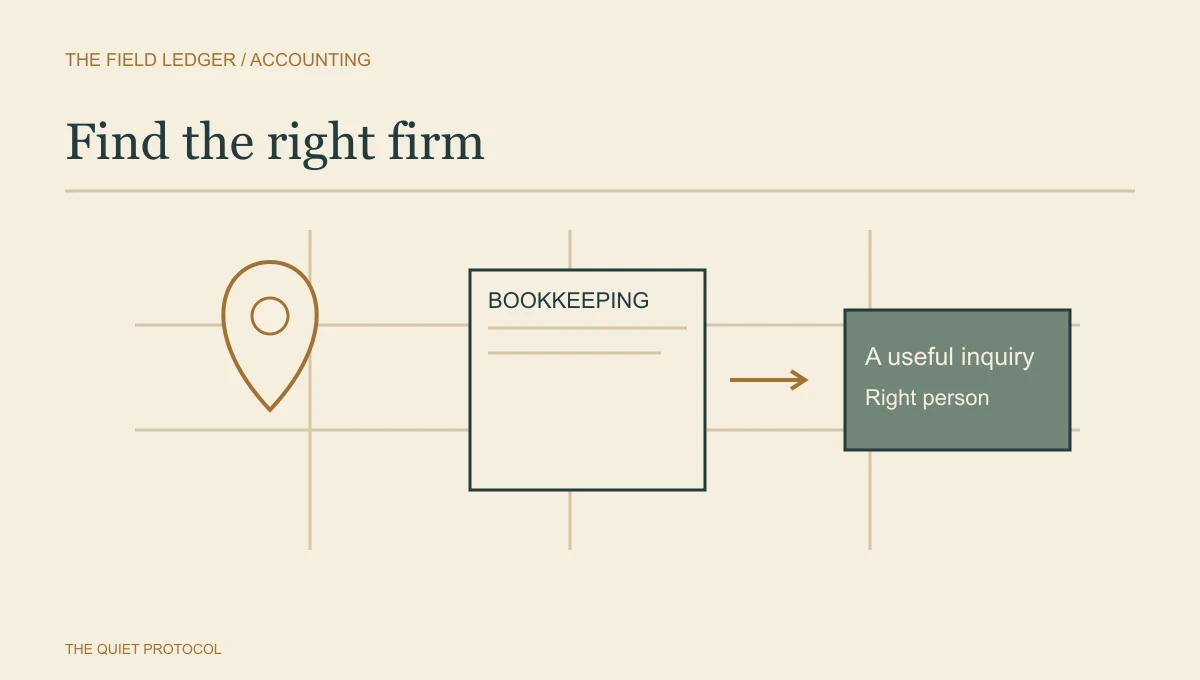
Directory listings are an important part of local SEO for an accounting firm. They give people more places to find and check the practice, and put its business details on sites beyond its own website. Google explains that its business information comes from several sources, including public web content and licensed third-party data. I would not leave those outside details to chance.
Start with accurate listings on relevant sites. Keep the firm's name, real address where appropriate, phone number and website consistent. Explain the work you actually accept. A directory that still sends callers to your previous office is doing the opposite of helping, however impressive it looks on a submission report.
For accountants, relevance includes the profession and the software clients use. The US QuickBooks ProAdvisor directory lets people search by location, services, industry and software. Xero's advisor directory offers another accounting-specific route. Each has participation requirements; check the program and country that fit your firm. A listing must not imply a qualification or relationship you don't hold.
Also check the major map and business directories your clients use, your relevant professional body's public directory if eligible, and a local chamber directory where membership makes sense. The useful question is whether that listing helps someone find, verify or contact the right practice.
- Who uses it?
- Identify the prospective client or referral source it serves. Check the actual public listing, not just the publisher's name.
- What does it say?
- Check the firm's identity, contact route, services and any displayed credentials. Correct stale details and investigate duplicates.
- Who controls it?
- Keep access and a record of the listing address. Ask what remains editable when a paid arrangement ends.
- What are you buying?
- Separate basic listing accuracy, ongoing maintenance and paid promotion. Ask for the named sites, work included and evidence of completed changes.
A useful paid directory can deserve a place in the budget. So can paying TQP to keep your details current across supported publishers. We review identity and duplicates, distribute updates to the publishers in your plan and keep those details current. Your firm gets a named responsibility for the work rather than a submission count to admire. Professional-program or chamber membership is a separate decision; choose it for the people it can help you reach. Our directory guide goes deeper into choosing which listings deserve your time and money.
Make one service page earn the inquiry
For our example firm, I would improve the bookkeeping page before adding ten city pages. Explain who the service suits, what recurring work it covers, how an untidy starting position is assessed and what the first conversation decides.
Give the location its proper place. If the firm meets clients at a real office, explain how to visit. If the service is delivered remotely, say that. Don't pretend each nearby town has its own branch. A local page needs useful local information; replacing a town name in identical paragraphs doesn't create it.
The person looking at your page may already have a referral. They still need to confirm that the firm fits. A named professional, clear service boundaries and a credible first step help them make that decision. Our accounting website checklist goes through the pages involved.
You don't need to publish a fixed quote for work that genuinely requires scoping. Explain how the fee is set and what the first assessment covers. Silence makes the person guess. A false starting price makes the first conversation awkward.
The first work order
- The wrong people keep calling
- Clarify the service page and profile services. Record the mismatch in the caller's words.
- The right person finds an old number
- Correct the firm's own contact details and relevant listings before buying more traffic.
- They visit but don't understand the next step
- Explain what the first conversation decides and who will reply.
- Good inquiries sit unanswered
- Assign the response job. More visibility will otherwise feed the same queue.
Ask for honest reviews without turning it into a campaign trick
Choose a point in the relationship when the client has experienced the service. Ask for an honest account, make declining easy and leave the rating to them. Google permits review requests but prohibits incentives.
For an accounting firm, privacy belongs in the wording. A client should not need to describe a tax problem, financial position or private engagement to review their experience. A public reply should stay equally restrained. The accounting review request guide includes usable wording and reply boundaries.
I would also look at what the review says the firm should improve. If clients keep praising the same coordinator, learn what she makes easy. If they keep describing confusing requests, fix the requests. Reviews are feedback from people, even when a marketing report treats them as an inventory.
Follow the inquiry past the click
Keep a simple record of how a new person found you, what they wanted, who replied and the eventual decision. A profile interaction, website visit and phone conversation can belong to the same person. Count one person, not three new clients.
Review discovery and client handling separately. You may be attracting the wrong work, losing suitable inquiries in an inbox, or declining good prospects because the firm is full. Those situations deserve different fixes. None proves a Google penalty for an unanswered call.
Our local SEO measurement guide shows how to distinguish search activity from qualified conversations and completed work. Use comparable periods and allow for your firm's seasonality. A tax deadline changes the kinds of inquiries you receive.
My recommendation is to fix one verified break, then inspect the next inquiries. Can the caller find the service, understand it and get a useful answer? That is a better first milestone than a colourful ranking chart with nobody assigned to the phone.
Start with Get Found and give your firm someone responsible for keeping its public details right. I would choose the annual plan for the included profile optimization and twelve months of maintenance. Bring the current listings and a few recent inquiry examples. We can identify the listing work in your plan, correct the customer routes and keep them current. That is a useful investment before asking more people to find you.
Frequently asked questions
Where should an accounting firm start with local SEO?
Start with the services and clients the firm actually wants, then make its business details consistent across its Google profile, important directories and website. Get Found gives that foundation a continuing owner, rather than leaving listing corrections on a partner's to-do list.
Do accountants need directory listings as well as a Google profile?
Yes. Relevant professional, software and community directories give prospects other ways to find and check a firm. Choose places your clients can use, meet their participation rules and keep the firm's details accurate. A large directory count alone is a poor buying test.
Why choose TQP Get Found for an accounting firm?
We handle supported listing distribution, synchronization, review of listing issues and agreed maintenance for you. The annual plan also includes one-time Google Business Profile optimization. That gives the firm a maintained local identity and leaves its team free to carry the client work.
Choose twelve months of accurate business details and agreed listing maintenance, with one-time Google Business Profile optimization included.
Put your firm on the Get Found annual plan