AI & digital marketing agency in BendKnow which buyer is in front of you.
An AI & digital marketing agency in Bend should help an owner distinguish the home-market buyer from the one seeking specialist work beyond Central Oregon. From Toronto, The Quiet Protocol builds the website, discovery and AI response paths that help each buyer understand the offer the firm can actually deliver.
Based in TorontoServing the United States and Canada
Discuss your buyer pathsEssential Website $99/month, no setup feePublished US offer; full scope and terms on the offer page.
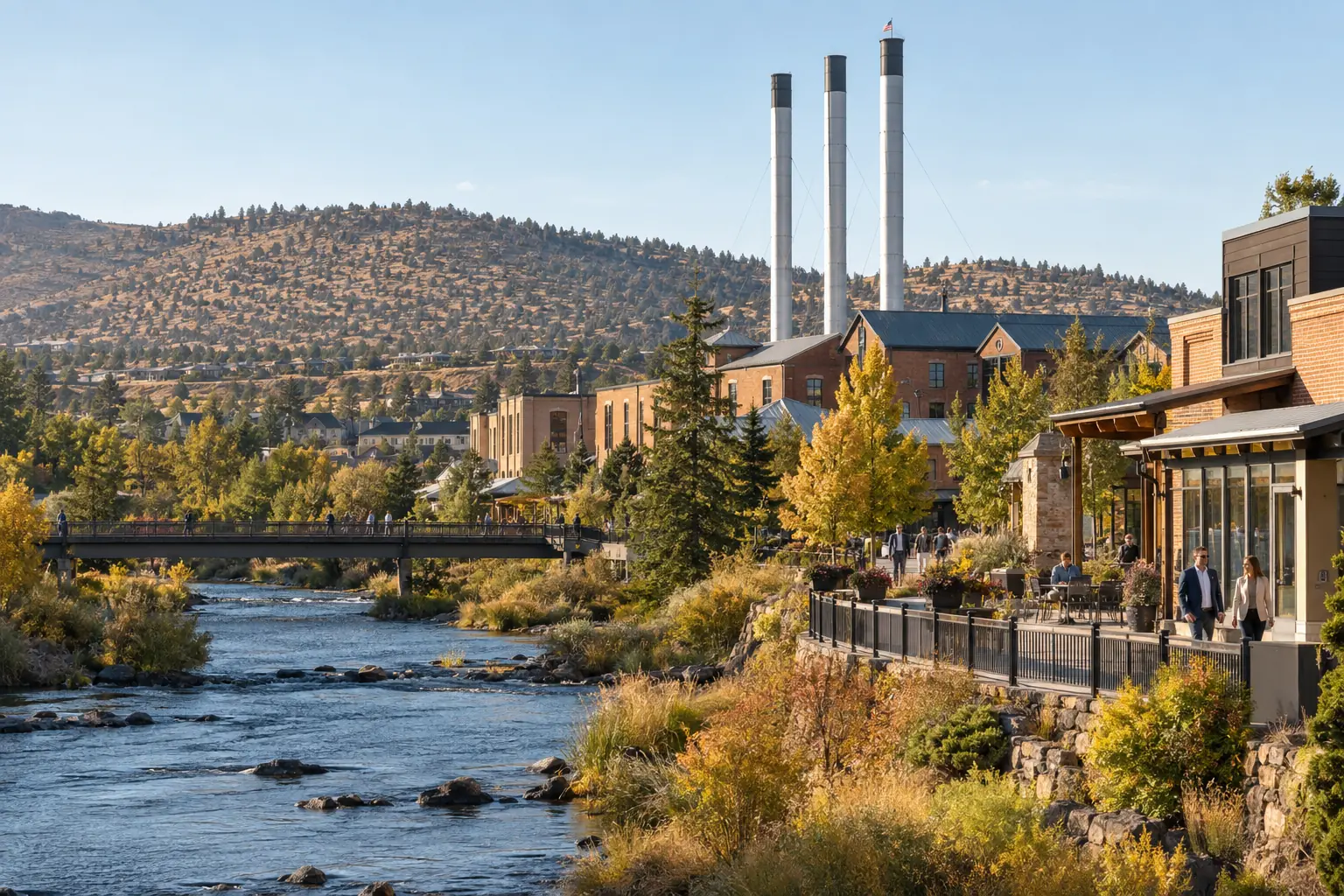
Bend's sectors have different horizons.
The City's target-sector work explicitly includes industries serving local people and industries selling goods or services outside Central Oregon. Its 2025 analysis examines both kinds of sector while projecting growth in healthcare and bioscience-related work and continued importance for manufacturing and tourism. These are planning findings, not a count of prospects for any one service firm.
Our view: that distinction belongs in an owner's marketing decisions. A practice can be highly visible in Bend yet unclear about whether it accepts a project elsewhere. Another may claim a broad territory but never explain what work can really be done remotely. The remedy is to publish the boundary of each offer and test it against actual work the team can deliver.
Geography is part of the offer, not just a location keyword.
A service area should tell the buyer what a firm can do there. Search pages, ads and AI answers become useful only when the scope behind them is real. If the same firm serves a homeowner in Bend and advises an organization beyond Oregon, those buyers may need different evidence, response questions and decision-makers.
One city. More than one reason to call.
The close-to-home buyer
They need to know if the firm serves their specific need, who will do the work and what happens after an inquiry. Local visibility should lead to a useful answer, not just an address.
The outside specialist buyer
They need to understand which work can be done remotely or across a wider region, what evidence supports the specialty and who makes a fit decision.
The referral partner
They need a precise description they can pass to a client without adding promises the firm never made. A short scope statement is often more useful than a broad claim.

Mark the line where the promise changes.
Take ten accepted projects and group them by buyer location, service delivered and the person who approved the work. If the scope, evidence or first response changes between groups, the website should show that distinction. If it does not, avoid multiplying pages for a difference the customer cannot use.
Bend's 2026 economic development plan calls for business retention and growth as well as future industry recruitment. That is city policy. The owner-level equivalent is more modest: know which work to keep, which to pursue and which to decline before marketing sends more inquiries.
Bend 2026 Economic Development Strategic PlanOur opinion · Bend
Bend runs on seasons and newcomers. Plan for both.
Bend attracts visitors year-round and new residents every year. Businesses face seasonal peaks and a constant flow of people who need to find new providers.
Our view: build systems that scale with the season rather than hiring and firing around it.
Bend in numbers
What the Census says about the Bend market, and what we make of it.
| Bend | Oregon | |
|---|---|---|
| Residents (2025 estimate) | 107,342 | 4,273,586 |
| Population change since 2010 | +40% | +12% |
| Median household income | $96,394 | $83,011 |
| Income per person | $58,652 | $45,612 |
| Median home value | $718,400 | $477,600 |
| Homes lived in by their owners | 61.7% | 63.3% |
| Adults with a bachelor's degree or more | 52.9% | 36.8% |
| Residents under 18 | 19.3% | 19.0% |
| Residents 65 and older | 18.1% | 21.0% |
| Average commute (minutes) | 16.3 | 23.0 |
Local sales and receipts, 2022
- Health care and social assistance receipts$2.0 billion$18,224 per resident · $10,009 statewide
- Retail sales$3.6 billion$33,368 per resident · $25,111 statewide
- Restaurant and lodging sales$575 million$5,359 per resident · $3,388 statewide
Your next customer here will read before they call.
52.9% of adults in Bend hold a bachelor's degree or more, against 36.8% statewide. People who read contracts for a living read your website the same way, and more of that reading now happens through AI assistants: Gartner forecast in 2024 that search engine volume would fall a quarter by 2026 as people move to chatbots. Our view: if your prices, process and proof are not written in plain text on your site, the assistant will recommend a competitor whose are.
Research: Gartner, search engine volume forecast (February 2024)A growing town is a town full of people who have not chosen their businesses yet.
Bend grew from 76,639 residents in 2010 to 107,342 in 2025. Every new household needs a dentist, a plumber, an accountant and a cleaner, and it has nobody to ask. Sociologist Mark Granovetter showed that people find opportunities through loose acquaintances more than close friends; for a newcomer, those weak ties are now reviews, neighbourhood apps and search results. The business that wins a family in its first month keeps it for a decade.
Research: Mark Granovetter, The Strength of Weak Ties (1973)In a crowded care market, the reply is the differentiator.
Health care and social assistance firms in Bend took in $2.0 billion in 2022, about $18,224 per resident against $10,009 across Oregon. Patients have choices, and the practices that grow are simply faster: HBR's study of online leads found that firms that reached out within an hour were nearly seven times as likely to qualify the lead.
Research: Harvard Business Review, The Short Life of Online Sales Leads (2011)
Figures: US Census Bureau QuickFacts (American Community Survey 2020-2024 5-year estimates; Vintage 2025 population estimates; 2022 Economic Census). Dollar figures for 2022 sales are in current dollars; per-resident figures divide by the latest population estimate. The readings are our opinion.
The Bend owner's desk
The boundary of a service is part of its value.
Four pieces on Bend's local and outside markets, growth policy, small-business tools and the evidence behind a wider promise.
Different professions, different proof.
Architecture firms
Separate a local site-sensitive project from specialist planning or advisory work that can start at a distance.
Industry guidePhysical therapy
Make clinical service location, scheduling and the first assessment legible; leave care decisions with clinicians.
Industry guideEvent planning
Distinguish the events a team can execute directly from consulting or planning work it can scope for another market.
Industry guideAn accounting firm should not turn a service-area claim into a tax conclusion.
A Bend practice may accept local bookkeeping, multi-state advisory work or a narrower set of engagements. Its page can state the services and territories it actually supports, which records begin a review and how an accountant decides fit. An AI first response can collect general context and hand an exception to the right person. It should not decide nexus, filing obligations or a client's tax position.
Build the right answer before buying more attention.
We can structure a site around accepted work, help the business appear for relevant searches and govern the first AI reply. The owner supplies the service boundaries and approves any professional or capacity decision.
Book an intro callWhere does your offer actually travel?
Does every Bend firm need to market beyond Central Oregon?
No. The City's analysis distinguishes locally serving and export-oriented sectors, but that is an economic planning category. A firm's real service scope should come from its capacity, qualifications and accepted work.
Can one website serve local and outside buyers?
Yes, if each buyer can find the relevant service, eligibility, process and contact path. Separate pages or sections are useful when the decision genuinely differs; extra pages for the same offer add noise.
What should an AI first response know about territory?
It can state approved geographic scope and capture where the work is needed. A person should review unusual licensing, capacity, travel or professional questions before a commitment is made.
Is The Quiet Protocol located in Bend?
No. We are based in Toronto and work remotely with Bend businesses on websites, local visibility and governed AI response systems.
Is Bend a good market for a premium service business?
US Census figures show a median household income of $96,394 ($83,011 statewide), a median home value of $718,400, 52.9% of adults with a bachelor's degree or more. Our reading: your next customer here will read before they call. We use numbers like these to decide positioning, pricing language and which channel to fix first.
How much should a Bend owner budget to start?
The Essential Website is $99/month, no setup fee. Get Found local SEO is $99/month, or $82.50/month billed yearly. The AI receptionist is from $1,495 setup + $497/month, with calls and AI minutes billed at actual use. Managed Signature Systems start from $995/month. Prices are in US dollars.