The Front Door ProblemAccounting & CPA Firms Edition
A field guide for accounting practices
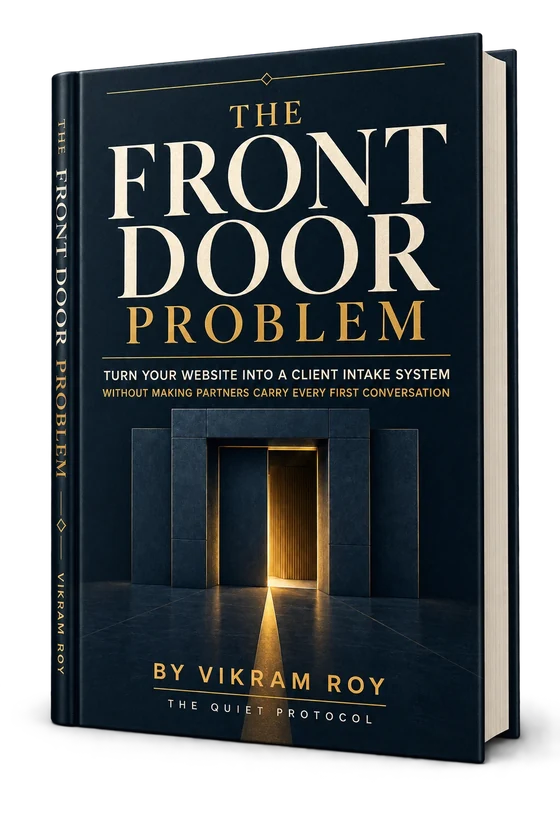
The Front Door Problem
Turn your website into a client intake system without making partners carry every first conversation.
Somewhere between the first inquiry and the signed engagement, things slip. A prospect emails on a Tuesday and hears nothing until Thursday. A referral from your best client lands in a general inbox and sits there unread while you are in a review meeting. You find out later, or you do not find out at all. This guide is about building a system so that instinct is not required for every single interaction.
Read the complete web edition below. The downloadable edition is being revised.
Part I
You are not behind. You are carrying the front door.
- If you work alone, every interruption reaches you.
- If you have a small team, the interruptions spread.
- If your firm is established, they often hide inside inboxes, calendars and staff habits.
The problem is not effort. The problem is that the path into the firm was never designed as one system, so you keep compensating for it.
A note before we start
Written for people who carry more of the firm than anyone sees.
You are probably good at your work. Your clients trust you. Your practice runs. And yet a new lead books a fifteen-minute call expecting to talk about their situation, and gets a generic intake form they never finish.
You compensate. You patch it. You make the call yourself at 7pm. You always do.
This guide is not about replacing that instinct. It is about building a system so the instinct is not required for every single interaction.
The first thing a prospective client experiences is not your expertise. It is your intake process.
Vikram RoyFounder and Managing Principal, The Quiet Protocol
The intake system at most accounting and advisory firms was never designed. It accumulated. A call here, a form there, a calendar link someone added once. This guide is about replacing that with something intentional.
Five things
What you will leave with
- 1
Diagnose
A six-statement diagnostic that shows exactly where your intake is leaking time and trust.
- 2
Map
A routing map for new prospects, existing clients and professional referrals, so each visitor gets the right path, not the same one.
- 3
Intake model
A minimum-question intake model that collects only what changes the next step. Nothing more.
- 4
AI test
A clear decision framework for whether voice AI would actually help your firm, or just add complexity.
- 5
Worksheet
A time-recovery worksheet to estimate how many hours per week your current front door is costing you.
You do not need to rebuild your entire practice. You need a better path into it.
Contents
The map
- Part I
The invisible intake problem
See where attention disappears.
- The front door nobody designed
- Two sides of the same moment
- Sarah's inquiry, a composite scenario
- The phantom vibration
- Tax season does not arrive as one task
- Where owner and staff time disappears
- The 90-Second Front Door Check
- Part II
The website becomes a system
Turn clarity into action.
- From brochure to client intake system
- Perception begins before contact
- The five client-facing moments
- Part III
The CPA intake blueprint
Give each visitor the right path.
- The three doors
- The existing-client relief valve
- Professional referrals need their own path
- Different services need different paths
- Ask only what changes the route
- Four valid outcomes
- The intake decision loop
- Keep the accounting stack
- Part IV
AI as an enhancement
Add coverage after the foundation is clear.
- First, make the path clear
- AI should extend a clear system
- When the website may be enough
- Choose the right layer
- The human boundary
- Part V
Install the quiet front door
Build your first working map.
- The installation sequence
- Your Time Recovery Worksheet
- The Quiet Front Door Scorecard
From Part I
Two sides of the same moment
Every first inquiry is two experiences happening simultaneously.
What the client feels
- Am I in the right place?
- Does this firm handle my situation?
- Should I call, email, or book?
- What happens next?
- Is anyone actually going to respond?
What the firm experiences
- An unqualified inquiry in a general inbox.
- No context about what the person actually needs.
- A partner who becomes the default first responder.
- A calendar that fills with the wrong conversations.
The gap between these two experiences is the front door problem. It is not a people problem. It is a design problem.
From Part III
The three doors
Start by separating three visitor types. Each needs a different path, not the same form.
New prospect
Needs to understand fit, share context, and receive a clear next step. Route through the intake form. Ask only what changes the outcome.
Existing client
Contacts the person they trust most. Give them three obvious routes instead: the client portal for documents, a dedicated scheduling link for meetings, and a direct message channel for urgent matters. Protect the partner's calendar.
Professional referral
Carries borrowed trust. Acknowledge the introduction immediately. Route to a dedicated referral path, not the standard prospect form. The response speed and tone signal how you treat the relationship.
Send all three through the same door and that is where the friction starts.
From Part III
Ask only what changes the route
Use this test for every intake question.
If the answer changes fit, urgency, owner, preparation, or next step.
If it only satisfies curiosity.
Good questions include
- Which service are you seeking?
- What entity or client type is involved?
- What deadline or trigger brought you here?
- Are records current?
- Who referred you?
The goal is not to complete discovery online. The goal is to make the next human step more useful.
From Part I
The 90-Second Front Door Check
From Part I. Score each statement from 0 to 2. 0 means not true, 1 means partly true, 2 means consistently true.
| Statement | Score |
|---|---|
| A visitor can quickly find the right service path. | 0, 1 or 2 |
| We collect enough context to choose the next step. | 0, 1 or 2 |
| Not every visitor reaches the same calendar. | 0, 1 or 2 |
| Existing clients have a clear route for routine needs. | 0, 1 or 2 |
| Professional referrals receive a distinct response. | 0, 1 or 2 |
| Every inquiry has an owner and a response expectation. | 0, 1 or 2 |
- 0 to 4Your front door depends on people catching gaps.
- 5 to 8Parts work. The handoffs need structure.
- 9 to 12The foundation is strong. Look for specific pressure points.
A scored, interactive version of this diagnostic runs on our accounting hub. Score it there.
From Part V
Your Time Recovery Worksheet
From Part V. Estimate one ordinary week, add the minutes, divide by sixty. That is the weekly attention surrounding your front door.
- 01New inquiries, times the minutes spent clarifying each
- 02Routine client requests, times the minutes spent routing each
- 03Meetings, times the minutes spent scheduling and confirming each
- 04Meetings, times the minutes spent collecting missing context
Add the minutes. Divide by sixty.
Do not assume the entire total will be recovered. Use it to decide where better structure would matter most.
The guide puts the combined owner and staff total at roughly 5 to 10 hours a week. That figure is illustrative, based on common patterns, and is not a guaranteed outcome.
A live version that does the arithmetic runs on our accounting hub.
From Part III
Keep the accounting stack. Upgrade the client-facing layer.
- Tax software can stay.
- Client portal can stay.
- Document system can stay.
- Practice management can stay.
The client-facing layer sits in front. It explains. It captures. It routes. It prepares. Then it hands the work into the systems your firm already uses.
The exact connections depend on your stack. We should never promise an integration before we verify it.
From Part IV
AI is the last layer, not the first.
Add AI to a front door that is already unclear and it can repeat the vagueness. The confusion moves faster.
- 1Define your services clearly.
- 2Build the intake questions that change the route.
- 3Set the booking rules that protect the right calendars.
- 4Then, and only then, consider where AI extends the system.
I start with the website-led intake system. Then I ask one question. Where does the firm still lose a good interaction because no person is available?
Take this with you
The Quiet Front Door Scorecard
Check what is true today.
Start with the unchecked item that creates the most repeated friction.
This guide is designed for CPA and accounting firm principals and their teams where the intake bottleneck is costing owner and staff time. If your firm already has a dedicated front-office team handling every first contact, most of this is already in place.
The Front Door Problem
Turn your website into a client intake system without making partners carry every first conversation.
Read the complete web edition below. The downloadable edition is being revised.
After the book
After the book
The guide is complete on its own, and a firm can act on it without us. If you would rather see the ideas working, or talk them through, these are the next steps.
- Use a working CPA intake systemOur live demonstration. Choose a service, answer the questions, watch the route change, and book at the end.
- The accounting authority hubThe argument from this book, applied: the three doors, the scored check and an interactive Time Recovery Worksheet.
- CPA client intake systemsThe deep page on qualification, routing, calendar protection and the prepared handoff.
- Accounting firm website designWhat the website itself has to do before it can carry intake.
What working together looks like
We start with a review, not a proposal.
- 01
The Client Intake Review
We map every way people currently enter your firm: website, phone, email, referrals and direct contact. We identify where confusion, delay and interruption are happening.
You leave with a clear picture of your front door.
- 02
The Design Session
We define your visitor types, your intake questions, your booking rules and your handoff owners. We decide what stays human and where structure can help.
You leave with a system design you can actually use.
- 03
Installation and verification
We build the paths, configure the tools, and test every route like a real client would. Then we verify the system is working before we hand it back.
You leave with a front door that runs without you carrying it.
The right starting point is always the Client Intake Review. It costs nothing to see the map clearly.
Book a call