A plumbing company does not lose business because it lacks a website. It loses business in the gaps between things: the call that rang while you were under a sink, the estimate nobody followed up, the customer from last year who has no reason to remember you, the happy homeowner who never got asked for a review.
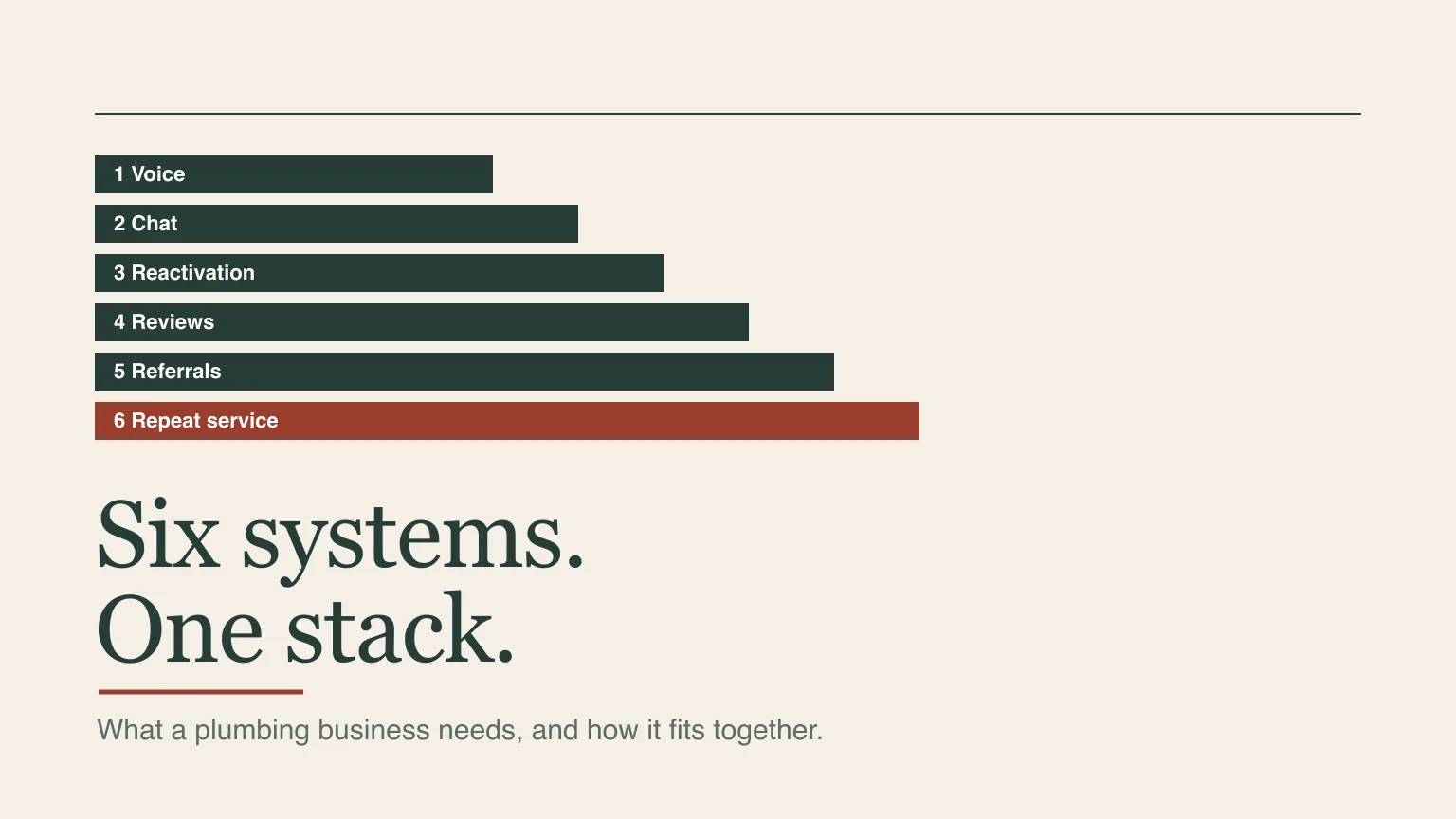
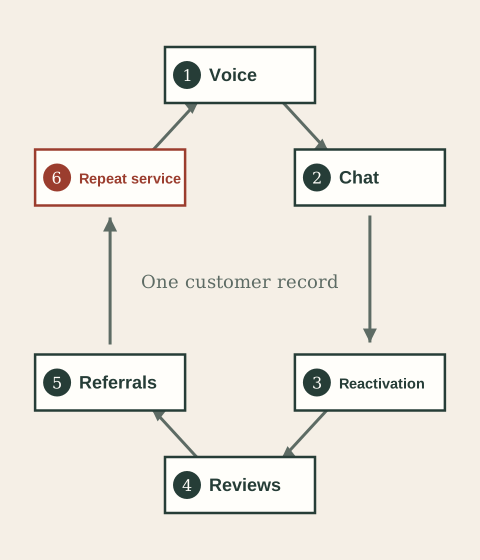
Six systems close those gaps. Each does one job, and each hands the customer to the next. Together they are one stack. This guide explains what each one does, what you decide, and how to have them built for your business instead of bought as six separate tools.
The loop in one picture
1. The AI voice employee: never miss a call
You are on a job. A homeowner's water heater is leaking. The call goes to voicemail, and the homeowner calls the next plumber. The first system fixes that.
An AI voice agent answers your phone around the clock, asks the questions you would ask, sorts the call into emergency now, same day, scheduled or not a fit, books the visit and texts you the summary. Real emergencies go to your on-call phone. Our guide to the plumber call card shows the sorting rules.
What you decide: your emergency rules, your service area, your hours and who gets the alert.
2. The AI chatbot: answers questions and books jobs
Not everyone calls. Some text your business number, and some type a question into your website at 9 p.m. A chatbot answers the common questions, such as what you service and whether you come out on weekends, and offers the next available time. It works while you sleep.
What you decide: what it may say about pricing, which jobs it books itself and when it hands the conversation to you.
3. The reactivation system: win back lost customers
Your customer list is the cheapest place to find work. Every plumber has past customers who have not called in a year, and some have an old estimate that went quiet. A reactivation system sorts that list by when you last served each customer and sends the right message to the right group.
It has a rule you cannot skip. Texts to customers need their consent, they need a clear STOP, and they should go out between 8 a.m. and 9 p.m. The FCC and the FTC set these rules. Our guide to bringing past customers back covers a clean version, and we build the consent and opt-out into the system so it is not an afterthought.
What you decide: who is on the list, what you offer and how often you are willing to contact them.
4. The review accelerator: more reviews, on autopilot
Reviews help decide who gets the call from a stranger. The review system asks every customer after the job, by text, with the link to your Google profile, sends a reminder to the ones who do not respond and alerts you when a review lands. It runs without you remembering to ask.
Two rules keep it safe. Ask everyone, not only happy customers, because Google calls screening who gets the link review gating. Offer nothing in return for a review, because Google treats rewards for reviews as prohibited. Our guides on how to ask for Google reviews and why reviews disappear explain both.
What you decide: when the request goes out, who sees unhappy feedback first and how you reply.
5. The referral flywheel: turn happy customers into new ones
A satisfied homeowner knows a neighbor with a problem. The referral system asks at the moment it is easiest, right after a job goes well, makes it simple to pass your name along and thanks the person who did. You can reward the referral. Never reward the review.
What you decide: the thank-you, how you track who referred whom and which customers you ask.
6. The lifetime value system: keep customers booking
Most plumbing customers need you again. A water heater ages. A fixture starts to drip. The repeat service system keeps your name in front of them with reminders for seasonal checks and maintenance, follows up on estimates that went quiet and invites regulars to a maintenance plan. It treats the first job as the start of the relationship, not the end.
Our HVAC maintenance agreements guide shows how a recurring plan works, and the same thinking applies to plumbing.
What you decide: which services you remind people about and what a maintenance plan includes.
Why one stack beats six tools
Buy each system separately and you get six logins, six customer lists and six places for a customer to fall through. The point of a stack is a single customer record. The call becomes a contact. The contact gets a booking, a review request, a seasonal reminder and a referral ask, in that order, from the same place.
That is how we build it. These systems run on a platform like HighLevel (we earn a commission if you buy through this link), which holds the contacts, calendar, texting and AI features in one place, and we also build on HubSpot and the tools you already use. We are a systems firm. We design the stack for your trade and install it, so you do not assemble it yourself.
What goes in the stack for you
Every plumbing company is different, so we start with your phone and your customer list and add the systems in the order they pay. Our Essential AI voice agent plan covers the first system and includes the customer system, website and phone app that the others build on. Price: $449/month with 600 minutes of calls, free setup, no contract. When you want the full stack designed and managed for your trade, that is our signature systems work, from $995/month, setup from $5,000.
Clinics and law firms need more, such as privacy controls, so those stacks are priced differently. Roofing, HVAC, electrical and other trades each get their own version, because each has a different call, a different season and a different repeat customer.
Where to start this week
- Pick the gap that costs you most. Missed calls, silent estimates, no reviews or a list that never hears from you.
- Write your emergency rules. Who gets the call, how and what happens if they do not answer.
- Export your customer list with the date of each last job and whether you have consent to text.
- Decide how you will ask for reviews: every customer, with a link, with no reward.
- Book a conversation about your stack. We will map it to your trade.
To hear the first system, call the demo line at +1 855-916-4334, see the plumbing page or book a demo built around your company.
Frequently asked questions
What systems does a plumbing business need?
Six: an AI voice agent that answers calls, a chatbot that books jobs, a reactivation system for past customers, a review system that asks every customer, a referral system and a repeat service system for maintenance and follow-up. They share one customer record so each hands the customer to the next.
Can an AI answer every call for a plumbing company?
An AI voice agent can pick up every call, day or night, ask your questions, book the visit and alert your on-call phone for emergencies. It should be tested with real emergency calls before you rely on it, and calls that need judgment should reach a person.
Is it legal to text past customers?
Marketing texts generally need the customer's consent, a clear way to reply STOP and sending inside the allowed hours. Rules differ by state and change, so build consent into the system and ask a lawyer about your own situation.
We are an independent HighLevel affiliate and are not HighLevel. Consent and messaging rules are summarized from the FTC and FCC and are not legal advice. Nothing here promises any number of calls, reviews, customers or revenue.
See how website enquiries, phone calls, estimate follow-up and review requests can fit your plumbing business. Start with the part you need.
See the plumbing page