Most HVAC owners know they should sell maintenance agreements. Fewer have a written one, a price they can defend and a way to make sure the agreement renews instead of quietly lapsing in month eleven. This guide covers all three: what goes in an agreement, how to price it from your own costs, and how to sell and renew it without turning your technicians into salespeople.
One note on sources. HVAC agreement data is thin and mostly comes from vendor blogs. Where a number below comes from one company's guide or an old trade article, we say so, and none of it is a promise about your results.
Why an agreement beats another repair call
A repair call is a transaction. An agreement is a reason for the customer to call you first next time, and a reason for you to be in the house in March and September when your schedule would otherwise be thin.
An Air Conditioning Contractors of America (ACCA) article from June 2015 gave two examples. One shop reported that service agreements made up about a quarter of its roughly $3.5 million in annual volume, and said nearly half of its agreements were paid monthly by card or bank account. Another reported about 14,000 residential HVAC agreements. The same article said monthly payment plans pushed renewal rates into the 90 percent range. Those are one trade publication's examples from over ten years ago, not a benchmark, but they show the shape: the shops that treat agreements as a product, with simple billing, keep their customers.
What goes in the agreement
Keep the document short enough that a homeowner reads it. One 2026 guide from a field-service software company lists the clauses most agreements carry:
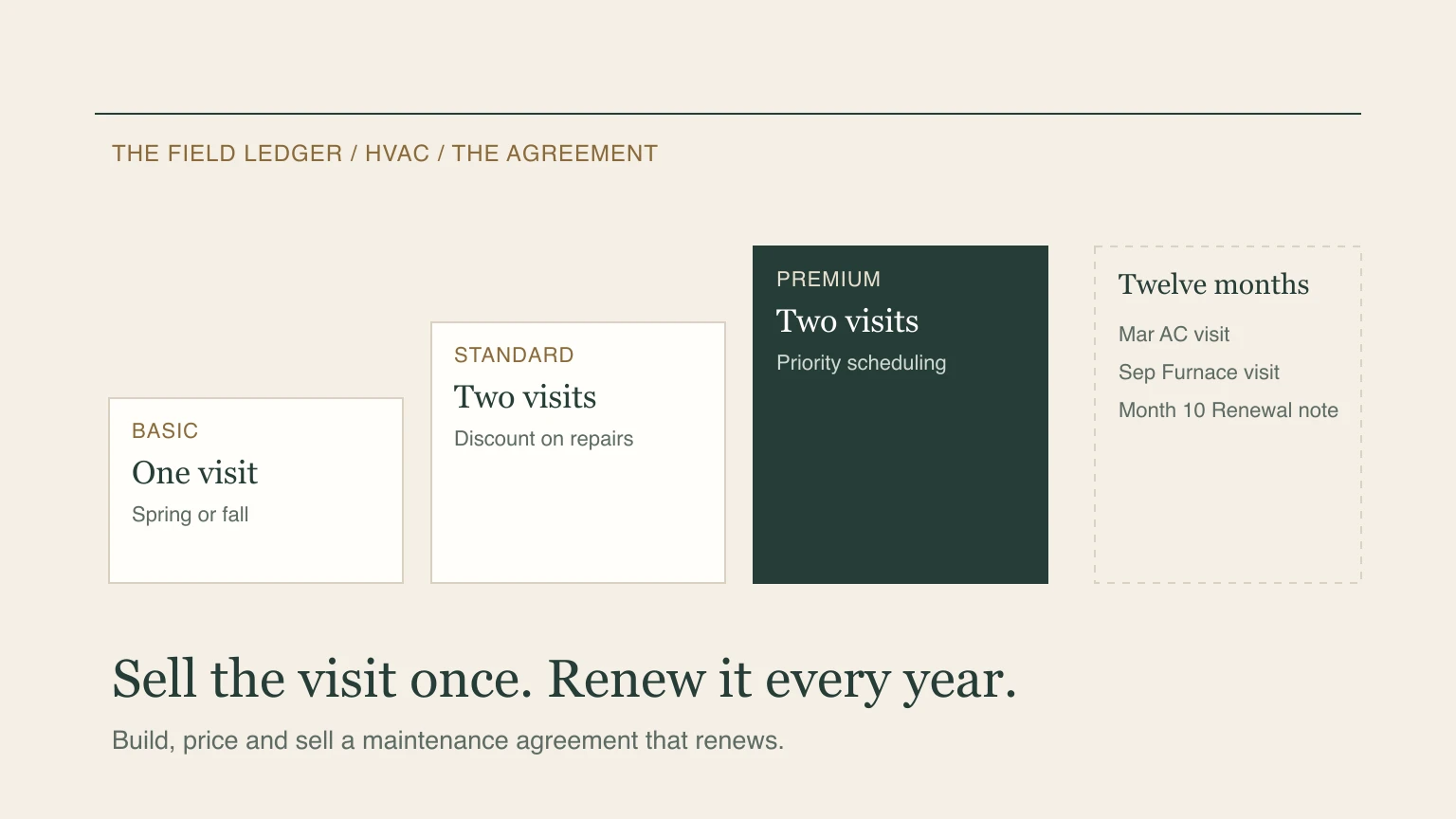
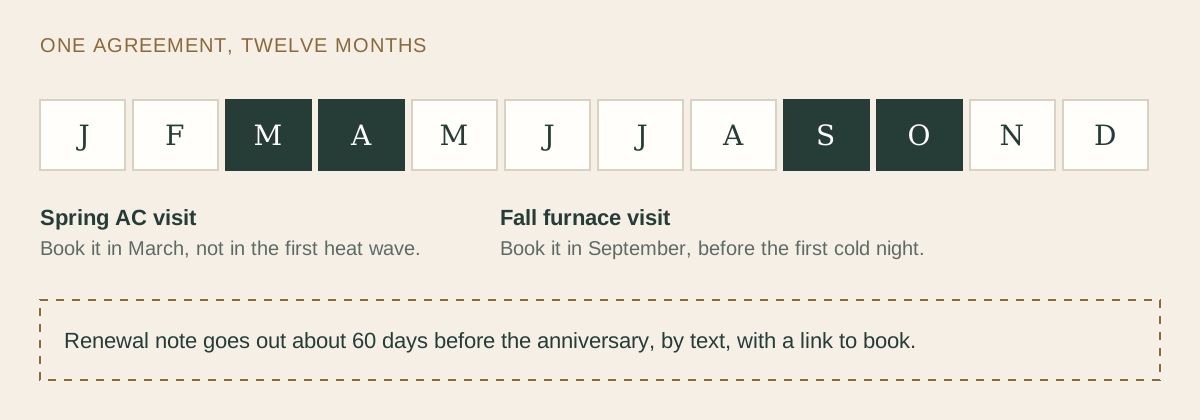
- Two visits a year. One before cooling season and one before heating season.
- Priority scheduling. A defined response window for agreement holders, stated in the document.
- A repair discount. The same guide cites 10 to 20 percent.
- No trip charge for agreement holders.
- Renewal terms. Whether it renews automatically, how the customer cancels and how much notice you give before charging them again.
Be careful with automatic renewal. Rules differ by state and province, and some require clear disclosure and an easy way to cancel. Have a local attorney read your final wording. This is general information, not legal advice.
What each visit should cover
Write the checklist into the agreement so the customer knows what they are paying for and your technician knows what to do. The 2026 guide lists, for a spring cooling visit, an inspection, filter replacement, condenser coil cleaning, refrigerant check, thermostat test, drain line inspection and electrical checks. For a fall heating visit it lists a gas connection inspection, a heat exchanger examination, ignition and burner checks, safety control tests and a written report. Adjust it to the equipment you actually service.
How to price it from your own numbers
The only price that works is one built from your costs. Do not copy another shop's number. Start with a worksheet:
- Technician time for one visit, including drive time, at your loaded hourly cost.
- Truck and fuel per visit.
- Parts and supplies per visit: filters, cleaner, small parts.
- Admin cost to schedule, remind and bill.
- Your target margin on the visit itself.
- The value of the extras, meaning the repair discount and priority scheduling you give away. Estimate how many repair calls an average agreement holder generates and how much the discount costs on them.
Add the first five lines for one visit, multiply by two, add the cost of the extras and add your margin. That is your floor. Everything above the floor is the value of the relationship.
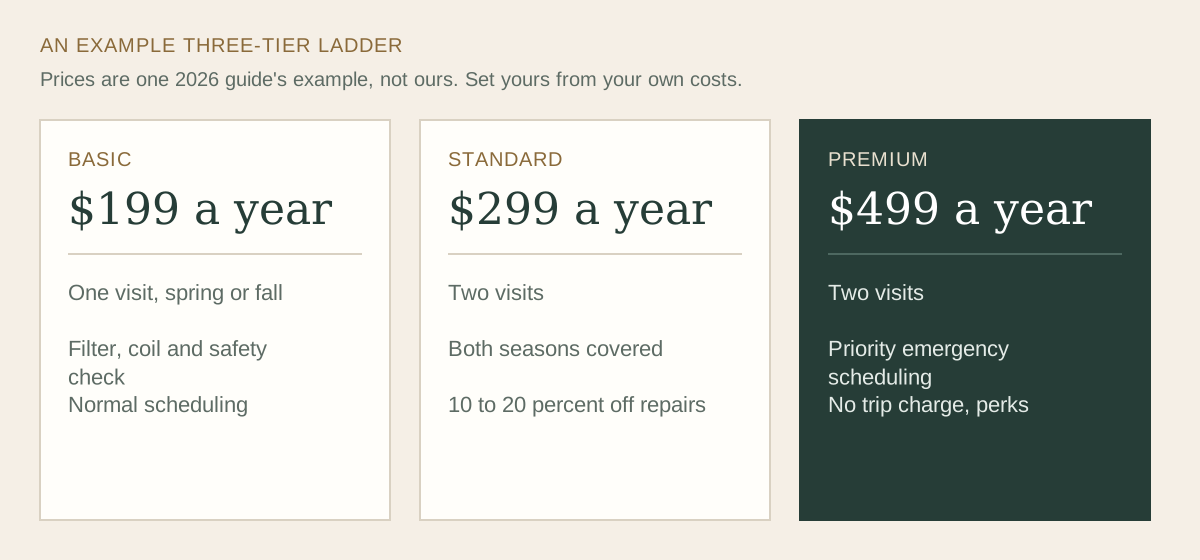
For reference only: the same 2026 guide suggests a three-tier ladder at $199, $299 and $499 a year for residential customers, and says the average sale with tiers is $319. The 2015 ACCA article cited about $174 a year at one shop. These figures come from single sources and they are not ours. Your market and your costs decide yours.
How to sell it without a hard pitch
The best moments are the ones where the customer already trusts you.
- At installation. A new system is the moment a homeowner wants to protect their investment. The 2026 guide reports a 60 to 80 percent close rate here, a figure it does not source, so treat it as an aim rather than a fact.
- At the end of a repair. Show what the agreement would have changed: the visit that might have caught the problem, the discount they would have had on this repair.
- On the phone. Customers call and ask whether you have a plan. If the person or system answering does not know, you lose the easiest sale you will make all year.
Pay technicians something for each agreement they sign. The guide suggests $25 to $50. Whatever you choose, make it simple and pay it quickly.
The phone script that sells it
Give whoever answers the phone one paragraph, in writing: "Yes, we have a maintenance plan. It includes two visits a year, priority scheduling and a discount on repairs. Plans start at [your price] a year, and I can book your first visit now."
An AI voice agent can follow that script on every call at any hour and book the first visit onto your calendar. It cannot negotiate or quote custom terms, and it should hand off when you tell it to.
How to make it renew
Renewals fail for boring reasons: the customer forgot, the card expired, nobody reminded them. Fix the boring reasons.
- Offer monthly billing. One twelfth of the annual price, charged by card or bank. The ACCA article tied monthly payments to renewal rates near 90 percent.
- Remind early. The 2026 guide recommends a reminder about 60 days before renewal. Send a text with a link to book the next visit.
- Book the next visit at the last one. Before the technician leaves, put the next spring or fall visit on the calendar.
- Track three numbers: agreements sold, agreements renewed and the share of agreement holders who book a repair with you. The last one tells you whether the agreement is protecting your repair revenue.
The guide calls a renewal rate between 75 and 85 percent excellent. It is an unsourced range, but it gives you something to measure against.
What to do this month
- Write the one-page agreement and the two visit checklists.
- Work out your floor price from your own costs.
- Put the phone script in writing for whoever answers calls.
- Add the agreement to the end of every installation and repair job.
- Set up monthly billing and a 60 day renewal text.
If you want the phone covered at all hours, see our two AI voice agent plans or call the demo line. If you want help with the reminders, read how maintenance reminder automation works for HVAC.
Frequently asked questions
What should an HVAC maintenance agreement include?
Two visits a year with written checklists, priority scheduling, a repair discount, no trip charge and clear renewal and cancellation terms. Have a local attorney read the wording, especially automatic renewal.
How much should I charge for an HVAC maintenance agreement?
Price it from your own cost per visit plus the cost of the discounts and priority you give, then add margin. One 2026 guide suggests $199, $299 and $499 residential tiers, but your market and costs decide yours.
How do I get customers to renew?
Offer monthly billing, send a reminder about 60 days before renewal with a link to book, and put the next visit on the calendar at the last one.
The ACCA article is from June 16, 2015. The 2026 figures come from EstimateKit's HVAC maintenance agreement guide and are not independently sourced. Both were read on October 7, 2026. Nothing here is legal advice.
Find the next useful step for your business.
Continue this decision