To start a plumbing business you need three things in a particular order: the right license for your state, a business set up and insured on paper, and a way for emergency calls to reach you from your first week. Most people plan the first two and forget the third, then learn why plumbers are known for missed calls.
We sell an AI voice agent and local search, so we have a stake in the third part. The first two come from government sources, and we link them so you can check the rules for your own state.
The license ladder
Plumbing licensing is set by states and some localities, so the rules differ by where you work. The Bureau of Labor Statistics describes the general shape, in an Occupational Outlook Handbook page last modified August 27, 2026.
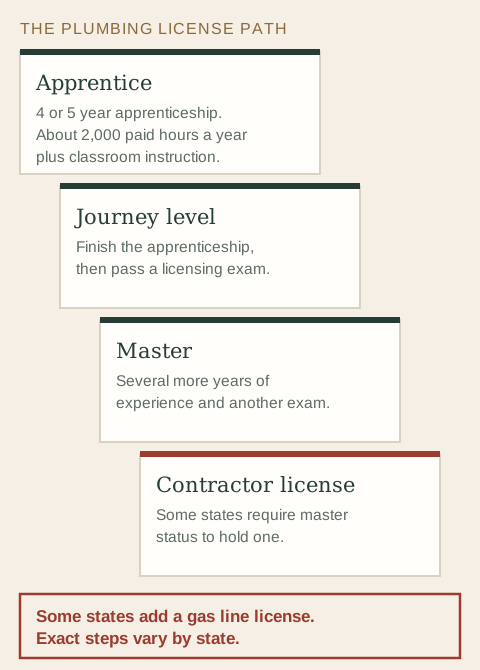
Here is what that means in plain terms:
- Most states and some localities require a license. It usually takes about 2 to 5 years of experience and passing an exam.
- Most people learn through an apprenticeship. BLS says most are 4 or 5 years, with about 2,000 hours of paid work a year plus classroom instruction on safety, local plumbing codes, blueprints, math and applied physics.
- The contractor license may need more. Some states require master plumber status before you can hold a plumbing contractor's license.
- Gas lines can be separate. Some states require a special license for gas line work.
Your first call is not to a bank. It is to your state's licensing board. Ask which license lets you work for the public under your own business name, what experience and exam it needs and whether your city adds anything.
Put the business on paper
The U.S. Small Business Administration's launch guide lists the steps in the order most new businesses follow them:
- Pick your location. Where you are based and where you will work.
- Choose a business structure. Ask an accountant which fits you.
- Choose a name, and check it is not already in use in your state.
- Register the business with your state.
- Get your federal and state tax IDs.
- Apply for licenses and permits. For you, that is the plumbing license above.
- Open a business bank account, separate from your own.
- Get business insurance. Ask an agent what your license and your state require.
We have not listed insurance types or fees, because they depend on your state and your work. Ask your licensing board and an insurance agent for your own list. The SBA page shows only the step titles, so use it as a checklist, not a manual.
The part nobody plans: the phone
BLS says most plumbers work full time, including nights and weekends, and that they are often on call for emergencies. Self-employed plumbers can set their own schedules, but the burst pipe sets yours.
That makes the phone the first real decision in a new plumbing business. Here are the options:
- You answer everything. Free, and tiring. You will miss calls while you are under a sink, and a homeowner with water on the floor will call the next plumber.
- Voicemail. Free, and it loses the emergency calls.
- A live answering service. A trained person answers in your business name. It costs more as your call volume grows.
- An AI voice agent. It answers every call at once, asks your questions, books the visit and alerts your on-call phone.
Our guides go deeper: how to choose a plumber answering service and write a call card, what an emergency dispatch looks like on a Sunday and what each type of service costs.
Where your first customers come from
You will not have reviews or a reputation on day one, so you need ways to be found that do not depend on either.
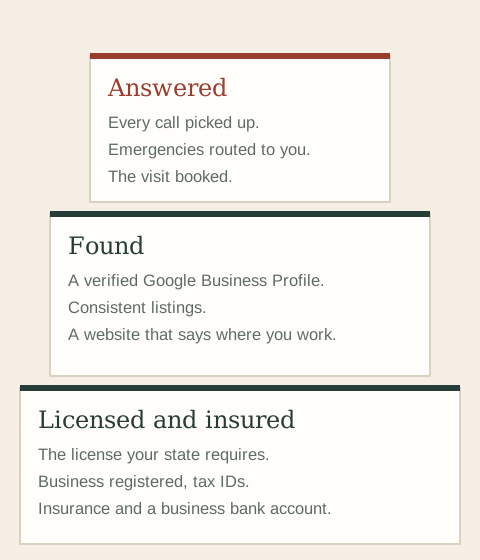
Get listed properly. A verified Google Business Profile, with the same name, address and phone everywhere customers look, is where nearby customers find you. Local Ranking Accelerator builds and manages that identity. Price: $99/month, or $82.50/month billed yearly.
Consider Local Services Ads, with patience. Plumber is a listed Google Local Services category. Google says verification requirements vary and may include licenses, insurance, background checks and a verified Google Business Profile, and that the process takes on average three to four weeks after you submit your documents. Our guide to the Google Verified badge explains what it takes and what it does not change.
Ask for the review after every job. Early reviews help a new business look established. Our guide on how to ask without pestering shows how.
Be careful with paid leads. Platforms sell leads from day one, which is tempting when you have none. Do the arithmetic first. Our Thumbtack guide shows how.
What to put in place first, and when
If you are one person starting out, you do not need everything at once. Here is the order we would use:
- The license and the paperwork. Nothing else matters without them.
- A phone rule. Decide who answers when you cannot, and test it.
- A Google Business Profile and consistent listings.
- A simple website that says where you work and how to call.
- Review requests from your first job.
When missed calls start costing you real jobs, an AI voice agent pays for itself. Our Essential AI voice agent plan answers 24/7 in English, Spanish or French, books the visit, texts you the summary, sends real emergencies to your on-call phone and texts back callers you miss. Price: $449/month with 600 minutes of calls, free setup, no contract. It also includes a customer system with a job pipeline, a booking calendar, a website of up to ten pages and a phone app for quotes and payments. If one extra job a month earns you more than the plan costs, it pays for itself. That math is yours to run, and we do not promise any number of jobs.
Do this month
- Call your state licensing board. Ask what you need to work under your own name.
- Talk to an accountant and an insurance agent, in that order.
- Write your emergency rule. Who gets the call, how, and what happens if they do not answer.
- Set up your Google Business Profile as soon as the business is registered.
- Test your phone. Call it after hours and pretend your kitchen is flooding.
To hear ours, call the demo line at +1 855-916-4334, see the plumbing page or book a demo built around your company.
Frequently asked questions
Do you need a license to start a plumbing business?
In most states and some localities, yes. The Bureau of Labor Statistics says licensing usually requires about 2 to 5 years of experience and passing an exam, and some states require master plumber status for a contractor's license. Rules differ by state, so call your state licensing board before you do anything else.
How long does it take to become a plumber?
The BLS says most plumbers learn through a 4 or 5 year apprenticeship, with about 2,000 hours of paid on-the-job training a year plus classroom instruction. Licensing can add experience and an exam, depending on your state.
What do you need before you take your first plumbing job?
Your license, a registered business with tax IDs, business insurance, a business bank account and a way to answer calls. The U.S. Small Business Administration lists the registration, tax ID, license, bank and insurance steps. Ask your licensing board and an insurance agent what your state requires.
Licensing information comes from the Bureau of Labor Statistics Occupational Outlook Handbook, last modified August 27, 2026, and the U.S. Small Business Administration's launch guide, both read October 11, 2026. Requirements differ by state and change. This is not legal, tax or insurance advice. Confirm your own requirements with your state licensing board.
Find the next useful step for your business.
Continue this decision