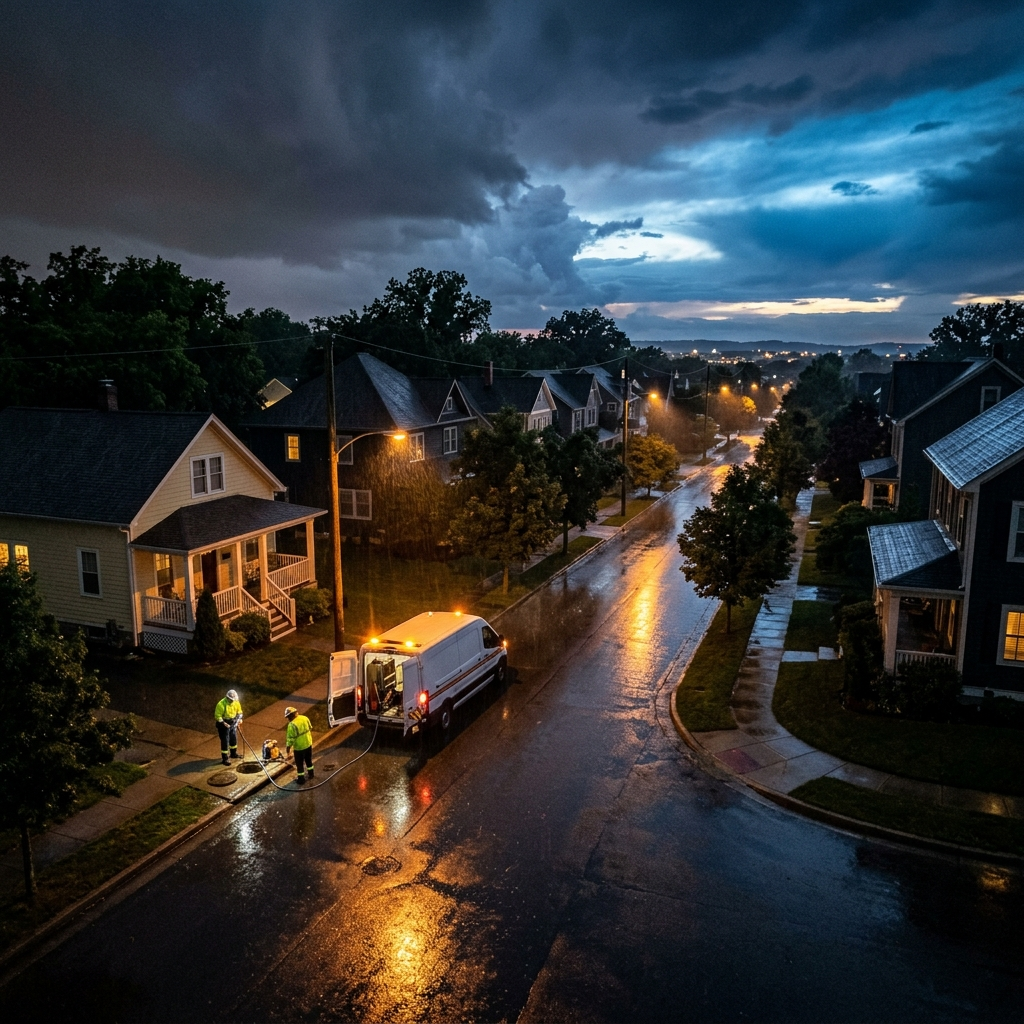

A single severe weather event can send a restoration company's call volume from 3 or 4 calls per day to 30 or 40 calls in a six-hour window.
Treat any number without a nearby source or stated method as a planning assumption, then replace it with your own records.
Most of those calls arrive between 10 PM and 6 AM, when a storm has passed and homeowners are discovering damage for the first time. Most of those calls, for most restoration companies, go to voicemail.
I've seen this play out specifically enough to describe it with precision. A storm moves through a market on a Thursday night. The restoration company's owner is asleep by midnight. Between 11 PM and 4 AM, 22 calls hit the main line. By the time he wakes up Friday morning and reviews voicemails, he has 7 messages, the homeowners who were patient enough to leave one. The other 15 called the next company on Google Maps. Some of those 15 become $15,000 remediation projects for a competitor.
The restoration companies that capture storm season are not the ones with the most trucks or the best marketing. They are the ones that can answer every call within three rings, regardless of the hour, and dispatch efficiently within minutes of first contact. The intake system is the bottleneck, not the production capacity.
How Storm Events Create a Restoration Call Surge
A severe weather event moves through a geographic area over hours. The damage discovery phase follows predictably.
During the storm itself, homeowners are focused on personal safety. Calls to restoration companies are low during active storm conditions.
Within 30 to 90 minutes after the storm passes, discovery calls begin. Homeowners go into basements and find standing water. They walk their properties and find tree damage. They notice ceiling stains from roof damage. Discovery calls peak in the 2 to 5 hour window after storm passage.
If the storm moves through in the early evening, the peak call window is overnight, often 10 PM to 3 AM. If it moves through midday, the peak call window is the late afternoon and early evening, overlapping with business hours but extending well past them.
For a company receiving 60 to 80 calls per month in normal conditions, a single significant storm event can generate 40 to 80 calls in 24 hours. For a major event covering a wide geographic area, a regional flood, a severe derecho, a significant ice storm, the number can be higher.
Why Normal-Month Intake Systems Fail During Storm Surges
The systems most restoration companies use for normal-month call volume are not built for surge conditions.
A single office line becomes a bottleneck when more than one call arrives simultaneously. The second caller gets a busy signal. The third caller gets a busy signal or rings through to voicemail while the first call is still active.
During surge conditions, this bottleneck is not a minor inconvenience. It is a systematic transfer of high-value jobs to competitors with better intake infrastructure.
A homeowner who discovers 6 inches of water in their basement at 11:30 PM and gets a busy signal does not try again in 20 minutes. They call the next number. The company that answers gets the job, in a storm event, that is $8,000 to $25,000 in mitigation and remediation work from a single answered call.
The staffing problem compounds the infrastructure problem. During normal operations, having one person on call overnight may be sufficient because overnight calls are infrequent. During a storm surge, one person on call cannot triage, dispatch, and manage customer interactions simultaneously when 15 calls are arriving in a two-hour window.
Voice AI resolves both problems without adding headcount. It handles unlimited concurrent calls, there is no busy signal, no hold queue, and no call that reaches voicemail because another call is active. Every caller gets a live response within three rings.
The Specific Information That Matters in Storm Intake
Storm restoration calls have a different profile than everyday water damage calls.
During normal months, restoration calls often involve slow-developing damage: a long-running leak under a sink, mold discovered during a renovation, a water heater failure. These calls have a 24 to 72 hour urgency window. The homeowner can wait until morning for a response.
Storm damage calls are nearly always immediate urgency. A homeowner with 8 inches of standing water in their basement is not waiting for a morning callback. The water is actively damaging structure, finishes, and contents. Every hour of delay increases the scope, and the cost, of the remediation project.
For storm calls, the intake needs to capture:
- The address, dispatch routing determines which crew responds and how quickly
- The nature and location of water intrusion, a flooded basement and a roof leak have different urgency levels and different crew requirements
- The approximate depth or extent of standing water, determines whether extraction equipment needs to accompany the initial response
- Whether the structure is currently occupied, inhabited structures with active water intrusion are dispatched before unoccupied structures
A voice AI intake system configured for storm events captures all four data points in a structured 90-second interaction and routes a complete notification to the on-call crew within 30 seconds of call completion. The crew has everything they need to make a dispatch decision and provide an ETA before the homeowner has finished calling their second company.
Insurance Coordination During Storm Events
Storm events also generate a parallel call stream from insurance adjusters, claim lines, and preferred vendor program coordinators. These callers are placing high-value referrals.
An adjuster calling a restoration company's main line during a storm surge and reaching voicemail moves to the next company on their preferred vendor list. Losing one adjuster referral during a storm event means losing a job typically $10,000 to $40,000 in scope.
Intake systems configured for storm events handle adjuster calls through a separate routing path. When the caller identifies as an insurance representative, the system captures the claim number, the insured's address, and the adjuster's callback number, then sends a high-priority notification to the project manager rather than the production crew.
This two-queue approach, one for direct homeowner emergency calls, one for insurance referral calls, ensures both call types receive appropriately prioritized responses without either queue degrading the other.
Preparation Timeline: What to Build Before Storm Season
Storm season preparation follows a specific calendar depending on geographic market. For tornado and severe thunderstorm markets (central US, mid-Atlantic, Southeast), the primary window is March through October. For winter storm markets (Northeast, Midwest, mountain regions), the primary window is November through March.
The preparation that matters most is building and testing the intake system during the low-volume months before peak season begins.
Setting up a voice AI intake system in the middle of a storm event, when call volume is already high and the stakes are highest, means deploying an untested system in the most demanding conditions. Errors in configuration are expensive when 40 calls are arriving overnight.
Restoration companies that prepare in January for a February ice storm, or in February for a spring flood season, arrive at peak conditions with a tested, tuned intake system that has handled hundreds of normal-month calls before it faces surge conditions.
The preparation steps are: configure the AI intake system and test it with low-stakes calls during normal months; set up crew routing and notification protocols; configure separate queues for direct and insurance-sourced calls; and run a tabletop exercise where the team simulates a 40-call surge night to identify any gaps before a real event exposes them.
The Financial Difference Between Prepared and Unprepared Operations
During a significant storm event producing 60 inbound calls in 48 hours, at an average water damage job value of $7,500 and a 30 percent close rate on answered calls:
Unprepared operation (single line, voicemail for overflow and all after-hours): answering approximately 12 to 15 calls, closing 4 to 5 jobs, $30,000 to $37,500 in storm revenue captured.
Prepared operation (AI intake handling all calls concurrently, no busy signals, 24-hour coverage): answering all 60 calls, closing 18 jobs, $135,000 in storm revenue captured.
Revenue difference from a single storm event: $97,500 to $105,000.
For a mid-size restoration company, this single event can represent 15 to 25 percent of annual revenue. The decision not to prepare is not a minor operational oversight. It is a $100,000 decision made by default.
Before the Next Sales Call
Use this section as a quick buyer check. A restoration company owner does not need another vague automation pitch. They need to know which part of the front door is leaking, what the system will change, and how they will measure whether the fix is working.
Source method: compare the article against your own call log, CRM notes, booking calendar, missed-call records, web form timestamps, and Google Business Profile review recency. Those records are more useful than a generic benchmark because they show what buyers actually experienced in your business.
What proof should I look for in my own business?
Look for proof in the places where demand either moved forward or stalled: missed calls, short calls, unbooked forms, slow callbacks, no-show recovery, old leads, and reviews that were never requested. If the business cannot see those moments clearly, the first improvement is better tracking and routing.
How do I know whether this is a marketing problem or an operations problem?
If people are already calling, filling forms, asking for prices, requesting appointments, or comparing reviews, the problem is usually operations. More marketing will not fix a front door that lets warm demand wait. The better move is to capture and route the demand already arriving.
What should happen after the first response?
The first response should create a next step: booked appointment, estimate path, intake handoff, callback window, review request, or reactivation sequence. A response that only says someone will get back to you is not enough when the buyer is comparing several providers at once.
Where does The Quiet Protocol fit?
The Quiet Protocol fits when the business already has demand but too much of it depends on manual attention. We connect AI receptionist coverage, web intake, missed-call recovery, booking logic, follow-up, review requests, and reactivation into one managed front-door system.
The loss estimate is basic business math, not a magic claim.
Revenue-leak examples on this site are built from visible operating inputs: inquiry volume, missed-call or slow-response rate, booking rate, average job or client value, repeat value, and follow-up recovery. The fastest way to make the number real is to run the diagnostic for your closest business type, then compare it against your own call log, CRM, booking calendar, form timestamps, and review activity.
The practical questions behind this decision.
How many calls does a restoration company typically receive during a storm event?
Call volume during a significant storm event varies with the size of the affected area and the severity of damage. A localized severe thunderstorm affecting a few neighborhoods may generate 20 to 40 additional calls in 24 hours. A regional flood or major winter storm event can generate 80 to 200 calls across a multi-day window. Companies typically see a 4 to 8 times increase over normal daily call volume during peak surge conditions.
When does the surge in storm-related restoration calls typically arrive?
The call surge peaks in the 2 to 6 hours following storm passage, as homeowners complete personal safety measures and begin assessing property damage. For storms that move through in the evening, the surge peak is typically overnight, between 10 PM and 4 AM. This is precisely when most restoration companies have the weakest call coverage.
Why do restoration companies lose insurance adjuster referrals during storm events?
Adjusters placing referrals during storm events are managing high call volumes themselves. They call down their preferred vendor list and place the job with the first company that answers professionally and confirms capacity. A company that routes an adjuster call to voicemail during storm conditions loses the referral to the next company on the list. In a storm event, an adjuster may be placing 15 to 30 referrals per day.
What is the difference between storm intake and normal restoration intake?
Storm intake requires handling concurrent calls without any caller reaching voicemail or a busy signal. It requires rapid urgency triage to identify the highest-priority dispatches from a queue of simultaneous jobs. And it requires structured capture of the specific information , address, water extent, occupancy status , needed for efficient dispatch decisions when multiple crews are being routed simultaneously.
Can a restoration company set up storm-ready intake quickly if a storm is already approaching?
A basic AI intake system can be configured and deployed within 24 to 48 hours. However, deploying during or immediately before a storm means the system goes live without any normal-volume testing period. Companies that build and test their intake during off-season months arrive at storm conditions with a mature, configured system. Emergency deployment is possible but carries configuration risk at the worst possible moment.
How should restoration companies prioritize dispatches during a surge when jobs outnumber available crews?
The dispatch priority framework during a surge should weight: occupied structures over unoccupied structures; active water source (still flowing) over stopped source; finished living space over unfinished basement; commercial properties with business continuity implications over residential. A structured intake that captures these variables automatically allows the dispatcher to sort and prioritize without making phone-tag calls to assess each situation individually.
What proof should I look for in my own business?
Look for proof in the places where demand either moved forward or stalled: missed calls, short calls, unbooked forms, slow callbacks, no-show recovery, old leads, and reviews that were never requested. If the business cannot see those moments clearly, the first improvement is better tracking and routing.
How do I know whether this is a marketing problem or an operations problem?
If people are already calling, filling forms, asking for prices, requesting appointments, or comparing reviews, the problem is usually operations. More marketing will not fix a front door that lets warm demand wait. The better move is to capture and route the demand already arriving.
What should happen after the first response?
The first response should create a next step: booked appointment, estimate path, intake handoff, callback window, review request, or reactivation sequence. A response that only says someone will get back to you is not enough when the buyer is comparing several providers at once.
Where does The Quiet Protocol fit?
The Quiet Protocol fits when the business already has demand but too much of it depends on manual attention. We connect AI receptionist coverage, web intake, missed-call recovery, booking logic, follow-up, review requests, and reactivation into one managed front-door system.
Map how a serious buyer decides in this kind of business.
Use the operating reality of the industry instead of copying a generic lead-generation playbook.
Replace broad industry assumptions with the business's actual inquiry volume, customer value, response time, and booking data.
See how the capability in this article fits into a complete customer journey.
Restoration & RemediationSee the same decision through the language, buyer behavior, and operating reality of this industry.
Client Results & ProofInspect the starting condition, installation, measurement window, and outcome behind real client work.
Restoration Emergency Call Intake: A Dispatch Handoff Guide
A practical guide for restoration companies that need to turn an urgent water-loss call into a clear, time-stamped incident brief without letting automation make safety or dispatch decisions.

The Real Cost of a Missed Call for a Service Business: The Math Nobody Runs
A missed call costs more than the immediate job. Here is the full three-layer calculation, immediate value, lifetime client value, and referral chain, and the annual total most owners never see.

What Is a Revenue Leak Diagnostic? The 15-Minute Diagnostic That Reveals Your Service Business Revenue Gap
A Revenue Leak Diagnostic is a structured 15-minute diagnostic that calculates the exact dollar value of revenue a service business is losing at the point of first contact, before a single dollar of marketing is changed.