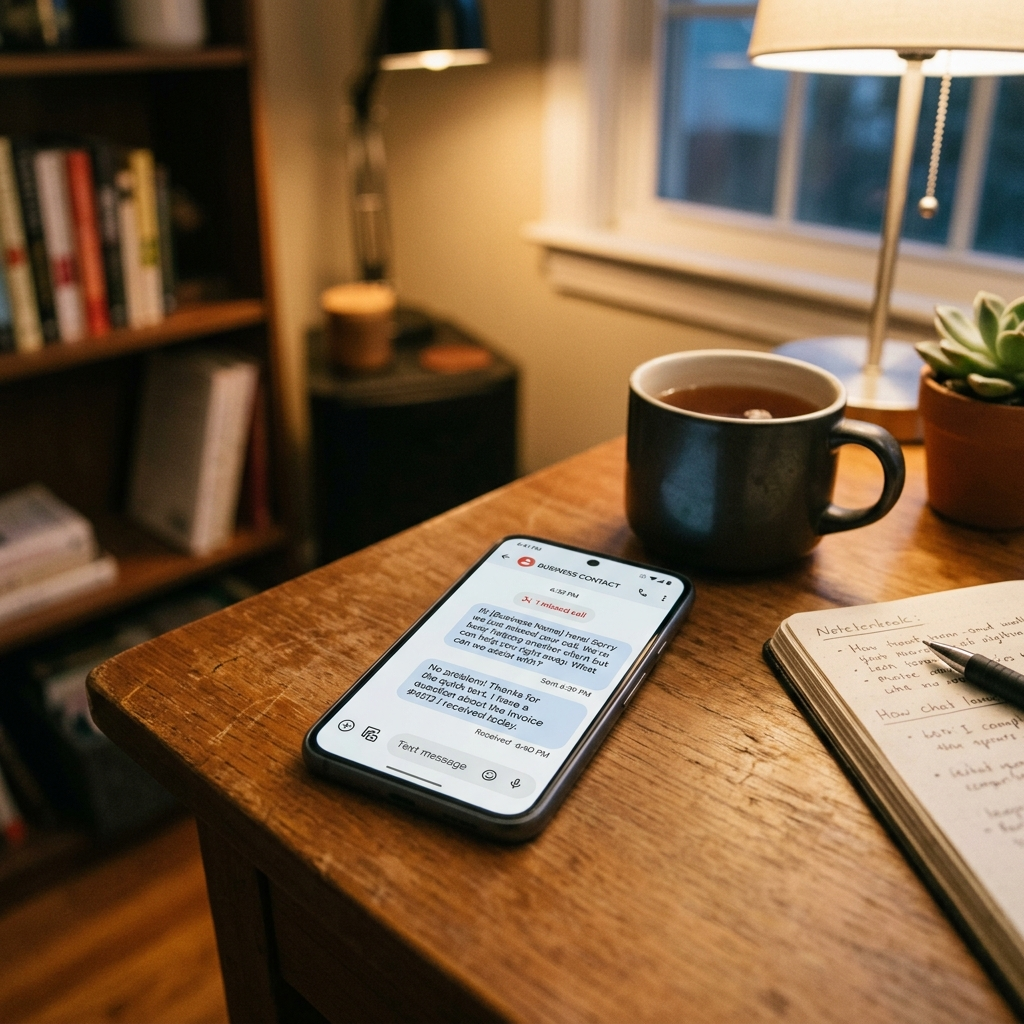

The missed call recovery system is the set of actions that contacts those callers before they make a final decision, and does so fast enough that the contact is still relevant.
Treat any number without a nearby source or stated method as a planning assumption, then replace it with your own records.
Every service business has a small pile of almost-revenue sitting in its phone records.
The owner usually does not see it that way.
They see missed calls as gone. The caller did not leave a voicemail, so the lead is dead. The phone rang after hours, so there is nothing to do. The call came in during a busy job, lunch break, or dispatch rush, so it gets mentally filed under "unfortunate but normal."
That is too passive.
Some missed calls are gone forever. A homeowner with water coming through the ceiling at 10 PM probably called the next plumber and booked whoever answered. But not every missed caller makes a final decision immediately.
Some are still comparing. Some called two other companies and hit voicemail there too. Some got interrupted. Some still need the service but have not booked anyone yet.
Those callers are recoverable.
Not all of them. Enough of them.
In Front Door Audits, missed-call recovery is one of the first places I look because the business already paid for the opportunity. The caller already had intent. The only question is whether the business has a way to re-open the conversation before the window closes.
The missed call recovery system is the set of actions that contacts those callers before they make a final decision, and does so fast enough that the contact is still relevant.
A Missed Call Is Not One Thing
The first mistake is treating every missed call the same.
A missed call at 2 AM for emergency plumbing is not the same as a missed call at 11 AM asking about a maintenance visit. A missed call from a repeat customer is not the same as a wrong number. A missed call during storm season is not the same as a routine pricing inquiry.
That matters because the recovery action should match the likely intent.
For urgent calls, the recovery needs to be immediate. A text 30 minutes later may already be too late.
For non-urgent calls, a fast text still helps, but the caller may remain recoverable for hours.
For repeat customers, the message can acknowledge the relationship.
For unknown callers, the message should simply reopen the door.
The goal is not to annoy every missed number. The goal is to stop pretending that missed calls are either fully captured or fully dead. Many sit in the middle for a short period of time.
The Recovery Window
The recovery window for a missed call is the time between when the call occurred and when the caller makes a final decision on a provider.
For emergency service calls (pipe burst, no heat, electrical issue), the recovery window is measured in minutes to hours. By the time a business sees the missed call at 9 AM, the emergency from 11 PM last night has been resolved by someone else. These calls are not recoverable by morning. An automatic text response within 2 to 5 minutes of the missed call, sent by an automated system regardless of the hour, is the only mechanism that reaches these callers in their decision window.
For non-emergency service calls (estimate request, scheduling, maintenance), the recovery window is longer, typically 4 to 48 hours. A caller who wanted to schedule a furnace tune-up did not go to the first available competitor immediately. They may have called another company, gotten a voicemail there too, and are waiting to hear from whoever calls them back first. A missed call recovery text within 15 to 30 minutes reaches this caller while they are still in an active search mode.
For passive inquiry calls (pricing questions, general information, not yet ready to schedule), the recovery window is longer still and the recovery text serves more as a relationship-opening move than an immediate conversion opportunity.
This is why the first few minutes matter so much. Recovery is not only about whether you respond. It is about whether you respond while the caller is still in the decision.
After that, your message becomes a callback. Before that, it is still part of the original decision moment.
The Missed Call Text: What Works
The missed call text that converts has three characteristics: it arrives within 5 to 15 minutes of the missed call, it is brief and personal, and it provides an immediate path to action.
The message that does not work: "Hi, you reached[Company Name]. We are sorry we missed your call. Please call us back at your earliest convenience at[number]. Thank you for your interest."
This message is corporate, passive, and asks the caller to do the work.
The message that works: "Hi, this is[Company], sorry we missed your call. What can we help you with? Reply here or call[number] and we will get right on it."
This message is brief, apologetic without being excessive, and invites a response through the same channel the text arrived on. Callers who receive this within 5 minutes of their missed call respond at rates of 20 to 35 percent, meaningful enough to recover a significant portion of the revenue from calls that would otherwise be permanently lost.
There is a subtle reason this works: it lowers the effort for the caller.
"Please call us back" asks the caller to restart the process. "What can we help you with?" lets the caller continue with almost no friction.
That difference matters when the caller is annoyed, busy, or already looking at competitors.
Building the Automated Missed Call Recovery System
A complete missed call recovery system has two layers: the automatic text-back and the human follow-up.
The automatic text-backfires within 2 to 5 minutes of any missed call, 24 hours a day. It does not require human involvement. When a call goes unanswered or reaches voicemail, the system detects the missed call and sends the pre-configured recovery text automatically. The caller receives a response before they have even decided to call the next number.
This automatic response is the highest-leverage intervention in the missed call recovery stack. It costs essentially nothing to implement relative to the revenue it protects, and it works for missed calls that happen at 2 AM just as effectively as those that happen at 2 PM.
The human follow-up queuehandles the incoming responses to the automatic text. When a caller replies, a notification goes to the responsible team member. They have the context of the original call (timestamp, caller ID), the recovery text that was sent, and the caller's response. They can respond immediately or within a structured timeframe.
The human follow-up also covers callers who did not respond to the automatic text but who called within the previous 24 hours. Each morning, the recovery system surfaces a list of missed calls from the previous day, prioritized by call time and urgency category, with a suggested outreach action for each.
The system should also separate calls that need immediate escalation from calls that can wait.
For example:
- Multiple missed calls from the same number should trigger urgency.
- Missed calls after hours during storm, freeze, or heatwave periods should move higher.
- Repeat customers should be flagged differently from unknown callers.
- Calls that lasted only one ring may be lower priority than calls that rang through.
- Missed calls followed by a voicemail should move into a callback queue with the voicemail summary attached.
This is where the recovery system becomes more than a text-back tool. It becomes a triage layer for revenue that almost slipped away.
What the Recovery Rate Looks Like in Practice
A service business receiving 80 calls per month with a 25 percent miss rate (20 missed calls per month):
Missed calls contacted via automatic text within 5 minutes: 20. Response rate to properly timed recovery text: 25 percent. Recovered conversations: 5 per month. Conversion rate from recovery conversation to booked job: 40 percent. Additional booked jobs per month from recovery system: 2 per month. At $1,400 average job value: $2,800 in additional monthly revenue.
At a recovery system cost of $50 to $150 per month (typically included in AI receptionist platforms), the ROI is 18 to 56 times cost.
For businesses with higher miss rates or higher average job values, the recovery revenue is proportionally larger. A restoration company missing 30 calls per month at a $4,000 average job value and a 20 percent recovery rate would see:
6 recovered conversations x 40 percent conversion = 2.4 additional jobs per month. 2.4 x $4,000 = $9,600 per month in recovered revenue.
The numbers do not need to be dramatic to matter.
If a small service business recovers even one additional job per month from calls it already missed, the system usually pays for itself. If the business is seasonal, emergency-driven, or high-ticket, the upside grows quickly.
This is also why missed-call recovery should be measured separately from normal lead capture. If the business only looks at total booked jobs, it may never see that a specific system is quietly recovering opportunities that used to vanish.
Track missed calls, texts sent, replies received, recovered conversations, and booked jobs from recovered calls. That is the scoreboard.
Where Businesses Usually Break the System
The missed-call text is simple. The operating discipline around it is where businesses usually fail.
The first failure is sending the text too late. A next-morning apology is better than nothing, but it is not missed-call recovery for urgent work. It is cleanup.
The second failure is sending a text but not watching the replies. If a caller responds and nobody sees it for an hour, the business has recreated the same problem in a new channel.
The third failure is using a message that sounds automated, cold, or closed-ended. The caller should feel like the door reopened, not like they received a receipt for being missed.
The fourth failure is never reviewing the data. If 30 missed-call texts go out and nobody replies, the message, timing, phone number, or call mix needs to be examined.
Automation is not a replacement for ownership. It is a way to make sure the first move happens every time.
The Quiet Protocol Version
The version I prefer is simple:
- Detect the missed call immediately.
- Send a short recovery text within 2 to 5 minutes.
- Notify the right person when the caller replies.
- Prioritize missed calls by urgency and value.
- Review recovery performance monthly.
That is not complicated. It is just more disciplined than hoping callers leave voicemails.
Most service businesses do not need a massive new phone system to start recovering missed calls. They need a response layer that treats every missed call as a live opportunity until the recovery window closes.
That shift alone changes the economics of the front door.
The Recovery Status Rule
A missed call should not sit in the phone log as a mystery. It should have a status: recovered, still open, not a fit, wrong number, booked elsewhere, or needs human follow-up. That single habit changes how the owner sees the front door. The call record stops being a graveyard of missed chances and becomes a short-term recovery queue.
The system does not need to save every call to be worth it. It only needs to recover enough still-warm callers that the business stops treating paid demand as disposable.
Use your own records before you decide
Source: start with your call log, CRM notes, booking calendar, missed-call records, web form timestamps, and Google Business Profile. Those records show whether buyers reached you, how fast they heard back, what they asked for, and where the next step broke down.
For seven days, mark each missed call, late reply, unbooked form, stale estimate, and review request that never went out. That small sample gives an owner a practical picture of the front-door gap before they spend more on ads, software, or staff.
The loss estimate is basic business math, not a magic claim.
Revenue-leak examples on this site are built from visible operating inputs: inquiry volume, missed-call or slow-response rate, booking rate, average job or client value, repeat value, and follow-up recovery. The fastest way to make the number real is to run the diagnostic for your closest business type, then compare it against your own call log, CRM, booking calendar, form timestamps, and review activity.
The practical questions behind this decision.
How quickly should a missed call text-back be sent?
The target is usually 2 to 5 minutes. Within that window, the caller may still be deciding what to do next. At 15 minutes, urgent callers may already have reached another company. At 30 minutes, even non-emergency callers may have moved on to another task. The faster the recovery message arrives, the more it still feels connected to the original decision moment.
Is an automated missed call text legal?
Rules depend on jurisdiction, consent, message type, and phone setup, so this should be configured with TCPA, CASL, and local compliance in mind. Operationally, the safest posture is to keep the message directly related to the call the person initiated, identify the business clearly, avoid marketing language, and provide a simple way to stop receiving texts.
What if the caller was not a genuine prospect , a wrong number, a vendor, etc.?
That will happen occasionally. The recovery message should be brief, clear, and easy to ignore if it is not relevant. The cost of a single polite clarification is small compared with the value of recovering a real buyer who called while the business was busy or closed.
Should the missed call text come from the business's main number or a separate number?
Ideally, it should come from the same number the caller dialed or from a clearly identified business line. A message from an unfamiliar number can look like spam if the business is not named immediately. The first words should make it obvious who is responding and why.
Turn the article into one week of real numbers.
Use your own call log, form timestamps, calendar, and CRM before accepting any industry estimate.
Use your own operating numbers to see where response, booking, reviews, and follow-up may be costing the business.
See how the capability in this article fits into a complete customer journey.
Service BusinessesSee the same decision through the language, buyer behavior, and operating reality of this industry.
Client Results & ProofInspect the starting condition, installation, measurement window, and outcome behind real client work.

The Real Cost of a Missed Call for a Service Business: The Math Nobody Runs
A missed call costs more than the immediate job. Here is the full three-layer calculation, immediate value, lifetime client value, and referral chain, and the annual total most owners never see.

The Follow-Up Problem: Why Service Businesses Lose Jobs After the Estimate
Most service businesses lose 30 to 45 percent of their estimates because no one follows up at the right time with the right message. Here is the follow-up system that converts estimates to signed jobs.

The 5-Minute Rule: Why Speed to Lead Determines Who Gets the Job in Service Businesses
Research shows leads contacted within 5 minutes convert at 21 times the rate of leads contacted after 30 minutes. Here is what that means for service businesses and how to close the gap.