
A quote follow-up email has one job: help your customer make the next decision. Confirm receipt, answer a scope question, discuss timing or learn that the work is no longer needed. Use the same approach for an estimate follow-up, while preserving what the document actually promises. Give them a reason to reply, not another reminder that you want the sale.
“Just checking in” makes them do all the work. Checking what? Am I meant to buy now, explain my silence, or remember which attachment you sent?
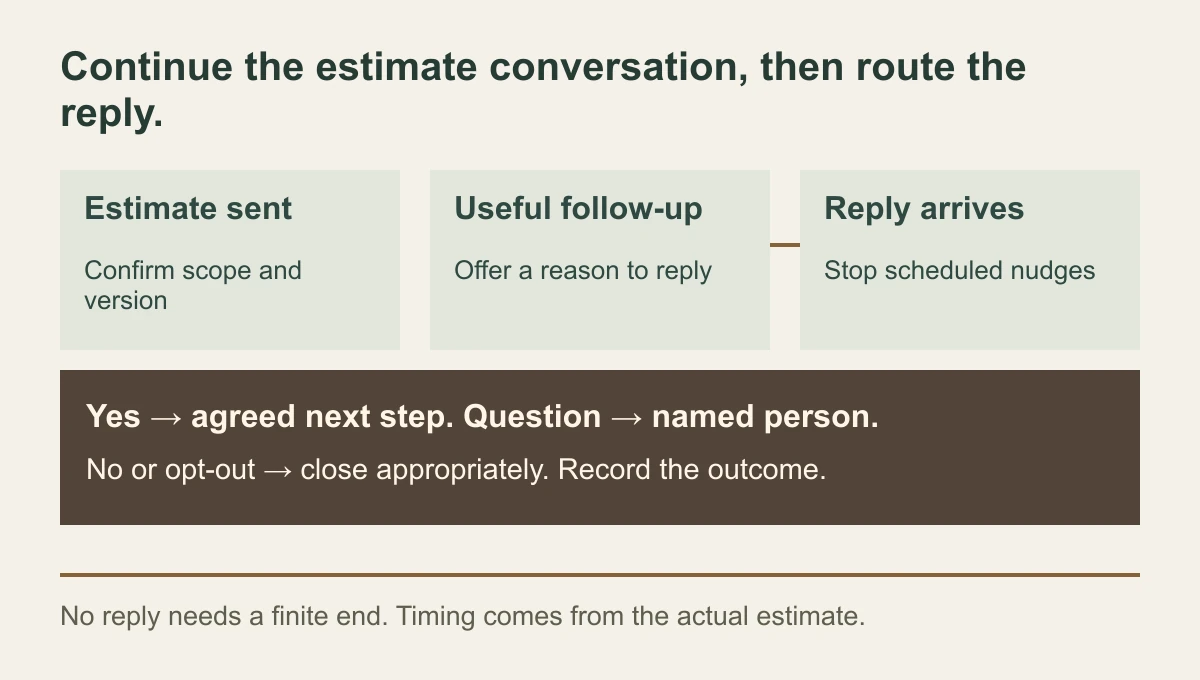
I would give them a reason to reply. Name the actual estimate and offer one useful next step. Then make sure someone reads the answer. A good email can open a conversation. It cannot finish that conversation while the replies sit unattended.
The Quiet Protocol's Estimate Follow-Up System starts at US$2,500 setup plus US$995 per month, with no contract and call minutes included. We map quote stages, timing, messages, stop rules and human handoffs, then configure and test the agreed sequence. Our ongoing work monitors delivery, replies, stage changes and exceptions. That is what I recommend buying: a working route from the sent estimate to the next decision, with someone maintaining it.
First, read the estimate you are about to chase
Confirm that the right version reached the right person, that the price and scope are still valid, and that your team can offer the stated next step. If a revised proposal exists, pause messages referring to the old one. The customer should not have to tell your software that your offer changed.
Record the estimate reference, service requested, date sent, version, person responsible and any decision date the customer gave you. Add the question still open. Sometimes the next action belongs to the business: an estimator owes a measurement, a partner needs to approve the scope, or the office promised to confirm availability.
In that case, do the promised work before asking the customer to decide. Sending a reminder about their silence while your answer is missing is an efficient way to be annoying.
Three emails with different jobs
These are illustrative drafts, not messages tested with clients. Replace placeholders with verified facts. Add the sender details, postal address and unsubscribe or other controls required for your actual message and jurisdiction. A useful paragraph is not a complete legal sending setup.
1. Confirm receipt and offer a specific explanation
An accounting proposal may leave the owner unsure which work the firm will take over. Refer to the scope rather than ask for financial documents in an email reply.
Subject: Your [service] proposal: any questions about the scope?
Hi [name],
I sent the proposal for [requested service] on [date]. Did it reach you?
If you are unsure about [a real item in the proposal], I can explain what is included before you decide. Reply with your question, or let me know if a short call would be easier.
[Name and business]
The reason to reply is clear: confirm receipt or get an answer. Use an item the proposal genuinely contains. Do not invent a concern because it makes the email sound personal.
2. Help with the decision the customer actually has
For a fictional flooring estimate with two written options, the useful follow-up could compare their scope. This email belongs only when those options are in the current estimate and the sender can explain them.
Subject: A question about the two options in estimate [reference]
Hi [name],
Our estimate includes [option A] and [option B]. Would it help to talk through the difference in [verified scope item]?
If your timing or the work you need has changed, tell me and I can arrange a review of the estimate. We will confirm the current scope and availability before booking.
[Name and business]
A different customer may have asked you to reconnect after a landlord reviewed the quote. Use that request instead. The message's relevance should come from the conversation, not from a trick for increasing replies.
3. End the unanswered sequence honestly
Subject: Closing the follow-up on estimate [reference]
Hi [name],
I have not heard back about [requested work], so I will stop following up on this estimate now.
If you want to revisit it later, reply here. We will check the current scope, price and availability before agreeing the next step.
[Name and business]
Send this only if the workflow actually stops. “Final reminder” followed by another final reminder is a small credibility problem of your own making.
Choose the timing, then set an end
Start with a date the customer gave you. If they asked for a call after a meeting, create that task and leave them alone until then. If they need a substantial project reviewed, allow time for that decision. A quote for urgent work needs a staffed conversation and real availability, not a leisurely promotional sequence.
For routine planned work without an agreed decision date, my starting rule is one receipt check, one useful clarification and one closing email. Choose and record their dates with the responsible team member before the sequence begins. This is a proposed operating limit, not a research benchmark or a promise that three emails will win the job. Adjust it to the service and the customer's request.
Every step needs a purpose. If you have no useful clarification to offer, omit that email rather than fill the space with another nudge. End sooner when the estimate expires or the company cannot provide the work. Do not restart the sequence simply because a contact remains marked open.
Use the Estimate Follow-Up Cadence Playbook to put the chosen dates and owners into a staff process. The dates should serve the decision your customer is making, rather than become a rule imposed on every job.
A reply ends the reminder and starts the next job
- Any reply: pause the unanswered-estimate sequence and assign the reply to its owner. Ambiguous replies need review before another automated message.
- A question: give it to the estimator or professional who can answer. Record the answer owed and the next agreed contact.
- A yes: confirm the current quote and availability, then use the real acceptance or booking path. A positive word is not a completed booking.
- A later date: replace the sequence with the requested future task. Keep the customer's reason and preferred contact route.
- A decline or stop request: close the quote follow-up, apply the appropriate suppression and cancel queued messages.
- No reply after the agreed final step: close the active sequence. Reopening requires a new customer request or a separately reviewed reason and permission.
The reply owner matters as much as the stop button. A paused sequence with an unanswered scope question still leaves the customer waiting. Set the handoff deadline the team can meet, with a backup for absences.
Keep permission attached to the message
In the United States, the FTC distinguishes commercial email from narrowly defined transactional or relationship messages by primary purpose. Do not assume an unaccepted quote or existing customer label exempts every follow-up. FTC CAN-SPAM business guide
In Canada, section 6(6)(a) provides a consent exception for a message solely supplying a requested quote or estimate. That does not remove the other message requirements or automatically cover a later sales sequence. Review the actual follow-up separately. CASL, section 6
CRTC guidance also covers commercial texts. Silence on email is not a reason to assume a new channel is permitted. CRTC CASL guidance
These examples focus on useful wording. The business still needs the applicable permission, identification and unsubscribe controls before sending. Older contacts require a separate decision; use the past-customer reactivation guide rather than quietly adding them to current quote follow-up.
Test what happens after “yes,” “no” and “please explain”
Use labelled test records for a reply with a scope question, a request for a later date, a decline and an opt-out. Also accept a fictional quote by phone while a reminder is queued. Check that the record changes, the next irrelevant email is cancelled and the appropriate person receives the task. Test a revised estimate too.
In The Quiet Protocol's implementation, we define these routes as part of the agreed scope, configure and test them, then monitor the installed sequence. That continuing responsibility matters because staff change, estimates change and a booking can arrive through another channel.
Review unanswered customer questions alongside open estimates. Count confirmed decisions separately from delivered messages. A reply saying “stop” is a reply, but it is not sales progress. An acceptance still needs the business's actual confirmation process.
Bring us one current estimate, the last useful conversation attached to it and the next question your customer needs answered. Choose our Estimate Follow-Up System to turn that into a managed process. The customer should get a clearer decision, and your team should be able to finish the day without remembering every quote by heart.
Frequently asked questions
What should an estimate follow-up email say?
Refer to the actual estimate and give the customer one useful next step: clarify a detail, confirm an intended decision or close the request. Keep the wording matched to the current conversation.
When should estimate follow-up stop?
Set an approved end and change the route when the customer accepts, declines, asks a question or requests no more contact. Repeating a sequence after a reply creates extra work and weakens trust.
How does TQP make estimate follow-up a system?
We connect estimate state, approved messages and the person who carries each reply. The customer gets a relevant continuation and the team gets a visible next job, rather than another reminder you must remember to cancel.
We map the quote stages, relevant messages, timing, stop rules and human handoffs, then configure and monitor the installed Estimate Follow-Up System. Bring your current estimate and the questions customers leave unanswered.
Put your estimate follow-up into a managed system