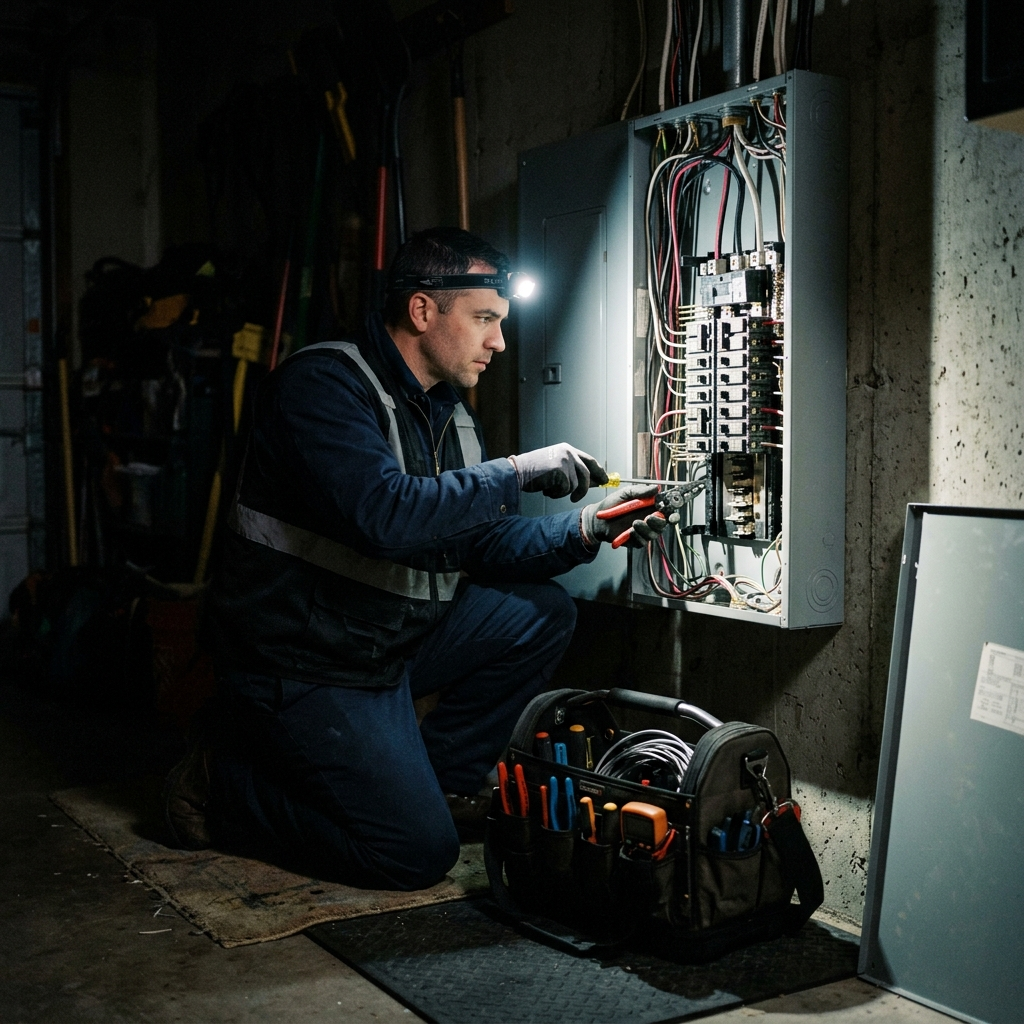

I've done Front Door Audits for electrical contractors across a handful of markets, and the pattern is consistent enough that I can predict what I'll find before I pull the data.
Treat any number without a nearby source or stated method as a planning assumption, then replace it with your own records.
The contractor has been in business 5 to 12 years. Good reputation. Mostly word-of-mouth. They're not running aggressive paid ads because they've never needed to, work has always come in. Growth has plateaued, but the owner attributes it to the market or the economy.
Then we pull the Google Business Profile call data.
The after-hours and weekend calls, the panel failures, the partial power outages, the circuits that tripped on a Saturday afternoon, are significant. In the contractors I've audited, after-hours and weekend calls typically represent 38 to 45 percent of total monthly inbound volume. Almost none of it is being answered.
For a contractor missing 6 of those calls per week across 50 working weeks:
- 300 after-hours calls per year
- 35 percent conversion rate on answered calls
- $1,800 average job value (conservative for jobs that start as breaker issues)
- Result: $189,000 per year going unanswered
The owner thinks his growth is limited by the market. It's limited by the phone.
Why After-Hours Calls Are the Highest-Value Calls in Electrical
The best jobs in residential electrical contracting don't come from planned renovations or scheduled panel upgrades. They come from moments of failure.
A homeowner losing power on a Friday evening with a refrigerator full of food and guests coming the next day is not calling to compare quotes. They are calling to fix the problem. They will pay for urgency, and they will remember the contractor who was there when they needed them.
Electrical emergencies follow predictable timing patterns:
Late afternoon:Homeowners return home. The household's electrical load increases suddenly, HVAC, cooking, entertainment, charging all coming online simultaneously. Problems that were dormant during the quiet day reveal themselves under load.
Evening and night:Circuits that tripped and won't reset. Outdoor lighting that stopped working. Partial power outages affecting one area of the home. The HVAC that runs at night for cooling, a homeowner waking at 2 AM to a warming house often traces it to an electrical problem.
Weekends:Power tools in the garage, outdoor entertaining equipment, pool and spa systems. A panel that trips a breaker during Saturday afternoon power demand is not being ignored until Monday.
The timing of these calls is not random. It follows when people are home and using their electrical systems heavily. Which is precisely when the typical electrical contractor is not available.
What an Unanswered Electrical Emergency Call Actually Costs
The revenue impact of an unanswered electrical emergency call is consistently underestimated, because these calls escalate.
A homeowner who calls about a tripped breaker that won't reset and gets no answer finds an electrician through another channel. When that electrician arrives, they typically discover something beyond the presenting complaint:
- Service call: $150 to $300
- Breaker replacement: $150 to $400
- Panel inspection revealing additional issues: $300 to $800
- Required repair work: $800 to $3,000
A "simple" breaker reset call routinely becomes a $1,400 to $4,500 job when an electrician actually shows up. The contractor who answered captured all of that. The contractor who didn't answer captured none of it.
Beyond the immediate job value: a homeowner whose electrical emergency was solved at 9 PM on a Friday becomes a committed long-term client. They give referrals. They leave reviews. They call again when the aging service panel finally needs replacement at $8,000 to $15,000. The missed after-hours call is not just a missed job. It's the beginning of a client relationship that started with someone else.
Why Safety Creates a Different Urgency Dynamic
Electrical emergency calls have a characteristic that separates them from most home service categories: the caller is sometimes genuinely worried about safety.
A homeowner who smells burning from an outlet, sees sparks, notices flickering lights suggesting a loose connection, or finds a circuit tripping repeatedly is not just inconvenienced. They are worried about their home and their family.
This safety dimension creates a different emotional state, and a different expectation of the intake experience. A caller worried about fire doesn't want to leave a voicemail. They want to speak to someone who can assess whether they need to take immediate action (main breaker off, 911) or whether they can wait for a technician in the morning.
The value of answering this call isn't just capturing the job revenue. It's providing the guidance a worried homeowner needs, building trust through competence in their worst moment, and becoming the contractor associated with safety and reliability rather than the one who didn't answer when it mattered.
An AI intake configured for electrical contractors handles this safety triage effectively: for calls describing actively dangerous situations (sparks, smoke, burning smell), the system provides immediate guidance, shut off the affected circuit or main breaker, call 911 if there's any visible fire, and simultaneously dispatches the on-call technician with priority. For calls describing concerning but non-immediately-dangerous situations, it collects intake information and provides a response time estimate.
The caller receives the right response. The contractor gets the call information. Nobody reaches voicemail.
Building After-Hours Coverage That Doesn't Burn Out Your Team
The first-instinct solution is to put the owner or a lead technician on personal call. This closes the coverage gap technically but creates a different problem: unsustainable personal burden.
An owner personally answering every after-hours call is not sleeping well. Their judgment degrades. Their capacity to serve the business in its other dimensions, estimating, managing staff, running operations, is reduced. The coverage solution becomes a liability.
The sustainable model separates two functions that most contractors bundle together: intake and dispatch.
Intake, answering the call, collecting information, triaging urgency, communicating a response time, can be handled by AI. It doesn't require an experienced electrician's judgment. It requires a consistent, professional, well-configured system that runs without human intervention.
Dispatch, deciding which technician is available and routing the right person, requires human judgment but not necessarily the owner's. An AI intake system that delivers a complete, structured notification to the on-call dispatcher reduces the dispatch decision to a 2-minute review rather than a 15-minute intake-assess-callback chain.
The on-call technician receives: address, nature of the issue, urgency classification, homeowner's name and phone number. They make the call on whether to roll immediately or schedule for first thing in the morning. The intake complexity has been removed from their plate.
The owner stops being the emergency answering service. The technician makes a structured decision. The homeowner gets a response.
Electrical Emergency Call Questions
What percentage of electrical contractor call volume is after-hours?
For residential electrical contractors in metro markets, after-hours and weekend calls typically represent 38 to 45 percent of monthly inbound call volume. The share is higher for contractors with strong emergency service reputations, where word-of-mouth specifically routes emergency calls to them, and lower for contractors who primarily serve commercial or new construction markets with standard business-hours operations.
What are the most common electrical emergencies that generate after-hours calls?
In order of frequency: circuit breakers that trip and won't reset; partial power outages affecting a subset of the home (typically indicating a panel issue or feeder fault); HVAC systems not receiving power (most common during peak summer and winter months); outdoor lighting failures for security-sensitive homeowners; and burning smell or visible sparks from outlets or panel components (highest urgency, requiring immediate safety triage).
How should an electrical contractor respond to a caller reporting burning smell or sparks?
The immediate intake response for any call describing burning smell, sparks, or visible heat from electrical components should prioritize safety: advise the homeowner to switch off the affected circuit or main breaker if they cannot identify the specific circuit; advise them to leave the area and not restore power until an electrician has assessed the situation; and if there is any visible fire or the smell is intensifying, advise calling 911 immediately. After safety guidance is provided, the service intake proceeds normally.
Is there liability risk in using AI to handle electrical emergency calls?
AI intake systems providing general safety guidance, shut off power, call 911 if there's fire, operate within normal customer service parameters, not technical electrical advice. The same guidance appears in standard homeowner preparedness materials. The risk is a system that provides incorrect or irresponsible guidance, which is a configuration problem, not an inherent AI risk. A properly configured intake system handles safety calls with conservative, protective guidance that reduces liability rather than increasing it.
*To build an after-hours intake system that captures every high-value electrical call in your service area, request a Revenue Leak Diagnostic at thequietprotocol.com.*
What to check before you choose a fix
Before buying another answering service, chatbot, phone tree, or AI receptionist, look at the actual path a panel, repair, emergency, estimate, or project inquiry takes when they reach your business. The first question is not whether the tool sounds impressive. The first question is whether the buyer gets a clear next step while they still care. In electrical contractor operations, that usually means a fast answer, a useful question, a booked appointment or estimate path, and a follow-up record that does not rely on memory.
A strong system should make the business feel easier to choose. It should reduce the waiting, repeating, guessing, and manual chasing that make a buyer keep searching. If the current setup answers only during business hours, takes a message without qualifying intent, or leaves the follow-up to whoever remembers first, the problem is not only staffing. It is front-door design.
The week-one diagnostic
Run this review over the last seven days before making a decision. Pull the call log, website form submissions, chat history, booking calendar, CRM notes, missed-call list, and Google Business Profile activity. Do not start with opinions. Start with timestamps and outcomes. A small sample is enough to show whether the leak is response speed, qualification, booking friction, review weakness, or follow-up failure.
- Count every missed call and every call that lasted under 20 seconds. Those are often buyers who never became visible in the CRM.
- Count every form or chat that waited more than 10 minutes for a real next step. This is where high-intent demand starts cooling off.
- Mark every inquiry that needed a human callback before booking. That tells you whether the website is explaining the next step clearly enough.
- Review the last five reviews buyers can see publicly. Recency matters because buyers compare proof before they commit.
This is the source method for the article: use your own call log, CRM, booking calendar, form inbox, and Google Business Profile review activity. Public research can explain the pattern, but your own records show where money is escaping in this business.
Where the revenue usually leaks
The leak usually appears in one of four places. First, the buyer calls when the team is busy or closed. Second, the buyer reaches the business but is not qualified clearly enough to book. Third, the buyer receives a polite response but no firm next step. Fourth, the buyer finishes the job or visit but no review, referral, or reactivation path happens after the work is done. Each leak looks small by itself. Together, they decide whether marketing produces booked revenue or only more noise.
For an electrical contractor, the most valuable fix is the one that protects faster estimates, cleaner routing, and fewer lost after-hours calls. That is why the electrician's after-hours problem: why the highest-value calls come when no one is answering should be judged by business outcomes, not by novelty. A phone feature that sounds clever but does not improve booked appointments is not enough. A website widget that collects contact details but does not trigger follow-up is not enough. A review tool that asks once and disappears is not enough.
What a stronger system should do
A stronger front door answers quickly, asks the right questions, captures the reason for contact, separates urgent from routine demand, books when rules are clear, sends confirmations, updates the follow-up path, and asks for reviews after the work is done. The system should make the owner less dependent on heroic callbacks and make the buyer feel that the business is organized from the first touch.
The Quiet Protocol treats this as an operating system, not a single widget. Calls, web forms, missed-call text-back, appointment booking, CRM handoff, review requests, and reactivation all need to point in the same direction. When those pieces are connected, an electrical contractor can capture more demand without turning the team into a bigger manual call center.
How to judge whether it is working
Do not judge the system by how futuristic it feels on day one. Judge it by what changes in the business. Useful measurements include missed-call recovery rate, average response time, booked appointment rate, no-show recovery, review request volume, review recency, reactivated past-customer conversations, and the number of leads that have a clear next action in the CRM.
The best early sign is calm. Fewer loose callbacks. Fewer mystery leads. Fewer buyers waiting for a reply. More conversations with a clear status. That is what good automation should feel like to the owner and to the customer.
The loss estimate is basic business math, not a magic claim.
Revenue-leak examples on this site are built from visible operating inputs: inquiry volume, missed-call or slow-response rate, booking rate, average job or client value, repeat value, and follow-up recovery. The fastest way to make the number real is to run the diagnostic for your closest business type, then compare it against your own call log, CRM, booking calendar, form timestamps, and review activity.
The practical questions behind this decision.
What percentage of electrical contractor call volume is after-hours?
For residential electrical contractors in metro markets, after-hours and weekend calls typically represent 38 to 45 percent of monthly inbound call volume. The share is higher for contractors with strong emergency service reputations , where word-of-mouth specifically routes emergency calls to them , and lower for contractors who primarily serve commercial or new construction markets with standard business-hours operations.
What are the most common electrical emergencies that generate after-hours calls?
In order of frequency: circuit breakers that trip and won't reset; partial power outages affecting a subset of the home (typically indicating a panel issue or feeder fault); HVAC systems not receiving power (most common during peak summer and winter months); outdoor lighting failures for security-sensitive homeowners; and burning smell or visible sparks from outlets or panel components (highest urgency, requiring immediate safety triage).
How should an electrical contractor respond to a caller reporting burning smell or sparks?
The immediate intake response for any call describing burning smell, sparks, or visible heat from electrical components should prioritize safety: advise the homeowner to switch off the affected circuit or main breaker if they cannot identify the specific circuit; advise them to leave the area and not restore power until an electrician has assessed the situation; and if there is any visible fire or the smell is intensifying, advise calling 911 immediately. After safety guidance is provided, the service intake proceeds normally.
Is there liability risk in using AI to handle electrical emergency calls?
AI intake systems providing general safety guidance , shut off power, call 911 if there's fire , operate within normal customer service parameters, not technical electrical advice. The same guidance appears in standard homeowner preparedness materials. The risk is a system that provides incorrect or irresponsible guidance, which is a configuration problem, not an inherent AI risk. A properly configured intake system handles safety calls with conservative, protective guidance that reduces liability rather than increasing it.
Is this just a 24/7 answering service?
No. A traditional answering service usually takes a message. A properly designed AI receptionist and front-door system captures intent, qualifies the buyer, routes the request, books when possible, triggers follow-up, and supports reviews after the work is done. Message-taking is coverage. Revenue capture is a fuller operating path.
What should an electrical contractor fix first?
Fix the first place buyers disappear. For some businesses that is after-hours calls. For others it is slow website follow-up, weak booking logic, old leads, or stale reviews. The right first move comes from the seven-day diagnostic, not from guessing.
Will AI make the business feel less human?
Bad automation feels colder than a person. Good automation feels like the business is paying attention. It answers quickly, uses plain language, collects the right information, and hands the buyer to a human when judgment or empathy is needed. The goal is not to remove people. The goal is to stop making buyers wait for basic next steps.
How fast should we expect improvement?
The first lift should come from visibility and speed: fewer missed opportunities and cleaner routing. Deeper gains come after the system has enough real conversations to tune scripts, booking rules, follow-up timing, and review requests. Treat the first month as deployment and calibration, not a magic switch.
Map how a serious buyer decides in this kind of business.
Use the operating reality of the industry instead of copying a generic lead-generation playbook.
Replace broad industry assumptions with the business's actual inquiry volume, customer value, response time, and booking data.
See how the capability in this article fits into a complete customer journey.
Home & Field ServicesSee the same decision through the language, buyer behavior, and operating reality of this industry.
Client Results & ProofInspect the starting condition, installation, measurement window, and outcome behind real client work.
Why Electrical Contractors Lose Leads in the First 5 Minutes (And What to Do About It)
How electrical contractors lose high-intent calls in the first minutes, and how AI receptionist coverage, booking, and follow-up reduce the leak.
The Real Cost of a Missed Call for a Service Business: The Math Nobody Runs
A missed call costs more than the immediate job. Here is the full three-layer calculation, immediate value, lifetime client value, and referral chain, and the annual total most owners never see.

The 5-Minute Rule: Why Speed to Lead Determines Who Gets the Job in Service Businesses
Research shows leads contacted within 5 minutes convert at 21 times the rate of leads contacted after 30 minutes. Here is what that means for service businesses and how to close the gap.