In a five-truck company, somebody answers the phone, somebody decides who goes where, and sometimes both jobs fall on whoever is standing closest. You are probably weighing a hire against an AI voice agent, and the honest answer is that they do different jobs. This guide splits the work, puts real numbers on a hire, and shows where each one earns its place.
The two jobs people mix up
A customer service representative, or CSR, answers the phone, takes the details, books the visit and handles the customer's questions. A dispatcher looks at the board, decides which technician goes to which job in which order, and moves the day around when something changes.
In a small shop one person often does both. That works until the phone rings during the busiest hour of the day, which is when the dispatcher needs to be looking at the board.
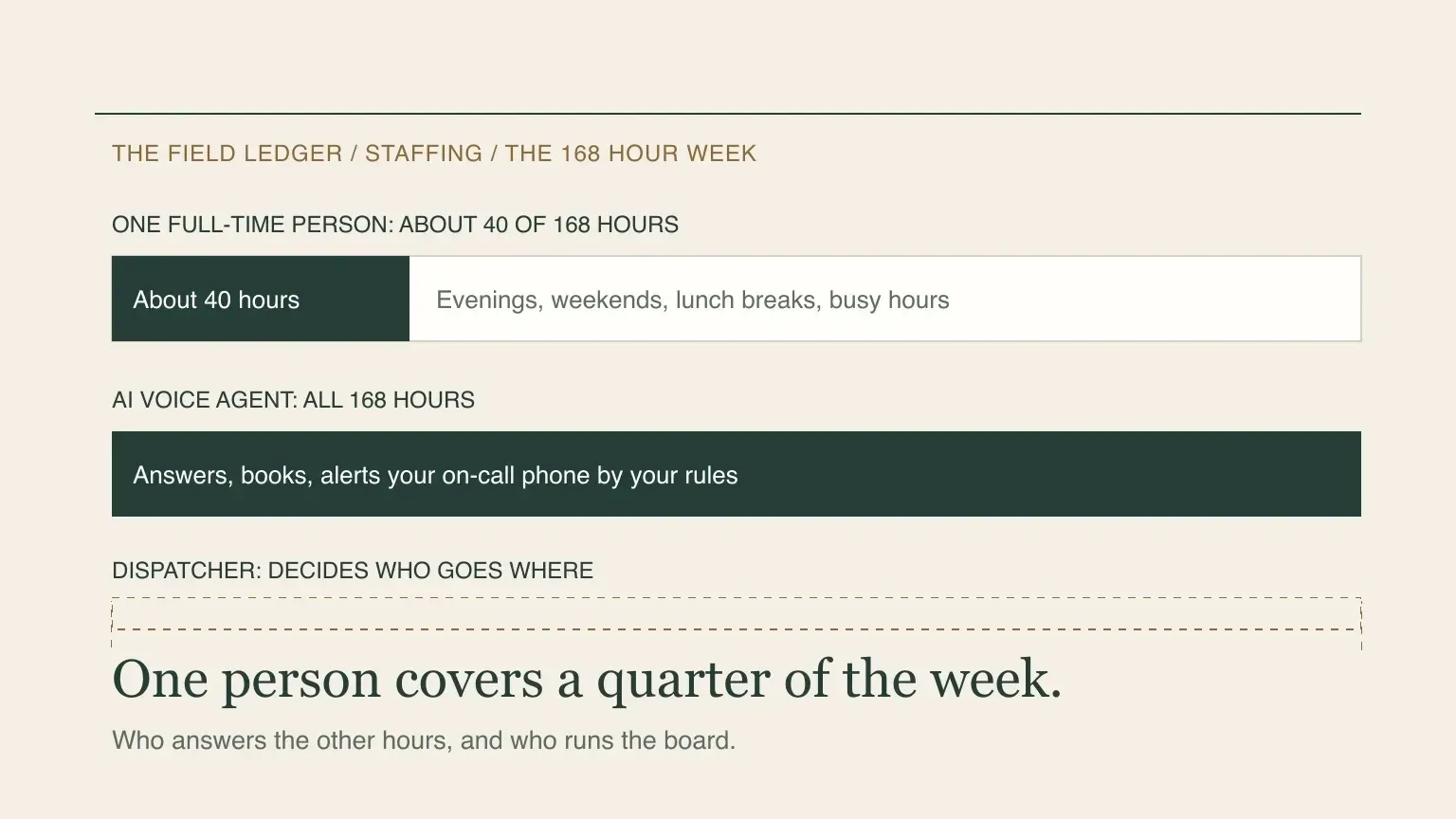
An AI voice agent covers the CSR's call-taking, not the dispatcher's judgment. It answers, asks the questions you approve, books onto the calendar and alerts your on-call phone by your rules. It does not decide who goes where.
What a CSR costs, with numbers you can check
The U.S. Bureau of Labor Statistics reports a median wage of $21.53 an hour for customer service representatives, or $44,770 a year, as of May 2025. That is wages only, before payroll taxes, benefits, training, software and the time you spend managing.
Take the wage alone as a floor. A full-time person works about 2,080 paid hours a year, and a week has 168 hours. So one full-time CSR covers about 40 of the 168 hours in a week, roughly a quarter. The other three quarters, which include evenings, weekends and lunch breaks, still need coverage.
Essential AI voice agent plan is $449/month with 600 minutes of calls, free setup, no contract. It answers every hour of the week. It does not replace a good person for the calls that need judgment or warmth, and it is not a manager.
Who does what
| Job | CSR | Dispatcher | AI voice agent |
|---|---|---|---|
| Answer calls during business hours | Yes | If free | Yes |
| Answer at 11 p.m. or on a weekend | Only if staffed | Only if staffed | Yes |
| Several calls at once | One at a time | One at a time | All at once |
| Ask your approved safety questions | Yes, if trained | Yes, if trained | Yes, every time |
| Book onto the calendar | Yes | Yes | Yes |
| Decide who goes where | No | Yes | No |
| Calm a frightened caller | Strong | Strong | Limited, hands off when you say |
| Handle a strange or angry call | Strong | Strong | Hands off to a person |
Look at the rows that matter to you. If your problem is calls going unanswered, the first four rows are where an AI voice agent helps. If your problem is a chaotic schedule, none of those rows fix it.
An illustrative five-truck week
This is an illustration with stated assumptions, not a statement about any customer. Say your shop gets 40 calls a week and your CSR is available for about a quarter of the hours in a week. Suppose a third of your calls come outside those hours, and a third of those are real jobs. That is about four jobs a week arriving when nobody is there to take them. At a $450 average ticket, it is $1,800 a week in work that goes to whoever answers first. Swap in your own numbers from your phone records.
The point is not the exact figure. It is that coverage hours, not talent, decide how many calls you lose.
Three setups that work
1. AI voice agent first, people for the rest. The agent answers everything, books the straightforward jobs and sends real emergencies to your on-call phone. Your CSR handles the complicated calls and the customers who ask for a person. This fits shops that already have one person at the desk.
2. A dispatcher plus an AI voice agent. The dispatcher stops being a call-taker and runs the board. The agent takes the calls, and the dispatcher sees the booked jobs arrive. This fits shops where the day keeps falling apart because the same person is answering and scheduling.
3. A hire when volume justifies it. If you are consistently over what one agent plan handles and your callers need a person for most calls, hire. Plans have included minutes, and you can add a prepaid top-up pack or move up a plan before you decide.
What to do this month
- Pull last month's phone records and mark the hours calls arrived against the hours someone was available.
- Write down your emergency rule: what counts, who is called and how fast.
- Decide which calls must reach a person, and say so in writing.
- Call the live line of any AI voice agent you consider and test it.
If you want ours, see the plans, call the demo line at +1 855-916-4334 or book a demo built around your company. For how this fits your trade, read the guides for HVAC, plumbing and roofing.
Frequently asked questions
Can an AI voice agent replace a dispatcher?
No. It answers, asks your approved questions and books onto the calendar, but it does not decide which technician goes where. A dispatcher or an owner still runs the board.
How much does a CSR cost?
The U.S. Bureau of Labor Statistics reports median pay of $21.53 an hour for customer service representatives in May 2025. That is wages only. Payroll costs, benefits, training and management time are extra.
When should a home service company hire instead?
When your callers need a person for most calls and volume stays above what an AI voice agent plan covers. Many shops add an agent first and hire for the complicated calls.
The wage figure comes from the U.S. Bureau of Labor Statistics Occupational Outlook Handbook, May 2025 data, read on October 7, 2026. The weekly example is an illustration with stated assumptions.
Find the next useful step for your business.
Continue this decision