
If you've asked “do Google reviews help SEO”, they can help your business rank in local results. Google's own guidance says more reviews and positive ratings can help. That is a useful reason to ask customers for honest feedback. It is a poor reason to believe someone promising that a particular review count will put you at the top of Maps. Google's local ranking guidance
I would build a reliable review habit on top of an accurate local presence. At TQP, Local Ranking Accelerator maintains the business information people use to find and contact you, while our Review Growth System handles the separately agreed invitation and response workflow. That combination addresses both what prospective customers read and how fresh, genuine feedback reaches them.
“We need more reviews” is a reasonable observation. “You need this many reviews by Friday to beat the accountant down the street” is a considerably more ambitious one. Google has not given us that formula.
Reviews matter. So does the person searching.
Google describes relevance and distance alongside how well known the business is, which it explains in its Prominence section. Reviews sit within that last part. They do not remove the others. How Google determines local ranking
Imagine an accounting firm with thoughtful feedback from bookkeeping clients. Someone nearby searches for bookkeeping help. Those reviews may support the firm's local presence and help the person decide whether to call.
Now imagine the same firm does not offer business valuations. More bookkeeping reviews do not make it the right business for a valuation request. Nor can the firm buy its way closer to a searcher across the city by collecting stars.
That is why I would check the services, category, address or service area, hours and website before deciding the only problem is reviews. This is the foundation I would buy through Local Ranking Accelerator annual: US$990 prepaid for twelve months for one location, with no setup fee and one-time Google Business Profile optimization included. TQP keeps that identity current through continuing synchronization, listing-health monitoring and corrections, giving the feedback a business customers can understand and contact.
There is another naming trap. Google's Search “reviews system” concerns standalone review articles and recommendations. It is not the system evaluating the customer reviews on your Business Profile. A document about writing a good laptop comparison does not establish how quickly a new customer rating will move your listing. Google Search's reviews system
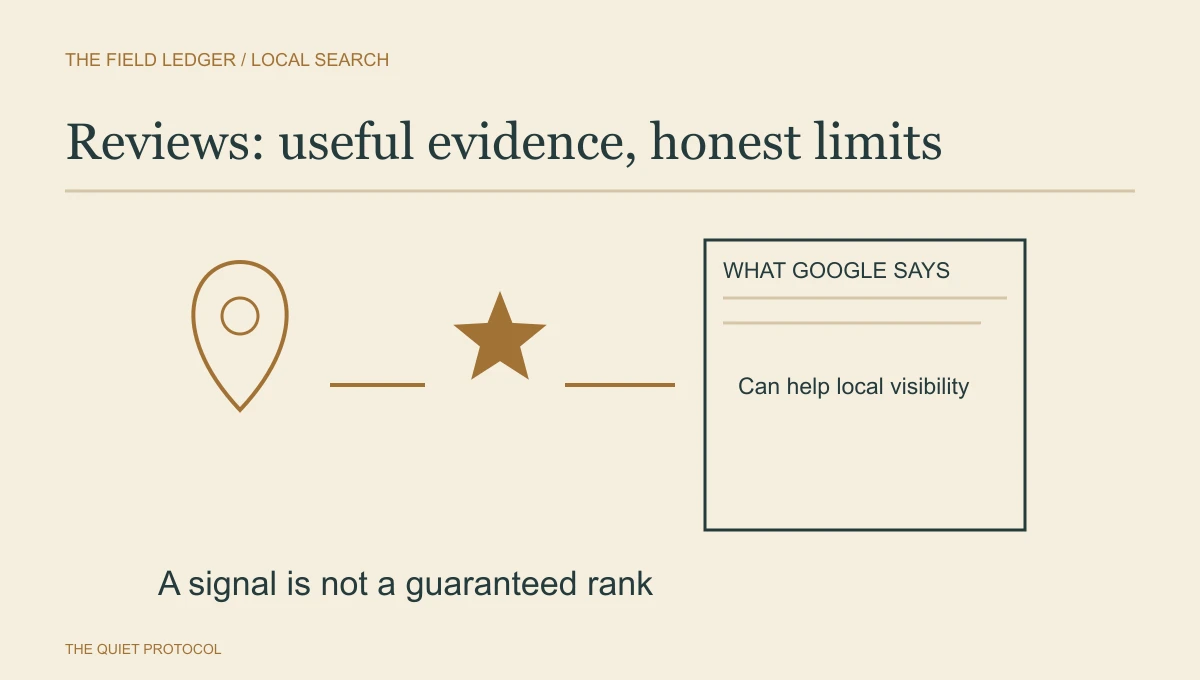
Put the promise in the right column
The useful distinction is between a documented possibility, a sensible business reason and an unsupported promise. They deserve different levels of confidence.
| What you hear | What it means | What to ask next |
|---|---|---|
| Reviews can help local ranking. | Google supports this possibility. It does not guarantee a position. | What else needs fixing in our local presence? |
| Reviews can help customers judge us. | Useful feedback describes the experience a future customer is considering. | Does our feedback reflect the work we actually want? |
| A steady request process is worth having. | That is a practical recommendation: fewer eligible customers are forgotten. | Who sends the request, and what happens when someone complains? |
| This review target guarantees ranking or revenue. | The promise exceeds the published guidance and skips the customer's decision. | Where is the evidence, and what conditions does it cover? |
In plain language: reviews can contribute to visibility and help a person assess the business. A consistent request process makes feedback easier to collect. None of those statements establishes how many positions you will gain or how much money you will earn.
Be suspicious of a magic review number
Google's current guidance does not publish a minimum review count, a required monthly pace or a waiting period after which new reviews raise your rank. “Review velocity” usually means the rate at which reviews arrive. Giving that rate a name does not make it a disclosed Google scoring rule. Google's published local ranking factors
Looking at competitors can still help. If the nearby firms customers find have recent, useful feedback and yours has little that describes your present work, you have a customer-information gap worth addressing. That comparison does not isolate the effect of reviews. The firms may also differ in location, services, website and reputation elsewhere.
I would use the comparison to improve what a customer can learn about you. I would not turn it into “catch this count and the ranking is ours.”
The same applies to revenue. A better position may create more opportunities. Whether any become paid work depends on fit, response, capacity and the customer's choice. You need your own inquiry and job records to connect those stages. The local SEO measurement guide shows how to do that without counting a phone-button tap as a customer.
Ask for an experience, not a scripted compliment
Google permits requests for genuine reviews without incentives. It prohibits selectively soliciting positive reviews, discouraging negative ones and asking for specific review content. That rules out a customer-satisfaction survey which sends only the happiest respondents to Google. It also rules out giving customers keywords to insert. Google Maps review policies
Use an ordinary point in your service process, such as completing the agreed work. Give the customer a direct review link or QR code, which Google supports. Leave them free to decline, choose their rating and use their own words. Do not make a staff review quota the goal.
For an accounting firm, that might mean a neutral request after an onboarding milestone or a completed engagement, sent through an appropriate existing communication channel. It need not arrive while the client is still trying to find a missing tax slip. Timing should make sense to the customer and your process; there is no universal two-hour rule to borrow.
A simple request is enough: “Thank you for working with us. If you'd like to share your experience, you can leave a Google review here.”
Then give someone responsibility for checking the feedback. Our Review Growth System turns that into an agreed process: a real completion event, a neutral invitation, sensible reminders, response alerts and a handoff when a person needs help. We configure and test the route, then maintain the agreed workflow. If a review mentions unanswered messages, investigate the messages. Replying with a pleasant sentence while leaving the same problem in place is a strange kind of improvement.
For negative feedback, keep the public reply short and helpful. Avoid disclosing account details, tax matters or other private information to win the argument. Google specifically advises protecting the reviewer's privacy and taking complicated situations to a private conversation. Google's review reply guidance
What I would change first
Check whether the profile describes the real business. Choose one natural moment to invite honest feedback. Assign the request and reply jobs. Then look at whether customers are receiving the invitation and what their feedback is telling you.
For the firm-specific process, use the accounting review-request guide. Then start with Local Ranking Accelerator annual and tell us whether review growth is the next job too. The annual plan works out to US$82.50/month, paid as US$990 upfront for twelve months, and includes the one-time profile optimization; review-workflow operation is agreed separately.
Choose TQP to make accurate public information and honest feedback part of a maintained customer experience. Bring the profile and the point at which you normally complete the work. We can show you which responsibility belongs in each service and give it a clear owner.
Frequently asked questions
Do Google reviews help local discovery?
Reviews can contribute to how well known a business is, alongside other local search factors. They also help a prospective customer assess an experience. A review count is not a guarantee of a particular position.
Is there a magic number of reviews a business should buy?
No. Do not buy fake reviews or treat a number as a ranking promise. Build a neutral request habit after real customer experiences and review the quality of the receiving operation too.
Why connect Local Ranking Accelerator and review growth?
Accurate business information helps people find the right business; an honest review habit helps them assess it. TQP can run the agreed listing and request work as connected systems, then keep the inquiry path usable when someone decides to contact you.
Start with Local Ranking Accelerator annual for accurate supported listings and included profile optimization. Add a separately agreed review-growth workflow to make genuine invitations consistent.
Build your local foundation and an honest review habit