
Review gating is the quiet policy violation hiding inside a lot of review tools. A first screen asks how the visit went, happy customers get the Google link and unhappy ones get a private form. It looks like customer care. Google calls it selective invitation, and it does not allow it.
A tool may call the first screen a satisfaction survey, a reputation funnel or a customer experience check. I would follow what happens next. If a happy customer sees “Review us on Google” while an unhappy one sees only a private form, the language on the sales page is less important than the route you built.
Our recommendation is a review growth workflow built around the same honest invitation for comparable customers, with reply alerts and a human route for service concerns. We configure and test those paths at The Quiet Protocol. For the profile and supported listings the customer reaches, choose annual Local Ranking Accelerator: US$990 prepaid for twelve months for one location, with no setup fee and one-time profile optimization included. The review workflow is a separate job, and the two belong together when both need attention.
The customer's sentiment must not control the invitation. Google's Maps policy prohibits discouraging negative reviews and selectively soliciting positive reviews. It permits genuine review requests without incentives or attempts to influence the rating or content. Google's review policy
Walk through the unhappy customer's path
Test the tool as if you had a poor experience. You do not need to post a review; inspect the invitation screens and messages.
Does a low survey score remove the public link? Does the process withhold the original invitation from customers who complain? Does a staff member choose who receives a link using a list labelled “happy clients”? Those are different implementations of the same filtering decision.
Stopping later reminders after a reply or an opt-out is a different matter. Apply that stopping rule regardless of sentiment, keep the review opportunity already shared available, and assign a service concern to a person. Respecting someone's request to stop is not review gating.
Now take the happy path. Compare the timing, prominence and available choices. It is possible to display the same link eventually while making it easy for one group and difficult for the other. I would assess the whole route, rather than declaring it fair because a vendor can point to a link on the final page.
A hypothetical home-service company shows four- and five-score customers a Google invitation. Lower scores go to the owner by email with “let us put this right first.” The owner may sincerely want to fix the job. That intention does not make withholding the review invitation from unhappy customers an acceptable review process.
Complaint handling and public feedback can coexist. You can offer a private contact route to everyone and respond thoughtfully when someone uses it. Keep that route available without making it a condition for an unhappy customer to see the public review invitation.
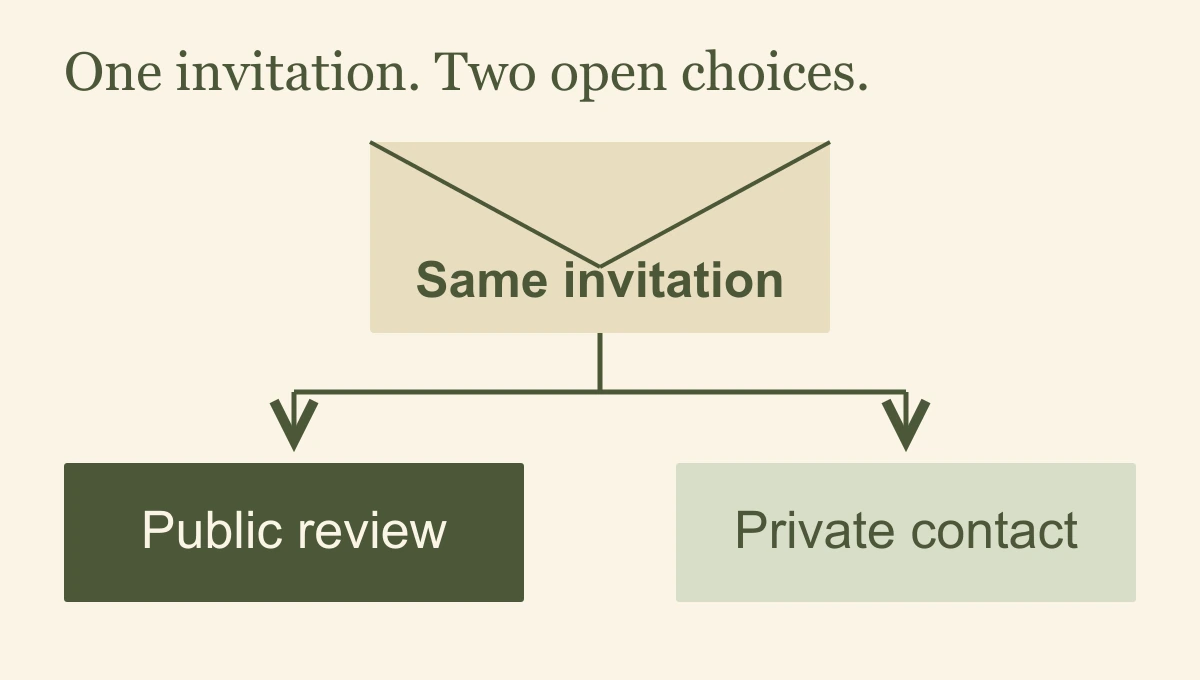
Replace the filter with a neutral trigger
Use an event that does not depend on happiness, such as completion of an eligible appointment or service interaction. Define the audience and exclusions in ordinary terms, including contact preferences and applicable communication requirements. Do not quietly use those exclusions to omit everyone who complained.
Choose a sensible time when the person has had a real experience to describe. Send the same invitation to customers who meet the rule. Make leaving a review optional and avoid telling them what rating, phrases or staff names to include.
Google also prohibits incentives for reviews and pressure to leave them on the premises or include specific content. Ask for an honest experience, not a manufactured compliment. A discount for “any review” still attaches a benefit to the review; changing the required star rating does not remove that issue. Google's content rules
Illustrative invitation wording
Thank you for choosing our business. If you would like to share your experience, you can leave a Google review using this link. An honest account helps others understand what to expect.
If you would prefer to contact our team about the service, you can also use this contact route. Both options are available, and leaving a review is your choice.
This is wording to adapt to your actual service and approved contact channel, not a legal consent template. Use the business's real review link and a monitored contact route. Google provides official instructions for sharing a review link or QR code. Google's review request guidance
A neutral review invitation you can send to everyone
Hi Dana, thanks for choosing Hartley Plumbing. If you have a minute, we'd appreciate an honest review of your experience: [link]. If anything wasn't right, please call [number] and we will fix it.
Hartley Plumbing and Dana are invented. The same message and the same link go to every comparable customer, whatever you expect them to say. The private help line is an addition, not a filter. Do not offer rewards for positive reviews, and ask every customer within a day or two of the job.
Check the settings, not just the promise
Ask your provider to show the trigger, audience, exclusions, message and both possible routes. A screenshot of a pleasant invitation is insufficient if an earlier screen decides who receives it.
Questions the provider should answer
| Check | Acceptable direction |
|---|---|
| Who receives the invitation? | Customers meeting a neutral service rule, without satisfaction filtering. |
| What happens after a low score? | The same review opportunity remains available; the team can also offer help. |
| What does the message request? | A voluntary, genuine experience, without incentives or prescribed wording. |
| What does the team measure? | Whether the agreed request process ran and feedback was handled, without pressuring staff or customers for a quota. |
A software feature is not policy permission. If the tool offers a sentiment gate, you still choose whether to enable it. Ask the provider to remove that branch and confirm the replacement in writing.
This is a reason to buy implementation from us. We define the service event, audience, message, reminder stop rules and person handling replies, then test the paths before launch. You get a process you can explain to your team and a clear place for complaints to be handled. A pleasant invitation screen is only one part of that work.
Let the feedback do a second useful job
An honest request process may surface things you would rather not read. That can be unpleasant and useful at the same time. A recurring complaint about arrival windows deserves operational attention even when the review process is working exactly as intended.
Read the feedback, decide who responds and carry credible service problems back to the team. Do not promise every unhappy customer a perfect outcome. Do make it clear that someone will look into the issue and say what can happen next.
For reviews that may genuinely violate policy, use the reporting and appeal guide. Fair invitations and careful removal reports solve different problems.
Bring us the current invitation screens and the route a customer follows after a low score. We can agree the review-growth work needed to replace the gate, maintain the request path and give replies an appropriate handoff.
I also recommend Local Ranking Accelerator annually for a properly maintained business presence behind that invitation. US$990 for the twelve months is equivalent to US$82.50 per month, including the initial profile optimization. Make fair feedback part of a business customers can find and reach, with the listing work and review workflow each given clear responsibility.
Frequently asked questions
What is review gating?
It is a process that selectively sends satisfied customers to a public review route while steering unhappy customers away from it. Inspect the actual paths, including what someone who gives negative feedback sees.
Can we offer a private feedback route as well as a review link?
Yes, but it should not be used to hide the public route from customers based on sentiment. Keep the invitation neutral and make the private help route useful in its own right.
How should TQP configure review requests?
We connect the request to a real service event, use approved neutral wording and set sensible stop rules. TQP review growth helps maintain the habit without making a satisfaction score the gate to a public invitation.
Annual Local Ranking Accelerator keeps your business listing information current and includes one-time profile optimization. Add a separately agreed review-growth workflow with neutral invitations, reply alerts and human follow-up.
Build fair review requests around an accurate profile