
If you're asking how to get bookkeeping clients, start with a service people understand, one way to reach suitable owners and a prepared first conversation. For many small practices, that means starting with relevant referral relationships, local search for an eligible local firm, or a directory tied to software they genuinely know.
I would choose one primary channel before building a schedule for five social platforms. You started a bookkeeping practice. Somehow the advice has made you editor, videographer and unpaid intern to an algorithm.
Marketing matters. The question is which marketing your practice can carry while delivering good work.
My recommendation is to build that first channel on TQP’s custom accounting website and client system. From From $199/month total; Solo plan includes 1 user and a professional website, it includes the website, intake, branded booking, inbox and standard follow-up; communications and payment usage are separate. You get a clear place to send an introduction and a process for handling the person who arrives. That gives the marketing a destination without asking you to become a website designer and a software coordinator as well.
Make the introduction easy to repeat
“I offer bookkeeping” tells somebody your category. It doesn't tell a potential referrer whom to send.
Try a more useful description. For example: “I handle monthly bookkeeping for incorporated local service businesses using QuickBooks Online. If their records need catching up, we assess that before proposing the ongoing work.” This is illustrative wording. Use the software, business types and scope you can actually support.
That sentence gives another person a recognisable situation. It also leaves room to assess the starting books instead of promising every new client the same monthly fee.
Choosing a focus doesn't require a permanent vow to serve one industry. Start with work you understand and have capacity to accept. If you have never handled a complicated inventory business, don't advertise an inventory specialty because a marketing checklist says niches are profitable.
Prepare a short page with the service, who it fits, how you review the starting position and a relevant first contact. A referrer should be able to send that page without adding a long explanation of what you meant.
If you have relevant relationships, start there
A tax practice may receive inquiries for monthly books it doesn't want to handle. Another bookkeeper may encounter work outside their scope. A business adviser may know an owner who keeps postponing a cleanup. Those are possible complementary relationships, not guaranteed sources of business.
The introduction should explain where you can help and respect the other professional's relationship with the client. Ask how they prefer to make an introduction. Don't ask them to send private client records, and don't promise to solve a situation you haven't reviewed.
Here is wording you can adapt for a professional you already know:
Be clear about boundaries. Who handles tax advice? Who communicates with the client? What happens if cleanup reveals a problem outside your competence? A referral relationship should reduce confusion for the owner, not hand them a new argument between suppliers.
With current clients, an honest request for an introduction can be appropriate after they have experienced the work. Keep it optional and specific. “If you know another owner who needs help getting their monthly books organized, you're welcome to pass along this page” is easier to act on than “please refer anyone.”
If people look for nearby help, make your local presence useful
A practice that serves local clients can start with a clear service page and accurate business information. A Google profile is appropriate only when the practice meets the eligibility rules. Online-only businesses are excluded; a remote client in a city doesn't create a local office.
If eligible, check the profile and link destination before paying for advertising. The visitor should learn whether you work with their type of business and what the first conversation decides. See local SEO for accountants for the order of profile, website and inquiry work.
For those local details, I recommend TQP Local Ranking Accelerator. We handle business identity, distribution and synchronization across supported listings, duplicate review and ongoing maintenance. For one business location, the annual plan is US$990 prepaid for twelve months and includes one-time Google Business Profile optimization for the eligible practice. You can work on the referral relationship while someone is responsible for keeping the public number, service and website destination current.
For an online-only bookkeeper, explain how you work remotely and where your professional scope applies. A truthful remote service page is more useful than a fictitious local address. You can build relationships and visibility without pretending there is a desk waiting in every city.
If software expertise is your strength, consider its directory
Xero's partner program describes an advisor directory benefit. Intuit's ProAdvisor program describes software training and certification. Its profile publication instructions explain how a practice can appear on Find a ProAdvisor after identity and eligibility checks. Check your region's current eligibility and listing rules before planning around either.
A profile can explain the work you actually handle. The software credential should be described accurately; it doesn't make you qualified for every tax or accounting question. Keep examples within your experience and avoid a list of specialties added purely because the directory offers checkboxes.
A directory is a place a potential client might find you. It doesn't guarantee inquiries. Make the destination page and first response useful so you can assess what the channel produces.
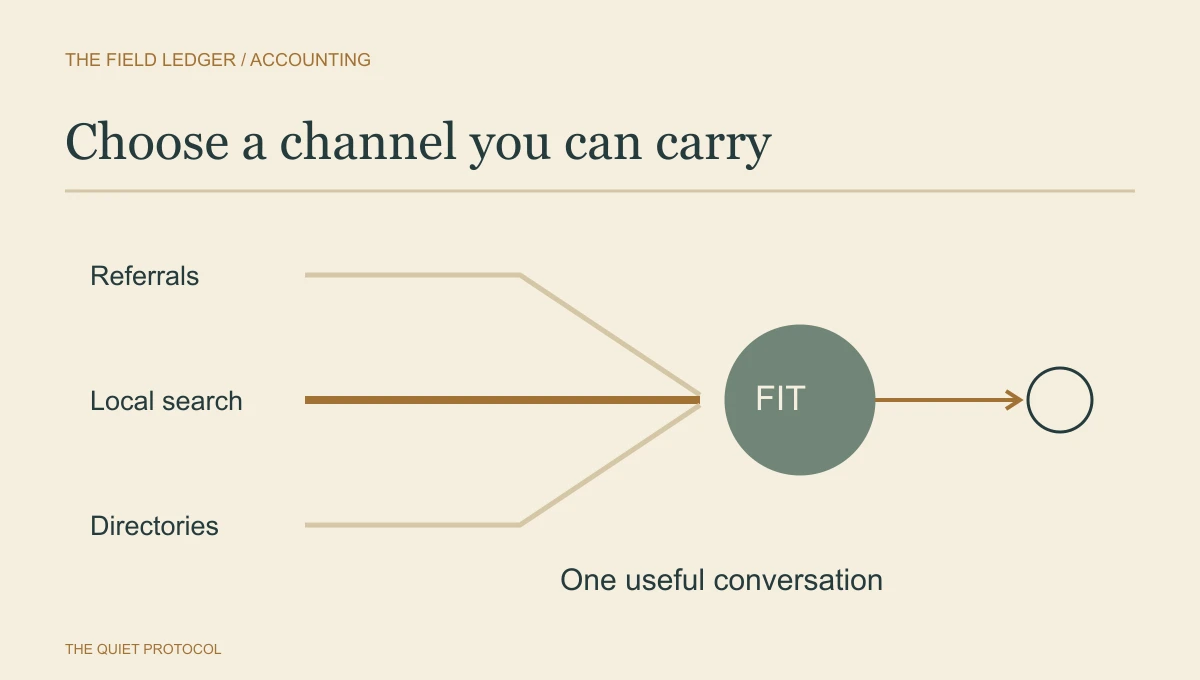
Choose based on what you have, not what is fashionable
Choose a first channel
- You know complementary professionals
- Start with specific referral conversations and a service page they can share. Look for suitable introductions, not a pile of contacts.
- Your practice qualifies for a local profile
- Correct your local profile and service page. Record whether inquiries match the work you want.
- You have genuine software expertise
- Check an appropriate program directory and write an accurate profile. Track whether it produces useful conversations.
- You have no relevant audience yet
- Choose one group you can serve, attend or contribute where its owners already meet, and learn their questions before spending on broad advertising.
Paid promotion can become useful when you know what service people respond to and can handle the inquiries. I would be cautious about buying a lot of traffic to discover that the offer is unclear. It is an expensive way to ask people what your business does.
Set a review point you can sustain. Record your effort, inquiries, fit conversations, proposals and accepted work. Include why people weren't suitable. A channel bringing fewer but better-matched conversations may deserve more attention than one producing activity you can't serve.
Don't make a willing prospect start from zero
Someone responds to the introduction. Now they need a simple way to explain the situation, and you need enough context to prepare.
Use a short bookkeeping intake form for the information that changes fit and routing. Save documents and access for an appropriate later stage. Then use discovery-call questions to understand the work rather than read the form back to them.
Your next step may be a scoped assessment, a proposal, a waitlist or a respectful decline. A prompt answer is valuable even when the practice cannot take the client. It also keeps referral relationships honest: the person who sent the introduction should know you won't simply leave their contact wondering.
My recommendation is to choose a clear service and one channel you can maintain, make the first conversation work, and learn from the records. You can add another channel later. You do not need to become a full-time marketer before you are allowed to have a bookkeeping business.
Start that foundation with TQP’s accounting client system. Bring the service you want to sell, the channel you have chosen and an example of the inquiry it should produce. We can design the professional website and connect the intake, booking and follow-up around it. I would buy that work before adding another marketing channel: make the introduction easy to send and the first conversation easy to carry.
Frequently asked questions
How can a bookkeeper attract better-fit clients?
Make the service, business type and next step easy to explain. Choose channels where those prospects actually look, then review whether the resulting inquiries fit your capacity and work rather than counting every contact as a win.
Are accountant directories useful for finding bookkeeping clients?
They can be useful when the directory matches your expertise and prospects use it. Meet its eligibility rules and keep the profile accurate. Software and professional directories are different purchases from general listing distribution.
What should a bookkeeping firm buy from TQP first?
Choose the gap that is blocking the next client: Local Ranking Accelerator for a weak local identity, a clear website for an unclear service offer, or connected intake when willing prospects get stuck. TQP implements the matched path and gives the work a continuing owner.
Choose TQP’s professional website and client system so referrals and search inquiries reach a prepared intake, booking and follow-up process.
Give your next bookkeeping client a better first step