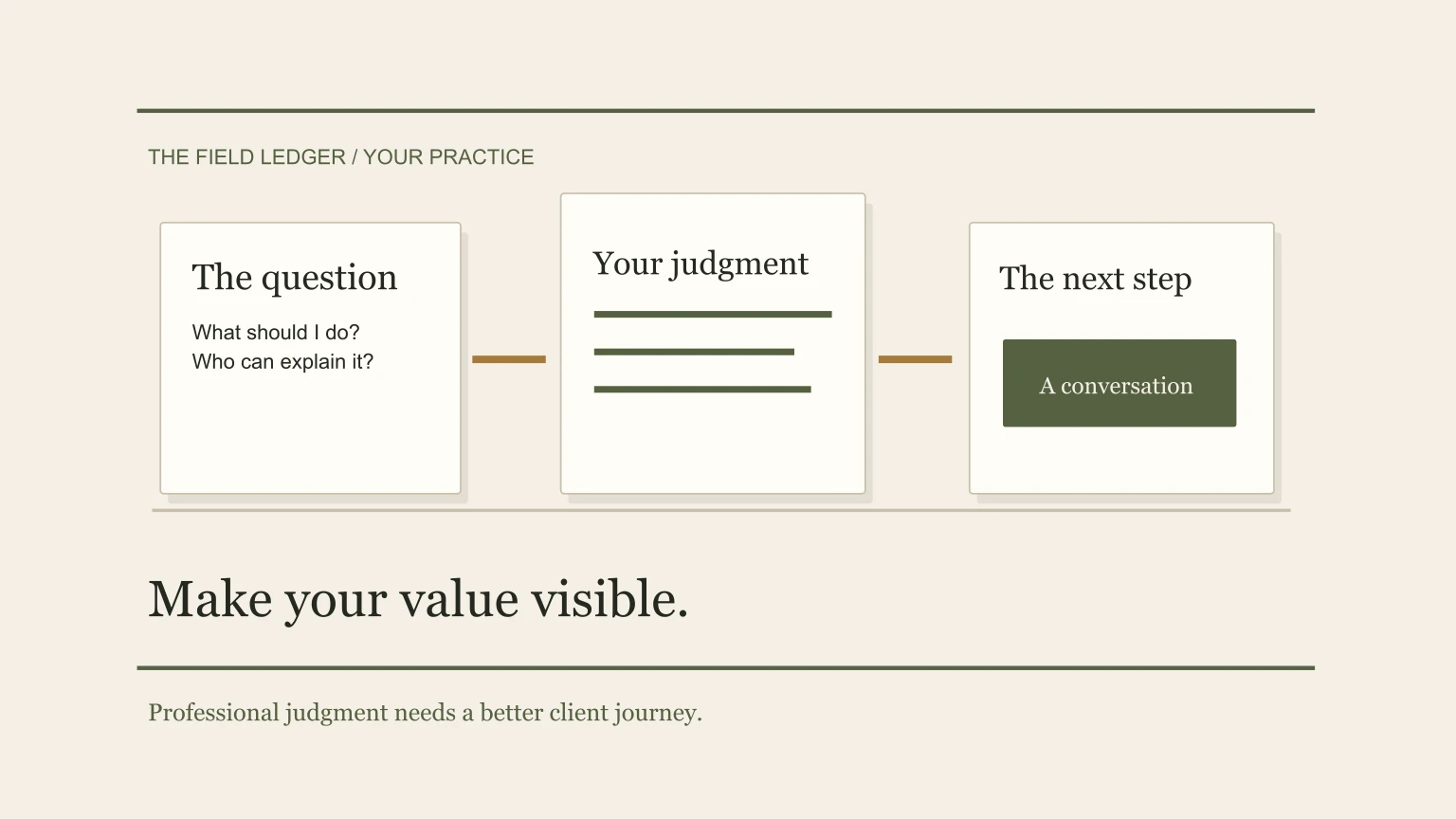
Will AI replace accountants? If you run a firm, the more useful question is what your clients will still value when a tool can produce a quick explanation. Your business needs to make that value clear before the first consultation, then deliver an experience that supports it.
You cannot build a sound plan around a promise that nothing will change. You also do not need to accept every prediction that your profession is about to disappear. A generated answer, a completed task and accountable professional work are different things.
Make your judgment easier to understand and your firm easier to work with. That is the part The Quiet Protocol helps you build: a professional website, clear service paths and connected client intake. You carry the accounting expertise. We build the front-office systems that help clients reach it.
The awkward question your website needs to answer
Suppose a prospective client has already asked an AI tool a question about their business. This is an illustrative situation, not a claim about all clients.
They now visit your website. It says you provide bookkeeping, tax and advisory services. It says you care about clients. It asks them to call during office hours.
What have they learned about why your firm is worth paying?
Your site should explain the problems you help clients evaluate, what information you need, what a consultation is for and how the engagement proceeds. You do not need to give away private methods or publish client details to make your professional work understandable.
A useful service page can show the difference between receiving a general explanation and having someone examine the relevant records, consider the context and take responsibility for the agreed work. Your firm should approve the wording and the services it describes.
| Work that tools speed up | Work clients still pay a person for |
|---|---|
| Sorting and categorizing transactions | Deciding what the numbers mean for this client's plans |
| Drafting a summary or an email | Standing behind the advice and signing the work |
| Looking up a general rule | Applying it to the client's actual facts and history |
| Collecting documents | Spotting what is missing and asking the right follow-up |
Three lines for your homepage, to adapt to your firm
"We handle the numbers. You get a person who explains what they mean and answers for the work."
"Your first call is 20 minutes. Bring last year's return and we will tell you what we would look at."
"Book online and we will send a short checklist so the call is spent on your questions."
These are illustrative lines. Use only claims your firm can support, and have the right partner approve the wording.
Stop presenting your firm as a list of tasks
If your positioning is only “we perform these tasks,” it invites a comparison with whatever appears to perform those tasks more cheaply.
Describe what the work helps your client decide. A report may inform a conversation about the business. A review may identify something requiring investigation. A planning engagement may help the client understand the choices you have agreed to examine.
Those are examples of ways to explain professional value, not promises that every firm offers every service. The point is to make your actual scope concrete. Your client should know what they are buying and where your responsibility starts.
This also makes your website more useful. Instead of a generic page that could belong to any accounting firm, you can build a path around the client questions your practice actually handles. TQP's websites for accounting firms combine that presentation with the booking and inquiry paths needed to start the relationship.
Make these three things clear to your next client
- The problem you help them understand
- Use a question a suitable client would recognize. Explain the service you actually provide and the purpose of the first conversation.
- The work behind your answer
- Describe the approved process in plain language: relevant information, review, context and the person responsible. Avoid private client details and unsupported outcome claims.
- The next step they can take
- Make the right consultation or inquiry easy to reach. Say what they should prepare and what your team will review before an engagement starts.
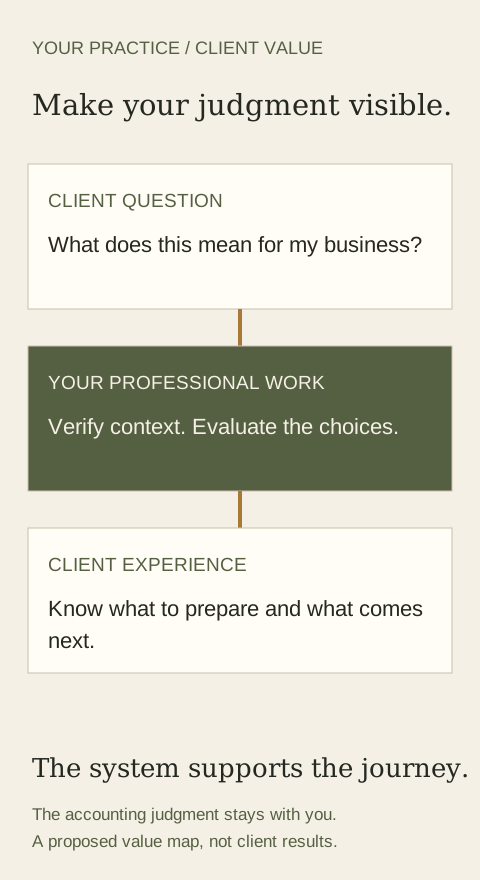
Give your expertise a client experience that matches it
You can offer careful professional work and still make a poor first impression through the process around it.
A prospective client should not have to guess which appointment to book. Your staff should not have to recreate an inquiry from scraps of email. An existing client should receive a clear request rather than several conflicting instructions.
TQP's client intake system for accounting firms connects the front-office steps around your approved service. We can scope the website path, inquiry details, consultation booking and follow-up together. That gives you a better basis for a prepared conversation, rather than another standalone tool your team has to reconcile.
This is business transformation you can see in a working day: the right request reaches the right place with useful context. It does not require pretending your intake software can make the accounting decisions for you.
Use AI without making its confidence your quality control
AI-supported work still needs a defined purpose, suitable access and the review appropriate to the task. A polished answer is not evidence that the underlying facts are correct.
CPA.com's AI resources describe provider due diligence that includes privacy, accuracy, security, governance and an evidence checklist. Those are practical purchase questions for a firm assessing AI.
For your client journey, make the boundaries visible. An intake conversation can gather what the prospect says they need. Your firm evaluates the suitability and agreed engagement. A reminder can ask for an approved next step. It should not invent professional advice or commit you to unapproved work.
If you want a practical starting point, our AI for accountants guide covers front-office admin. This article addresses the wider positioning question: why a client should choose your firm and how the experience makes that choice easier.
Compete as a modern firm, not a worried observer
Waiting for a final verdict on whether AI replaces accountants leaves the useful work undone.
You can clarify your services, show your judgment and improve your client journey now. That is a stronger response than adding an AI label to an old website or asking your staff to juggle more disconnected software.
Choose TQP to make your accounting expertise visible and accessible through a website and client intake system built together. Give prospective clients a clear reason to choose you, then a clear way to start.
Frequently asked questions
Will AI replace your accounting firm?
No reliable blanket forecast determines the future of your particular firm. You can respond to the change by explaining your professional judgment, reviewing AI-supported work appropriately and making your actual services easier for suitable clients to reach.
What should your accounting website explain in the AI era?
Explain the client problems your firm handles, the purpose of a consultation, the information needed and the approved engagement process. A custom TQP website can connect that explanation with the right inquiry and booking path.
Can TQP's client intake system replace accounting software?
TQP's system supports the front-office journey, including scoped inquiry handling, booking and follow-up. Your accounting software and professional review still carry the accounting work. We can assess the supported connections around your firm's existing process.
Show us how prospective clients find, contact and book with your firm. We can scope a modern website and connected intake journey around your approved services.
Build your firm's client intake with TQP