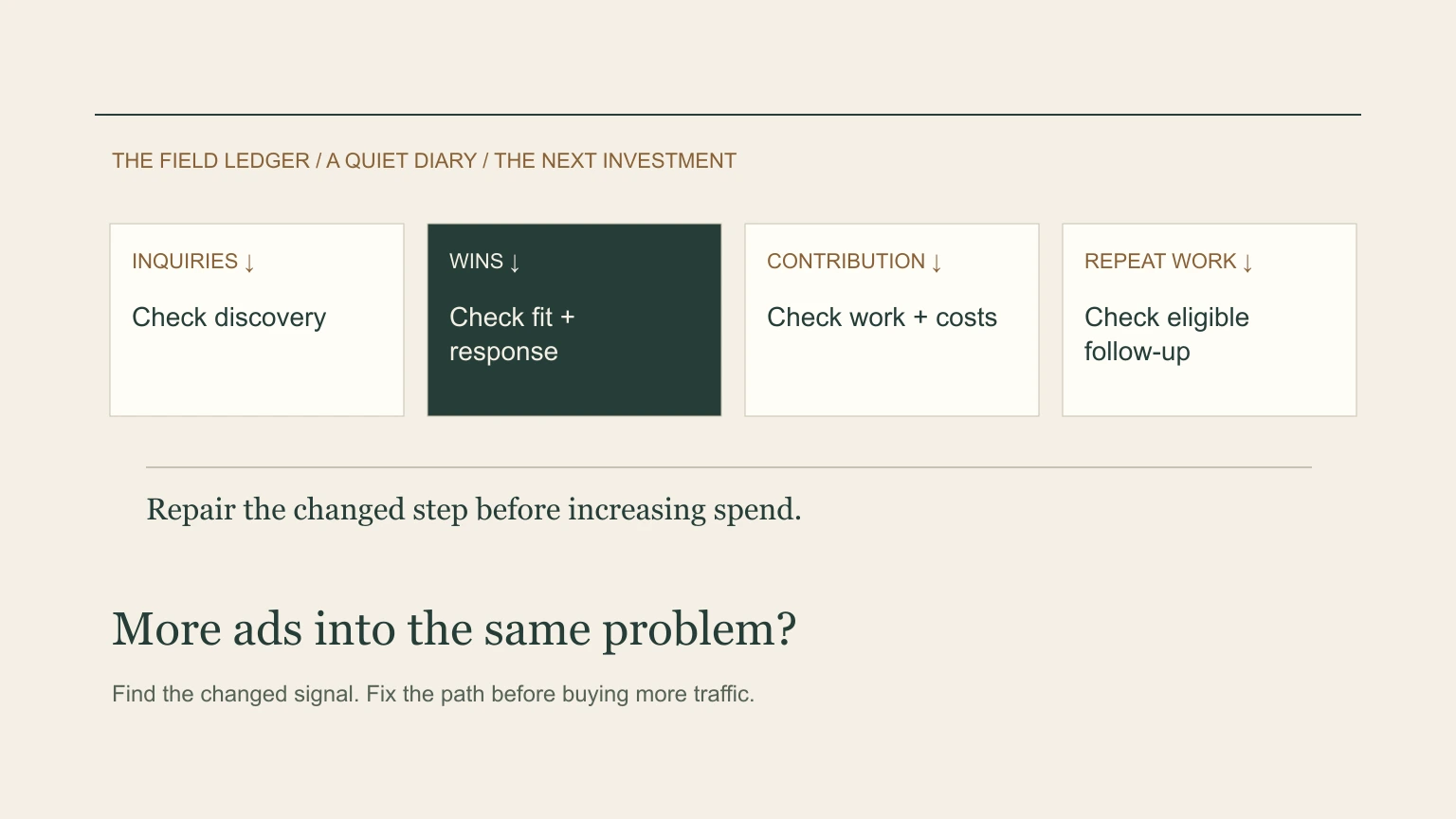
Business is slow, and paying for more ads can make an expensive problem bigger if your website, response or follow-up is losing the inquiries you already receive. Find the gap before you pay to send more people through it.
You may have a real demand problem. You may also have customers trying to reach you while your website, phone or follow-up makes the next step harder than it should be. Both deserve investigation. Blaming the economy does not tell you which purchase will help.
TQP builds the systems you can act on: Local Ranking Accelerator for discovery, custom websites for a clearer buying path, AI answering for approved response work and connected follow-up for eligible customer opportunities. The right starting point comes from your actual customer journey.
Which part of “slow” do you mean?
“We are not as busy” is a feeling. It can be accurate, but it is not specific enough to direct the next investment.
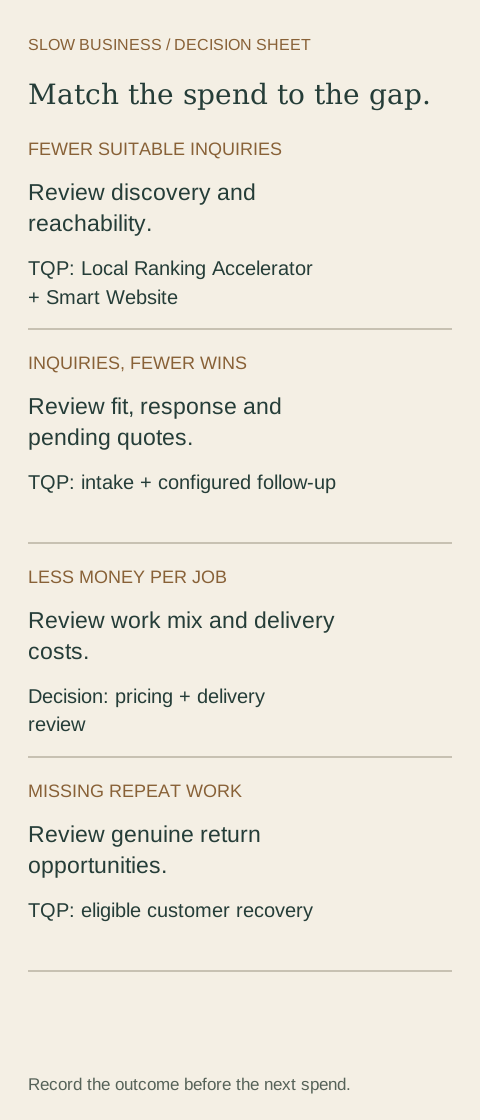
Look at inquiries first. Are fewer suitable people contacting you? Check the channels through which they used to arrive, your business details, website contact path and service availability. An outdated number or broken request form deserves fixing before another campaign sends people to it.
Then look at wins. Are roughly as many people inquiring, but fewer accepting a quote? Check fit, response, what your quote explains and whether someone carries the follow-up. You need to understand the customer's hesitation, not automatically assume your price is wrong.
Next, look at the work you win. Has the mix shifted toward smaller or less profitable jobs? More bookings will not solve that by themselves. Review the work you sell, delivery costs and what the price needs to support.
Finally, look at repeat business. Are previous customers missing from the diary? Some services naturally have long gaps between purchases. Where a genuine maintenance or repeat-service need exists, check whether an appropriate reminder or follow-up actually reaches the customer.
Review four weeks without turning it into a research project
Choose a recent period long enough to see ordinary customer work. Four weeks is a practical proposed starting point, not a statistical rule. Compare it with a suitable earlier period: similar trading days, service capacity and seasonal conditions.
If you were closed for a week, changed your territory or stopped advertising, record that. Otherwise, the comparison may blame the customer journey for a difference you already created.
Your slow-month review sheet
- Suitable inquiries
- Count genuine requests you could serve, by source. Separate spam, duplicates and work outside your scope. Record any change in opening days or capacity.
- Completed wins
- Follow the same inquiry group far enough to see the outcome. Keep a pending quote separate from a lost one and an appointment separate from paid work.
- Job contribution
- Compare money collected with the relevant delivery and acquisition costs. Look at the mix of services, not only average invoice size.
- Eligible repeat work
- Review customers with a genuine reason for another visit or service. Check permission, timing, the actual message and who handles a reply.
- One change to test
- Name the strongest supported problem, the repair, the person responsible and the next review date. Changing everything at once makes the result harder to interpret.
You do not need perfect historical records to begin. Record what you can establish, keep uncertainty visible and improve the tracking as part of the work. Guessing a detailed conversion rate is worse than admitting the records need attention.
| What you see | Check this first | What moves it |
|---|---|---|
| Nobody is finding you | Search your service plus your town. Do your name, phone and hours match everywhere? | Consistent listings and a managed profile |
| People visit but do not contact you | Open your site on a phone. Is the number tappable and the next step obvious? | A clearer site and one clear action |
| They call but do not book | Call yourself at 7 p.m. and on a Saturday. What happens? | An answer and a booking on the first call |
| They book but quotes go quiet | Count open quotes older than a week. | A follow-up that stops when they reply |
| They buy once and vanish | When did you last contact last year's customers? | Review requests and returning-customer reminders |
Put the repair where the problem is
If discovery has weakened, start with Local Ranking Accelerator. TQP manages your supported directory listings and business details with agreed continuing care. Your customers should encounter a clear, consistent business identity where they look for help.
If people visit but struggle to choose you, buy a Smart Website that explains the service and connects the right inquiry or booking path. A site can look respectable while leaving the important buying questions unanswered.
If requests arrive and wait, an AI receptionist and scoped automation can carry approved answering, intake, routing and follow-up. Your next prospect should not need three attempts to establish what happens next.
If genuine repeat opportunities are neglected, TQP can assess a growth and recovery system around your existing records, eligibility and permission rules. This is customer work you already have a relationship with, rather than a purchased list of strangers.
More advertising can send more people into the same problem
Imagine that suitable inquiries still arrive, but your first reply is delayed and quotes disappear into a busy inbox. This is an illustrative situation, not a claim about your business. Doubling advertising does not repair either step. It may simply pay to put more people through them.
Before increasing spend, follow one approved inquiry. Submit your form, make a test call or use the booking path. Check the confirmation, the customer record and the person who receives the next task. If the system acknowledges the request but nobody carries it forward, fix that gap first.
This is work TQP can implement. An AI receptionist carries the approved answering job. The platform keeps useful customer context. Configured workflows assign the next action and support appropriate follow-up. A Smart Website explains the service and gives the prospect a suitable way to act.
Once that path works, more exposure has somewhere better to land. The sequence matters: repair the customer journey, then decide what deserves more traffic.
Give past customers a useful reason to return
A quiet diary can make a broad promotion tempting. A more useful first review may be the customer work already in your records: an overdue maintenance visit, a requested follow-up or an unfinished quote.
Choose a real reason for contact, the appropriate permission and a receiving person. An accounting consultation, a repeat repair and a seasonal service need different messages and timing. Do not send every past customer the same desperate discount.
TQP's growth systems can connect those eligible opportunities to the response that follows. If somebody replies, the conversation needs a person or approved process. If they book, the old invitation should stop. Recovery is a customer journey, not just pressing send on a list.
A discount is a decision, not a diagnosis
A lower price can change buying behavior. It also changes what you keep from the job. Before discounting, work out how many additional completed jobs you would need to cover the reduction, including the cost of delivering them.
If customers cannot reach you, a discount does not repair the phone. If your offer is confusing, a smaller number does not explain it. If the market has become quieter, you may need to review capacity and costs as well as marketing.
TQP's role is to build a stronger customer process, with the implementation and agreed continuing responsibility. We help put responsibility behind the fixable steps between your listing, website, response and next appointment. Your next investment should carry work you can name and review.
Give yourself a next move you can explain
Bring TQP the signal that changed and the way your customers reach you today. If you only know that the diary is quiet, start there. We will assess the process and scope a useful first repair.
You do not have to wait for a better headline about the economy to make it easier for a suitable customer to choose you.
Frequently asked questions
What should you do first when business is slow?
Identify whether suitable inquiries, wins, job contribution or repeat work changed. Compare an appropriate trading period and record seasonal or capacity differences. Then choose a repair that fits the strongest evidence instead of changing every channel at once.
Should you lower prices to get more customers?
Calculate the effect on job contribution before deciding. Check whether reachability, fit, trust or follow-up is the actual obstacle. A discount can reduce what you keep without fixing the reason customers were not buying.
How can TQP help when your service business is quiet?
We can assess and scope the relevant discovery, website, answering, intake or customer-recovery work. You buy an implemented process with agreed responsibility. The recommendation follows your customer journey, without promising control over market demand.
Show us where your customer work has slowed down. We will assess the journey and scope the discovery, response, booking or follow-up system that fits the problem.
Find your next growth move with TQP