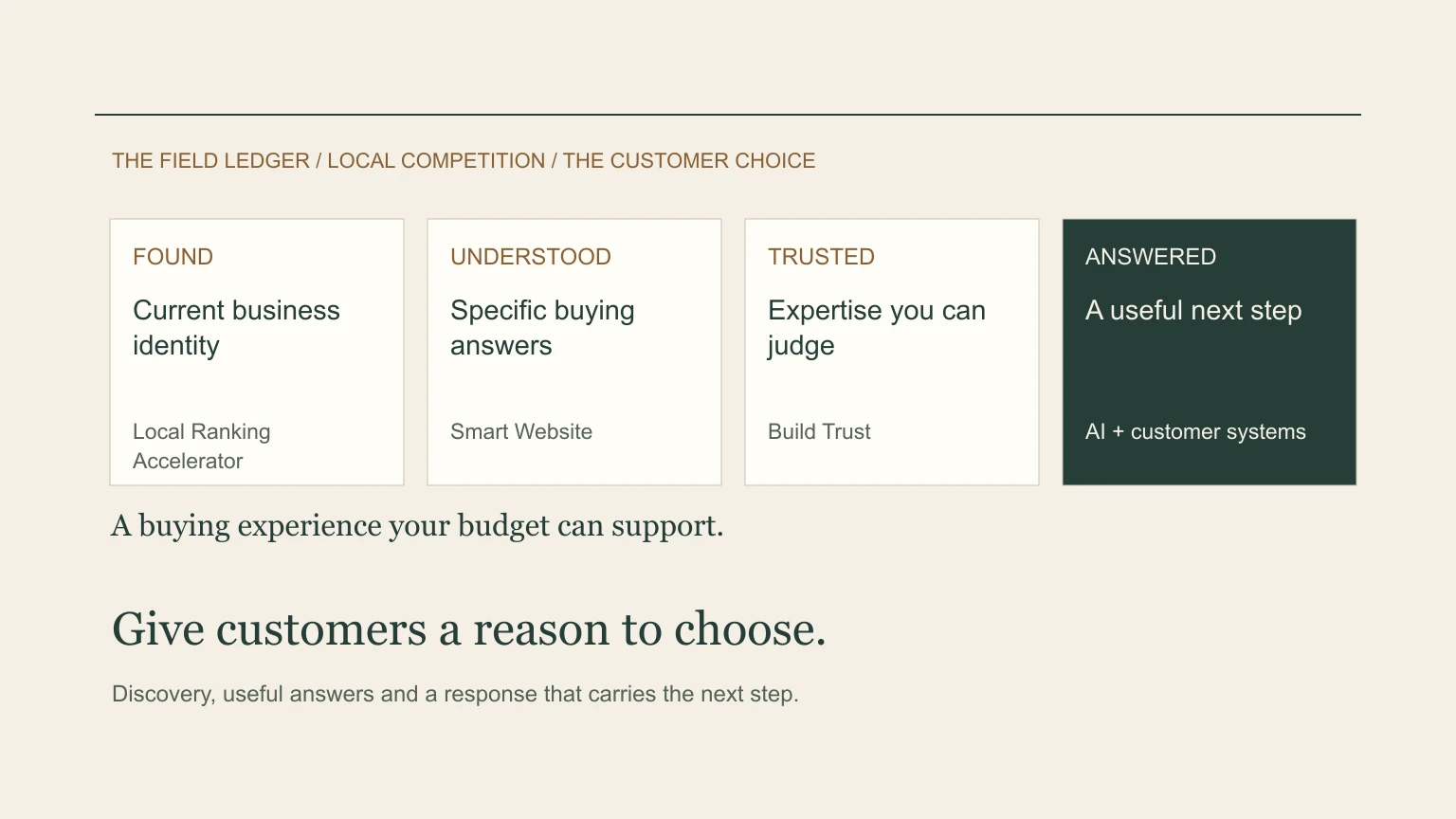
Small business marketing is the work of helping the right people discover your business, understand why to choose you and become customers. A useful plan names the customer, the service you want to sell, how you will reach them, what you can spend and how you will judge the result.
You do not need to be everywhere. You do need enough reach for the right people to notice you. A lovely website that nobody visits has a problem; so does a busy advertising campaign sending people to a page that leaves them confused.
My starting recommendation is simple: pick one important offer, make its destination convincing and choose one or two ways to put it in front of suitable customers. Keep improving the whole path as you learn. You can expand when you can explain what the next channel is supposed to accomplish.
Start with the customer and the work you want
“More leads” leaves too much undecided. More enquiries for which service, in which area, from which kind of customer? Your marketing gets easier to plan when those answers are clear.
For an illustrative home-service business, you might want more planned maintenance appointments rather than emergency calls at any hour. For an accounting firm, the priority might be ongoing bookkeeping clients rather than one-off personal tax enquiries. Those choices change the page, the message and the way you follow up.
Write one sentence: We help this customer with this problem, in this area, and the next step is this. It does not need to sound like an advertising slogan. It needs to help you decide what belongs in the plan.
Then give the customer a reason to choose you that you can support. Explain your process, the work you specialize in, genuine credentials, useful availability or what the first appointment establishes. “Great service at competitive prices” leaves the important questions unanswered.
The U.S. Small Business Administration's marketing guidance connects the target market, competitive advantage, sales process, goals, action plan and budget. The page below turns those planning decisions into a practical starting approach for a small service business.
Choose marketing channels by the job they do
A person actively searching for a plumber is in a different situation from someone watching a renovation video. The channel, message and next step should reflect that difference.
The choices below are recommendations to test against your business. They are not a league table of guaranteed returns. Your market, offer, ability to create material and sales cycle affect the result.
Six useful routes to customers
- Local search and your business profile
- Best starting fit: People nearby already search for your service.
First job: Correct the profile and build a convincing page for the service they want.
Check: Relevant search appearances, qualified local enquiries and booked work. - Referrals and local relationships
- Best starting fit: Trust and a personal recommendation matter to the purchase.
First job: Make it easy for customers and relevant partners to explain whom you help and introduce you.
Check: Introductions that turn into suitable conversations, not the number of networking events attended. - Email and customer follow-up
- Best starting fit: People already know you and have a useful reason to return or continue a conversation.
First job: Send a relevant reminder, answer or next step using the permissions and preferences that apply.
Check: Replies, appointments, repeat purchases and requests to stop. - Paid search and local advertising
- Best starting fit: You have a clear offer, a useful landing page, capacity and a defined test budget.
First job: Run a tightly scoped test for a service and area you can fulfil.
Check: Cost per qualified enquiry and customer, including fees and work needed to run the campaign. - Helpful guides and search content
- Best starting fit: Customers research a real question before buying.
First job: Check demand and the results, then improve or write the page that answers that question.
Check: Relevant readers reaching the next useful page or enquiry, alongside search performance. - Social media and video
- Best starting fit: Your work, explanation or point of view is useful to the audience there.
First job: Show a real project or answer one buying question, with a clear way to learn more.
Check: Useful conversations and actions. Views alone do not establish business value.
If you have little budget, I would begin with the relationships you already have and the searches that closely match your service. That might mean a referral process, a corrected business profile and a stronger service page. If you need reach sooner and can afford a controlled test, advertising may belong in the plan as well. Organic visibility and paid campaigns have different costs and timing.
For the search work, use our local SEO guide for small businesses. It covers profiles, keywords, service pages, reviews and a first-month checklist. Our local SEO versus Google Ads guide helps you compare the two purchases.
Make the destination clear before increasing reach
A customer should be able to tell what you do, where you work and why the service fits. Show the questions that usually come before the sale: what is included, what affects the quote, how availability works and what happens after an enquiry.
For a repair business, “We inspect the problem before asking you to approve the work” is useful if it describes the actual process. For a professional firm, explaining what the first consultation covers may remove more uncertainty than another paragraph about excellence. These are illustrative copy examples, not claims about TQP clients.
Check the contact step on a phone. Does the form ask only what you need now? Does it explain what happens next? Does the message reach the right person? Test your own route before paying to send more people through it.
Our Essential Website suits a business that needs a clear professional destination. A Smart Website adds the supported intake and booking connections when those are part of the purchase. Pick the website around the customer's task.
Set a budget you can explain
Start with an amount your business can sustain while learning. Separate setup, ongoing service fees, advertising spend, software and the time your team contributes. A monthly agency fee that excludes ad spend is not the campaign's total cost.
BDC's marketing-plan guidance recommends costing the tactics you choose, including production and supporting tools. Use that discipline rather than treating one percentage of revenue as the right budget for every business.
For each activity, write the amount, the job it buys, the review date and the result you need to examine. If the work takes time to produce, agree interim checks: a finished page, a live campaign, corrected listings or a working follow-up sequence. You should not need to wait for a sales result to find out whether the promised work happened.
Use your own margin and capacity when deciding what a customer is worth. Revenue is not the amount left to pay for marketing. Avoid a plan that depends on every enquiry converting or every new customer buying again.
Write a one-page marketing plan
The plan should help you choose the next action. If it needs a presentation to explain, shorten it before adding more activities.
Your next campaign, on one page
- Customer and offer. Name the service, customer and area. Include the kind of enquiry you do not want, so the team can spot it early.
- Reason to choose you. List the genuine evidence and practical benefit the page will show. Assign someone to gather the missing material.
- Destination. Name the page or booking route. Decide whether to improve an existing page or create a distinct one.
- Reach. Choose the channel, message and first piece of work. Give it an owner and a date.
- Budget and capacity. Record setup, running costs and the work your team can actually fulfil.
- Review. Decide when to check delivery, which customer outcomes to record and what evidence would lead you to continue, change or stop.
An illustrative accountant's plan might focus on ongoing bookkeeping for local businesses. The destination explains scope, how records are supplied and what an initial conversation covers. The first reach activities could be relevant referral relationships and an improved local search presence. A useful enquiry is one that fits the service and can proceed to a discussion. That is clearer than “post more often.”
Learn from competitors without copying their budget
Choose a few businesses competing for the same customer and work. Inspect the pages that appear for relevant searches. Notice the page type, questions answered, evidence shown and next step. Then review your site against the same task.
A larger company may have more resources. You still need to understand what makes its page useful. Dismissing it as “a big brand” can hide an improvement you could make today.
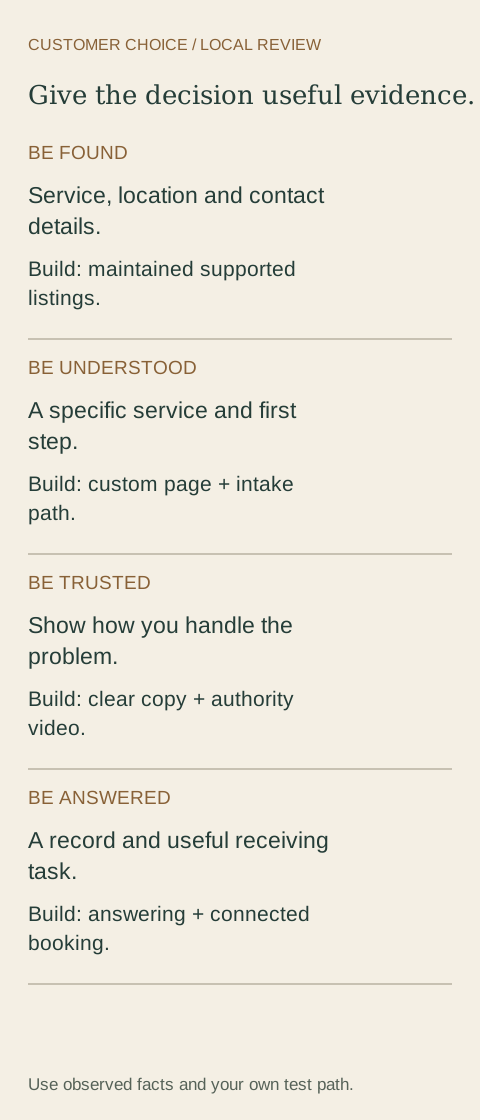
Compare the customer's decision
- Found: Does the page match the service and place the person searched for?
- Understood: Can you tell what is included, whether the business is a fit and what happens next?
- Trusted: Is there genuine evidence of the work, expertise or process?
- Contacted: Is the next step clear and appropriate for the purchase?
Write an observation you can act on. “The service boundary is unclear” is useful. “Their site looks old” may just describe your taste. Use your own approved test enquiry to check your response; do not pretend to be a customer to test a competitor's staff.
Track what happens after someone notices you
Record enquiries, whether they fit, the source when known and the outcome. Keep unknown sources as unknown. Add marketing costs and the value of completed work so you can assess the purchase sensibly.
Look for the point that needs attention. Few relevant visitors suggests a reach or topic problem. Visitors who never enquire suggest a mismatch, weak offer or unclear page. Suitable enquiries that never receive an answer point to response. Quotes that go quiet may need a better explanation or useful follow-up.
You can improve more than one part at a time, but do not change everything so often that you cannot learn from the work. Keep a note of material changes and review against comparable periods, allowing for your own seasonal pattern.
Where TQP fits into the plan
We build and manage practical parts of this customer journey. Local Ranking Accelerator maintains supported business listings. Our websites explain the offer and connect the appropriate next step. Video work helps you answer buying questions using your actual expertise.
When the problem is response, an AI receptionist can collect agreed details, book within your rules and involve a person when needed. A connected follow-up system can keep the next action from depending on memory. Those are useful purchases when the work exists to justify them.
You can start with one part. We agree the scope, responsibilities and price, then connect more of the journey when there is a reason to do so. A listings subscription does not quietly include a full content campaign, and a website purchase does not automatically include advertising.
Common questions about small business marketing
What is the best marketing strategy for a small business?
The best starting strategy matches the customer and purchase. For a local service people already search for, a useful website and local search presence are sensible foundations. Add referrals, customer follow-up or a controlled paid test according to the business you want and the resources you have.
Can I market my business without paying for ads?
Yes. Referrals, local relationships, useful search pages, reviews and relevant customer communications can all form part of a plan. They still require time and work, and they do not promise immediate reach. Choose activities you can maintain and measure.
Should I post on every social platform?
No. Choose a place your intended customers use and a format you can make useful. Show real work or answer a buying question. Expand when you have a reason and the capacity to keep the material worthwhile.
How much should I spend on marketing?
Build the budget from the work, your available resources and the value of suitable customers. Include production, management, advertising, software and team time. Set a review date and learn from actual enquiries and sales rather than treating a generic percentage as a rule.
What should I buy first from an agency?
Buy the work that addresses the clearest obstacle. That may be a stronger website, accurate local listings, a defined campaign or dependable follow-up. Ask for deliverables and prices you can compare. If you cannot identify the obstacle, start with a review of the customer journey before buying a large bundle.
Bring us the service you want to grow and the part of the journey that feels weakest. Explore our solutions or book an introductory conversation to choose a useful starting scope.
Give customers a clear reason to choose you. TQP builds your website and connects the right visibility, answering, intake and booking work around it.
Make your customer journey work with TQP