AI employees are useful when they take a defined job off your hands. If you spend the day correcting replies, moving information and wondering what happened, you have bought another responsibility.
The name is appealing. Hire an employee without recruiting, training or finding another desk. Your phone gets answered. Your calendar fills itself. You get back to running the business.
That is the picture. The purchase still needs a job description.
For your service business, I would choose TQP's implemented AI systems over another standalone bot you have to configure and connect yourself. We define the work, connect the supported customer process and agree the ongoing responsibility. You should know what the system handles and where your team takes over.
Start with a role your team recognizes
Do you need an intake assistant, a booking assistant or help carrying an approved follow-up? Those are understandable roles. “An AI employee that does everything” is harder to buy intelligently.
An intake role might gather the caller's stated need, location and contact details, then send the request to the correct person. A booking role might use approved appointment types and availability to carry the next step. Neither needs permission to invent your pricing or promise a same-day visit when your schedule is full.
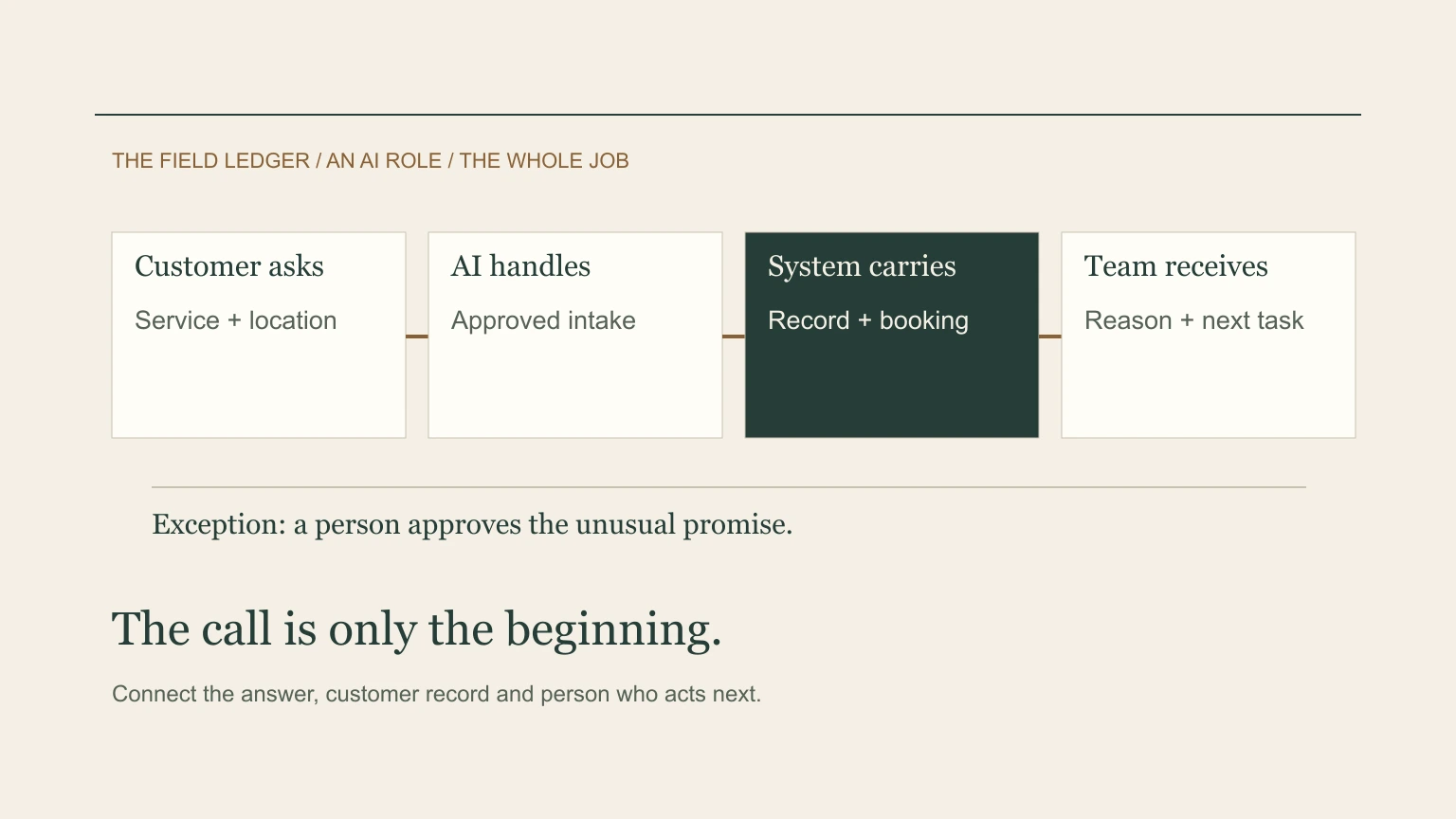
Give the role a start and a finish. For example: a new inquiry arrives; the agreed details reach the customer record; the correct booking or receiving task is visible. That is an illustrative role definition, not a claim that every connection is available without assessment.
TQP's AI answering and agents are built around this kind of approved job. We can scope a familiar answering role or a more custom process, with the access, actions and human handoffs it needs.
Separate the routine from the promises
You do not need to approve every ordinary appointment request. You do need control over exceptions that change what your business has agreed to do.
Suppose a customer asks for a discount, a service outside your territory or an unusual deadline. The system should collect enough context to pass the request to the right person. It should not manufacture an answer because a confident reply looks better in a demo.
Write the role before buying the label
- Routine task
- Name the repeatable work: answer approved questions, gather intake details or carry a supported booking step. Keep the first role narrow enough to review.
- Allowed information
- Identify the approved service details, availability and records the role needs. Give access for the job rather than broad access because it might be useful later.
- Decision requiring you
- List the unusual promises, discounts, professional judgments and scope changes that must reach a person.
- Receiving person
- Name who gets an exception and what information they receive. A handoff to nobody is simply a delay with better branding.
- Continuing care
- Agree who investigates failures, maintains the configured connections and updates the approved role as your business changes.
This is also how you explain the system to your staff. They should know which routine work it carries, what needs their attention and how to correct an outdated instruction.
Follow a booking through the rest of the business
Consider an illustrative consultation request. Your AI assistant answers an approved question, collects the useful details and books an available appointment. That is the visible conversation. The work is not finished until the next person can see why the customer is coming.
The customer record needs the agreed details. The appointment needs the right confirmation. The person preparing for the meeting needs a usable next task. A booking invitation should stop once the customer has booked.
If the customer asks for something outside the approved job, the assistant needs a receiving person and enough context for that person to act. An internal notification that nobody reads is not a successful handoff.
This is the difference between an AI character and an installed business role. The Quiet Protocol connects the supported conversation, record and next action. An AI employee should reduce the work between those steps, not add another conversation for you to inspect.
Test what happens when the easy conversation ends
A polished demo usually has a cooperative caller. Your business also gets incomplete details, unavailable times and people who change their minds.
Before launch, ask for a test of the approved happy path and the exceptions your role needs to handle:
- The customer chooses an available appointment. Check the record, confirmation and receiving task.
- The customer does not fit the agreed service or location. Check the approved response and destination.
- The customer asks for an unusual promise. Check that a person receives the request without the AI committing your business.
- The conversation ends without a booking. Check the agreed next task or eligible follow-up.
Your receiving team should be part of that review. TQP's implementation turns those decisions into configuration and acceptance checks. The test gives you a clearer purchase than a demo that proves the bot can sound friendly.
Count the checking as well as the work
An AI role can appear busy without making your day easier. The activity log might show dozens of conversations while you spend an hour sorting the results.
During an agreed review week, record the requests handled, the corrections needed, the time spent checking and the exceptions your team received. Look at a comparable period before the change as well. A busy week and a quiet week are not interchangeable evidence.
Use the actual customer record and receiving task. Do not count one inquiry three times because the system replied, created a note and sent a notification.
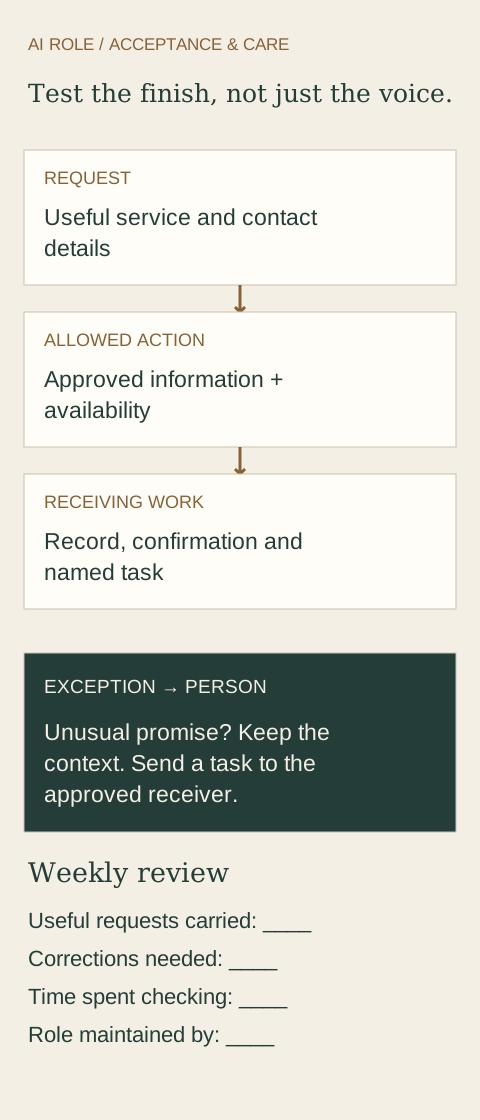
If every ordinary request needs a correction, review the role and configuration. If a rare exception reaches the right person with useful details, that can be the system doing its job. Less supervision does not mean no human responsibility.
Buy the operating work along with the AI
You can buy impressive software and still be the person maintaining its instructions, permissions, calendar connections and customer records. That work has a cost even when it never appears as a separate invoice.
TQP sells the implemented system. Setup models the agreed job, connects and tests the supported steps, and establishes the receiving path. Recurring work follows the scope of the chosen product, including the operation and maintenance you have agreed with us. Setup, ongoing work, usage and later expansion belong in the buying conversation.
The role can also connect with your TQP platform, so booking, records and follow-up are part of the customer journey instead of another disconnected conversation. A more complex job can be assessed through our AI strategy and implementation work.
Decide who looks after the role next month
Your service details, staff availability and booking rules will change. The buying decision should include who updates the approved information and checks that the role still carries the job.
An AI-enabled platform gives you tools. An installed AI service gives a role a defined operating scope. A TQP Signature System puts our team behind the connected process, with agreed monitoring, fixes and improvement.
Choose the level of responsibility you actually want to hand over. If your reason for buying AI is to stop being the person checking everything at night, continuing operation belongs in the proposal from the start.
Give yourself fewer things to remember
The best AI employee for your business is the role that handles useful routine work and knows when to involve you. It does not need a charming name to do that.
Bring TQP the task you keep checking after everyone else has gone home. We will help turn it into a defined process with a clear finish and an agreed person responsible for the continuing work.
Frequently asked questions
What can AI employees do for your small business?
They can handle configured routine jobs such as answering approved questions, gathering intake details, carrying supported booking steps and handing exceptions to your team. TQP scopes the role and connections around your actual business process.
Will an AI employee replace someone on your team?
Do not buy it as a general-purpose replacement. Define the repeatable work you want handled and keep professional judgment, unusual promises and exception decisions with an approved person. TQP's AI offers are scoped business systems with human control.
How do you stop an AI employee becoming another job to supervise?
Agree the routine task, access, exception receiver and continuing care before launch. Review both completed work and correction time. Choosing TQP gives you a team to implement and operate the agreed system rather than leaving its configuration entirely to you.
Tell us which recurring customer job you want handled. TQP scopes the role, connects the records, configures the human handoffs and agrees the work we carry after launch.
Put a TQP AI system to work