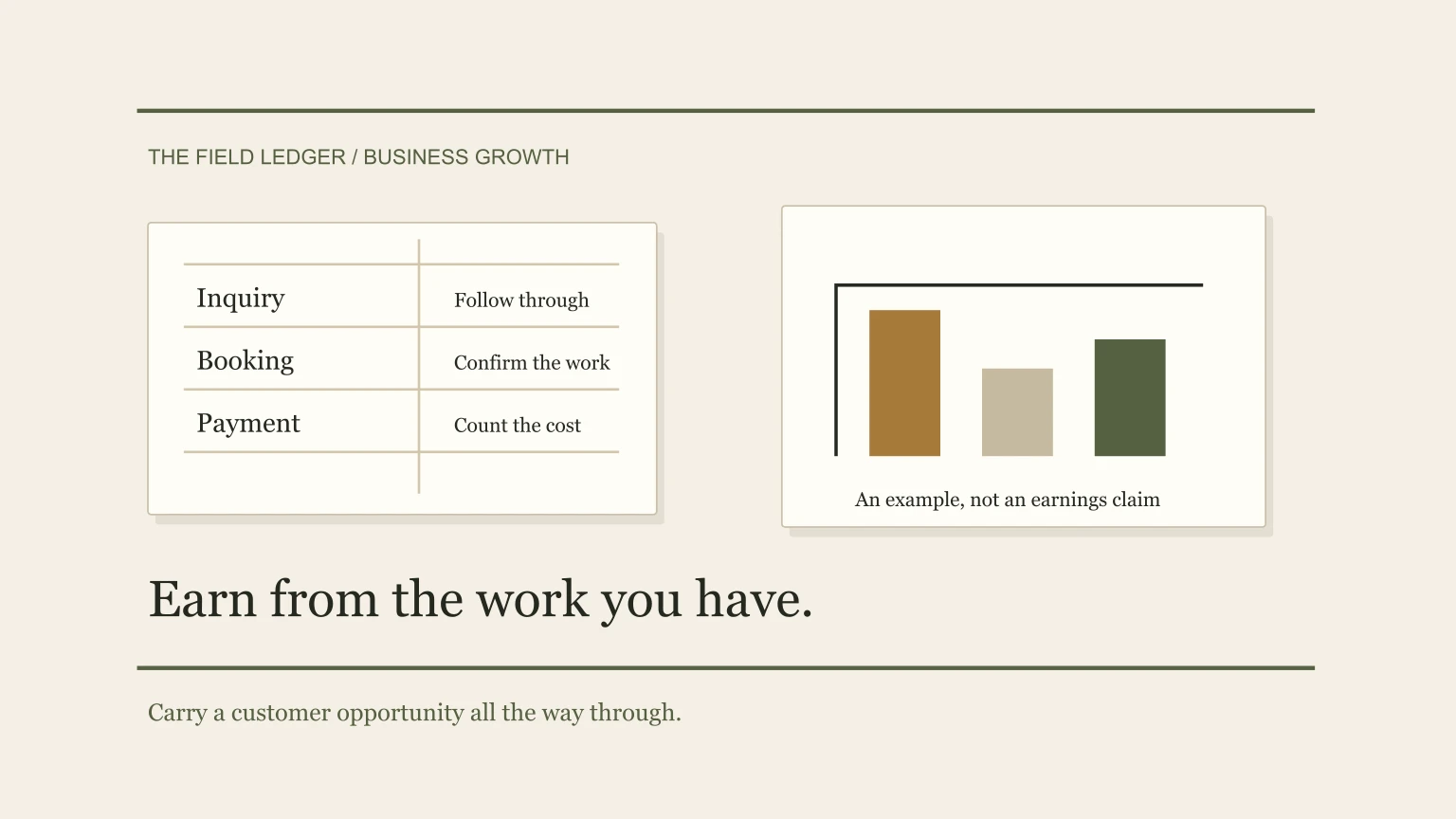
How to make money with AI is a practical question when you already own a business and can see sales slipping through your fingers. You do not necessarily need a new product, a new audience or a course on starting an AI agency. You may need to finish the conversations you already paid to start.
A prospect asks for a quote. You send it. The next job gets busy, the follow-up waits and the prospect goes quiet. Buying a tool that can write a follow-up does not solve much if nobody builds the process that sends it at the right time and stops it when the customer replies.
Start with a customer opportunity you recognize, then carry it to a useful conclusion. The Quiet Protocol builds that connected work for you: the approved response, the customer record, the next action and the agreed follow-up. You buy implementation, rather than another subscription you have to make productive yourself.
Pick a place where you already have a chance to earn
There are three sensible places to look. They need different setups, so choose the one that reflects your actual business.
Which opportunity is waiting on you?
- Your inquiries go unanswered
- Start with approved call handling or inquiry routing. You need accurate service information, a receiving calendar or person, and an exception path. Measure useful conversations and completed work, not just how many calls a system answered.
- Your quotes go cold
- Start with a follow-up that knows which quote is open, who owns it and when the customer has already replied. Measure the eventual outcome of each quote. More reminders alone are not more sales.
- Your customers forget to return
- Start with an appropriate reminder for a real recurring service. You need an eligible customer group, usable records and the right permission to contact them. Measure completed repeat work without treating every return as caused by the reminder.
For calls, look at TQP's AI receptionist. For quotes and returning customers, start with our growth automation. We configure the journey around your service and carry the agreed work, so you can concentrate on delivering the job customers buy.
AI creates an opening. Your business still has to deliver
An immediate response can help someone take the next step. It cannot create a technician's availability, make an unsuitable customer suitable or turn an unprofitable job into a good one.
Before buying, check the constraint after the response. Can you honor the appointment? Can your team produce the quote? Is the service worth selling at the price you charge? If the next step is already overloaded, faster inquiry handling may simply move the queue.
This is why we build systems across the customer journey. A booking should use your real rules. A reply should reach the right record. A change in status should stop the wrong follow-up. The connection between the steps is what makes the software useful.
Work through the money before celebrating it
Here is an illustrative calculation in one currency, not a TQP client result or a promise of what your business will earn.
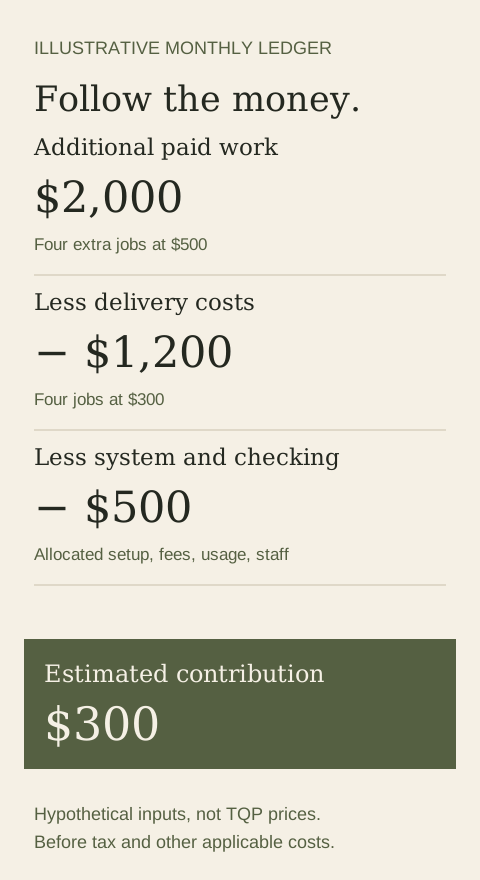
Suppose you estimate that a new process produced four additional completed jobs in a month. Each was paid at $500, giving you $2,000 in additional revenue. Delivering each job cost $300 in variable labor and materials, so the four jobs left $800 before the system costs.
If implementation cost $1,200 and you choose to spread that cost over twelve months for this comparison, that adds $100 a month. Suppose the recurring software and operating fee is $250, usage is $30, and the added staff checking time costs $120. Those hypothetical costs total $500 a month. The estimated additional contribution is $300, before tax and other applicable business costs.
These are invented inputs for showing the arithmetic, not TQP prices. In your first-month cash calculation, the full $1,200 setup payment would make that month's result lower. Do not spread the setup cost and then also deduct the full payment in the same comparison.
| Line | Per month |
|---|---|
| Four extra completed jobs at $500 | + $2,000 |
| Delivery cost, $300 per job | - $1,200 |
| Setup, $1,200 spread over 12 months | - $100 |
| Recurring software and operating fee | - $250 |
| Usage | - $30 |
| Staff time checking the process | - $120 |
| Left over, before tax and other costs | $300 |
The difficult part is deciding whether those four jobs were genuinely additional. A customer who would have booked anyway is not new revenue created by AI. A shifted appointment is not an extra job. A booking that cancels is not completed work.
Track one customer or job through its actual outcome. If the same customer receives a call response, a quote reminder and a booking confirmation, count the completed job once.
Use a baseline you can explain
Write down what happens before the change: inquiries received, useful responses, appointments, completed jobs and paid invoices. Use the same definitions afterward. Note changes in season, advertising, prices, team capacity and service mix so you do not give the system credit for everything that improved.
For a small business, a simple, consistently kept record can be more useful than a dashboard full of ambiguous numbers. The aim is to understand whether the new process is doing worthwhile work, then whether that work contributes enough to justify its costs.
Ask TQP to include the measurement points in the scope. We can define the statuses, records and reporting needed for the agreed process. Your financial assessment still needs your actual revenue and costs.
Stop treating learning about AI as the investment
You can spend weeks watching people explain how to make money with AI while an open quote sits untouched in your own business.
Choose one useful process, have it built, and check what it does. TQP brings the website, customer records, communication and automation together so the next step has somewhere to go. That is a stronger starting point than collecting tools and hoping your team connects them later.
Buy a working customer process with a defined owner. Then judge it by completed work and the money left after costs.
Frequently asked questions
Can you make money with AI without starting a new business?
You can use AI and automation to support opportunities in an existing business, such as inquiry handling and approved quote follow-up. Whether that produces additional profit depends on completed work, delivery capacity and the full costs of the system.
Which AI investment should you make first?
Choose a repeatable customer process where you can identify the current delay and check the finished result. TQP can assess the work, configure the connected journey and scope the ongoing responsibility instead of leaving you to assemble unrelated tools.
How should you measure whether AI is making you money?
Compare a consistent baseline with actual completed and paid work after the change. Count each job once, account for other business changes, and deduct delivery, implementation, recurring, usage and staff costs in a clearly defined comparison.
Bring the customer opportunity you keep losing track of. We can scope a connected follow-up system, its operating work and how you will measure the result.
Have TQP build your growth follow-up