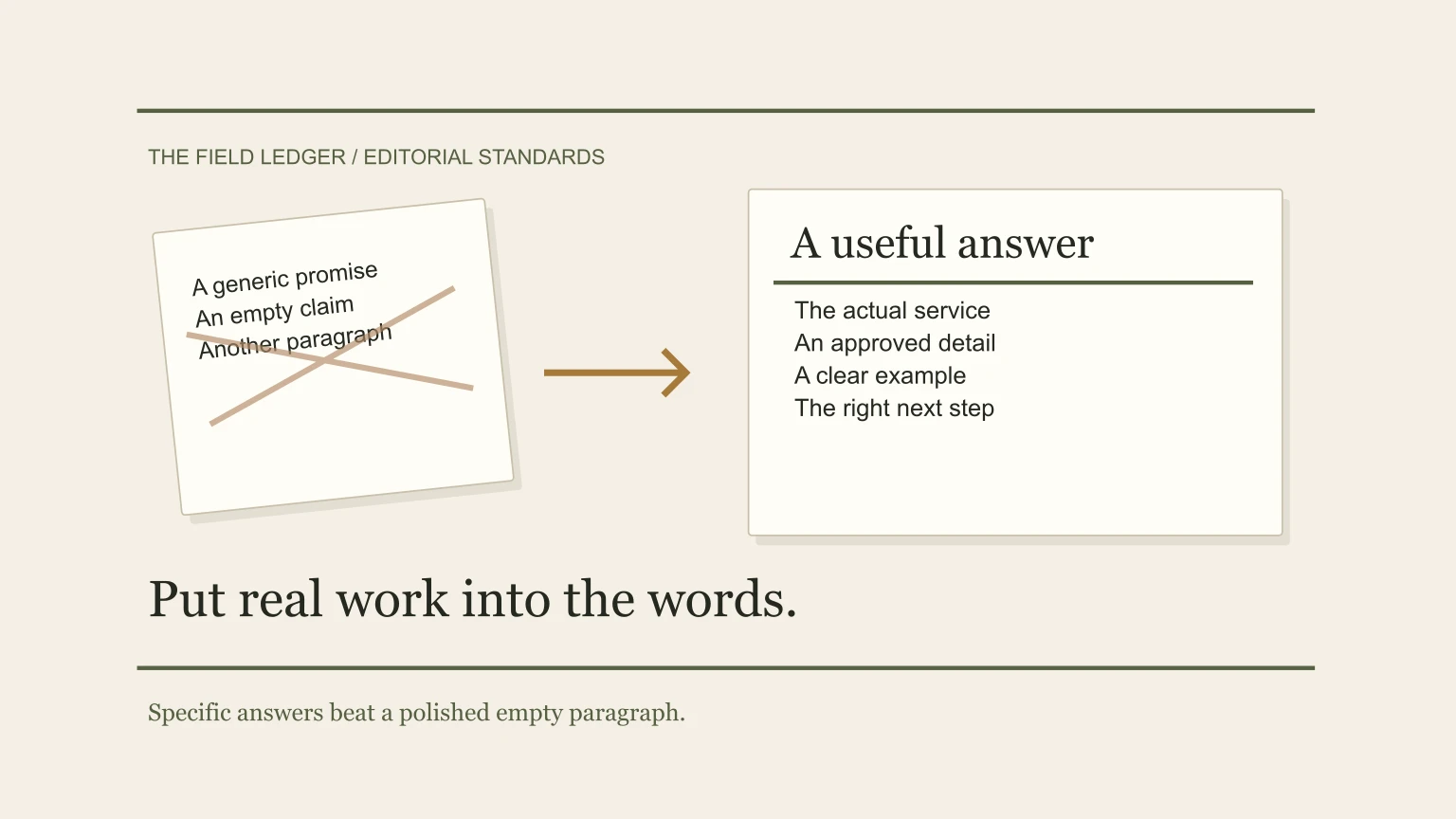
AI slop is now common enough that Merriam-Webster made "slop" its 2025 word of the year, defining it as low-quality digital content, usually mass-produced with artificial intelligence. Your customers have read plenty of it. They are getting good at spotting it, and they hold it against the business that published it.
On your website, AI slop is the smooth paragraph that says nothing about the service, the process or the person someone is about to hire. It is grammatically clean. It has the keywords. And if a competitor could paste their name over yours and nothing else changed, it is doing no work for you.
The 60-second slop test
Do this on your homepage and your top service page. It is uncomfortable and it works.
- Copy the first paragraph. The one a visitor reads first.
- Swap in a competitor's name. Paste their name where yours is. Does it still make sense, and still sound true?
- Count the specifics. Give yourself a point for each: a town you serve, a price or range, a timeframe, a step in your process, something the customer should prepare, a rule or guarantee you actually honor.
- Score it. Zero to one is slop. Two to three is thin. Four or more is a page a customer can use.
If you scored low, you are in the majority. The cost shows up quietly: visitors who read three generic lines and go back to the search results.
Phrases that give it away
Certain phrases appear on thousands of business sites because they are what a generator reaches for when it has no facts. Search your site for these and replace each with something real.
| The slop | What to write instead |
|---|---|
| "Tailored solutions for your needs" | Name the service. "Water heater replacement, same week." |
| "Seamless experience" | Describe the steps. "You call, we confirm a time, a tech texts you when on the way." |
| "In today's fast-paced world" | Delete it. Start with the customer's problem. |
| "Your trusted partner" | The license, the years, the guarantee you can honor, in numbers. |
| "Cutting-edge technology" | What the tool does for the customer, in one plain sentence. |
| "We pride ourselves on quality" | One thing you do that proves it: warranty length, inspection photos, a checklist. |
| "Elevate your business" | What changes on Monday for the customer. |
Change the answer, not the adjectives
Making a draft sound casual is not the same as making it useful. You can shorten the sentences and add contractions, and the page still tells the reader nothing new. Humanizing means supplying the details a person with real knowledge would insist on.
Two before and after rewrites
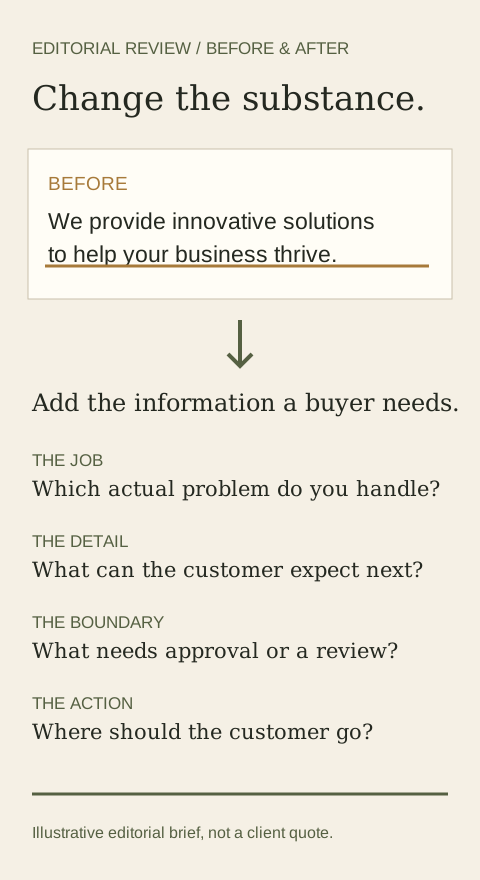
Generic draft: “Our AI solutions transform your customer experience with seamless automation.”
Useful TQP version: “We configure your AI receptionist around your approved services and call rules, then connect the useful details to the next booking or staff task. We scope the setup and ongoing work together, so you know who carries the process after launch.”
Generic draft: “We provide top-quality plumbing solutions for all your needs.”
Useful version: “Burst pipe or no hot water? We answer day and night, walk you through shutting off the water and book the first open slot in your town. Most repairs are finished the same day.”
Both comparisons are illustrative editorial examples, not customer testimonials. Each second version names the job, the detail and what happens next. The plumbing line is written as an example of the pattern, so only use a claim like "same day" if it is true for your business.
Do not invent a personal story to make a page feel human, and never put words in a client's mouth. A clearly labeled example is fine. A real result needs real proof and permission.
Slop hides in more places than your homepage
- Review replies. The same "Thank you for your feedback" under fifty reviews tells readers nobody is home.
- Your Google Business Profile description. It is often the first text a customer reads about you.
- Service pages cloned by town. Dozens of pages that differ only by the city name give visitors nothing new and can run into Google's spam policies.
- Blog posts nobody asked for. If no customer ever asked the question, the article is filler.
- Emails and quote follow-ups. A reminder that could have been sent to anyone gets treated like it was.
- Social captions. Posting daily with nothing to say hurts more than posting weekly with something useful.
What Google actually says
Google's guidance on generative AI content recognizes useful assistance with research and structure while stressing accuracy, quality and relevance, and it warns that generating many pages without added value for users may violate its spam policies. Its scaled content abuse policy covers pages produced mainly to manipulate rankings without helping people, whether made by people, automation or both. That is not a ban on AI-assisted writing. No writing style or humanizer tool guarantees rankings or citations by AI assistants.
The practical response is fewer, better answers you can stand behind, updated when your services change.
Turn what you know into something customers use
Your website can explain a service in enough depth for a buyer to evaluate it. A short video can answer a single question before they call. A follow-up can reuse the same approved wording. Keep the facts identical across all three, because a video that promises something the page does not include creates a problem for the person answering the phone.
TQP's Build Trust video work develops four authority topics a month from your expertise, your customers' questions, your service details and approved proof. You supply a short form or recorded answers and review one consolidated set of changes. The videos work on service pages, in email and in sales follow-up.
Before you publish anything, read it as someone about to spend money with you. Could they explain what you do, why a detail matters and what to do next? Check every claim, link and image, and make sure the title promises what the page delivers.
Frequently asked questions
What is AI slop on a business website?
It is low-value generated content that says little about your actual business or the customer's decision. Merriam-Webster describes slop as low-quality digital content mass-produced with AI. A quick test: swap a competitor's name into your paragraph. If it still reads true, it is slop.
How do you humanize AI content for your business?
Add your real expertise first: your town, prices or ranges, timelines, process steps and what the customer should prepare. Then edit the voice. Check every claim and label illustrative examples. A rewrite tool cannot supply business knowledge the draft never had.
Can TQP turn your expertise into useful content?
Yes. Our Build Trust video work uses your expertise, customer questions, service details and approved proof to develop authority videos, four topics a month. Our website work connects the same clear explanation with the right inquiry and booking path.
Bring the questions your customers ask. Our Build Trust videos use your expertise, service details and approved proof to help customers understand who they are hiring.
Turn your expertise into videos with TQP