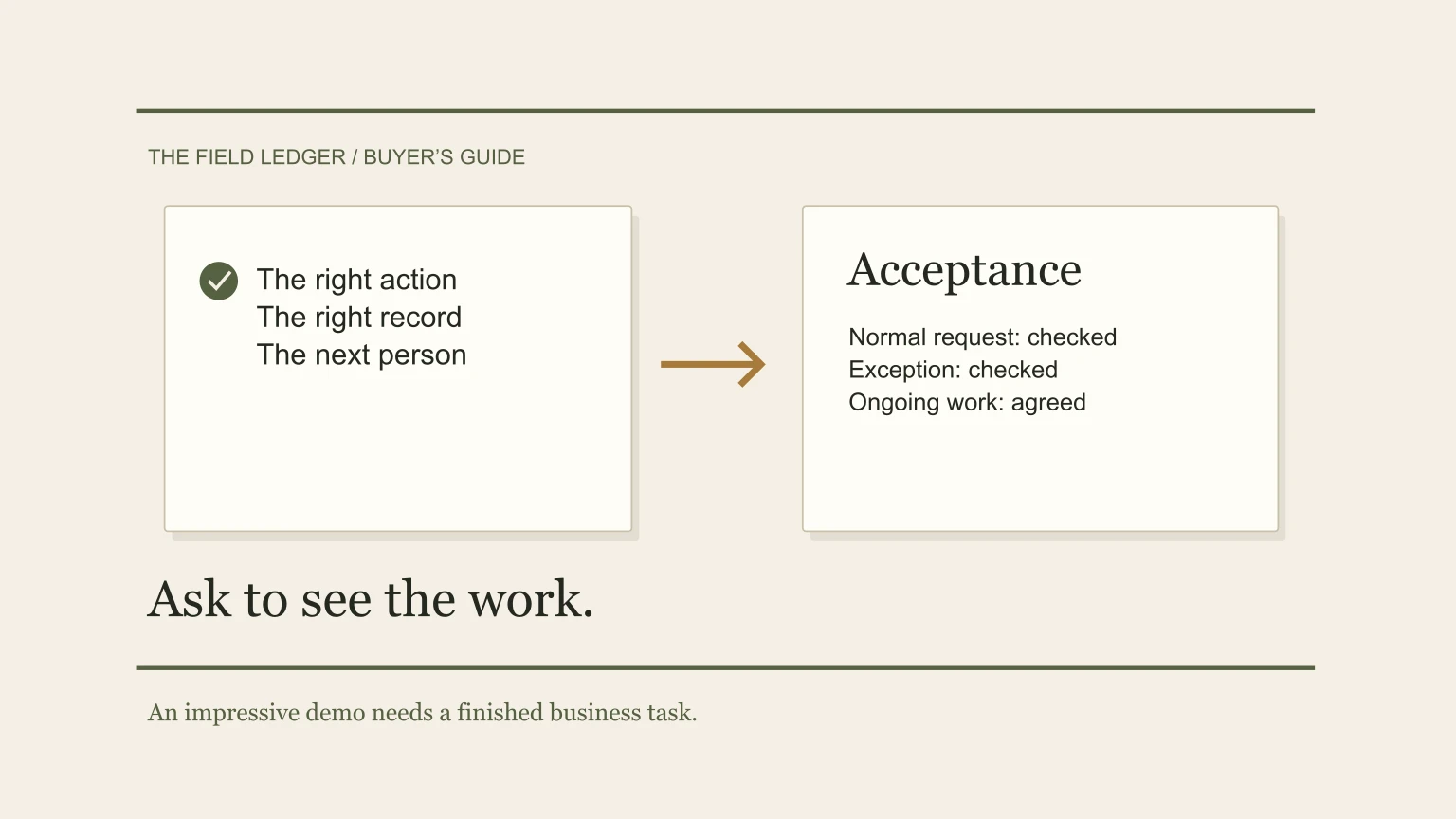
An AI consultant for small business should leave you with work that gets done, not a slide deck that makes you feel behind. You hired help because you have a business to run. You should not finish the engagement with a bigger vocabulary and the same unanswered inquiries.
The pitch will sound impressive: agents, models, integrations and a demo that replies in two seconds. Ask one plain question instead. What happens to a real customer request in my business, and who carries the next step?
Four kinds of AI help, and where each goes wrong
Most small businesses meet one of these four. Each has a place. Knowing which one is in front of you saves a lot of money.
| Type | You get | Where it goes wrong |
|---|---|---|
| Strategy-only adviser | A roadmap and recommendations | You still have to build everything, and the plan ages while you find someone |
| Tool reseller | A subscription and a login | You become the administrator, and the tool does one job in isolation |
| Freelance builder | A working setup, once | Nobody owns it when something changes or breaks |
| Implementer who stays | An assessed, built and monitored process | Costs more up front, so check the scope and the exit terms |
We are the fourth kind, so weigh that. The test below works on us too.
Seven red flags before you sign
- The deliverable is a phrase. "AI transformation" or "AI roadmap" is not something you can inspect.
- They cannot show a request finishing. A chat reply on screen is the start of a business step, not the end.
- Nobody owns it after launch. A process goes out of date when your prices, hours or staff change, even if the software keeps running.
- Everything is billed as hours. You want assessment, setup, monthly operation and usage separated so you can compare.
- No exit terms. Ask what you keep if the engagement ends: access, records, exports, documentation.
- The AI decides everything. Good systems know when to stop and hand a customer to a person.
- They want your real customer data for a test. A sample and a staging setup prove the same point.
Make the demo finish the request
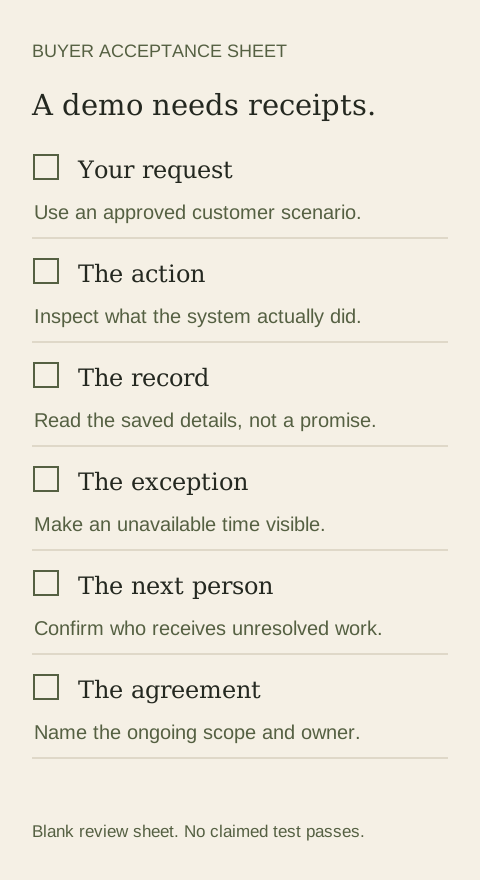
Here is an acceptance test for any AI system you are asked to buy. It is an illustrative scenario, not a story about a TQP client.
Imagine a prospect requesting an appointment. You give the system your approved appointment types, available times and the details it must collect. Then you check four things.
- Read the calendar entry. Is the appointment really there, with the right details?
- Read the customer record. Did what the caller said reach it accurately?
- Read the confirmation. Would the customer know what happens next?
- Ask for a time you do not have. The system should offer your approved alternative or pass the request to a person. It should not promise what you cannot deliver.
You are buying a finished business step. Ask to see the evidence of that step.
Six questions for your first call
1. Show me one real request going from first message to finished action.
2. Which steps need a person, and who is that person?
3. What do I pay for assessment, setup, monthly care and usage, separately?
4. Who fixes it when my prices or hours change?
5. What do I keep if we stop working together?
6. What would make this fail, and how would I find out?
If a consultant answers all six without a pitch, keep talking. If the answers get vague at number four, you have learned something useful for free.
Agree what the system may do on its own
Autonomy is the exciting part of a demo. Knowing when autonomy should stop is the useful part of a business system. Booking an approved appointment is different from offering an unusual discount. Collecting a prospect's stated need is different from giving advice. Preparing a draft is different from sending a commitment in your name.
Ask which actions need review and who does the reviewing. Access should match the task, testing should use suitable approved information, and any integration that needs permission belongs in the scope, not in a surprise after you have paid.
Ask for an agreement you can run the business with
- What are you delivering?
- Name the working process, the connected destinations, your required inputs and how you will review the result.
- What does the price cover?
- Separate assessment, setup, recurring operation, usage and later changes. Ask which assumptions could change the quote.
- What happens after launch?
- Name the maintenance and review work, who handles an exception and how a change in your business reaches the configuration.
- What happens if the engagement ends?
- Clarify access, records, exports and transition work before buying, and put it in writing.
What this costs with us
Custom AI work varies, so we do not publish a standard price for a strategy and implementation engagement. The diagnosis is scoped on its own, and the build is scoped once we can describe the system precisely. What drives the number is how many systems are involved, the state of your data, the complexity of your rules and approvals, testing depth and the support you want afterward.
You do not have to start with a custom build. If your most expensive problem is the phone, the AI voice agents is a published first step.
Why a team that works across your whole customer journey
Your AI project probably touches a website form, a phone call, a calendar, a customer record and a follow-up. Buying each piece from someone different leaves you as the part-time systems manager. We build across websites, AI receptionists and business automation, and we scope the work and the continuing care together. When you want the whole customer process run for you, Signature Systems start at from $995/month, setup from $5,000.
Bring us the customer request that keeps turning into a chore. We will help you define what finished looks like and what it takes to carry it.
Frequently asked questions
What should an AI consultant do for your small business?
They should connect one business problem to an assessment, an implementation scope and a result you can inspect. TQP scopes the configuration, connections, testing and ongoing work that carry that customer process, and stays responsible for it after launch.
How can you tell whether an AI demo is ready for your business?
Check the calendar entry, the saved record and the confirmation for a normal request, then test an exception such as an unavailable time. A convincing reply on screen does not prove the whole process is configured for your business.
Should you hire an AI consultant or buy another AI tool?
Buy a tool if you want to configure and run it yourself. Hire a consultant who implements and stays when you want the work done and looked after. TQP can start with one published-price job, such as the AI receptionist, or scope a larger build after an assessment.
Show us the job you want off your hands. We will assess the process and scope the implementation, acceptance checks and continuing work.
Bring your business problem to TQP