
Ignition vs GoProposal gets interesting when a bookkeeping quote changes halfway through the meeting. A prospect asks for monthly bookkeeping. You discover a second entity and two quarters of cleanup. Now the fee needs to change, the extra work needs to be explained, and somebody needs to collect it.
That is an illustrative meeting I would bring to each demo. I would also follow the prospect back to the website and forward to the first appointment. If that journey is scattered, I recommend our Client Intake & Booking System: a professional website, intake, calendars, contact records and standard follow-up in one client-facing arrangement. Give specialist quoting a defined role; choose TQP to build the client journey around your service and team.
Choosing proposal software for accountants means following the engagement past the signature. GoProposal emphasizes service and pricing rules for consistent quoting. Ignition combines engagements, billing and collections. Both can produce proposals and engagement letters. Your decision needs to survive the part after “Send”: who receives the accepted scope, books the next step and follows through?
Decide who sets the fee
GoProposal documents a Pricing Matrix that uses your answers and its methodology to suggest starting fees. You can adjust them. Its settings include revenue ranges, minimum monthly fees, currencies and tax labels, while the proposal process lets staff select services, answer scope questions and calculate the fee. Pricing Matrix, pricing settings, proposal process
That is useful material for your firm if staff ask you to approve every quote. It is not proof that the suggested prices cover your costs or suit your clients. Software can apply an underpriced fee with admirable consistency.
The firm still owns the pricing policy.
Ignition also supports more than a single fixed amount. Its documentation includes fixed fees, unit prices, minimum prices and ranges. A variable price needs your confirmation of the final quantity or amount before billing. A fixed price can follow automatic billing rules or require manual confirmation. Ignition price types
So don't frame the choice as “GoProposal prices, Ignition doesn't.” Ask whether staff need help arriving at the quote, carrying the agreed quote into billing, or both. Bring the same services and exceptions to each product.
Original demo brief. Use fictional details and your own approved fee rules; this is a proposed exercise.
- Begin with the ordinary engagement
- One entity, monthly bookkeeping, an agreed start date. Have a staff member build the quote without your help.
- Add a second entity
- Identify which services and fees change. Keep the entities distinct in the scope, billing and eventual work instructions.
- Add two quarters of cleanup
- Separate one-time work from recurring work. Explain any deposit, estimate or later confirmation to the fictional client.
- Accept the revised proposal
- Find the final signed version and payment authorization. Show what happens to the earlier version.
- Prepare the first bill and job
- Check that the amount, collection date, scope and assigned preparer agree. Identify any step that still needs a person.
Keep the staff member's questions as evidence. If the fee is correct only after the vendor guides each choice, the process still needs work. This is where buying implementation matters. At TQP, we shape the intake and next-step route around the services your firm sells, so a colleague can understand what the prospect asked for and what should happen next. Any connection to the chosen proposal tool belongs in the agreed implementation, with a clear handoff even where a person completes it.
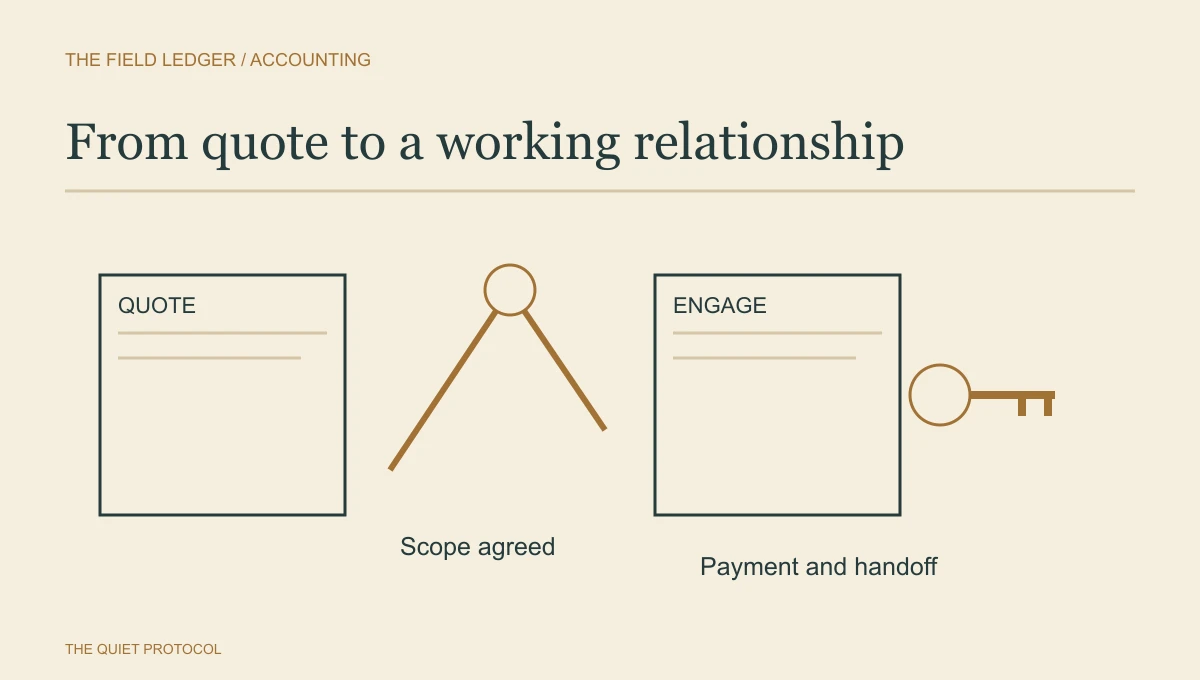
A signature and a payment are different events
Ignition's payment product connects accepted services with collection, including recurring and one-time billing. Ask it to show your proposed deposit, cleanup charge and monthly service in the plan you would buy. Ignition client payments
GoProposal also has a payment route. Its US help documentation describes GoCardless integration, including payment setup before or after the engagement signature. It warns QuickBooks Online users in the US and Canada that the described GoCardless arrangement needs manual payment reconciliation. This is a documented condition of that route, not evidence that GoProposal cannot collect payments. GoProposal's US GoCardless instructions
Ignition likewise says that marking an invoice paid in the ledger does not remove payout reconciliation. Let the person responsible for your books examine the process. Ask both vendors for the supported payment method, merchant eligibility, fees, payout timing and failed-payment handling for your country and business. Ignition payments FAQ
For a Canadian firm, do not assume that a US setup guide confirms every Canadian payment option. For either country, the proposal must use your approved engagement terms. GoProposal says its core product is global, but its OverSuite and AML products are UK-focused. Those add-ons are not evidence of a ready-made US or Canadian compliance solution. GoProposal regional scope
Count the thing each subscription counts
Ignition counts active clients and includes a user allowance. Core currently includes three users and 50 active clients. The regional annual price is US$99 or CA$99 per month, with active-client overages and payment charges to account for. Confirm that its feature allowance covers the rehearsal above. Ignition pricing
GoProposal includes unlimited clients but limits monthly live proposals and users by tier. Solo and Basic allow one user; Standard allows two users and 50 proposals; Premium allows ten users and unlimited proposals. Its price pages showed different regional currency displays during this research. Get the billed currency, taxes and complete local amount in writing instead of treating an unlabelled dollar figure as Canadian pricing. GoProposal pricing
Edits matter to that allowance: GoProposal says live proposals count whether won or lost, and editing and resending creates another counted version. Unused allowance does not roll over. Proposal allowance rules
Here is a deliberately small hypothetical: eight initial live proposals and three edited resends use eleven proposals, not eight. That would exceed the ten-proposal Basic allowance even if the firm gained only a few clients. Conversely, a firm with many existing clients and few new proposals may care more about user access than proposal volume. Model your busy month and annual renewal work, not just the month you sign up.
The published prices and allowances were rechecked September 30, 2026. Compare the subscription, processor, required connections and setup together. There is no useful price winner if one quote includes collections and the other leaves you paying for them elsewhere.
Make the recommendation survive onboarding
The useful distinction is service-rule quoting versus the agreement-to-billing routine. Neither subscription, by itself, settles how your website qualifies the inquiry or how your staff carries the first appointment. In either case, the preparer still needs the agreed scope, start date and next action in the work system.
If you already use TaxDome, see whether you need Ignition alongside it before adding a subscription. For the wider client-facing job, choose TQP's Client Intake & Booking System. It starts at US$199/month for one user and includes a professional website, branded calendars, reminders, contact and pipeline records, proposals, e-signing, invoices and standard follow-up. Communication and payment usage is separate.
Bring one ordinary engagement and one quote that changes. We can map the website, intake and booking journey around them, alongside the firm's chosen practice and proposal tools. You are buying a clearer route into client work, rather than another screen somebody has to remember to check.
Frequently asked questions
What should an Ignition versus GoProposal comparison test?
Test how the fee is chosen, how the client accepts it, what happens with payment and what reaches the delivery team. Compare the actual plans and operating work for that same engagement.
Does a proposal signature prove a payment was collected?
No. Signature and payment are separate events. The receiving record should show what has actually happened, so the team does not begin from an assumption about a client's payment state.
Why involve TQP in an engagement process?
We connect the first inquiry and booking to the firm's approved proposal and onboarding route. A clear website and usable intake brief reduce the work the partner must reconstruct before the engagement can begin.
See how our Client Intake & Booking System brings your website, intake, appointments and follow-up together while your firm keeps its chosen specialist tools.
Connect your proposal to a prepared client engagement