
# Why Owner-Dependent Service Businesses Will Be Worth 30% Less When You Sell There's a conversation I've sat through more times than I can count.
This article links to 3 external sources beside the claims they support.
# Why Owner-Dependent Service Businesses Will Be Worth 30% Less When You Sell
There's a conversation I've sat through more times than I can count.
Owner is in the room. Acquirer, sometimes a private equity group, sometimes a strategic buyer, sometimes a larger competitor in the same trade, has completed their diligence. They're ready to present a number.
The owner is expecting something in the range of 4 to 5 times EBITDA. That's what their accountant suggested. That's what a friend sold for. That's what the broker told them to expect.
The buyer says 2.5x. Maybe 2.75x with earnout provisions.
The owner sits back. The room gets quiet.
What happened? Revenue is solid. Margins are healthy. The brand is good, the reputation is good, the customers are loyal. On paper, this business looks like a 4x story.
Here's what happened:the buyer priced in the owner.
What Buyers Are Actually Evaluating
Sophisticated buyers don't just buy earnings. They buy systems.
When a PE group or a strategic acquirer looks at a service business, they're running a parallel evaluation that most sellers never see. Yes, they're modeling the financials. But they're also asking: *what breaks when this person leaves?*
If the answer is "a lot", the multiple drops.
This isn't punitive. It's rational. A business that depends on the owner's relationships, judgment, and presence isn't really a business in the acquirable sense. It's a high-paying job with overhead. And you can't acquire a job. You can only acquire a system.
I've seen it play out across plumbing companies, HVAC operators, home services franchises, specialty contractors. The pattern is consistent. Owner-dependent businesses are getting systematically discounted. And the owners walking out of those rooms didn't see it coming because nobody told them what buyers were actually grading.
TheSBA's data on business acquisitionsandBizBuySell's annual Insight Reportboth reflect this: service businesses with documented, transferable systems command meaningfully higher multiples than comparable businesses where the owner is embedded in operations. The gap has widened as buyers have become more sophisticated about operational risk.
The Systems Discount, Explained
Let me be specific about what buyers mean when they talk about operational dependency, because it's not just about whether the owner shows up to jobs.
Intake and lead handling.If new customer inquiries get answered because you answer them personally, or because your team calls you when they can't, that's a dependency. The moment you're unavailable, leads fall through. A buyer modeling this business for the next 3 - 5 years post-acquisition can't assume you'll be there to do that.
Follow-up and nurture.If leads that didn't book on the first call get re-engaged because you remember them and personally reach out, that's a dependency. It's not scalable. It doesn't transfer with the sale.
Customer relationships.If your best customers stay because they know *you*, and would probably follow you to a new business or simply churn without you, that's a dependency. The acquirer is not buying those relationships. They're buying the risk that those relationships evaporate.
Operational judgment calls.If every service exception, pricing decision, or difficult customer situation gets routed to you, that's a dependency. Buyers will watch how your team behaves when you're not in the room. If they're paralyzed or constantly asking for your input, that's a red flag.
Estimates and proposals.If you personally estimate jobs or write proposals because no one else does it the way you do, or you haven't built a system that lets others do it consistently, that's a dependency.
The buyer is counting these. Each one is a risk. Risk gets priced.
Why "I'll Train Them" Doesn't Work
Almost every owner I've talked to in this situation says the same thing: *"I can document everything. I'll train whoever buys it."*
Buyers know this doesn't work. Or rather, they know it takes longer and costs more than sellers expect, and they price that risk into the multiple.
Training a new operator to replicate *your judgment* about when to negotiate price, which customers to prioritize, how to handle a technician who wants to quit, that's 12 to 24 months of embedded learning, minimum. Buyers don't pay full price for 24 months of operational uncertainty.
What actually works is replacing the judgment with a system.
Not training a person to think like you. Building a process that means the thinking is already done, documented, automated, systematized, and the person just has to follow it.
This is a fundamentally different project. And it's the project most owners who want to exit in 3 - 7 years should be working on *right now*.
A Phoenix Plumbing Story
A Phoenix plumbing company came to us after a failed sale attempt. The owner had run the business for 14 years, built it from himself and one truck to 9 technicians and $3.4M in revenue. Solid reputation. Great Google reviews. He expected to sell for around $1.1 million, roughly 4x his adjusted EBITDA.
The best offer he received was $640,000.
When I did the audit, the dependency map was obvious. Every new customer inquiry that came in after hours, including the emergency calls, which are the most profitable in plumbing, went to his cell phone. He handled those personally. He had no CRM. He followed up on leads via text messages from his iPhone. He remembered which customers had which problems because he visited the jobs himself.
This wasn't a bad business. It was a *brilliant* one-man operation disguised as a 9-person company.
The buyer saw a business that would produce $270,000 in EBITDA, so long as Mike was there.
Mike wasn't going to be there.
We spent 8 months building the systems before he went back to market. AI voice handling for after-hours intake. A CRM with automated follow-up sequences. A documented estimate process his office manager could run. A customer communication playbook that didn't require Mike to make the call.
He sold at 3.8x the following year.
The Unexpected Fix: Remove Yourself, Not Just Your Time
Here's what surprises most owners when I walk them through this.
The fix isn't financial. You don't improve your exit multiple by growing revenue faster. You don't fix it by cutting costs. You fix it byremoving yourself from the critical path, and that's a completely different kind of work.
Most owners think about scale as a revenue problem. Get bigger, sell for more. But buyers don't pay a premium for a bigger owner-dependent business. They pay a premium for a *systematized* business at any revenue level.
A $1.2M revenue HVAC company with clean systems, automated intake, documented processes, and a team that functions without the owner present will often sell for a higher multiple than a $2.4M HVAC company where everything runs through the founder.
Harvard Business Review's work on business systems and sellabilityreflects this consistently: the ability to operate without the founder is a primary value driver in SMB acquisitions, often weighted more heavily than revenue growth in buyer underwriting models.
The work of improving your valuation multiple is operational, not financial. You're not building more revenue. You're building a machine that generates revenue without you, and *that machine* is what buyers pay for.
The 6-Question Sellability Self-Audit
Run through these honestly. One point per "yes." Total your score at the end.
1. If you took a two-week vacation with your phone off, would new customer inquiries still be handled properly, booked, confirmed, and followed up?
2. Does your business have a CRM that tracks every lead from first contact to closed job, that any team member can access and update without your involvement?
3. If a lead doesn't book on the first call, does your system automatically follow up, without you remembering to do it manually?
4. Do you have a documented, repeatable process for estimating and proposing jobs that a non-owner employee currently follows?
5. Can your business answer after-hours inquiries, including emergency calls, without ringing your personal phone?
6. Have you had at least 3 months where your revenue and customer satisfaction metrics were stable while you were meaningfully absent from day-to-day operations?
Score:
- 5 - 6:You have a sellable business. Focus on revenue growth and cleaning up the books.
- 3 - 4:You have moderate dependency risk. A buyer will price this, but it won't kill a deal. Targeted systems work will move the multiple.
- 0 - 2:You have a job, not a business. Exit planning should start with operations, not financials.
Most service business owners score 1 - 2. Almost no one wants to say that out loud, but it's where most operators actually are.
What Raising Your Multiple Looks Like Operationally
The path from owner-dependent to systemized looks like this in practice, not theory.
Replace your after-hours presence first.This is the highest-leverage place to start. After-hours call handling is where most owner-dependent businesses bleed leads AND demonstrate to buyers that the owner is the safety net. An AI voice system that handles after-hours intake, books appointments, and follows up automatically removes this dependency completely. It also has an immediate revenue impact while you're still operating, two wins with one change.
Install a CRM and use it.Not just for existing customers, for every lead, from the first contact. Every call logged. Every follow-up documented. Every job tied to a customer record. When a buyer does diligence and your CRM shows 3 years of clean lead data, follow-up history, and customer lifetime value, that's a multiple-raising asset. A folder of iPhone texts and paper estimates is a multiple-destroying one.
Document your estimate process.Record yourself doing it. Write the steps. Have someone else follow the steps on a real job. Refine until it's repeatable without you. This is tedious work. It's also worth tens of thousands of dollars at sale.
Let things break, and fix them.This is the one nobody wants to hear. The only way to know if your systems work without you is to actually not be there. Take the vacation. Leave your phone in a drawer. Come back and look at what broke. Fix those specific things. Repeat. After 6 - 12 months of this, you'll have a business that genuinely doesn't need you day-to-day.
The Work That Actually Matters Before You Sell
I've spent years watching owners prepare for exit the wrong way. They hire a broker. They clean up the books. They paint the office. They invest in marketing to show a revenue uptick.
None of that moves the multiple the way systems do.
The most valuable thing you can do in the years before you sell is make yourself genuinely unnecessary. That's uncomfortable work. It requires admitting that the business currently can't function without you, and then systematically fixing every single place where that's true.
Start with the front door. Start with the calls you're not answering, the follow-ups that depend on your memory, the intake that routes through your phone. Those are the most visible dependencies, and fixing them produces immediate revenue benefit while you're doing it.
The business you build in that process, the one that answers at midnight, follows up automatically, runs without your presence, is worth materially more. Not slightly more. Materially more.
→ See how much your operational gaps are costing you today: [Run the Revenue Leak Diagnostic](/resources/free-tools/rage-calculator)
→ Want a full system audit before you start building? [Book a Revenue Leak Diagnostic](/book-a-call)
The loss estimate is basic business math, not a magic claim.
Revenue-leak examples on this site are built from visible operating inputs: inquiry volume, missed-call or slow-response rate, booking rate, average job or client value, repeat value, and follow-up recovery. The fastest way to make the number real is to run the diagnostic for your closest business type, then compare it against your own call log, CRM, booking calendar, form timestamps, and review activity.
Connect one customer path before adding more disconnected tools.
The first useful system owns a defined journey from customer action to team handoff and follow-up.

Vikram Roy is the founder of The Quiet Protocol, a Toronto-based systems firm serving service businesses across the Greater Toronto Area, Canada, and the United States. He works directly with professional firms, home service companies, dental practices, clinics, and local businesses to connect websites, customer intake, booking, reviews, follow-up, and practical AI into a clearer digital front door. All content is written from Toronto, Ontario. See the editorial method →
See where a website, platform launch, AI intake path, or Custom Conversion System fits before committing to a scope.
See how the capability in this article fits into a complete customer journey.
Service BusinessesSee the same decision through the language, buyer behavior, and operating reality of this industry.
Client Results & ProofInspect the starting condition, installation, measurement window, and outcome behind real client work.

The Real Cost of a Missed Call for a Service Business: The Math Nobody Runs
A missed call costs more than the immediate job. Here is the full three-layer calculation, immediate value, lifetime client value, and referral chain, and the annual total most owners never see.

What Is a Revenue Leak Diagnostic? The 15-Minute Diagnostic That Reveals Your Service Business Revenue Gap
A Revenue Leak Diagnostic is a structured 15-minute diagnostic that calculates the exact dollar value of revenue a service business is losing at the point of first contact, before a single dollar of marketing is changed.
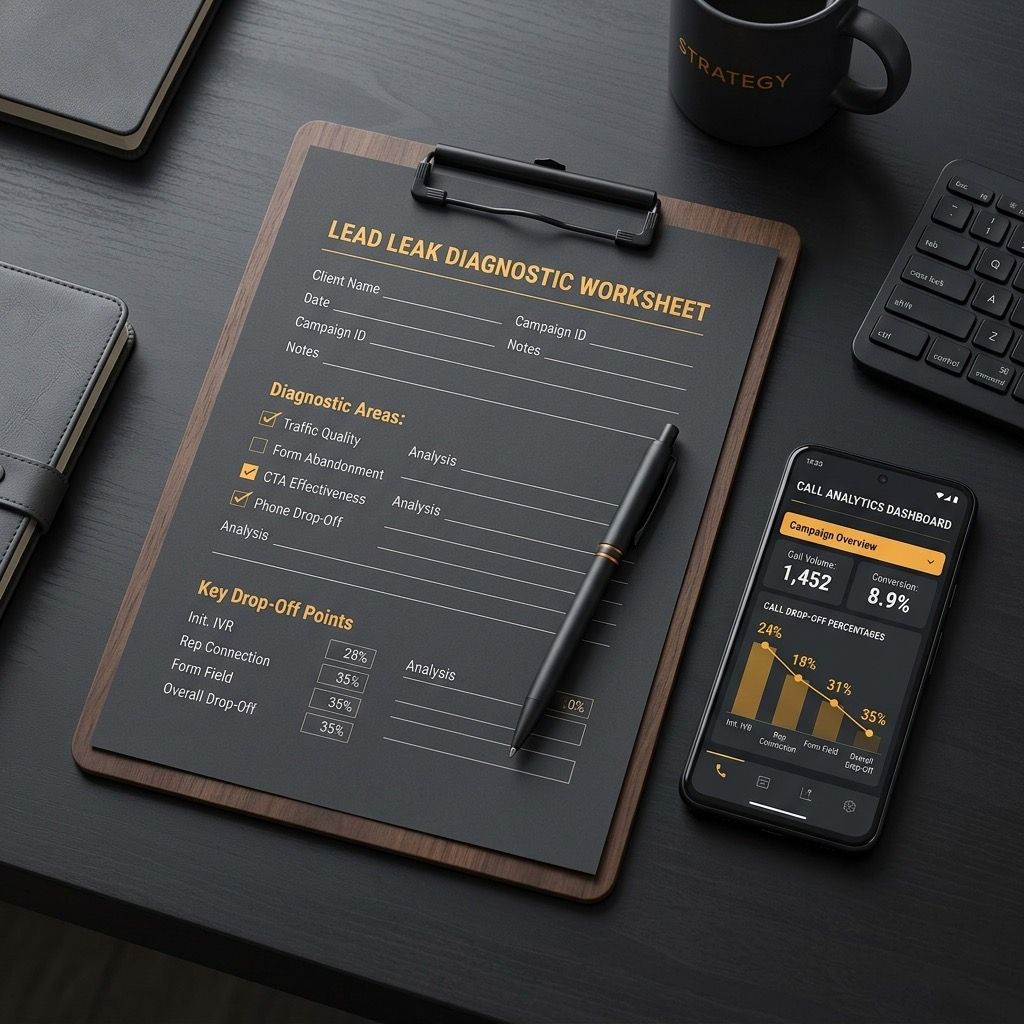
The Service Business Lead Leak Diagnostic: 10 Questions That Reveal Where Your Leads Are Going
Most service businesses are not losing leads to competitors. They are losing them at the front door. This 10-question diagnostic shows you exactly where.