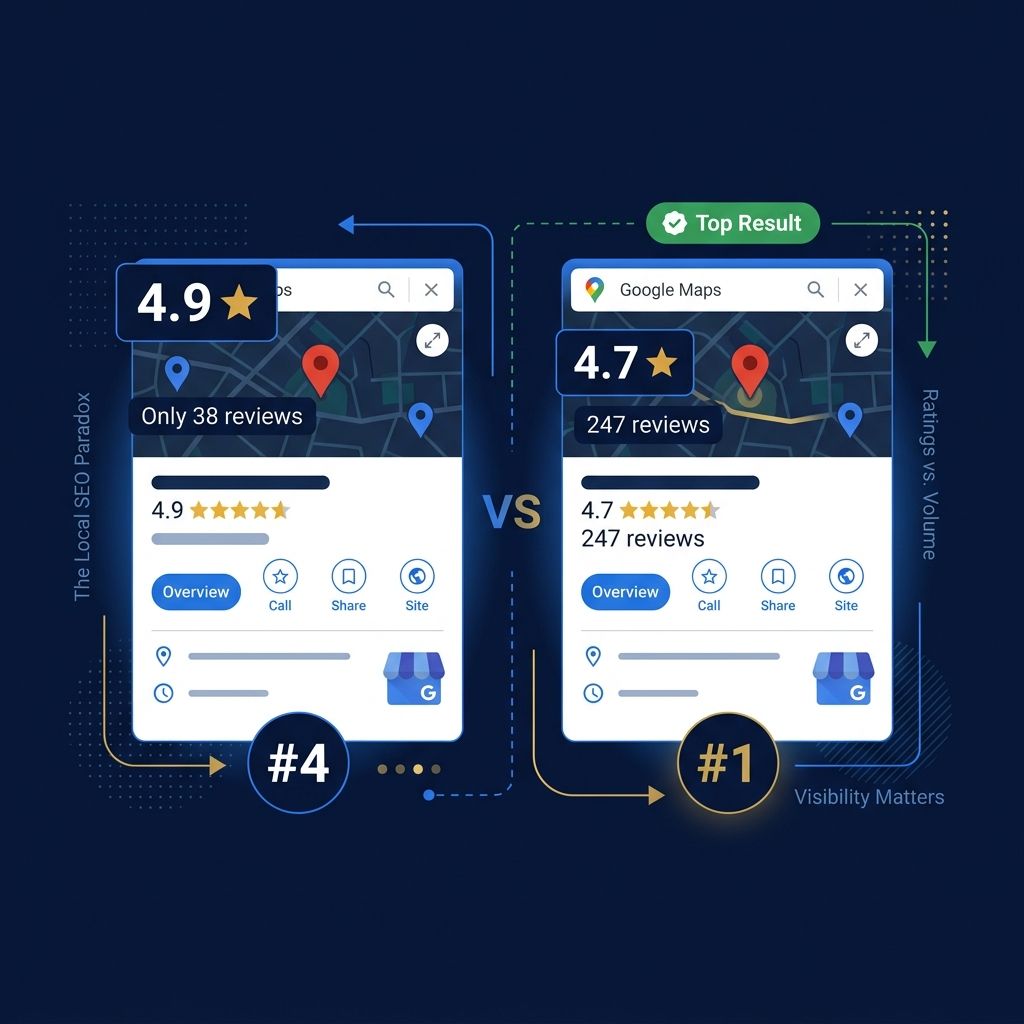
Why review volume and freshness often matter more than a perfect score, and how service businesses can automate review capture safely.
This article links to 3 external sources beside the claims they support.
# Why 200 Reviews at 4.7 Stars Beats 40 Reviews at 4.9, The Local Search Math Most Owners Miss
Picture this.
You're sitting across from me in a Revenue Leak Diagnostic. You've just shown me your Google Business Profile, 42 reviews, 4.9 stars. You're smiling. You should be. That's a hard-earned rating.
Then I open Google Maps.
I type in the search your ideal customer types. "Dental clinic Toronto." "Med spa near me." "HVAC repair [your city]." And we look at who's ranking in the top three spots, the ones that get 70% of the clicks, the ones that your future customers see before they ever see you.
Your competitor is sitting at position one.
Their rating?4.7 stars.Their review count?312.
I've done this in over 200 audits. The reaction is almost always the same. The smile fades. There's a pause. Then: *"How are they ranking above me? Their rating is lower."*
That's the question this post answers.
The Assumption That's Costing You Clicks
Most business owners think Google Maps works like a personal reputation system, the cleanest record wins. Four-point-nine beats four-point-seven. Simple.
That belief is wrong. And it's a costly kind of wrong, because it keeps you optimizing for the wrong thing.
Google isn't grading you on moral character. It's a search engine. It's trying to give searchers the result that most reliably satisfies their query. And when a potential customer types "best dentist near me," Google is not asking *who has the highest rating?*
It's asking:who is the most credible, active, and trusted business for this search?
Those are very different questions.
What Google Actually Uses to Rank Local Businesses
Google's own documentation on how reviews affect Google Maps rankingsmakes clear that reviews are one of the primary signals used in local search ranking, and that it's not just about the score.
Three signals dominate the review side of the algorithm:
1. Review Volume
The raw number of reviews is a legitimacy signal. A business with 300 reviews has been chosen, evaluated, and rated by 300 real humans. That's a track record. Google weights this heavily because it's hard to fake at scale.
2. Review Recency
When were those reviews posted? A business with 40 reviews where the last one was eight months ago looks dormant. Google interprets recency as a signal of whether you're still actively serving customers, and whether your reviews reflect the current state of the business.BrightLocal's Local Consumer Review Surveyconsistently shows that consumers themselves distrust reviews older than three months. Google knows this and builds it into its ranking logic.
3. Review Response Rate
Do you respond to your reviews? Owner responses signal engagement. They tell Google, and prospective customers, that a real human is behind this listing, that they care, and that they're paying attention. Businesses that respond to reviews consistently outperform those that don't, all else being equal.Moz's Local Search Ranking Factorshave flagged this for years.
Here's the brutal part:a 4.9 star rating with 40 reviews scores poorly on all three of these signals simultaneously.You have low volume, likely low recency (because review flow has stalled), and probably a spotty response rate.
Your competitor at 4.7 with 312 reviews is winning on all three.
The Math Is Brutal
I show this to every dental practice and med spa I audit, and it lands the same way every time.
They look at their 4.9-star rating and feel proud. Then I pull up their top competitor who has 4.7 stars but 300 reviews, and they're ranking above them on Google Maps for every search that matters.
Let's run the actual math on what it takes to close that gap.
Say you have 42 reviews today. Your competitor has 312. That's a 270-review deficit.
If you generate zero new reviews in the next six months, the gap grows, because your competitor isn't standing still either. But let's just focus on catching up.
To close a 270-review gap in six months, you need45 new reviews per month.That's roughly1.5 new reviews every single day.
Most service businesses, even busy ones, generate two to four reviews a month organically. They rely on the occasional customer who happens to feel moved enough to open Google and write something.
That pace gets you nowhere near 45 per month. It doesn't even maintain your position, because your competitor is pulling ahead while you wait.
This is not a marketing problem. It's a systems problem.
The Part Nobody Talks About: Your 4.9 Rating Might Actually Be a Warning Sign
Stay with me here, because this is the thing that surprises people most.
A 4.9 rating with only 42 reviews often means one of two things:
Option A:You're genuinely delivering exceptional service, but only to a small number of customers, and you've never asked most of them for a review.
Option B:You've unconsciously curated your reviews, you mention it to happy customers, but not to neutral or unhappy ones. This happens naturally without anyone intending it.
Either way, the result is the same: a suspiciously high rating with low volume that sophisticated consumers and Google both treat with mild skepticism.
Here's a stat that will either reassure you or unsettle you:BrightLocal's researchshows thatconsumers find businesses with ratings between 4.2 and 4.5 more trustworthy than those with 4.9 or 5.0, because perfect scores now look curated or fake.
You spent years building toward 4.9. The market has moved past trusting it.
A Dental Practice in Toronto That Turned This Around
I worked with a dental practice, mid-sized family clinic in Toronto, established for about eleven years. Excellent clinicians, loyal patient base. They'd been getting referrals through word of mouth for most of their history, and their online presence had largely run itself.
When we audited them, they had 38 Google reviews at 4.8 stars. Their top local competitor, a newer practice, open for just four years, had 284 reviews at 4.6 stars and was ranking first on Google Maps for their three highest-intent search terms.
The established practice was invisible online despite being the better clinic by any clinical measure.
The problem wasn't the quality of their care. The problem was that they had no system to turn satisfied patients into online advocates. Happy patients left the office, went home, and the moment passed. Nobody asked. Nobody followed up.
We built a simple three-touch review request sequence: a same-day text message from the clinic thanking the patient for their visit, a follow-up 48 hours later if they hadn't responded, and a front-desk script for the moment before discharge. No begging. No incentives. Just a well-timed, frictionless ask.
In ninety days, they went from 38 to 127 reviews. Their Maps ranking for "family dentist [neighbourhood]" moved from position seven to position two. New patient bookings from Google increased by 31% in that quarter.
The star rating? It dropped from 4.8 to 4.6.
Nobody cared. The phone kept ringing.
How Many Reviews Do You Actually Need Per Month?
Here's a practical framework I walk clients through when we're building their review strategy.
Step 1: Find your competitor's review velocity.
Go to your top local competitor's Google profile. Look at their most recent reviews. Count how many they've gotten in the last 30 days. That's their monthly velocity. You need to match it or beat it, not just catch up to their total count, but stay ahead in the ongoing race.
Step 2: Calculate your catchup requirement.
Take the gap between your review count and theirs. Divide by the number of months you want to close it in. Add their monthly velocity on top. That's your monthly target.
For most service businesses in competitive markets, you're looking at 20 - 50 reviews per month just to stay competitive. Winning usually requires more.
Step 3: Build backward from that number to daily asks.
If you need 30 reviews a month, and your conversion rate from ask to review is 30% (a realistic rate for well-timed, friction-free requests), you need to be asking 100 patients or customers per month. That's roughly 4 - 5 asks per business day.
For a busy clinic or service business, that's achievable, but only with a system. Not with hope. Not with a paper sign in your waiting room.
The System That Makes This Possible
Manual review requests fail at scale. Someone on your front desk is juggling the phone, the schedule, and six other things. Asking for a review becomes the thing that happens "when there's time."
There's never time.
The practices and businesses we work with that generate consistent review volume have one thing in common:the ask is automated and triggered at the right moment, close enough to the positive service experience that the emotion is still fresh, far enough from the transaction that it doesn't feel transactional.
The mechanics:
- Trigger the review request via SMS within 2 hours of service completion
- Include the direct Google review link (not your website, not a survey, the actual Google page)
- Keep the message short and human, not corporate
- Send a single follow-up at 48 hours if there's no response
- Flag any negative signals early so staff can intervene before a bad review is posted
That last point matters. The fear of bad reviews is why most businesses don't ask. We'll address that in the FAQ. But the short answer is: the system gives you an early warning system that prevents most of them.
What About Star Rating, Does It Matter At All?
Yes. But not the way most owners think.
The floor matters more than the ceiling.BrightLocal's dataconsistently shows that falling below a 4.0 rating causes significant drop-off in consumer trust and click-through rate. Below 3.5, you're effectively invisible to most searchers regardless of where you rank.
Above 4.0, the incremental value of each additional decimal point is minimal, especially compared to the compounding value of more reviews and better recency.
In other words:protect your floor, stop obsessing over your ceiling.
A 4.2 with 500 reviews will outrank, outperform, and out-earn a 4.9 with 45 reviews in almost every competitive market I've seen. Every single time.
FAQ: The Skeptical Questions I Actually Get
"What if we get a bad review, doesn't that hurt us?"
This is the number-one reason businesses don't ask for reviews. And it's understandable. But here's what I've found in practice: businesses that ask for reviews at scale actually get *fewer* bad reviews proportionally, not more.
Why? Because unhappy customers leave reviews whether you ask or not. Happy customers often don't, unless prompted. A systematic ask program floods your profile with the positive reviews that were already out there waiting to be captured.
And when a bad review does come in? Respond to it publicly, promptly, and professionally. A well-handled response to a 2-star review does more for your credibility than ignoring it ever could. Consumers know businesses aren't perfect. What they're watching for is whether you care.
"We've tried asking and it doesn't work."
What they usually mean is: they verbally mentioned it at the end of the appointment, or they put a QR code on a flyer, and almost nobody followed through. That's not a review strategy, that's a wish.
The channel matters. SMS conversion rates for review requests are three to four times higher than email. Timing matters. The friction of finding your Google page and writing a review matters. A good system removes every one of those barriers.
"Won't Google penalize us for getting too many reviews too fast?"
It's a valid concern. Google can flag unusual spikes that look like manipulation. The answer is pacing and authenticity. A business that serves 200 patients a month generating 40 reviews a month is not flagging any algorithms, that's a 20% capture rate, which is normal for a well-run ask program. The businesses that get penalized are the ones buying reviews in bulk from fake accounts. Don't do that.
"Our competitor has 300 reviews, can we realistically catch up?"
Yes. But not by hoping, by running the math and building the system. A 270-review gap closed over 12 months is 22 - 23 new reviews per month. That's entirely achievable with the right process. I've watched clinics close gaps larger than that in under six months.
"Is review volume really more important than our actual quality of service?"
No, and this is a false choice. Quality of service is what *earns* the right to ask for reviews. Volume is what *captures* the credit for quality you're already delivering. Most businesses with low review counts aren't serving customers poorly. They're just not asking. The system converts invisible satisfaction into visible proof.
The Number That Will Follow You
Here's how I end most review audits.
I pull up a calculator and we work out what a first-page Maps ranking is worth in new patient or new customer revenue over twelve months. For a busy dental practice, that number is usually somewhere between $80,000 and $200,000 in new revenue, based on typical new-patient lifetime value and the volume difference between ranking first and ranking fifth.
Then I ask: "How much would you pay per month for a system that moves you from position five to position two on Google Maps?"
Most owners say something between $500 and $2,000.
The system that does it, automated, consistent review generation, costs a fraction of that. The gap isn't a budget problem. It's a priority problem.
Your 4.9-star rating is something to be proud of. Now let's make sure Google, and your future customers, actually see it.
Want to know exactly how many reviews you need to close the gap on your top competitor?
Run the Revenue Leak Diagnostic, it will show you your estimated annual revenue leak from every Front Door gap, including review volume. Orbook a Revenue Leak Diagnosticand I'll pull your competitor data live on the call.
The loss estimate is basic business math, not a magic claim.
Revenue-leak examples on this site are built from visible operating inputs: inquiry volume, missed-call or slow-response rate, booking rate, average job or client value, repeat value, and follow-up recovery. The fastest way to make the number real is to run the diagnostic for your closest business type, then compare it against your own call log, CRM, booking calendar, form timestamps, and review activity.
Review the trust signals visible before someone decides to call.
The useful question is not only the star rating. It is whether recent proof supports the promise the website makes.

Vikram Roy is the founder of The Quiet Protocol, a Toronto-based systems firm serving service businesses across the Greater Toronto Area, Canada, and the United States. He works directly with professional firms, home service companies, dental practices, clinics, and local businesses to connect websites, customer intake, booking, reviews, follow-up, and practical AI into a clearer digital front door. All content is written from Toronto, Ontario. See the editorial method →
Inspect review recency, response habits, and the public trust signals buyers see before they contact the business.
See how the capability in this article fits into a complete customer journey.
Service BusinessesSee the same decision through the language, buyer behavior, and operating reality of this industry.
Client Results & ProofInspect the starting condition, installation, measurement window, and outcome behind real client work.

The Real Cost of a Missed Call for a Service Business: The Math Nobody Runs
A missed call costs more than the immediate job. Here is the full three-layer calculation, immediate value, lifetime client value, and referral chain, and the annual total most owners never see.

What Is a Revenue Leak Diagnostic? The 15-Minute Diagnostic That Reveals Your Service Business Revenue Gap
A Revenue Leak Diagnostic is a structured 15-minute diagnostic that calculates the exact dollar value of revenue a service business is losing at the point of first contact, before a single dollar of marketing is changed.
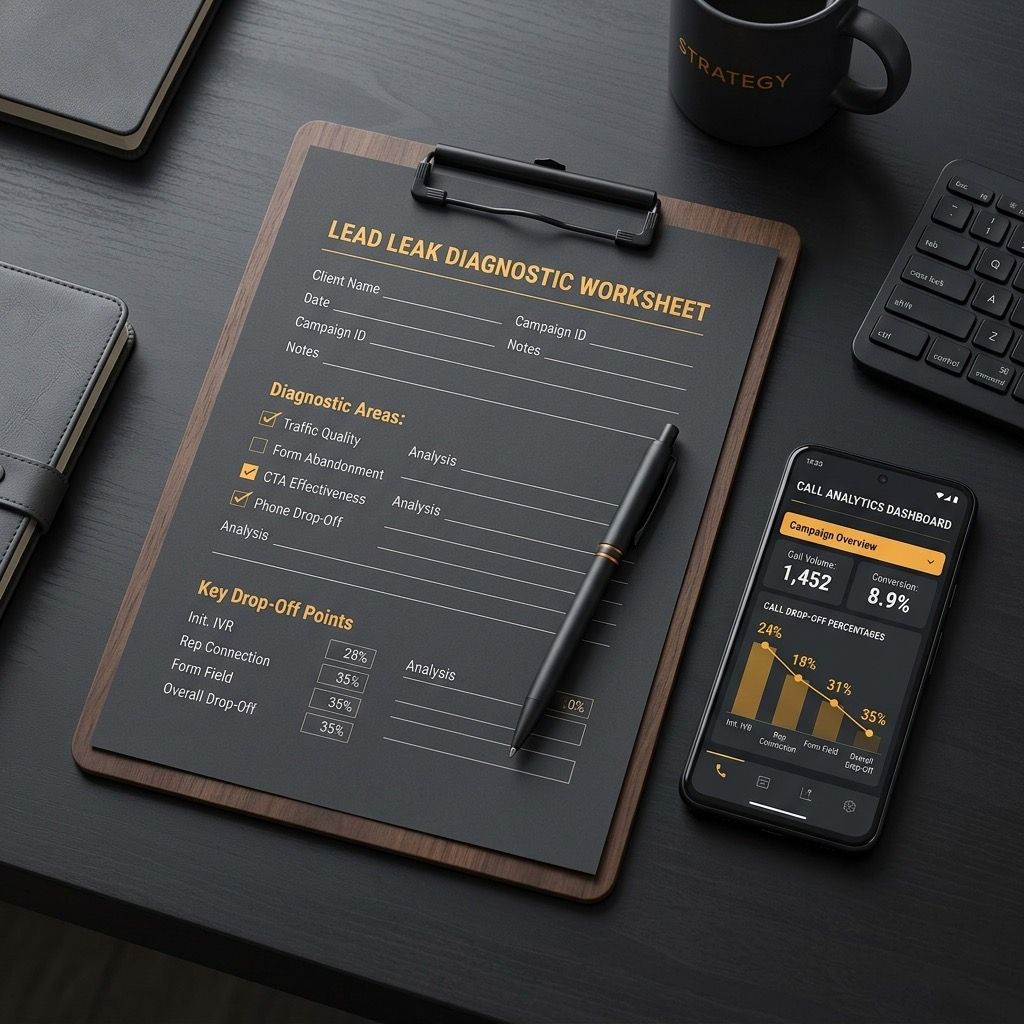
The Service Business Lead Leak Diagnostic: 10 Questions That Reveal Where Your Leads Are Going
Most service businesses are not losing leads to competitors. They are losing them at the front door. This 10-question diagnostic shows you exactly where.