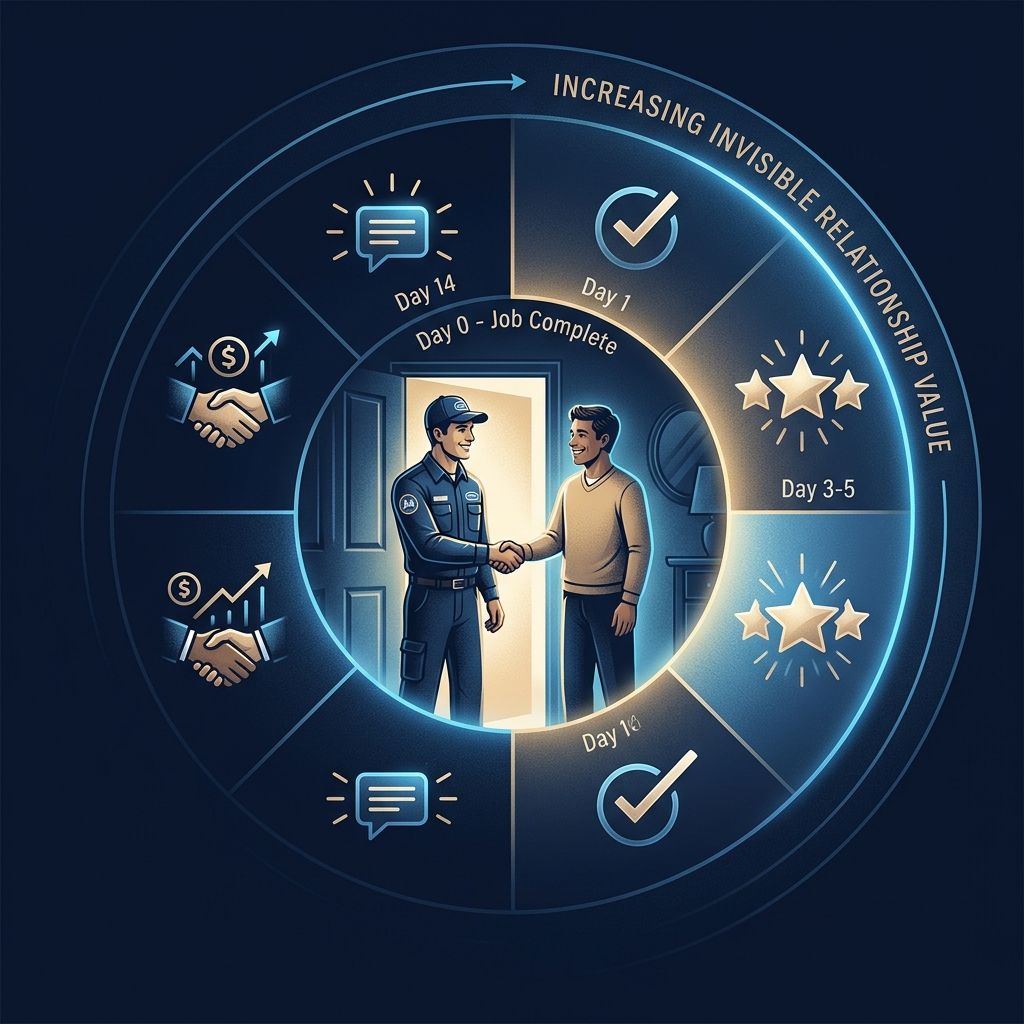
What should happen after the job: review requests, referral prompts, warranty check-ins, CRM tasks, reactivation timing, and customer retention.
This article links to 2 external sources beside the claims they support.
# What Happens to Your Customer 30 Days After You Finish Their Job? (Most Owners Can't Answer This.)
Try this right now.
Think about your last 20 jobs. Not the ones from two years ago, the last 20. Customers whose invoices you marked paid in the last three or four months.
Three questions:
Do you know which of those 20 left a review?
Do you know which of those 20 will call you again in the next 12 months?
Do you know which of those 20 have referred a neighbor, a friend, or a colleague to your business?
I ask these questions in almost every Revenue Leak Diagnostic I run. And I'll tell you exactly what happens.
Owners can answer the first one. Always. They know their reviews, because they can see them. Google shows them. The stars are visible. The count is public.
The second question, repeat customer likelihood, usually gets a shrug, sometimes a guess: *"I mean, we do good work, so probably a lot of them."*
The third question, referrals from those specific 20 jobs, almost nobody can answer with certainty.
Two out of three of your post-job growth levers are invisible. That's the problem.
The Day the Relationship Ends
Here's a truth most service business owners haven't said out loud:
For the majority of your customers, your relationship ends the day the invoice is paid.
Not when the work is done. Not when they send a thank-you text. Not 30 days later. The moment the payment clears, that's when the clock stops.
The crew packs up. The owner moves on to the next job. The customer files the receipt somewhere. And then... nothing. No check-in. No follow-up. No "how did everything look after the first rain?" No "we're running a referral promotion this month if you know anyone who might need us."
I'm not describing neglectful operators. I'm describing extremely common ones, including some of the best craftspeople in their markets. The work is excellent. The follow-through is zero.
And here's the thing: the customer usually doesn't think anything is wrong. They had a good experience. The job looks great. They just... forgot about you. Because you gave them no reason to remember.
When they need something done in 18 months, they'll search Google again. And whoever shows up first will get the call, because your name isn't top of mind anymore.
Why This Is Bigger Than It Looks
Research fromBain & Company, cited widely in the customer retention literature, found that increasing customer retention by just 5% increases profits by 25% to 95%. And the cost of acquiring a new customer is, depending on the industry, five to seven times higher than the cost of retaining an existing one.
In service businesses, those numbers are even more stark.
A new customer requires marketing spend, lead generation, a quote, sales effort, and a first-job trust-building period. An existing customer already trusts you, already knows your quality, and already knows your team. The sale is faster, easier, and cheaper to close.
But most service business owners spend 80% of their growth energy on new customer acquisition and approximately zero on post-job relationship management.
Not because they don't care. Because nobody built the system.
I've watched a 14-year landscaping business in Florida generate $340,000 in repeat and referral revenue in one year, from customers they already had, after we mapped out a simple post-job sequence. They weren't getting new leads. They were finally activating the dormant asset they'd been sitting on for over a decade.
The customers were there. The follow-through wasn't.
The Invisible vs. Visible Problem
Let me be more specific about what "invisible" means here.
Reviews are visible because platforms surface them. Google shows you a count. You get an email notification when a new one lands. You can see the rating in real time. So you track them, you respond to them, and, in most cases, you've figured out some way to ask for them.
Repeat bookings and referrals don't work like that. There's no dashboard. No notification. No count that climbs when someone calls their neighbor and says "use the same company we used for our deck."
That referral is completely invisible to you unless:
- The neighbor mentions it when they call, OR
- You have a system that tracks where new leads come from and asks directly
Most service businesses have neither. So the referrals happen, and they do happen, at a meaningful rate, but they're not visible, not attributed, not understood, and not optimized.
BrightLocal's research on review request timingconsistently shows that customers who are asked for a review within 24 hours of a completed service are dramatically more likely to leave one. The same logic applies to referrals, timing matters. The customer is most enthusiastic immediately after a great job. If you wait 30 days to ask, the emotion has faded.
This is why the 30-day window exists as a framework, not because Day 30 is magical, but because most businesses are doing nothing between "job complete" and "maybe we'll see them again someday."
The 30-Day Timeline, Day by Day
Here's what an intentional post-job relationship looks like. This isn't aspirational, I've helped service businesses implement versions of this across roofing, plumbing, landscaping, dental, pest control, and home cleaning.
Day 1: The Completion Message
Within a few hours of the job wrapping up, the customer gets a message, text or email, depending on their preference, that thanks them personally and confirms everything is done.
Not a generic "thanks for your business!" message. Something specific:
*"Hi [Name], we finished up at your place today. The crew sealed around the chimney flashing per your request and did a final walk of the gutters. Everything looks great. If you notice anything in the next few days you want us to revisit, just let me know directly."*
Two things this does: it reminds them of the specific care you took (anchoring the quality experience), and it opens a communication channel before anything goes wrong.
This message takes 90 seconds to send. Almost nobody sends it.
Day 3 - 5: The Review Request
Three to five days post-completion is the sweet spot for a review request. Early enough that the experience is fresh. Late enough that they've had a chance to actually observe the work, the new paint in different light, the repaired pipe through one full cycle, the cleaned gutters after a rain.
The ask should be personal, direct, and low-friction:
*"Hi [Name], hope everything with [the project] is looking great. If you have two minutes, we'd really appreciate a Google review. Reviews are how families like yours find us. Here's the direct link: [link]"*
One link. No navigation. No hoops.
Here's the counterintuitive part:you don't need 90% of your customers to leave a review.If you complete 200 jobs per year and 15% of those customers leave a review, that's 30 reviews. Thirty reviews on Google at an average of 4.8 stars is enough to make you the most visually credible option in most local markets.
The volume problem most businesses have isn't that customers won't review them, it's that nobody asked.
Day 14: The Check-In
Two weeks after the job, the relationship either solidifies or quietly evaporates.
At Day 14, a simple check-in message keeps the connection alive:
*"Hey [Name], it's been a couple weeks since we wrapped up your [project]. Just wanted to see if everything's holding up well and if there's anything you have questions about. We're always around."*
This is not a sales message. It's a service message. But it does something powerful: it makes you the *only contractor* that reached out after the job was done. In an industry where post-job silence is the norm, a two-week check-in is unusual enough to be memorable.
This is also the moment where you learn about problems early, before a small issue becomes a complaint, a dispute, or a bad review.
Day 30: The Referral Ask
Thirty days out, if the experience has been positive and the relationship has been maintained through the prior touches, the referral ask lands naturally.
*"Hi [Name], it's been about a month since we wrapped up your [project], and we hope it's been everything you hoped for. We're heading into [season/busy period] and doing great work for homeowners in your area. If you know anyone who needs [what you do], we'd love an introduction, and we take good care of anyone referred by our existing clients. Thanks again for trusting us with your home."*
No incentive required. No formal referral program. Just a human message from a business that stayed in touch and earned the right to ask.
In my experience, businesses that execute this sequence consistently see referral rates climb by 30 - 50% within the first year, simply by asking at the right time, in the right way.
The Revenue Math on 100 Jobs
Let's run it for a business completing 100 jobs per year at an average ticket of $4,500. (This applies cleanly to plumbing, pest control, landscaping maintenance, or general home services.)
Current state (no post-job sequence):
- Repeat customers in Year 2: Maybe 15 (15% retention)
- Referrals per year: Maybe 8 (rough industry average without active referral cultivation)
- Total: 23 leads from existing customer base
- Revenue from those leads: ~$103,500
After implementing the 30-day sequence:
- Repeat customers in Year 2: 28 (a conservative 28% retention, easily achievable with consistent follow-up)
- Referrals per year: 18 (doubling referrals is typical when you simply ask at the right time)
- Total: 46 leads from existing customer base
- Revenue from those leads: ~$207,000
The difference is$103,500 per year in revenue from customers you already served, without any additional marketing spend, without new lead generation, without expanding your service area.
Every single dollar of that delta comes from four simple touchpoints, one at Day 1, one at Day 3 - 5, one at Day 14, one at Day 30.
Why Most Businesses Don't Do This
I genuinely don't think it's laziness. I've run hundreds of these audits. The owners I work with are not lazy, they're running lean operations at high velocity with small teams and zero margin for extra process.
The reason is simpler:the post-job sequence has no natural deadline.
When a lead comes in, there's urgency, call them now or lose them. When a job needs to be scheduled, there's urgency, the customer is waiting. When a problem arises on site, there's urgency, fix it before it gets worse.
But "follow up with the Johnsons who we wrapped up on Tuesday"? That's important, not urgent. And in a busy service business, important-but-not-urgent items simply don't happen unless they're scheduled, automated, or assigned to someone whose job is to make them happen.
This is why the businesses I work with don't rely on willpower or good intentions to execute the 30-day sequence. They build the automation around it. A voice AI that handles the Day 1 message. A text sequence that fires automatically at Day 3 with the review link. A check-in trigger at Day 14. A referral message at Day 30.
The owner doesn't have to remember. The system runs regardless of how busy the week is.
The Three Things Your Last 20 Jobs Didn't Generate (But Could Have)
Go back to those 20 jobs for a second.
If you ran the 30-day sequence on all 20:
- You'd have20 personalized completion messagesthat cemented the quality impression
- You'd have asked20 customers for a reviewat the optimal moment, maybe 4 - 6 of them would have left one
- You'd have had20 check-ins at Day 14that caught any concerns before they turned into complaints
- You'd have made20 referral asksat the moment of maximum goodwill, statistically, 2 - 4 of those would generate a lead
From 20 jobs: 4 - 6 new reviews, 2 - 4 warm referral leads, stronger repeat booking probability for all 20 customers.
That's not a marketing campaign. That's infrastructure.
The Customer Relationship Doesn't End at Invoice Paid
The best service businesses I've worked with share one thing: they understand that the job is not the product. The relationship is the product. The job is just how you earn the right to build one.
Your last 20 customers are a dormant asset. They already trust you. They've already seen your quality. They're primed to refer, to review, and to call you again.
All they needed was for you to stay in touch.
The 30-day sequence isn't about marketing. It's about not abandoning people who chose to trust you.
Want to see what your post-job follow-through gap is costing you annually?
TheRevenue Leak Diagnostic Calculatorruns the math on your specific numbers, jobs per year, average ticket, current retention rate, and shows you the revenue sitting in customers you've already served.
It takes three minutes. Most owners find a number they weren't expecting.
Orbook a call with me directly. I'll walk through your Revenue Leak Diagnostic and show you exactly where your customer relationship is breaking down, and what a realistic fix looks like for your business.
The loss estimate is basic business math, not a magic claim.
Revenue-leak examples on this site are built from visible operating inputs: inquiry volume, missed-call or slow-response rate, booking rate, average job or client value, repeat value, and follow-up recovery. The fastest way to make the number real is to run the diagnostic for your closest business type, then compare it against your own call log, CRM, booking calendar, form timestamps, and review activity.
Review the trust signals visible before someone decides to call.
The useful question is not only the star rating. It is whether recent proof supports the promise the website makes.

Vikram Roy is the founder of The Quiet Protocol, a Toronto-based systems firm serving service businesses across the Greater Toronto Area, Canada, and the United States. He works directly with professional firms, home service companies, dental practices, clinics, and local businesses to connect websites, customer intake, booking, reviews, follow-up, and practical AI into a clearer digital front door. All content is written from Toronto, Ontario. See the editorial method →
Inspect review recency, response habits, and the public trust signals buyers see before they contact the business.
See how the capability in this article fits into a complete customer journey.
Service BusinessesSee the same decision through the language, buyer behavior, and operating reality of this industry.
Client Results & ProofInspect the starting condition, installation, measurement window, and outcome behind real client work.

The Real Cost of a Missed Call for a Service Business: The Math Nobody Runs
A missed call costs more than the immediate job. Here is the full three-layer calculation, immediate value, lifetime client value, and referral chain, and the annual total most owners never see.

What Is a Revenue Leak Diagnostic? The 15-Minute Diagnostic That Reveals Your Service Business Revenue Gap
A Revenue Leak Diagnostic is a structured 15-minute diagnostic that calculates the exact dollar value of revenue a service business is losing at the point of first contact, before a single dollar of marketing is changed.
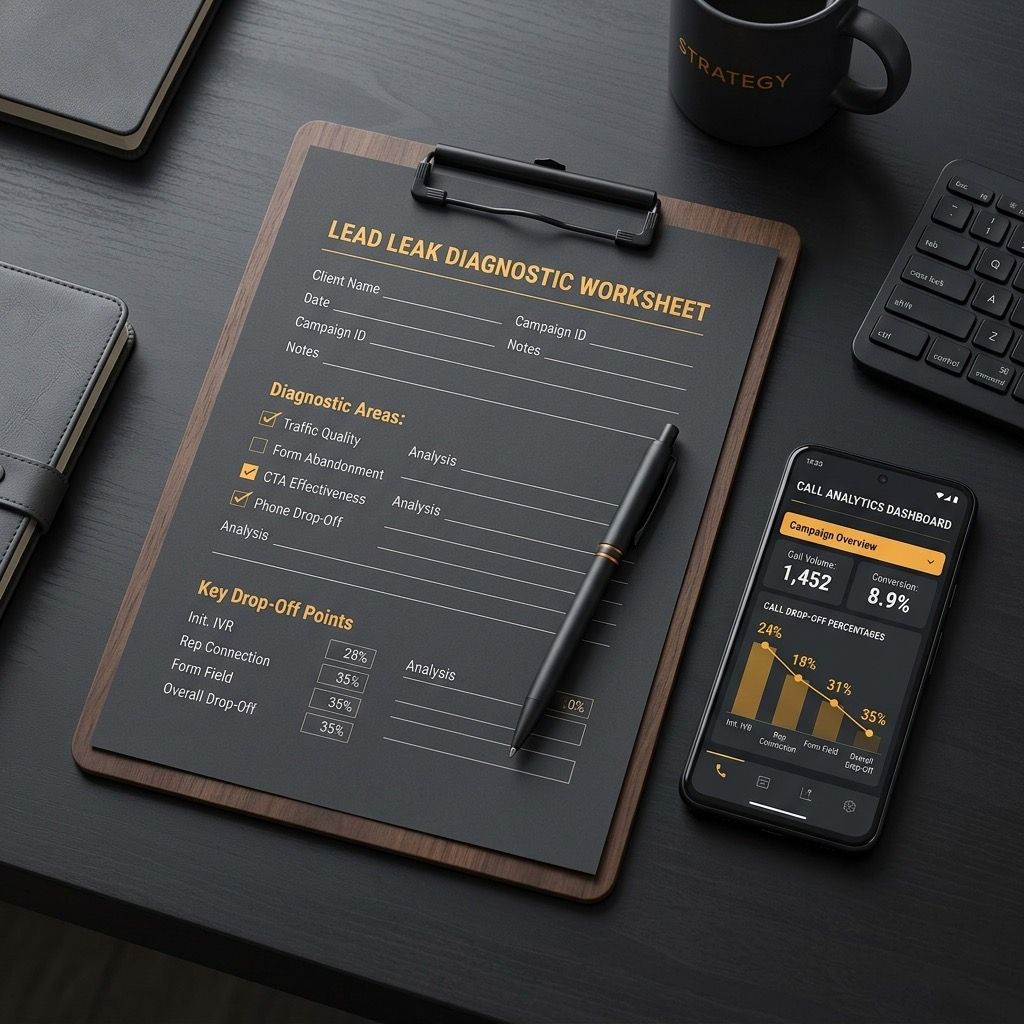
The Service Business Lead Leak Diagnostic: 10 Questions That Reveal Where Your Leads Are Going
Most service businesses are not losing leads to competitors. They are losing them at the front door. This 10-question diagnostic shows you exactly where.