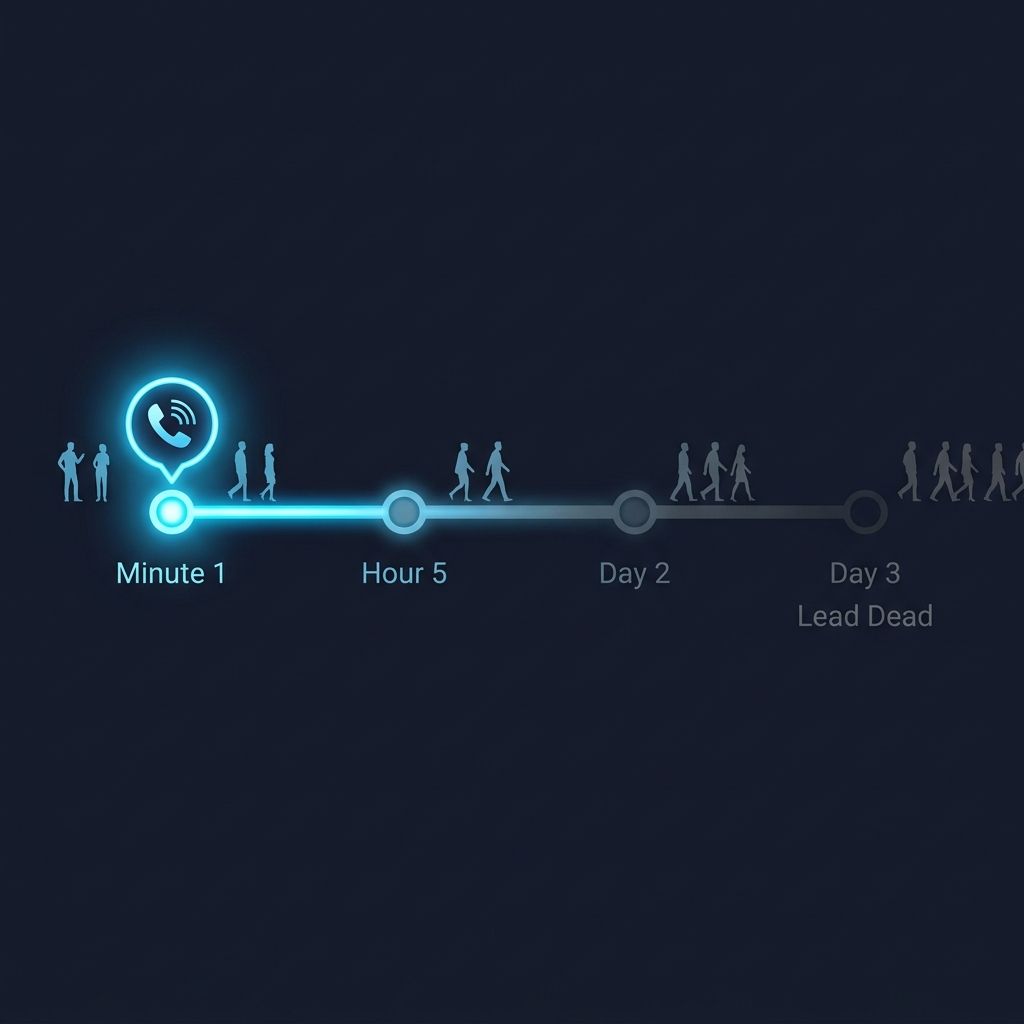
The 5-minute rule gets all the attention. The bigger revenue killer is what happens in the next 72 hours.
This article links to 2 external sources beside the claims they support.
# The 72-Hour Window: Why Service Business Leads Die Before Anyone Realizes
It was a Monday afternoon when Marcus submitted the contact form.
He was a homeowner in suburban Atlanta. His roof had taken hail damage two weeks earlier. He'd already called two roofing companies, neither one picked up, and his insurance adjuster had told him to get estimates quickly.
He found a third company through Google. Liked what he saw. Filled out the form.
The company's owner, a guy I'll call Derek, saw the lead come in on his phone while he was on a job site. He thought, *I'll call him after I wrap up here.* The crew ran long. He forgot.
Tuesday came. Tuesday went.
By Wednesday evening, Marcus had signed a contract with a competitor.
When I ran Derek's Revenue Leak Diagnostic three months later, he showed me his lead log. Marcus's submission was right there. "Interested, hail damage, wants estimate ASAP." Timestamp: 2:14 PM Monday.
Nobody touched it for four days.
I've seen versions of this story in nearly every audit I run. The lead didn't evaporate in the first five minutes. It survived the initial miss. It died in the silence that followed.
You've Heard About the 5-Minute Rule. Here's Why That's Only Half the Story.
The 5-minute rule is real.
Research published by Harvard Business Reviewfound that companies that attempt to contact leads within five minutes of form submission are 100 times more likely to reach them than those who wait 30 minutes. One hundred times.
That stat gets shared constantly in sales circles. And it should, it's important.
But here's what we don't talk about:when I analyze a service business's full lead log, I consistently find three times more lost revenue in the 24 - 72 hour window as in the first five minutes.
The 5-minute window is the headline. The 72-hour window is the real story.
Because most businesses have *some* kind of first-touch. Maybe it's not instant, but they get back to the lead that day. The call happens. A voicemail gets left. A text goes out. The initial contact, imperfect as it is, usually occurs.
What almost never happens is the second touch. The third touch. The structured follow-through that converts a curious prospect into a paying customer.
That's where the money goes.
The Decay Curve Nobody Shows You
Think about how a lead feels from the prospect's perspective.
Monday afternoon: They fill out a form. They're hot. They have a problem. They want it solved. They're also filling out forms for two other companies. They'll go with whoever feels most responsive and most professional.
Monday evening: Your competitor calls. Leaves a friendly voicemail. Sends a follow-up text.
Tuesday morning: Your competitor follows up again. "Hey, just checking in, I know you're getting a few quotes. I'd love to come by Thursday morning, does that work?"
Tuesday afternoon (36 hours after the lead came in): You finally call. Marcus has already scheduled the competitor's estimate.
You didn't lose Marcus because you didn't respond in five minutes. You lost him because your competitor built a relationship in 36 hours while you were silent.
This is the decay curve. Lead intent doesn't crash instantly, it erodes. It erodes fastest when a competitor fills the vacuum.
Research fromXant (formerly InsideSales.com), one of the most cited sources on sales follow-up data, shows that 50% of sales go to the first vendor who responds. Not the cheapest. Not the one with the best reviews. The first one who actually follows up consistently.
Most service businesses I audit are letting that 50% walk out the door.
The Industries Where This Hurts Most
Not every industry has the same decay curve. The 72-hour window matters most in what I callhigh-consideration purchases, situations where the customer is weighing a significant decision and has real options.
Roofing and exterior contractors.Storm damage leads have urgency, but so does comparison shopping. A homeowner dealing with insurance claims is talking to multiple contractors. The first one to build trust and follow through wins. The job value? Anywhere from $8,000 to $40,000. The follow-up investment required? Three to four touches over three days.
HVAC replacement.A system replacement is a $7,000 - $20,000 decision. Homeowners get three estimates as a rule. The window to be the front-runner is exactly 72 hours, that's when they're still gathering quotes, still haven't committed, still receptive to a follow-up that shows you're professional and organized.
Dental implants and elective dental work.A patient who inquires about implants at 10 AM on a Tuesday is a completely different person by Friday afternoon. The initial inquiry is often driven by discomfort, a triggering event, or finally making a decision after months of thinking about it. That emotion fades. The 72-hour follow-up is the window to catch them while the decision is still live.
Home remodeling and kitchen/bath.The longest sales cycles in residential services, but the first week after initial contact still determines who gets the in-home consultation, and consultations have an 80 - 90% close rate for operators who run them well.
I've run audits across all four of these verticals. The pattern is identical: the first-touch attempt happens. The second and third touches don't.
What a Real 72-Hour Sequence Looks Like
Here's the three-touch sequence I recommend to every client. It's not complicated. It doesn't require a CRM with 14 integrations. It requires deciding to do it and then actually doing it.
Touch 1: Immediate (within 15 minutes of lead submission)
Call first. If no answer, leave a voicemail that says: *"Hi [name], this is [you] from [company]. I saw your message come in about [their issue], I wanted to make sure you heard from a real person today. I'll also send you a text in case that's easier. Feel free to reach out anytime."*
Then immediately send a text that mirrors the voicemail. Friendly. Human. No pressure.
This is your first-touch. It plants a flag. It says: we respond fast, we're professional, we're not a company that makes you wait three days.
Touch 2: 24 hours later
A second call. If no answer, a different voicemail, not the same script. Something like: *"Hi [name], following up from yesterday. I know scheduling is busy, I just wanted to make sure this didn't fall through the cracks on our end. We have some availability this week if you'd like to get eyes on [the project]. No pressure at all."*
Follow with a text. Keep it brief.
The magic phrase here is "I just wanted to make sure this didn't fall through the cracks on our end." It's a psychological shift, it makes the follow-up about your professional diligence, not desperation.
Touch 3: 72 hours after the initial inquiry
A final direct outreach. This one can be an email if you have it, or another text. The message is simple: *"[Name], I want to make sure you have everything you need to make a decision on [their project]. If you've already moved forward with someone else, no worries at all, but if you haven't chosen yet, I'd love 20 minutes to walk you through what we'd recommend. Here's a link to schedule a quick call: [link]."*
Then close the loop. If no response after this touch, move the lead to a longer-term nurture sequence and stop active outreach.
Three touches. Three days. Most service businesses do one.
The Math That Should Make You Uncomfortable
Let's run the numbers on a roofing company doing 150 jobs a year with an average ticket of $12,000.
If they generate 400 leads per year (a reasonable ratio for that volume), and they're converting at 37%, which is about where most operators land after auditing them, they're closing 148 of those 400 leads.
The 252 that don't convert: how many were dead on arrival? In my experience, maybe 30%. They were shopping, or price-sensitive, or not in their service area.
That leaves roughly 176 leads that were genuinely viable but didn't convert.
What would happen if a structured 72-hour follow-up sequence converted even 15% of those?
26 additional jobs. At $12,000 average. That's$315,000 in annual revenuesitting in leads that already came in, already expressed interest, and got nothing but silence after the first attempt.
The math works in every industry. The inputs change. The conclusion doesn't.
A Note on Automation vs. Doing It Manually
I get asked constantly: "Do I need software to do this?"
No. You can build a simple follow-up habit with nothing more than your phone, a notes app, and a calendar reminder. I've seen small operators do exactly this and add six figures in revenue.
But here's the honest answer: manual follow-up at scale is nearly impossible to sustain. Owners get busy. Jobs run long. The lead list grows. Priorities shift.
This is exactly why we built the follow-up sequences inside The Quiet Protocol's voice AI system, to make the first-touch automatic (immediate, every time, no exceptions) and the subsequent touches structured and consistent regardless of how busy things get on the operations side.
Consistency is the thing that turns a follow-up strategy from theory into revenue.
The Bottom Line
The 5-minute rule is real. Respond fast. It matters.
But the bigger opportunity for most service businesses I work with isn't in the first five minutes. It's in the next 72 hours, the structured, professional follow-through that most businesses simply don't execute.
Derek, the roofing contractor from Atlanta, implemented a three-touch sequence after his audit. He automated the first call with voice AI. He set calendar reminders for the 24-hour and 72-hour touches until he could automate those too.
In the next quarter, his lead conversion rate went from 31% to 46%. On 400 leads a year at $12,000 average, that's the difference between 124 jobs and 184 jobs. Sixty additional jobs. He told me it felt like "finding money I didn't know I had."
You already have the leads. The window is open.
Want to see what your 72-hour follow-up gap is costing you?
Run the numbers yourself with ourRevenue Leak Diagnostic Calculator, it quantifies your annual revenue leak from lead response gaps and post-job follow-through in about three minutes.
Or if you'd rather walk through your specific numbers with me directly,book a call. I'll show you exactly what I find when I run a full Revenue Leak Diagnostic for businesses like yours.
The loss estimate is basic business math, not a magic claim.
Revenue-leak examples on this site are built from visible operating inputs: inquiry volume, missed-call or slow-response rate, booking rate, average job or client value, repeat value, and follow-up recovery. The fastest way to make the number real is to run the diagnostic for your closest business type, then compare it against your own call log, CRM, booking calendar, form timestamps, and review activity.
Connect one customer path before adding more disconnected tools.
The first useful system owns a defined journey from customer action to team handoff and follow-up.

Vikram Roy is the founder of The Quiet Protocol, a Toronto-based systems firm serving service businesses across the Greater Toronto Area, Canada, and the United States. He works directly with professional firms, home service companies, dental practices, clinics, and local businesses to connect websites, customer intake, booking, reviews, follow-up, and practical AI into a clearer digital front door. All content is written from Toronto, Ontario. See the editorial method →
See where a website, platform launch, AI intake path, or Custom Conversion System fits before committing to a scope.
See how the capability in this article fits into a complete customer journey.
Service BusinessesSee the same decision through the language, buyer behavior, and operating reality of this industry.
Client Results & ProofInspect the starting condition, installation, measurement window, and outcome behind real client work.
The Real Cost of a Missed Call for a Service Business: The Math Nobody Runs
A missed call costs more than the immediate job. Here is the full three-layer calculation, immediate value, lifetime client value, and referral chain, and the annual total most owners never see.

What Is a Revenue Leak Diagnostic? The 15-Minute Diagnostic That Reveals Your Service Business Revenue Gap
A Revenue Leak Diagnostic is a structured 15-minute diagnostic that calculates the exact dollar value of revenue a service business is losing at the point of first contact, before a single dollar of marketing is changed.
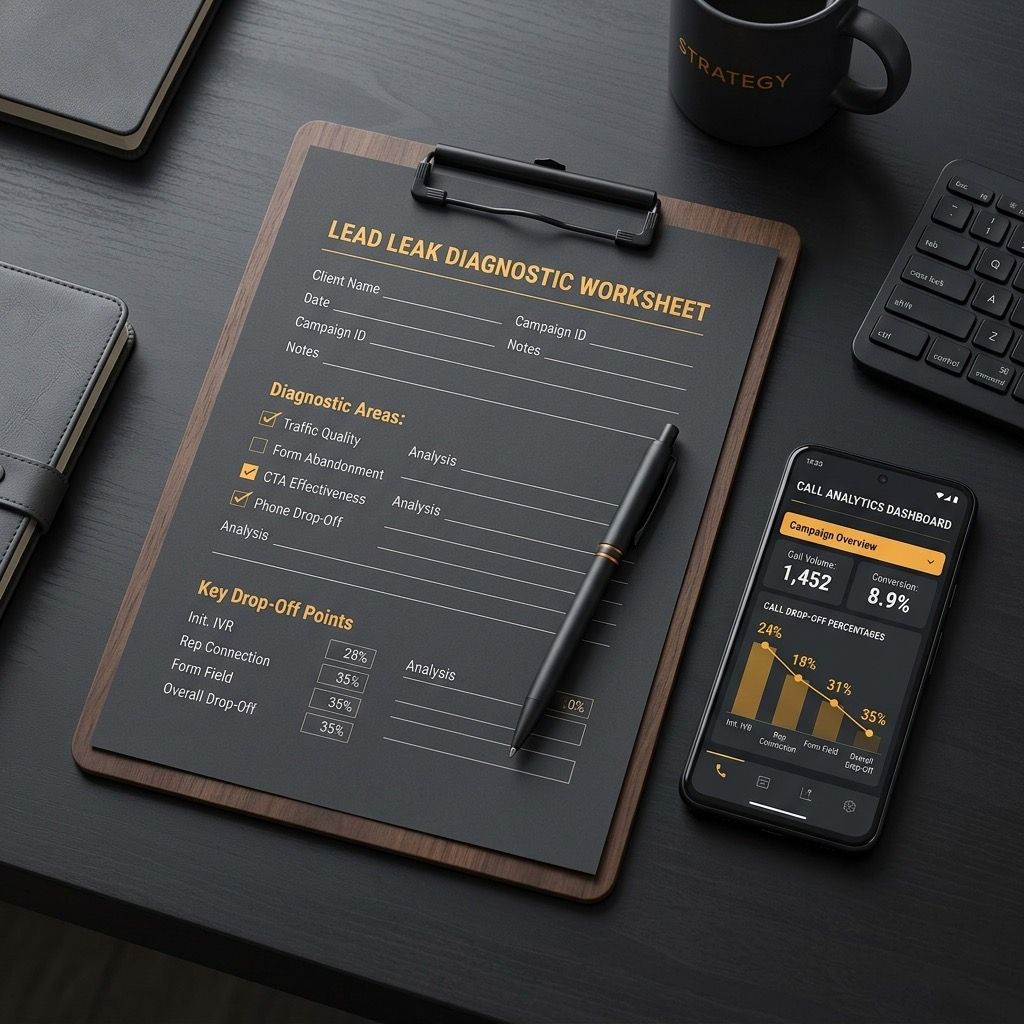
The Service Business Lead Leak Diagnostic: 10 Questions That Reveal Where Your Leads Are Going
Most service businesses are not losing leads to competitors. They are losing them at the front door. This 10-question diagnostic shows you exactly where.