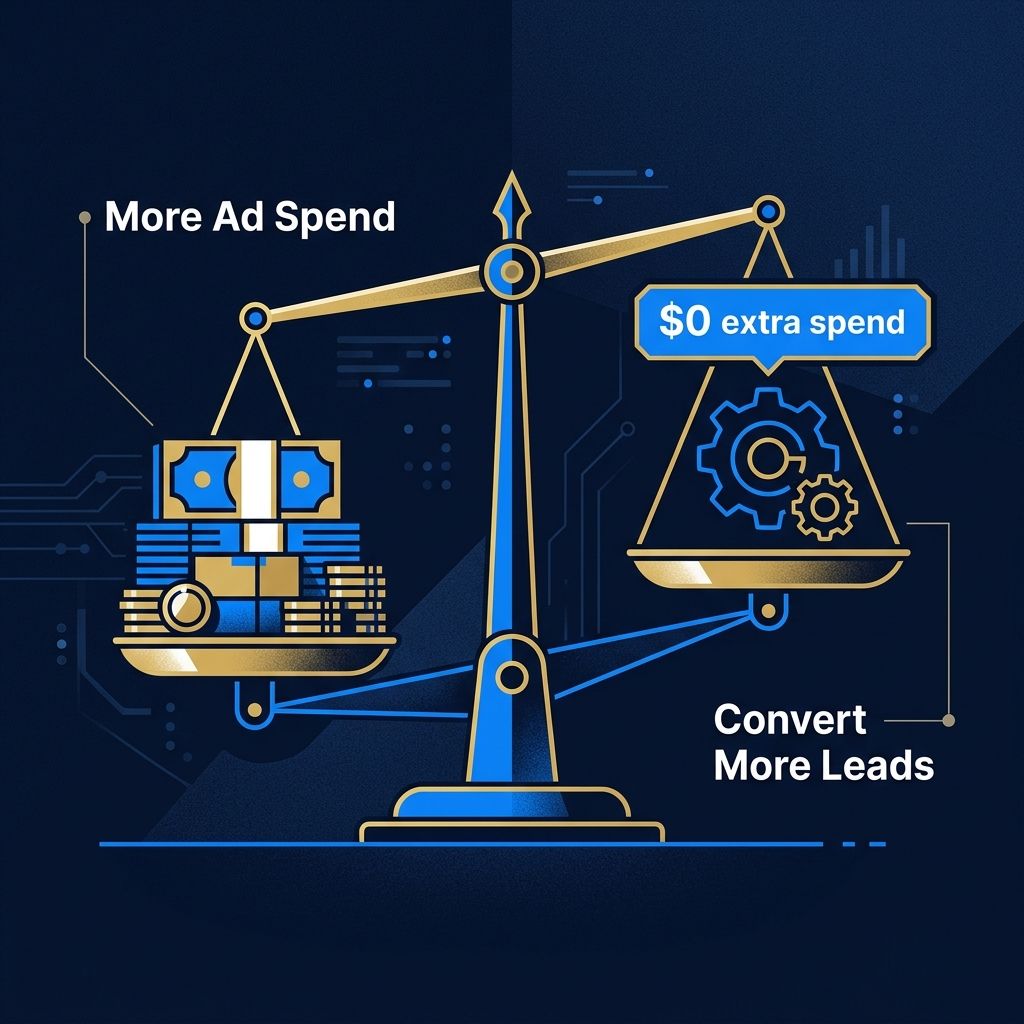
If you're converting 35% of leads and want 30% growth, you can buy more leads or fix where the other 65% goes.
This article links to 3 external sources beside the claims they support.
# The $0 Growth Strategy: How Service Businesses Add Revenue Without Spending More on Ads
Let me start with a list.
Here's what will *not* grow your service business revenue without more ad spend:
- A new website
- A rebrand or new logo
- Posting more on Instagram
- "Better content"
- A new CRM you don't have time to learn
- A consultants' slide deck about your "brand story"
- Hiring another salesperson before you fix what's breaking in the current funnel
- Any conversation that begins with "have you thought about TikTok?"
I run Front Door Audits for a living. I've done over 200. Every single one of those things comes up as a suggestion from someone, a vendor, a well-meaning advisor, sometimes the owner themselves.
None of them move the needle without solving the real problem first.
The Real Problem
Here's what I tell owners in every audit:
*If you're converting 35% of your leads and you want to grow 30%, you can spend 30% more on ads, or you can figure out where the other 65% of your leads are going. One of those costs money. The other one makes you money.*
Read that again.
If you have 500 inbound leads this year and you're converting 35%, you're booking 175 jobs. The other 325 inquiries, people who called you, filled out your form, sent you a message, they went somewhere else. Or they didn't go anywhere. They just... fell through.
What does it cost to replace one of those lost leads with a new paid lead?
For most service businesses, somewhere between $40 and $200 per lead, depending on the channel and market. Let's call it $75, which is conservative for most trades.
325 lost leads × $75 =$24,375that you're effectively spending to re-acquire leads you already had.
That's before we even get to the revenue you didn't book.
If your average job value is $600, those 325 unbooked leads represent $195,000 in revenue that already knocked on your door. It left without a job being scheduled.
This is the $0 Growth Strategy: instead of buying more leads, stop losing the ones you're already paying for.
The Math Comparison: Buy More Leads vs. Convert More Leads
Let's run this side by side for a typical $1.5M service business.
Current state:
- Annual leads: 600
- Conversion rate: 35%
- Booked jobs: 210
- Average job value: $714
- Annual revenue: ~$1.5M
Option A: Spend more on ads (30% revenue growth target)
To add $450K in revenue at $714 per job, you need 630 more booked jobs, but you're not at that scale, so let's recalculate. You need 420 total booked jobs to hit $2M (rough target). At 35% conversion, you'd need1,200 leads, double what you have today. If leads cost $75 each, you'd be spending $90K per year on lead gen vs. $45K today. That's $45,000 in additional annual spend to hit a $500K revenue target. Your cost to acquire a customer goes up. Your margins tighten as you scale.
Option B: Convert more leads (same lead volume)
Same 600 leads. Same $45K in ad spend. You improve conversion from 35% to 55%, which is achievable for most service businesses with proper systems (we see this consistently in post-audit implementations).
600 leads × 55% = 330 booked jobs × $714 =$235,620 in additional annual revenue.
You didn't spend a dollar more on ads. You just stopped losing the leads you already had.
That's the $0 Growth Strategy in its simplest form.
Why 65% of Leads Leave Without Booking (The Five Sources)
Most owners assume leads leave because of price. They're wrong, at least most of the time.
Research from InsideSales.comfound that speed to first response is the single biggest predictor of whether a lead converts. Responding within five minutes makes you 100x more likely to connect with that lead than responding after 30 minutes. Most service businesses don't respond within five minutes. Many don't respond until the next business day.
Harvard Business Review's analysis of B2C lead responsefound that companies that try to contact potential customers within an hour of receiving a query are nearly seven times as likely to have meaningful conversations with key decision-makers, and that was in 2011. In a world where customers can get three quotes in 20 minutes via Google, the gap is even worse now.
Here are the five specific places where service businesses lose leads, and the revenue attached to each one.
Source 1: Speed to First Response
The problem:Someone contacts you at 7:30 PM. Your office closed at 5. They hear voicemail or silence. By morning, they've booked with someone else.
The math:For a business with 600 annual leads, roughly 40% arrive outside business hours. That's 240 leads hitting silence. If even half of those book with a competitor before you call back, that's 120 lost jobs. At $714 each:$85,680 in silent annual revenue loss.
The fix:An AI voice agent on your after-hours line captures the name, need, and urgency, books the appointment or routes emergencies to on-call staff. Not a voicemail. A response. The lead feels heard. The conversion rate on those calls goes from near zero to comparable to business-hours leads.
I've seen this single change add $60K - $120K in annual revenue for mid-size service businesses without touching ad spend.
Source 2: Estimate Follow-Up (or the Lack of It)
The problem:You send an estimate. You wait. You maybe follow up once if you remember. The lead goes cold.
The math:Most service businesses convert 35 - 45% of estimates to jobs. Operators with a structured follow-up sequence convert 55 - 70%. On 150 estimates sent per year, that's the difference between 60 booked jobs and 90 booked jobs. At $714:$21,420 in revenue hiding in your CRM.
The fix:A three-touch automated sequence after every estimate. Day one: personalized email referencing the scope. Day three: text check-in. Day five: a task created for a human call. Most wins happen after the second or third touch. The estimate that goes cold without follow-up isn't a no, it's an unfinished conversation.
Source 3: Review Trust Signal (The Silent Closer)
The problem:When your lead is deciding between you and one competitor, they Google both of you. If the competitor has 280 reviews and you have 60, they go with the competitor, not because the competitor is better, but because the competitor *looks* more trusted.
The math:This one is harder to isolate, but consider: every percentage point of conversion rate improvement on 600 leads is worth 6 additional jobs × $714 = $4,284 annually. Your review count influences conversion at the top of your funnel before you ever talk to the lead. Operators with 200+ reviews consistently convert at higher rates from organic and map pack traffic than operators with under 100.
The fix:Automated review request after every completed job. Text message 24 hours post-completion with a direct link to your Google review page. Second nudge at 72 hours if no review was left. This doesn't require you to remember or ask awkwardly in person. The system asks every time, whether you're on the job or not. Operators who deploy this see their review count triple within 12 months.
Source 4: Post-Job Relationship (The Repeat Revenue Gap)
The problem:Your relationship with a customer ends when the invoice is paid. Six months later, when they have a related problem, or when a neighbor asks who they'd recommend, they've forgotten your name.
The math:Bain & Company researchis the gold standard here: increasing customer retention by just 5% can increase profits by 25 - 95%. For a $1.5M service business with a repeat rate of 28%, moving to a 40% repeat rate adds roughly $180,000 in annual revenue, all from customers you've already paid to acquire and serve.
The fix:A post-job communication sequence. Thank-you message within 24 hours. Seasonal check-in at the relevant time of year (pre-summer for HVAC, pre-winter for heating, spring for landscaping). Referral ask at the 30-day mark. These don't require you to remember. They run on schedule, automatically, from a template you set once.
The cost to acquire a returning customer is near zero. The cost to acquire a new one is $75 - $200. The math writes itself.
Source 5: Estimate Follow-Up on Incomplete Estimates
This is a separate category from the standard estimate follow-up above, and it's the one most operators don't track at all.
The problem:Some leads never even get an estimate. They called, left a message, got a call back, and somewhere in that process, the lead information got lost, the callback was missed, or the intake was incomplete. These are the leads that should have a pending estimate and instead have nothing.
The math:In most of my audits, 10 - 18% of leads that should have received an estimate never did, because the intake was incomplete, the callback loop broke, or the owner or estimator dropped the ball in a busy week. On 600 leads, that's 60 - 108 leads that should be in your pipeline and aren't. At your conversion rate and average job value, that's $15,000 - $50,000 in invisible pipeline loss.
The fix:A lead-tracking system where every inbound inquiry gets a status. Not "call log." A system. If a lead doesn't have an estimate within 48 hours of initial contact, someone gets a task. This is not glamorous. It is extremely effective.
The Combined Effect: Annual Revenue Impact for a Typical $1.5M Business
Let's put numbers to all five:
| Source | Improvement | Annual Revenue Impact |
|--------|------------|----------------------|
| After-hours response | Capture 50% of currently lost evening/weekend leads | +$85,000 |
| Estimate follow-up | Conversion rate on estimates: 40% → 60% | +$21,000 |
| Review trust signal | Conversion rate improvement from stronger review profile | +$25,000 |
| Post-job repeat rate | Repeat rate: 28% → 38% | +$110,000 |
| Incomplete estimate recovery | Recover 60% of leads that fell through intake | +$27,000 |
|Total| |+$268,000|
That's $268,000 in additional annual revenue, without a dollar more in ad spend, if a $1.5M business systematically addresses all five gaps.
I've seen businesses hit $180K of that in year one and then compound the rest as systems mature. I've also seen operators implement one piece, see the results, and then build the rest. You don't have to boil the ocean. You have to start.
One Client Story
Priya ran a residential cleaning company in the Southeast doing $1.1M when we first spoke. She had a consistent ad budget, about $3,000/month on Google, and she felt stuck. Every time she tried to grow, she had to spend more to get more leads, and margins kept tightening.
Her conversion rate was 33%.
Her after-hours response rate was essentially zero, her business line went to a personal cell phone that she sometimes answered and sometimes didn't. Her estimate follow-up was a single email. Her review count was 54, despite having served over 800 customers in the past three years.
We identified that she was losing approximately $140,000 in annual revenue across those five gaps.
We didn't touch her ad budget.
We deployed after-hours handling. We built a two-touch estimate follow-up sequence. We set up automatic review requests after every completed service.
In eight months, her conversion rate was 49%. Her review count was 186. Her annual revenue was tracking toward $1.6M on the same ad spend.
She didn't need more leads. She needed to stop losing the ones she already had.
What to Do Next
If your business is doing $700K to $3M and you feel like you're working hard but revenue growth requires constant reinvestment in ads, this is usually why. The ads aren't the problem. The system behind the ads is.
The $0 Growth Strategy isn't about doing more. It's about stopping the leak.
→[Run your numbers in the Revenue Leak Diagnostic](/resources/free-tools/rage-calculator), it shows you the annual dollar impact of your specific gaps in 60 seconds.
→[Or book a Revenue Leak Diagnostic](/book-a-call)and we'll walk through your specific business together. 45 minutes. I'll show you exactly what's leaking and what it's worth in dollars per year.
The revenue you want is already in your pipeline. It's just not making it to the finish line.
Let's fix that.
The loss estimate is basic business math, not a magic claim.
Revenue-leak examples on this site are built from visible operating inputs: inquiry volume, missed-call or slow-response rate, booking rate, average job or client value, repeat value, and follow-up recovery. The fastest way to make the number real is to run the diagnostic for your closest business type, then compare it against your own call log, CRM, booking calendar, form timestamps, and review activity.
Connect one customer path before adding more disconnected tools.
The first useful system owns a defined journey from customer action to team handoff and follow-up.

Vikram Roy is the founder of The Quiet Protocol, a Toronto-based systems firm serving service businesses across the Greater Toronto Area, Canada, and the United States. He works directly with professional firms, home service companies, dental practices, clinics, and local businesses to connect websites, customer intake, booking, reviews, follow-up, and practical AI into a clearer digital front door. All content is written from Toronto, Ontario. See the editorial method →
See where a website, platform launch, AI intake path, or Custom Conversion System fits before committing to a scope.
See how the capability in this article fits into a complete customer journey.
Service BusinessesSee the same decision through the language, buyer behavior, and operating reality of this industry.
Client Results & ProofInspect the starting condition, installation, measurement window, and outcome behind real client work.

The Real Cost of a Missed Call for a Service Business: The Math Nobody Runs
A missed call costs more than the immediate job. Here is the full three-layer calculation, immediate value, lifetime client value, and referral chain, and the annual total most owners never see.

What Is a Revenue Leak Diagnostic? The 15-Minute Diagnostic That Reveals Your Service Business Revenue Gap
A Revenue Leak Diagnostic is a structured 15-minute diagnostic that calculates the exact dollar value of revenue a service business is losing at the point of first contact, before a single dollar of marketing is changed.

The Service Business Lead Leak Diagnostic: 10 Questions That Reveal Where Your Leads Are Going
Most service businesses are not losing leads to competitors. They are losing them at the front door. This 10-question diagnostic shows you exactly where.