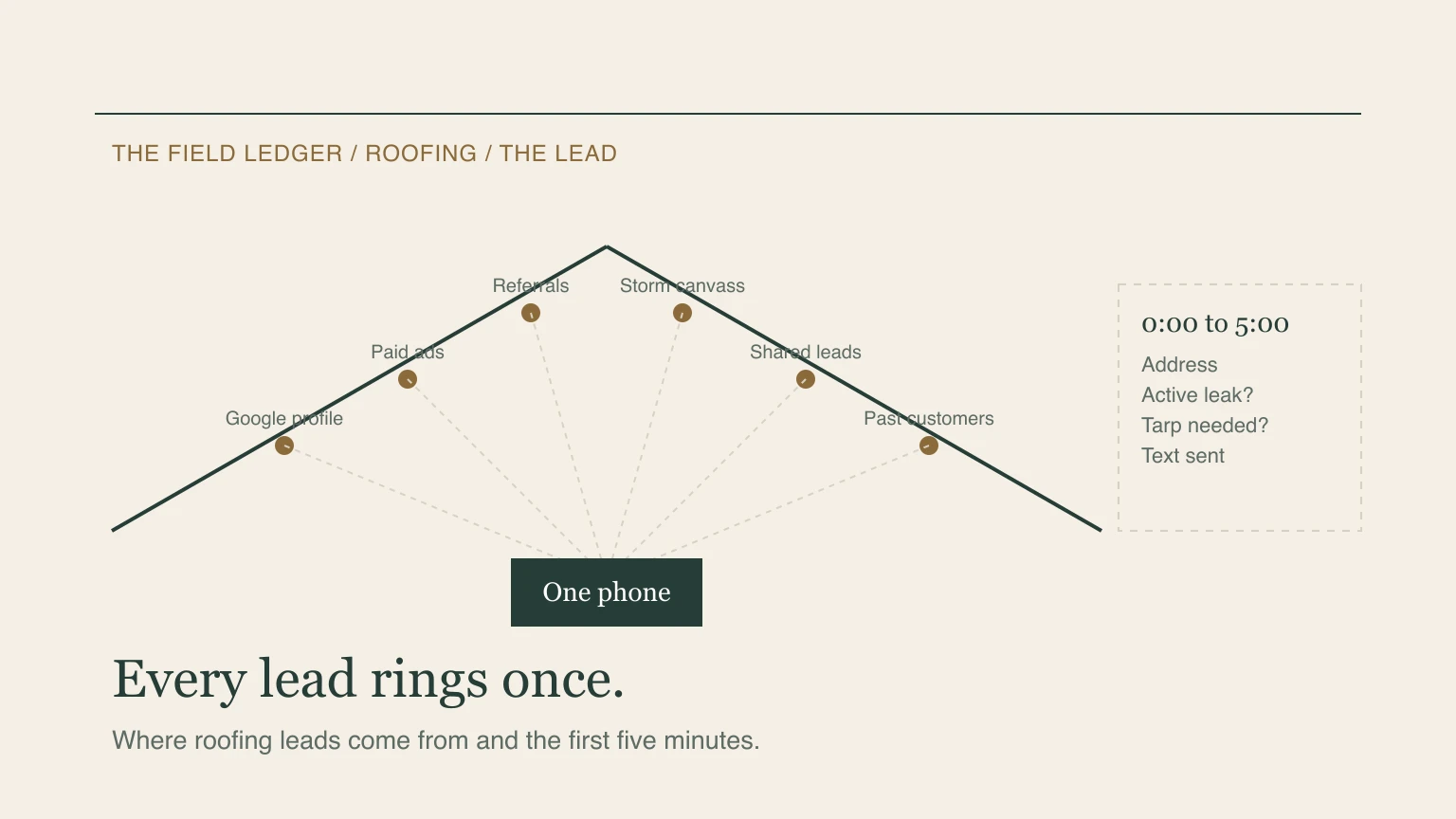
Roofing leads come from six places, and most roofers pay for the one they control least. This guide ranks them by what you control, what you pay and where each one quietly leaks, then walks through the first five minutes after a call, which is where most of the money is won or lost.
We sell an AI voice agent that answers roofing calls, so we have a view on the phone. We say so and we keep the numbers to sources you can check.
The six sources, side by side
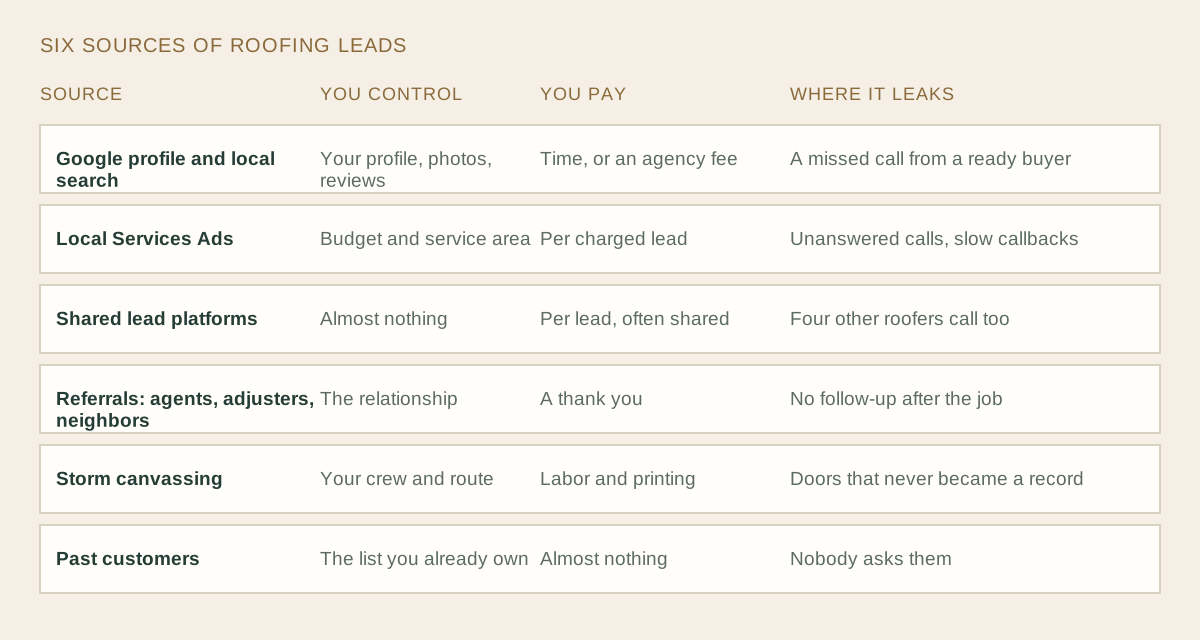
1. Your Google profile and local search. When a homeowner searches "roofer near me," a complete profile with real photos and reviews is what they see first. It costs time or an agency fee, not a per-lead price. It leaks when a ready buyer calls and no one picks up. Our guide to local SEO for roofers covers the setup.
2. Local Services Ads. Google's paid ads that charge per lead rather than per click. One September 2026 agency estimate puts roofing leads at about $40 to $75 each; it is an estimate, not a Google figure. Google's own help page lists what counts as a charged lead, and it includes a voicemail. We cover the mechanics in the Local Services Ads guide for home service companies.
3. Shared lead platforms. Some platforms sell the same inquiry to several contractors. Ask the vendor in writing how many contractors receive each lead, how a bad lead is credited and whether you pay when the homeowner never answers. Our Angi review goes through that platform specifically.
4. Referrals. Real estate agents, insurance adjusters, property managers and neighbors. You control the relationship and pay a thank you. It leaks after the job, when nobody follows up or asks for the next referral.
5. Storm canvassing. Your crew goes to the neighborhoods the storm hit. It costs labor and printed material. It leaks when a door conversation never becomes a record, because the name and address live on a clipboard.
6. Past customers. The cheapest list you will ever own. A roof lasts years, but your customers have neighbors, relatives and second homes. Almost no roofer asks them on a schedule.
What the search data says
We checked how much advertisers pay for these searches. OpenSEO's US estimates in October 2026 put the average cost per click that advertisers pay at roughly $48 for "roofing leads" and $49 for "roofing marketing." Those are estimated advertiser costs for the search terms themselves, not what a lead costs you, but they show why paid search is expensive and why answering the click matters. About 1,300 people a month search "roofing leads" in the United States, which tells you how many roofers are looking for a dependable source.
The five minutes that decide the job
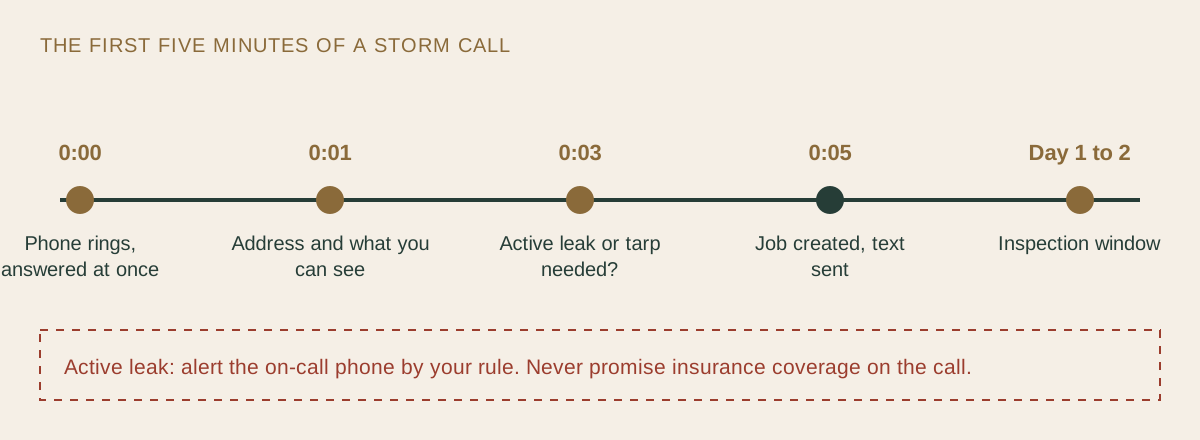
A homeowner with water coming through the ceiling does not browse. They call the first number that looks credible, and if nobody answers they call the next. The first five minutes of a call are about collecting the same few facts every time.
Write the card once and keep it:
- Address and the best number to reach them.
- What they can see. Missing shingles, water inside, a fallen branch, a tarp already on.
- Active leak or not. If water is coming in now, this call goes to your on-call phone.
- Whether they need a tarp today or an inspection this week.
- Whether they have already contacted their insurer. Ask. Do not promise coverage, advise on a claim or say what insurance will pay.
- The next step, with a time window, confirmed by text.
An AI voice agent can ask exactly these questions at 2 a.m., create the job and alert the on-call phone when you set the rule. It does not diagnose damage and it does not give insurance advice.
The math that decides which source you keep
You cannot judge a source by cost per lead. Judge it by cost per signed job. Fill this in for each source over three months:
- Spend on the source.
- Leads it produced.
- Leads you reached within five minutes.
- Inspections booked.
- Jobs signed and their value.
Then divide spend by jobs signed. A source that looks cheap at $45 a lead can cost more per job than one that looks expensive, if half of its leads never get reached.
An illustration, with assumptions stated: say you pay $60 for each of 50 leads in a month, which is $3,000. You reach 40, book 20 inspections and sign 7 jobs. That is about $429 per signed job. Reach 48 of the 50 and the same spend might sign more, depending on your close rate. The point is not the figures. It is that the gap between "leads" and "reached" is where you can improve without spending more.
What to do this week
- Count last month's leads by source. If you cannot, start now.
- Count how many you answered live and how many you called back, and how fast.
- Write the six-question call card and give it to whoever answers.
- Pick the one source with the best cost per signed job and put more behind it.
- Ask your past customers for one referral each.
If you want every call answered with that card, see our two AI voice agent plans, read the roofing page or call the demo line and play a homeowner.
Frequently asked questions
Where do roofers get leads?
Mostly from six sources: a complete Google profile, Local Services Ads, shared lead platforms, referrals from agents and adjusters, storm canvassing and past customers. Track each by cost per signed job.
How much does a roofing lead cost?
One September 2026 estimate puts Local Services Ads roofing leads at about $40 to $75 each. Costs vary by market and season, and a lead you do not reach still costs money.
What should I ask on a roofing lead call?
Address and number, what the caller can see, whether water is coming in now, whether a tarp is needed today, whether they have contacted their insurer, and the next step with a time window. Do not promise coverage.
Lead cost ranges are from a September 2026 StackMatix estimate and are not Google figures. Search volumes and cost-per-click figures are OpenSEO US estimates read on October 7, 2026. The cost-per-signed-job example is an illustration, not a result.
Find the next useful step for your business.
Continue this decision