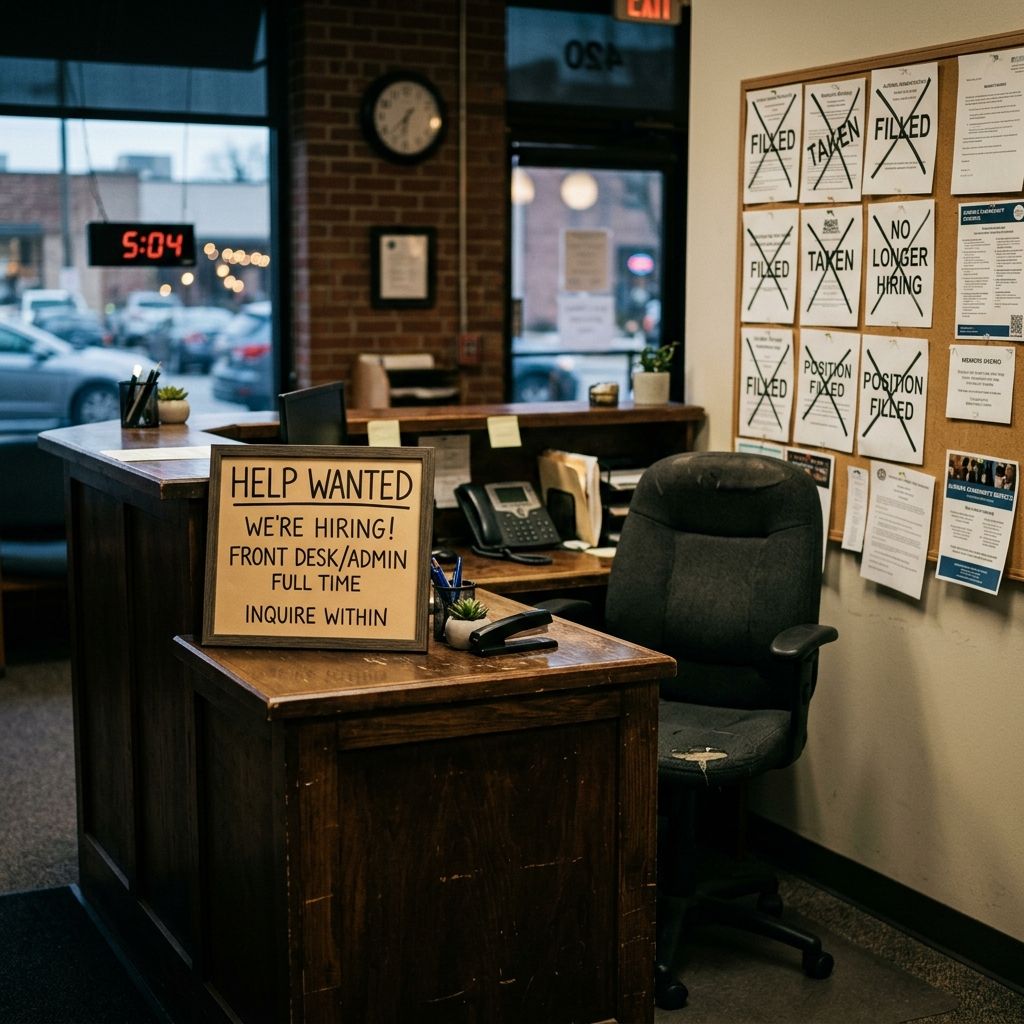

This is not a complaint about workforce quality. It is a structural problem with the economics of the job category.
Treat any number without a nearby source or stated method as a planning assumption, then replace it with your own records.
Let me tell you what happened to a roofing company I talked to in February.
They had a great front desk person for three years. She knew the customers, knew the pricing structure, knew how to handle the angry calls without escalating them. She left. Got a job offer twenty percent higher from a commercial real estate firm downtown.
They posted the role. Got 11 applications. Three showed up to interviews. Hired one. She quit after six weeks when a competitor offered her remote work.
Posted again. Got seven applications. Two showed up. Hired one. She stayed for four months, then moved across the country.
By the time I met the owner, he had been through four front desk hires in eighteen months. He had spent close to $28,000 in job posting fees, onboarding time, and lost productivity during each gap period. And his business was stuck. Every time someone new started, the institutional knowledge reset to zero.
He asked me if AI was the right solution for his front desk problem.
I told him the question was backward. The question was not whether AI could solve his front desk problem. The question was whether he could keep solving it with humans -- and whether he could afford the cost of trying.
The Numbers Behind the Hiring Crisis
This is not a complaint about workforce quality. It is a structural problem with the economics of the job category.
Front desk and administrative roles in service businesses have one of the highest turnover rates in any sector. According to [Bureau of Labor Statistics data on administrative occupations](https://www.bls.gov/ooh/office-and-administrative-support), annual turnover in this category consistently runs between 40 and 55 percent. That means the average tenure for a front desk hire at a service business is somewhere between fourteen and eighteen months.
Think about what that means for your business.
Every fourteen months, you are recruiting. You are interviewing. You are onboarding. You are paying for the period where the new hire is at 40% effectiveness while they learn your pricing, your service areas, your customer base, your escalation logic, and how you like calls handled.
The cost to hire and fully onboard a front desk employee is typically estimated at 50 to 75 percent of that role's annual salary. At $42,000 per year, that is $21,000 to $31,500 per replacement cycle. At fourteen-month average tenure, you are cycling through that cost every two years or less.
And this is before accounting for what happens during the gap. When someone leaves and you have not yet hired their replacement, your phones either get answered badly or not answered at all. Leads slip. Customer experience degrades. The owner either returns to the phones or scrambles to cover with other staff.
In 2026, wages for front desk roles in service businesses have increased an average of 18% compared to 2022 levels, according to [compensation data from the Society for Human Resource Management](https://www.shrm.org). You are paying more, for the same job, with the same turnover rate.
The math is not improving.
Why "Just Pay More" Does Not Fix It
The intuitive answer to retention problems is to pay more. If turnover is driven by people taking better offers elsewhere, you match the offer.
I want to push back on this, because in most service business contexts it is not the solution people think it is.
First, the competitive wage ceiling for a front desk role in a local service business has a hard limit. You cannot pay a $1.2 million plumbing company's receptionist what a downtown law firm pays. The margins do not support it. Pushing wages high enough to compete with white-collar remote work puts most trades businesses in an impossible position.
Second, pay is often not the primary driver of turnover in these roles. The primary drivers, based on exit interview patterns I have seen across dozens of audits, are: the job is chaotic and stressful, there is no clear escalation path when calls go badly, the work environment does not feel organized, and there is no system to lean on when things go wrong.
The front desk role in most service businesses is a hard job because the business has not invested in making it a manageable job. There is no script for common call types. There is no clear protocol for what to do when a customer is angry. There is no system that handles the after-hours calls so the daytime person is not starting every morning with seventeen unanswered voicemails.
Paying someone more to work in a broken system just delays the inevitable resignation by a few months.
What the Hidden Cost Actually Looks Like
I want to walk through the full cost of the receptionist cycle so it is not abstract.
Year one: You hire a front desk person at $42,000 per year. Onboarding and lost productivity during the ramp period costs you roughly $12,000 in real dollars. She is fully effective by month three.
Month fourteen: She leaves. You spend $1,800 in job posting and recruiting time. You conduct interviews over three weeks, during which your owner is spending four hours per week on phones. At an effective hourly value of $150 for the owner, that is $1,800 in opportunity cost.
The gap period is three weeks. During those three weeks, your call answer rate drops from 85% to 52%. You lose approximately eight leads per week to voicemail or competitor pickup. At your average job value of $900 and a 38% conversion rate, that is $2,736 in lost revenue per week of gap. For three weeks: roughly $8,200.
New hire onboarding: $12,000 again.
Total cost of one replacement cycle: approximately $23,800, plus the $8,200 in gap revenue. Just under $32,000.
Over a five-year period with that turnover rate, you spend somewhere between $80,000 and $95,000 managing the receptionist churn problem. Not counting the wear on the owner, the customers who experienced the degraded service during gap periods, or the reviews that got written while coverage was thin.
The question is not whether AI is affordable. The question is what you are already spending to avoid it.
What AI Does Differently
I want to be clear about what I am not saying. I am not saying you should fire your receptionist and replace them with AI. That framing is both wrong and unhelpful.
What I am saying is that the front desk role at most service businesses is currently carrying two very different categories of work: the human relational work (handling escalations, building rapport with repeat customers, managing the things that require judgment and empathy), and the high-volume repetitive work (answering routine inquiries, booking standard appointments, collecting intake information, sending confirmations).
The second category -- the repetitive, high-volume, routine work -- is what AI is genuinely excellent at. When you build a system where AI handles all of that, two things happen.
One: the human who is still part of your front desk is freed to do only the high-value relational work. Their job becomes better. They are not burning out on the grind of answering the same three questions four hundred times a week. Their job satisfaction goes up.
Two: the high-volume routine work never leaves for another company. It does not request a pay raise. It does not call in sick the Tuesday before a holiday. It does not quit when a competitor offers remote work.
The service businesses that are doing this well are not "replacing" their front desk. They are restructuring it. The human handles exceptions and relationships. The system handles volume and intake.
The Businesses That Figured This Out First
I talk to owners every week who have made this shift and would not go back. A Charlotte-based HVAC company I work with had burned through six front desk hires in four years. When they implemented a full AI system, they reduced their front desk to one part-time person who handles customer relationships and escalations only. That person has been with them for two years and loves the job. The work is less chaotic. The system handles the chaos.
Their annual HR cost for front desk coverage dropped from around $48,000 to $22,000. Their after-hours call capture went from 31% to 94%. Their Google review average improved, in part because customers were no longer reaching voicemail during evenings and weekends.
The part-time person they kept is excellent. She has been there long enough to know the repeat customers by name. She handles the calls that require a human. Everything else runs on the system.
That is the model. Not replacement. Restructuring.
What to Think About Before You Post Another Job Listing
If you are currently recruiting for a front desk role, I want you to ask yourself a few things before you spend time and money on that search.
What percentage of your inbound calls are routine inquiries that follow a predictable script? Probably between 60 and 75%.
Of those routine calls, what percentage could be handled accurately by a well-built AI system with access to your service catalog and scheduling tool? Probably most of them.
What is left after you subtract the routine calls? Escalations. Angry customers. Unique situations. High-value repeat clients who want to talk to a person. Complex multi-visit scheduling. That is the work that requires a human. How many hours per week is it actually?
Estimate the human work from your own records: complex scheduling, in-person help, exceptions, judgment, and relationship care. Required hours depend on the business and the role; revenue alone does not establish whether it needs full-time or part-time staffing.
You may be hiring for a forty-hour job when the genuinely human-required portion is twenty hours. The other twenty hours are high-volume routine work that is burning out your staff and driving turnover.
A system can carry the twenty hours. Your human can own the twenty hours that require them.
Run the Hiring Math Against the Call Log
Before posting another front-desk role, compare salary, onboarding time, turnover risk, missed-call volume, after-hours demand, and booking authority. The right AI alternative is not a cheap message taker. It is a system that answers, qualifies, books, writes CRM notes, requests reviews when appropriate, and escalates the calls humans should still own.
Sources and further reading
- Receptionists: Occupational Outlook Handbook, U.S. Bureau of Labor Statistics
- The Short Life of Online Sales Leads, Harvard Business Review
The loss estimate is basic business math, not a magic claim.
Revenue-leak examples on this site are built from visible operating inputs: inquiry volume, missed-call or slow-response rate, booking rate, average job or client value, repeat value, and follow-up recovery. The fastest way to make the number real is to run the diagnostic for your closest business type, then compare it against your own call log, CRM, booking calendar, form timestamps, and review activity.
Decide what the AI must handle before you choose the software.
A useful intake system begins with the caller journey, the rules, and the human handoff, not a long feature list.
Give the receptionist a realistic scenario and hear how it answers, gathers context, and moves the caller toward a useful next step.
See how the capability in this article fits into a complete customer journey.
Service BusinessesSee the same decision through the language, buyer behavior, and operating reality of this industry.
Client Results & ProofInspect the starting condition, installation, measurement window, and outcome behind real client work.

Calculate the revenue leak.
Stop guessing. See how much demand your business may be losing through missed calls, slow replies, weak booking, review gaps, and follow-up drag, then decide whether AI Receptionist is the right system path.
Run the calculationPrefer to hear it first?
Call the live AI receptionist and test the conversation.
Call the live AI receptionist anytime. Tell it about service businesses, then hear a short live roleplay based on the calls your front desk actually gets.