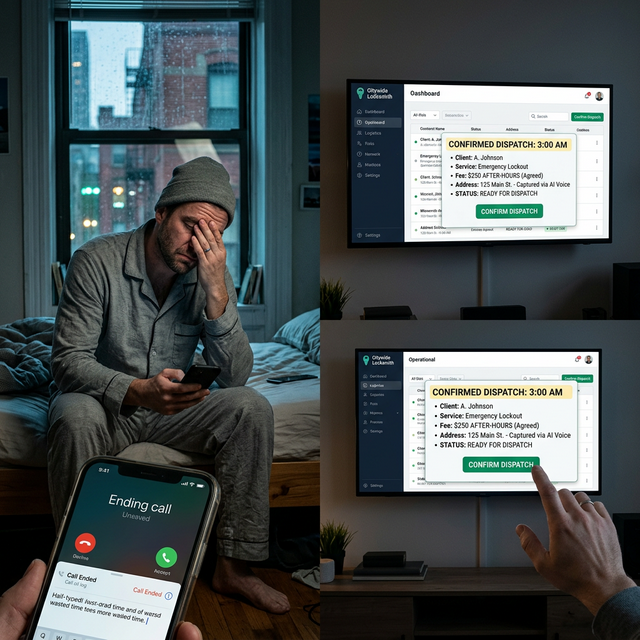
If this scenario occurs three times a night, three nights a week, the resulting burnout destroys the operational capacity of the locksmith during prime daytime commercial hours. The owner eventually stops answering the phone entirely after midnight, surrendering thousands of dollars in high-margin emergency revenue simply to protect their energy.
Treat any number without a nearby source or stated method as a planning assumption, then replace it with your own records.
The economics of a local locksmith business are fundamentally different from traditional home services like plumbing or HVAC. While a plumber might handle two after-hours emergency calls a week, a successful metropolitan locksmith handles a continuous, high-velocity stream of vehicular, commercial, and residential lockouts that peak between 11 PM and 4 AM on weekends. These calls are highly lucrative, often carrying baseline surcharge fees of $150 to $300 before standard labor and hardware costs are even calculated.
The midnight bottleneck: however, the friction required to capture this revenue is immense. Consider the reality of a sole-proprietor locksmith or a small agency owner managing a team of two on-call technicians. At 2:45 AM, the primary business line rings. The owner, startled awake from a deep sleep cycle, fumbles for their smartphone. They attempt to sound professional while clearing their throat. The caller on the other end is panicking outside a downtown apartment complex. The owner explains that emergency dispatch will be a $250 flat fee. The caller, unaware of the reality of after-hours labor costs, begins negotiating. "Two hundred and fifty? That is too much. It's just a deadbolt. I could kick it in for that. Can you do seventy-five dollars?"
The owner spends four exhausting minutes attempting to reason with a highly agitated, un-qualified prospect. The caller hangs up to try the next company on the Local Pack results. The owner puts the phone down. It takes them another forty-five minutes to fall back asleep. They have effectively traded an hour of critical recovery time for absolutely zero revenue.
If this scenario occurs three times a night, three nights a week, the resulting burnout destroys the operational capacity of the locksmith during prime daytime commercial hours. The owner eventually stops answering the phone entirely after midnight, surrendering thousands of dollars in high-margin emergency revenue simply to protect their energy.
The Local Search Problem for Real Locksmiths
Adding pressure to this dynamic is the current state of local search engine optimization for emergency services. In 2026, genuine, local, brick-and-mortar locksmith shops are engaged in a visibility fight against "ghost locksmiths." These are national lead-generation companies that blanket Google Maps with hundreds of fake localized listings, utilizing manipulated exact-match addresses or virtual P.O. boxes.
When a stranded driver calls one of these ghost listings at 3 AM, the call is immediately routed to a centralized call center operating 24/7. An operator answers within two rings. The caller has no idea they are speaking to someone thousands of miles away. The offshore operator blindly dispatches the lead to whichever actual local subcontractor is awake, often resulting in a technician arriving 45 to 60 minutes later than promised, and charging triple the naturally quoted price upon arrival. This bait-and-switch pricing model has eroded consumer trust in the industry. It has resulted in a skeptical consumer base that immediately assumes the $75 quote they see online is a scam, increasing the friction at the point of dispatch.
The genuine local locksmith has a real strategic advantage over these ghost networks: proximity, ethical pricing, and reputation. A local tech can actually be on the scene in fifteen minutes. They have real Google reviews from real localized community members, often with photos of the actual branded trucks and uniformed technicians. But that entire advantage is lost if the local owner is asleep and their phone rolls to a generic voicemail. In the emergency lockout matrix, the consumer does not leave voicemails. The stranded driver clicks the "Call" button on the Maps listing, and if a human or a human-equivalent intelligence does not answer immediately on the first ring, they return to the search results and click the next listing until an offshore call center captures them and subjects them to the bait-and-switch loop.
Building the After-Hours Qualification Layer
To compete with the instant-answer capability of national call centers without sacrificing the health and sanity of the local owner, modern locksmith agencies are deploying an operational model known as the after-hours qualification layer.
What is the after-hours qualification layer?It is a voice AI system configured for late-night lockout calls. It does not replace the locksmith; it filters price-shopping calls before they wake the owner. It answers the call instantly, on the first ring, 365 days a year.
The intelligence of the after-hours qualification layer lies in its structured conversational flow. It is programmed to extract necessary operational data while simultaneously qualifying the caller's willingness to pay the premium emergency fee, effectively separating the serious emergencies from the price-shoppers.
The Late-Night Dispatch Protocol
Consider the same 2:45 AM scenario, but routed through a after-hours qualification layer. The stranded driver calls the local number. The AI answers instantly with a calm, highly professional local presence: "Citywide Locksmith Emergency Dispatch. Are you currently locked out of a vehicle, a residence, or a commercial property?"
The AI immediately establishes authority and control of the interaction. The caller, relieved that someone answered, states they are locked out of their running car. The AI continues the protocol: "I understand. I can dispatch an emergency technician to your location right away. Please note, our after-hours emergency dispatch fee is a flat rate of two hundred and fifty dollars, which includes the vehicle recover. Do you agree to this emergency rate?"
The Filter Engagement:This is the critical juncture where the after-hours qualification layer proves its value. If the caller begins arguing, complaining about the price, or attempting to negotiate ("I only have fifty bucks man, come on"), the AI remains entirely consistent. It does not get tired, rushed, or pulled into a negotiation. It simply holds the boundary: "I understand completely, however, the two hundred and fifty dollar rate is standard for emergency overnight dispatch. Can I confirm you would like me to route a technician at this rate?"
If the caller refuses and hangs up, the system logs the interaction. The locksmith owner remains entirely asleep. The owner stays asleep. The AI handled the rejection with zero emotional cost.
The confirmed dispatch: however, if the caller is genuinely stranded in freezing weather and agrees to the rate ("Yes, fine, just please send someone as fast as possible"), the AI moves to coordinate capture. "Understood. Please provide the exact cross streets or business name you are parked near, as well as the make and model of the vehicle."
Only Wake the Owner for Confirmed Dispatches
Once the client has explicitly agreed to the $250 emergency fee, provided the vehicle description, and confirmed the geo-location data, the AI after-hours qualification layer executes the final phase of its protocol: the confirmed dispatch alert.
The AI instructs the caller: "Your emergency dispatch is confirmed. I am routing the on-call technician now. They will call you from a local number in approximately three minutes for final ETA confirmation. Please stay near the vehicle."
It is only at this exact moment that the AI system wakes the locksmith owner. The system triggers an emergency notification on the primary technician's phone.When the owner wakes up at 2:48 AM, they are not waking up to argue. They are waking up to an operational dashboard or heavy SMS alert containing a confirmed $250 job. The text reads: "CONFIRMED DISPATCH. 2021 Honda Civic. 125 Main St. Client agreed to $250 after-hours fee. Name: Michael."
The owner wipes their eyes, puts on their boots, and hits the road. They call the client directly while pulling out of the driveway, already knowing the car, the location, and most critically, that the payment terms have been unequivocally accepted. The friction has been reduced to absolute zero. The local locksmith just beat the billion-dollar national call center to the punch, and they did it while only waking when the job was qualified and ready to dispatch.
The After-Hours Revenue Math
The financial change from deploying a after-hours qualification layer is profound, primarily because it alters the local locksmith's willingness to aggressively market their after-hours services. When receiving calls at 3 AM equates to exhausting arguments with drunk college students who refuse to pay, local owners understandably scale back their Google Ads budget between midnight and 6 AM. They turn off their Local Services Ads (LSAs) when they go to sleep.
This is a massive strategic error because click costs and lead costs drop during these overnight hours due to the sudden drop in local competition. The national ghost networks buy up this cheap inventory because they have the automated offshore infrastructure to handle the call volume efficiently.
When a local owner installs the AI after-hours qualification layer, they can confidently leave their Google LSAs running 24 hours a day, 7 days a week. They know with absolute certainty that they will only be awakened for high-margin, pre-qualified, non-argumentative dispatches. If they capture just two additional, undisputed $250 emergency lockouts per week that they previously would have missed by silencing their phone, that translates to an $26,000 in purely incremental annual revenue. And this revenue is generated precisely from the marketing hours that their local competitors consider entirely too draining to pursue.
The Authority Standard: ROI and Resonance
When we evaluate the ROI of an intake system like the one described for Locksmith Services: Routing Late-Night Lockouts Without Waking the Owner, we look beyond the immediate convenience of automation. We look at the 'Revenue Leak' that occurs in the silence between a prospect reaching out and a business responding. In this vertical, that silence is the biggest competitor you have.
Data Anchor: The average LTV of a client in this space is significantly higher than the cost of a missed intake opportunity. By resolving for 'concurrency': the ability to handle infinite leads simultaneously-The Quiet Protocol transforms a passive operation into an aggressive revenue engine.
The loss estimate is basic business math, not a magic claim.
Revenue-leak examples on this site are built from visible operating inputs: inquiry volume, missed-call or slow-response rate, booking rate, average job or client value, repeat value, and follow-up recovery. The fastest way to make the number real is to run the diagnostic for your closest business type, then compare it against your own call log, CRM, booking calendar, form timestamps, and review activity.
The practical questions behind this decision.
Can the AI accurately identify complex lock or hardware terminology?
Yes, the natural language processing models driving the after-hours qualification layer are specifically trained on highly specialized hardware lexicons relevant to the security industry. Whether a caller is describing a broken mortise lock on a historic residential door, a compromised Schlage smart deadbolt that has lost its Bluetooth connectivity, a commercial panic bar mechanism that is jammed, or a snapped transponder key stuck inside a Honda ignition cylinder, the AI parses the technical terminology accurately. It identifies the classification of the lockout (automotive, residential, commercial) and immediately correlates that classification with the correct dispatch pricing matrix before the technician is ever notified.
What if the caller cannot effectively articulate their location?
In scenarios where a driver is stranded on an unfamiliar highway access road at night and cannot provide an exact street address, the AI relies on milestone routing. It will calmly guide the caller to identify the nearest major intersection, highway mile marker, fast-food restaurant, or brightly lit commercial signage. Furthermore, the AI can trigger an automated SMS containing a secure tracking link that requests one-time GPS location sharing from the caller's smartphone, pushing the exact coordinates directly into the locksmith dispatch dashboard before the technician even puts their vehicle in gear.
Does the AI handle payment processing on the phone?
While the AI is entirely capable of capturing credit card information securely over a voice channel via PCI-compliant integrations, best practices for emergency physical services recommend against it during the initial highly volatile call. The primary goal of the Gatekeeper is to verbally lock in the agreement to the fee structure and secure the dispatch commitment. Taking a credit card over the phone at 2 AM on a dark highway often causes the panicked caller to suspect they are being scammed by a fake operator. The standard protocol is for the AI to secure the verbal contract, state that the technician will process a physical or digital payment upon arrival, and immediately dispatch the unit.
How does the AI handle calls during standard business hours?
The system is fundamentally time-aware and condition-based. During standard operating hours from 8 AM to 6 PM, the AI can be configured to act as a smooth overflow buffer. If the primary dispatcher is on the other line coordinating a massive commercial master-key installation, the AI warmly answers the secondary line, captures the standard residential re-key request, logs the client details, and informs them the scheduling coordinator will call them back in exactly five minutes. It ensures the daytime book of business remains completely sealed against leaks while aggressively aggressively guarding the owner's sleep schedule at night.
What proof should I look for in my own business?
Look for proof in the places where demand either moved forward or stalled: missed calls, short calls, unbooked forms, slow callbacks, no-show recovery, old leads, and reviews that were never requested. If the business cannot see those moments clearly, the first improvement is better tracking and routing.
How do I know whether this is a marketing problem or an operations problem?
If people are already calling, filling forms, asking for prices, requesting appointments, or comparing reviews, the problem is usually operations. More marketing will not fix a front door that lets warm demand wait. The better move is to capture and route the demand already arriving.
What should happen after the first response?
The first response should create a next step: booked appointment, estimate path, intake handoff, callback window, review request, or reactivation sequence. A response that only says someone will get back to you is not enough when the buyer is comparing several providers at once.
Where does The Quiet Protocol fit?
The Quiet Protocol fits when the business already has demand but too much of it depends on manual attention. We connect AI receptionist coverage, web intake, missed-call recovery, booking logic, follow-up, review requests, and reactivation into one managed front-door system.
Map how a serious buyer decides in this kind of business.
Use the operating reality of the industry instead of copying a generic lead-generation playbook.

Vikram Roy is the founder of The Quiet Protocol, a Toronto-based systems firm serving service businesses across the Greater Toronto Area, Canada, and the United States. He works directly with professional firms, home service companies, dental practices, clinics, and local businesses to connect websites, customer intake, booking, reviews, follow-up, and practical AI into a clearer digital front door. All content is written from Toronto, Ontario. See the editorial method →
Replace broad industry assumptions with the business's actual inquiry volume, customer value, response time, and booking data.
See how the capability in this article fits into a complete customer journey.
Locksmith & SecuritySee the same decision through the language, buyer behavior, and operating reality of this industry.
Client Results & ProofInspect the starting condition, installation, measurement window, and outcome behind real client work.
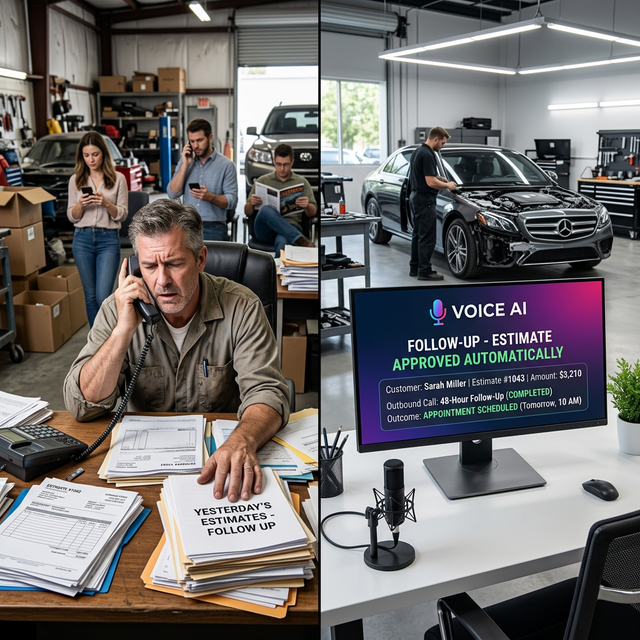
Auto Body & Collision Repair: Automating Estimate Follow-Ups to Stop Shop-Hopping
The collision repair industry has accepted 'shop-hopping' as an unavoidable reality of the business. An estimator spends 45 minutes walking around a damaged vehicle, writes a $4,500 quote, hands it to the customer, and then never speaks to them again. Two days later, a competitor wins the job for $4,700 - not because they were cheaper, but because they were the only shop that actually picked up the phone to ask for the business. The 48-hour follow-up gap is the single largest revenue leak in the modern auto body shop, and fixing it requires outbound automation.
The Real Cost of a Missed Call for a Service Business: The Math Nobody Runs
A missed call costs more than the immediate job. Here is the full three-layer calculation, immediate value, lifetime client value, and referral chain, and the annual total most owners never see.

The Speed to Lead Equation: Why the First Five Minutes Decide the Job
In emergency services, the first company to answer wins. Not the best company. Not the cheapest. The fastest. Here is the math that proves it.