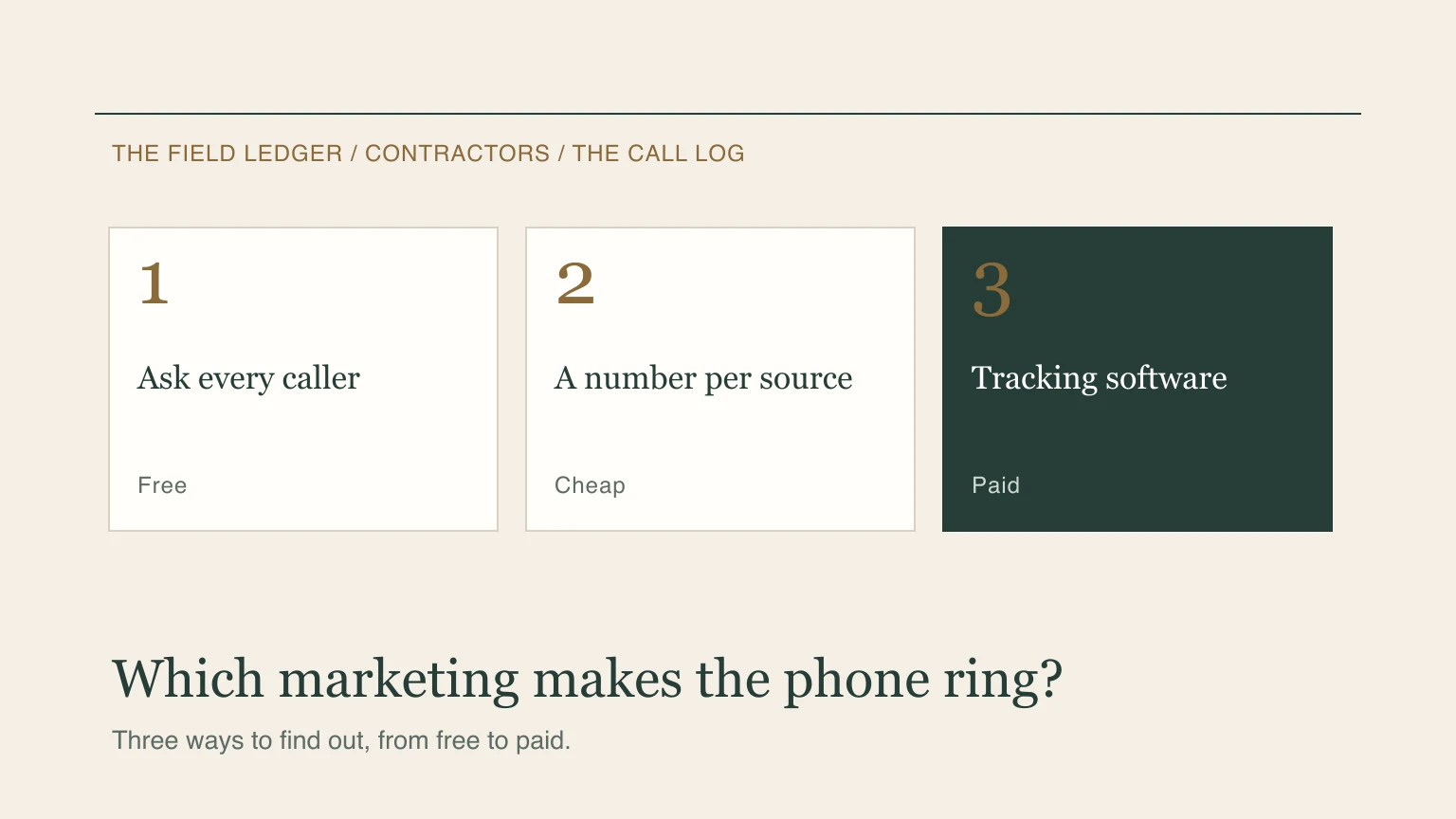
You spend money on a Google profile, ads, a website and maybe a postcard. The phone rings. Which one made it ring? Most contractors cannot say, so they cut the wrong thing in a slow month. This guide shows three ways to find out, from free to paid, and what to do with the answer.
We sell an AI voice agent that can write down where a caller came from, so we mention it where it fits. We keep prices to pages you can check.
Why call tracking matters more for contractors
For a contractor, the phone is the sale. Forms and chat matter less than they do for a software company. A homeowner with a leaking roof or a dead furnace calls. So the first question about any marketing is not how many clicks it got, it is how many calls it produced, how many you answered and how many became jobs.
Three levels, from free to paid
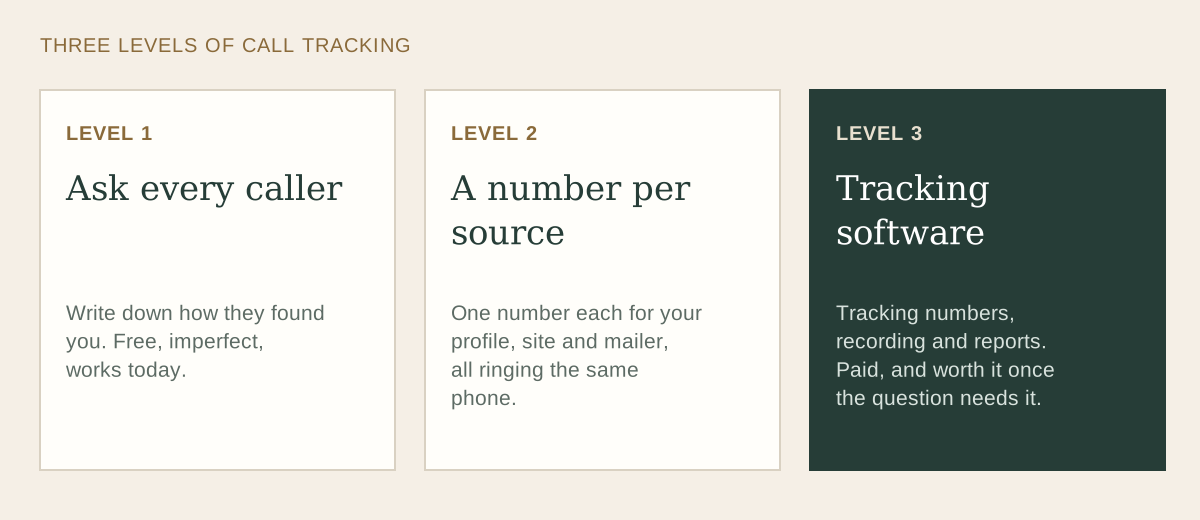
Level 1: ask every caller. "How did you find us?" Write the answer next to the call. It costs nothing. It is imperfect, because people forget and say "Google" for everything, but it is far better than not knowing, and it works on day one. An AI voice agent can ask this on every call and write the answer onto the job, so nobody forgets.
Level 2: a separate number per source. One number on your Google profile, another on your website, another on a mailer or a truck wrap, all forwarding to the same phone. Each call shows which number rang. Cheap and simple. It only works if you keep the numbers where you put them, and it needs care on your Google profile, where the number should stay consistent with your listings.
Level 3: call tracking software. Software gives each source a tracking number, can swap numbers on your website depending on where a visitor came from, and records and reports on calls. CallRail, one of the best-known tools, lists plans from about $50 a month for five local numbers and 250 minutes, with call and text tracking, recording and transcription, and charges about $0.05 to $0.06 for each minute beyond your plan. Its page says all plans include a 14-day free trial. Prices change, so check the current page.
What to do with the data
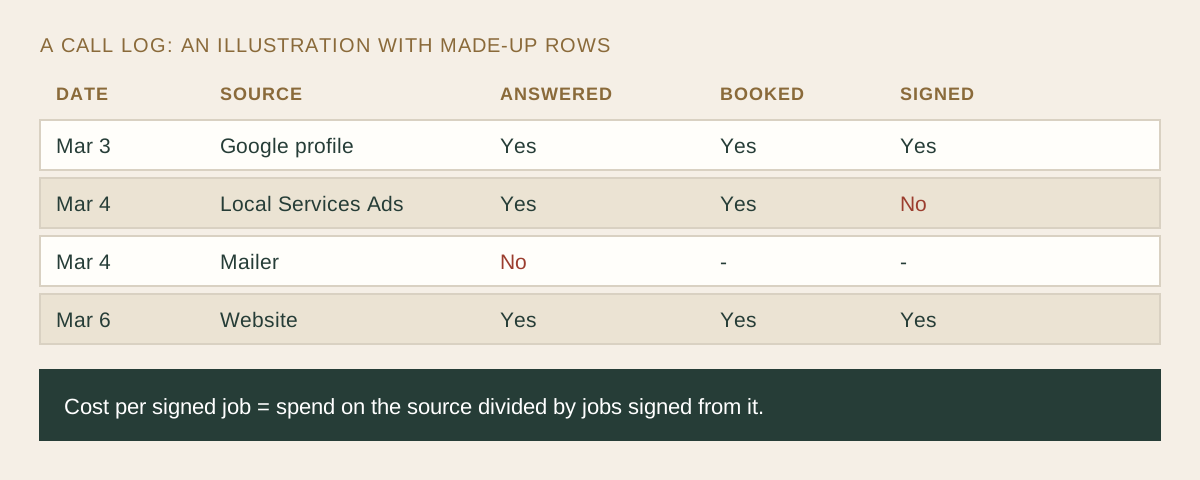
Collect five numbers per source over 90 days and put them in one place:
| Number | Where it comes from |
|---|---|
| Calls | The tracking number or your caller answer |
| Answered | Calls you or your system picked up |
| Booked | Visits on the calendar |
| Signed | Jobs completed and their value |
| Cost | What you spent on the source |
Divide cost by signed jobs and you have cost per job for each source. Divide answered by calls and you have the number you can fix this week. Our guide to HVAC lead sources shows how to score them, and the same method works for any trade.
Three traps
- Counting every call as a lead. Wrong numbers, vendors and existing customers are not leads. Mark them.
- Judging by clicks. A click that never calls costs money and produces nothing.
- Recording without checking the law. Recording laws differ by state, and some require everyone on the call to consent. Tell callers they may be recorded and ask a local attorney how to word it. This is general information, not legal advice.
Where the answer pays off
When you know which source rings, you can put more behind it, and you can see how many of those calls went unanswered. That is the number most contractors have never counted, and often the cheapest to improve. If your phone is the leak, see our two AI voice agent plans or call the demo line.
What to do this week
- Start the log. Ask every caller how they found you.
- Put a different number on your three main sources.
- Write down last month's spend by source.
- Count the calls you missed.
- Decide whether software is worth it after 30 days of the log.
Frequently asked questions
How can a contractor track where calls come from?
Ask every caller how they found you and log it, use a different phone number for each source, or use call tracking software. Start with the free log.
How much does call tracking software cost?
CallRail lists plans from about $50 a month with five local numbers and 250 minutes, plus per-minute charges beyond the plan, as of October 8, 2026. Other tools differ, so check the current pages.
Is it legal to record calls?
Recording laws differ by state and some require everyone on the call to consent. Tell callers they may be recorded and ask a local attorney how to word it. This is general information, not legal advice.
CallRail details are from its public pricing page, read on October 8, 2026, and change. Recording rules vary by state. The call log is an illustration with made-up rows.
Find the next useful step for your business.
Continue this decision